
Your board approved an AI initiative. Your operations team is pushing for a cloud migration. Security wants tighter controls. Finance wants budget certainty. Product leaders already know the requirements will change once users see the first release.
That’s the core context behind waterfall vs agile methodology. This isn’t a classroom debate. It’s an operating decision that changes delivery speed, budget behavior, risk exposure, and executive trust.
Most CTOs don’t fail because they chose a “bad” methodology. They fail because they chose a model that didn’t match the work. A fixed-scope infrastructure rollout does not behave like an AI-driven automation program. A regulated ERP modernization does not behave like a digital product launch. If you force both through the same delivery system, one of them will break.
Here’s the blunt view. Waterfall is still the right choice for stable, compliance-heavy work. Agile is the right choice for uncertain, fast-learning work. Hybrid is usually the right choice for complex enterprise transformation. That’s the practical answer most leaders need, but it only helps if you understand where each model wins, where it fails, and how to govern the gray area in between.
The Modern Enterprise Project Dilemma
A CTO rarely gets to choose between certainty and change. You usually get both at once.
Your executive team expects a clean plan, clear milestones, and budget discipline. At the same time, your users, vendors, data constraints, security findings, and business priorities keep shifting. That tension is why the waterfall vs agile methodology decision matters so much in enterprise settings.
What leaders are balancing
Most major initiatives force you to manage several competing realities:
- Predictability: Finance wants committed budgets and dates.
- Adaptability: Product and operations teams need room to respond to what they learn.
- Governance: Security, legal, and audit teams need documentation and approvals.
- Speed: The business wants visible progress now, not at the end of a long delivery cycle.
When leaders default to Waterfall for everything, teams often spend too long proving the plan instead of testing whether the plan is still right. When they force Agile everywhere, they often create avoidable chaos in areas that need stronger controls.
The wrong methodology doesn’t just slow delivery. It creates the wrong conversations. Teams debate process when they should be solving business problems.
Why this choice is harder now
Enterprise work has changed. AI projects depend on experimentation, model performance, and data quality. Cloud programs often include a mix of lift-and-shift moves, refactoring, security redesign, and operational handoffs. Managed operations need repeatability, but they also need ongoing optimization.
That means the methodology question isn’t binary anymore. It’s architectural. You’re deciding how work flows, how decisions get made, when risk gets surfaced, and how fast the organization can correct course.
Understanding the Two Foundational Methodologies
A CTO choosing between Waterfall and Agile is really choosing how the organization will handle uncertainty. That decision shapes funding, governance, escalation paths, stakeholder behavior, and how quickly the team can correct a bad assumption.
Waterfall favors sequence and control
Waterfall came out of phase-based delivery thinking in the 1970s and remains a strong fit for work that depends on ordered execution, stable requirements, and formal approvals (IJFMR).
The model is straightforward. Define requirements up front. Complete design before build. Complete build before test. Move through the plan in sequence, with each phase handing off into the next. If your initiative has fixed compliance obligations, contractual scope, or infrastructure dependencies that cannot shift midstream, that discipline is useful.
It is also restrictive by design. That is the point.
For regulated implementations, core platform replacements, and projects where traceability matters as much as speed, Waterfall gives executives a structure they can audit and defend. The trade-off is obvious. If your assumptions are wrong early, the process makes them expensive to correct later.
Agile favors learning and adaptation
Agile was formalized in the 2001 Agile Manifesto and works best when requirements will change, user feedback matters, and delivery teams need room to adjust course.
Instead of treating the initial plan as fixed, Agile breaks delivery into short cycles. Teams prioritize a backlog, ship increments, review results, and revise based on what they learn. If you want a useful external primer on what Agile methodology entails, that resource does a good job of explaining the mechanics behind sprints, feedback loops, and iterative delivery.
For a more practical view of where Agile creates business value, Dr3amsystems explains the advantages of Agile methodology in implementation terms rather than theory.
Agile is the better default for product development, AI initiatives, customer-facing digital programs, and cloud modernization efforts where discovery continues during execution. But Agile without governance quickly turns into backlog churn, weak accountability, and endless reprioritization. Enterprise teams need more than ceremony. They need decision rights, release controls, and clear success measures.
The core mindset difference
The core difference is:
- Waterfall says: predictability comes from defining the work before execution starts.
- Agile says: better outcomes come from learning during execution and changing course quickly.
For complex enterprise programs, that distinction matters, but it is not the final answer. Pure Waterfall is often too rigid for AI and cloud work. Pure Agile is often too loose for audit-heavy environments and multi-vendor programs.
The smart move is to understand both models well enough to combine them on purpose. That is how experienced delivery partners like Dr3amsystems help enterprises structure transformation programs that need experimentation in some layers, strict control in others, and one governance model across both.
A quick visual helps if you're aligning executive stakeholders around the basics:
Key Differences in Enterprise Project Execution
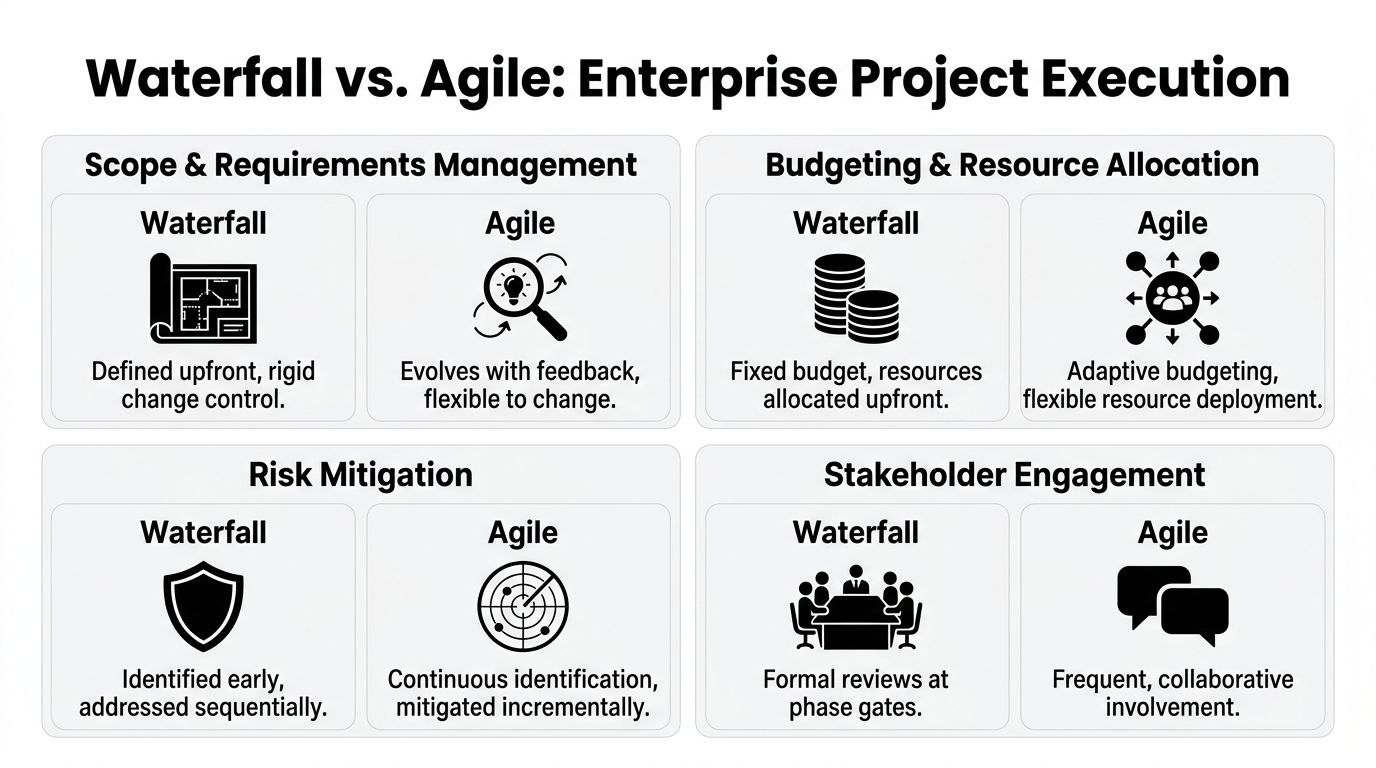
Here’s the side-by-side view CTOs need.
| Criteria | Waterfall | Agile |
|---|---|---|
| Scope and requirements | Defined early, tightly controlled | Evolving backlog, reprioritized with feedback |
| Budgeting model | Upfront estimate tied to fixed scope | Rolling prioritization tied to value delivery |
| Risk handling | Major risks identified early, often validated later | Risks surfaced continuously through short iterations |
| Stakeholder cadence | Formal reviews at phase gates | Frequent demos, reviews, and course correction |
| Governance style | Documentation-heavy and approval-based | Lightweight governance unless scaled intentionally |
| Best fit | Stable, regulated, fixed-scope initiatives | Product, AI, and uncertain digital initiatives |
Scope behaves differently in each model
Waterfall assumes scope can be understood and locked early. That’s an advantage when business rules, interfaces, and compliance obligations are already known.
Agile assumes scope clarity improves through delivery. Teams maintain a prioritized backlog and change direction as they learn from users, system behavior, and stakeholder input.
Many enterprise mistakes start here. Leaders call a project “Agile” but still demand frozen requirements and fixed deliverables from day one. That isn’t Agile. It’s Waterfall with daily standups.
Practical rule: If your team expects requirement changes throughout delivery, stop pretending a locked-scope plan will protect you. It will only hide change until rework becomes expensive.
Budgeting is a governance choice, not just a finance choice
Waterfall gives you stronger upfront budget predictability because scope is locked and estimates are tied to that fixed baseline. Agile uses continuous trade-offs, so funding is managed dynamically as priorities shift (Easy Agile).
That difference matters at the executive level. In Waterfall, budget confidence comes from reducing variability. In Agile, budget control comes from deciding what not to build.
For enterprise planning, the question isn’t “Which one controls cost better?” The question is “Do we trust our current scope enough to lock it?”
Risk is surfaced on different timelines
Agile’s biggest operational advantage is speed to learning. Teams deliver working increments in short iterations and can reach usable value 30% to 50% faster than Waterfall equivalents, while reducing the chance of finding major defects late in the lifecycle (Float).
Waterfall can identify risks early on paper, but it often validates assumptions later through downstream testing and integration.
Agile validates assumptions continuously.
That distinction matters more than most methodology debates.
Waterfall often manages risk through analysis. Agile often manages risk through exposure.
Both are legitimate. But for AI initiatives, customer-facing platforms, and workflow automation, exposure usually beats theory.
Stakeholder engagement changes the quality of decisions
Waterfall tends to concentrate stakeholder participation around requirements reviews, design approvals, and final acceptance. That cadence fits organizations with formal governance and limited stakeholder bandwidth.
Agile demands more active involvement. Product owners, users, and sponsors need to review increments, clarify priorities, and make decisions regularly. If they won’t do that, Agile degrades fast.
This is why methodology fit depends on executive behavior, not just delivery mechanics.
Governance is where enterprise Agile often fails
Small teams can run Agile with minimal overhead. Enterprises can’t. Coordination complexity changes the game.
If you're formalizing delivery controls, a practical planning reference is this guide to https://dr3amsystems.com/steps-of-project-management-plan-2/, especially for defining gates, dependencies, and ownership before execution begins.
The issue isn’t whether Agile can scale. It can. The issue is whether your organization has explicit rules for architecture, risk, dependency management, release control, and decision rights. Without those, “Agile at scale” turns into fragmented teams moving quickly in different directions.
A Decision Framework for Your Next Technology Initiative
Your leadership team approves a cloud program with a fixed budget, an aggressive deadline, and strict security controls. Two months later, the business is still clarifying priorities, architects are finding integration surprises, and delivery teams are arguing over whether to run the work in sprints or stage gates.
That is not a process debate. It is a project design problem.
Choose the methodology that matches the shape of the work, the speed of decision-making, and the level of control your board expects. For enterprise programs, the better choice is rarely pure Waterfall or pure Agile. It is whether you have enough certainty to run linearly, enough flexibility to iterate aggressively, or enough discipline to combine both without creating chaos.
Methodology decision matrix
| Project Characteristic | Favors Waterfall | Favors Agile | Favors Hybrid |
|---|---|---|---|
| Requirement stability | Requirements are well defined and unlikely to move | Requirements will evolve during delivery | Core requirements are fixed, implementation details will change |
| Budget expectations | Fixed-budget commitment is required upfront | Budget can be managed through ongoing prioritization | Budget cap is fixed, scope within the cap can flex |
| Compliance needs | Formal approvals and documentation drive the process | Compliance is lighter and can be embedded iteratively | Compliance gates are mandatory, but teams still need iterative build cycles |
| Stakeholder availability | Stakeholders can review only at major milestones | Stakeholders can engage frequently and make quick decisions | Executive reviews are periodic, working teams can collaborate continuously |
| Delivery pressure | One coordinated release matters most | Early increments and learning matter most | Program milestones are fixed, but teams can release in stages |
| Team structure | Specialized handoffs are the norm | Cross-functional teams can own outcomes | Multiple teams need a shared governance layer |
The recommendation
Use Waterfall for initiatives where change is expensive and approvals drive the schedule.
- Scope is stable
- Funding must be approved upfront
- Traceability, sign-off, and audit evidence carry more weight than reprioritization
Use Agile for initiatives where learning changes the solution.
- Requirements will change after real users see the product
- Business owners can make frequent trade-off decisions
- Early delivery creates more value than upfront precision
Use Hybrid for enterprise programs where governance is fixed but delivery details will evolve. That is the default pattern for AI, cloud modernization, data platform work, and large system replacement efforts.
Budget pressure usually forces the decision. If finance needs a committed number, Waterfall or Hybrid will fit better. If leadership is willing to fund outcomes and adjust scope as teams learn, Agile will produce better decisions and a better end product.
Use this boardroom test before kickoff
Ask three questions and force clear answers.
- What is fixed: budget, deadline, scope, compliance, or architecture?
- What will the team learn only after execution starts?
- Who can approve trade-offs in real time when cost, scope, and risk collide?
If those answers are vague, your delivery model will fail regardless of what you call it.
For CTOs, this is the practical rule. Choose Waterfall when uncertainty is low. Choose Agile when uncertainty is high and decision velocity is strong. Choose Hybrid when executive control, delivery uncertainty, and cross-functional dependencies all exist at the same time.
That last case is the enterprise norm, not the exception.
If you need to align business goals, architecture decisions, funding logic, and delivery structure before launch, use a technology strategy consulting framework to define the operating model first. Dr3amsystems helps leadership teams set that model up properly, so methodology supports execution instead of becoming another source of friction.
Applying the Models to AI, Cloud, and Managed Operations
Methodology choices become much clearer when you look at the actual work.

AI initiatives usually need Agile at the core
AI programs rarely start with full certainty. Teams discover data quality issues, model limitations, integration constraints, and adoption barriers only after they begin testing.
That makes pure Waterfall a bad fit for model development, prompt orchestration, intelligent automation, and analytics-heavy products. You need short cycles, fast feedback, and clear decision points for whether to continue, pivot, or narrow scope.
A better pattern looks like this:
- Use structured upfront planning for use-case selection, risk boundaries, and governance.
- Run Agile delivery for experimentation, iteration, and user validation.
- Hold formal checkpoints for security, legal review, and production readiness.
If your AI program lacks those guardrails, it will drift. If it lacks iterative learning, it will stall. The control layer matters as much as the sprint layer. That’s why a governance lens like https://dr3amsystems.com/ai-governance-best-practices/ matters in enterprise AI delivery.
Cloud migrations split into different delivery types
Cloud work is not one project. It’s usually several.
A straightforward infrastructure relocation with known dependencies can tolerate more Waterfall-style planning. You map workloads, sequence cutovers, define rollback paths, approve change windows, and execute in controlled phases.
Application modernization is different. Refactoring services, redesigning integrations, improving observability, and tuning performance all benefit from iterative release cycles. Teams learn from each wave.
So the same cloud program may need:
- Waterfall for data center exit milestones, compliance sign-offs, and cutover governance
- Agile for application refactoring, DevOps pipeline improvements, and user-facing enhancements
- Hybrid for the overall program office and release structure
That’s why simplistic methodology labels don’t help much in cloud transformation. The right answer depends on the workstream.
Managed operations need discipline plus continuous improvement
Managed services are often ignored in methodology discussions, but they shouldn’t be. Operations teams need repeatable controls, documented runbooks, escalation paths, and clear service ownership. That’s the Waterfall instinct, and it’s useful.
But strong operations teams also improve constantly. They refine workflows, automate tickets, tune monitoring, and reduce recurring failure patterns. That requires iterative thinking.
The best operations environments don’t choose between stability and improvement. They institutionalize both.
A mature managed operations model uses structured governance for reliability and an Agile improvement loop for optimization. That’s especially important when cloud, security, and AI-powered automation all intersect.
Beyond Pure Play The Power of Hybrid Methodologies
The most useful answer in the waterfall vs agile methodology debate for enterprise leaders is often this: use both, deliberately.

Why hybrid exists
Enterprises don’t operate in pure theory. They have annual planning cycles, procurement rules, architecture reviews, change control boards, and audit requirements. At the same time, they need teams to move faster and adapt to what they learn.
Hybrid models exist because both realities are true.
A PMI analysis notes that approaches such as Water-Scrum-Fall are increasingly used in regulated industries. These models use Waterfall for planning and approvals, then Agile for builds. The same analysis says 68% of regulated firms adopt hybrids, while 40% report failure due to poor integration (PMI).
That last number matters more than the adoption number. Hybrid isn’t automatically smart. Hybrid done badly is just two broken systems taped together.
What a useful hybrid model looks like
A strong hybrid model usually separates concerns instead of blending everything into one messy process.
Use Waterfall for:
- Business case and funding approval
- Architecture standards and control points
- Compliance documentation
- Release governance and production sign-off
Use Agile for:
- Backlog-driven design refinement
- Incremental build and testing
- Stakeholder demos
- Prioritization based on evidence
That separation keeps executive governance intact without crushing delivery speed.
Where leaders get hybrid wrong
Most hybrid failures come from one of three mistakes:
- They keep Waterfall approvals but never enable Agile teams to make decisions.
- They run Agile ceremonies but still demand fixed scope from the start.
- They never define how work moves between governance and delivery layers.
Hybrid succeeds when planning cadence, change control, and sprint cadence are designed to work together. Hybrid fails when each layer operates on a different clock.
That’s why hybrid needs intentional operating design. You need explicit interfaces between PMO oversight, architecture review, security review, product ownership, and engineering execution.
The best use case for hybrid
If you’re delivering in finance, healthcare, life sciences, insurance, or enterprise infrastructure, hybrid is usually the pragmatic default.
You need enough structure to satisfy auditors and enough flexibility to avoid building the wrong thing. Pure Waterfall slows learning. Pure Agile can create governance gaps. Hybrid gives you a way to preserve both trust and speed, but only if you design it with discipline.
Establishing Governance, KPIs, and Tooling for Success
Methodology selection matters. Governance determines whether it works.
Many enterprise programs collapse here. Leaders debate Waterfall versus Agile, then underinvest in decision rights, measurement, and tooling. The result is predictable. Teams run ceremonies, generate reports, and still miss business outcomes.
The stakes rise at scale. Agile projects show stronger success in small initiatives, with 42% success versus 29% for Waterfall, but that Agile success rate drops to 18% at enterprise scale because coordination overhead grows. The same source also notes 35% higher burnout in cross-functional Agile teams versus Waterfall’s structured handoffs (Atlassian).
Governance needs clear decision rights
Start with roles, not rituals.
For Waterfall, governance should define who approves requirements, who owns dependencies, who signs off each phase, and how change requests are handled. For Agile, define backlog authority, architectural guardrails, release approval rules, and escalation paths when priorities conflict.
For Hybrid, make the handoffs explicit. The planning layer, the sprint layer, and the release layer must each have named owners.
A simple model works well:
- Executive steering group: owns funding, priorities, and major trade-offs
- Program leadership: owns dependency management, risk coordination, and delivery transparency
- Product and engineering leads: own day-to-day prioritization and implementation choices
- Security and compliance functions: own mandatory controls and release readiness criteria
If those lines blur, decision latency climbs and teams burn out.
Choose KPIs that match the methodology
Don’t track the same metrics everywhere. That creates false confidence.
For Waterfall, focus on:
- Schedule variance
- Budget variance
- Scope completion
- Defect escape at major validation points
For Agile, focus on:
- Cycle time
- Throughput or velocity trends
- Backlog health
- Stakeholder or customer satisfaction
For Hybrid, combine delivery and governance metrics:
- Milestone predictability
- Sprint completion quality
- Change request aging
- Release readiness
- Post-release stability
If your leadership team confuses strategic goals with operating metrics, this explainer on understanding the relationship between OKRs and KPIs is worth reviewing before you finalize dashboards.
Tooling should support the operating model
The tool stack should reflect how decisions are made.
Useful patterns include:
- Waterfall-heavy environments: Microsoft Project, SharePoint, structured RAID logs, formal change workflows
- Agile teams: Jira, Confluence, Azure DevOps boards, sprint reporting, backlog analytics
- Hybrid programs: Jira Align or equivalent portfolio coordination tools, shared documentation standards, integrated release dashboards
The specific software matters less than consistency. If architecture decisions live in one system, sprint status in another, risks in a spreadsheet, and approvals in email, governance breaks down fast.
A solid risk framework also matters, especially when cloud, AI, and security obligations overlap. This reference on https://dr3amsystems.com/technology-risk-management-framework/ is useful for aligning operational delivery with enterprise control requirements.
Good governance should shorten decision time, not increase reporting volume.
That’s the test. If your process creates more meetings than clarity, fix the governance before blaming the methodology.
Accelerate Your Transformation with an Expert Partner
Choosing between Waterfall, Agile, and Hybrid isn’t hard in theory. It’s hard in live enterprise conditions where budgets are fixed, requirements move, compliance matters, and teams are already overloaded.
That’s why methodology decisions should never be treated as a template exercise. They need to reflect the shape of the work, the maturity of the team, the expectations of leadership, and the risk tolerance of the business. Get that alignment right and execution gets sharper. Get it wrong and every status meeting turns into a recovery meeting.
For most organizations, the best path is straightforward:
- Use Waterfall where control and predictability are essential.
- Use Agile where learning speed determines success.
- Use Hybrid where enterprise governance and delivery uncertainty have to coexist.
The mistake is forcing one model across every initiative. Mature technology leaders build a delivery system that fits the portfolio.
That’s also why execution support matters. Designing the right operating model is only the first move. You still need architecture alignment, cloud and security controls, data readiness, implementation discipline, and a managed path from pilot to production. Without that, methodology talk stays theoretical.
If you're planning a major initiative and need a partner that can turn strategy into execution, Dr3amsystems is built for that role. The team helps businesses accelerate outcomes with AI-driven solutions, secure cloud migrations, and dedicated managed support across Dr3am IT, Dr3am Cloud, Dr3am AI, Dr3am Security, Dr3am Hosting, and Dr3am Marketing. Backed by executive testimonials, Dr3amsystems has delivered measurable results including significant reductions in processing time and highly reliable transitions. Start with a free consultation to clarify your goals, uncover automation opportunities, and build a roadmap that aligns technology decisions with business value.