
You’re trying to ship something important. An AI workflow. A cloud migration. A security hardening program that can’t wait for the next budget cycle. The roadmap is approved, the business wants dates, and your internal team is already stretched across releases, incidents, and technical debt.
Then hiring reality hits.
The role sits open. Recruiters send resumes that don’t match the stack. The few candidates who do fit want a long process, a compensation package you didn’t plan for, or timing you can’t afford. That’s usually the moment leaders start looking at staff augmentation services. Not because it sounds trendy, but because the business still expects delivery.
Done well, staff augmentation gives you a controlled way to add scarce expertise without rebuilding your org chart around every project spike. Done poorly, it creates management drag, weak handoffs, and a team that never quite gels. The difference comes down to how strategically you use it.
The Modern Talent Gap Demands a New Strategy
A common scenario looks like this. A company decides to automate a manual process with AI, modernize part of its infrastructure, or move a customer-facing workload into the cloud. The internal team knows the business logic and the existing architecture, but it doesn’t have enough hands or enough depth in one critical area.
That gap might be an ML engineer who can productionize models, a cloud architect who has handled a complex migration before, or a security specialist who can lock down the new environment without slowing delivery. Hiring all of those people full time rarely makes sense, especially when the need is tied to a transformation program with changing intensity.
That’s one reason the market has moved so strongly toward flexible delivery models. The global IT staff augmentation services market was valued at approximately USD 299.3 billion and is projected to reach USD 857.2 billion by 2032, a projected 13.2% CAGR, according to Squareboat’s staff augmentation market analysis. That kind of growth signals a structural shift, not a temporary workaround.
What changed in practice
Leaders used to treat augmentation as a stopgap for filling seats. That view is outdated. The stronger use case is narrower and more strategic:
- Bridge skill gaps: Add expertise your core team doesn’t need year-round.
- Absorb delivery spikes: Increase capacity during migrations, launches, or remediation work.
- Reduce execution risk: Bring in people who have already solved the problem you’re about to encounter.
Staff augmentation works best when the business problem is clear and the internal team still owns direction.
That last part matters. If your company wants to keep product decisions, technical standards, and operating knowledge inside the business, augmentation is often the cleaner model.
Teams evaluating this approach should also pay attention to execution patterns, not just headcount. The useful questions are operational: Who owns architecture? Who approves pull requests? How will knowledge transfer happen before the engagement ends? Those practical details determine whether added talent becomes an advantage or noise.
For leaders sorting through those decisions, Dr3am Insights offers perspective on AI, cloud, security, and modernization issues that often trigger augmentation in the first place.
Understanding Staff Augmentation vs Outsourcing and Managed Services
Staff augmentation gets lumped together with outsourcing all the time, but they solve different problems.
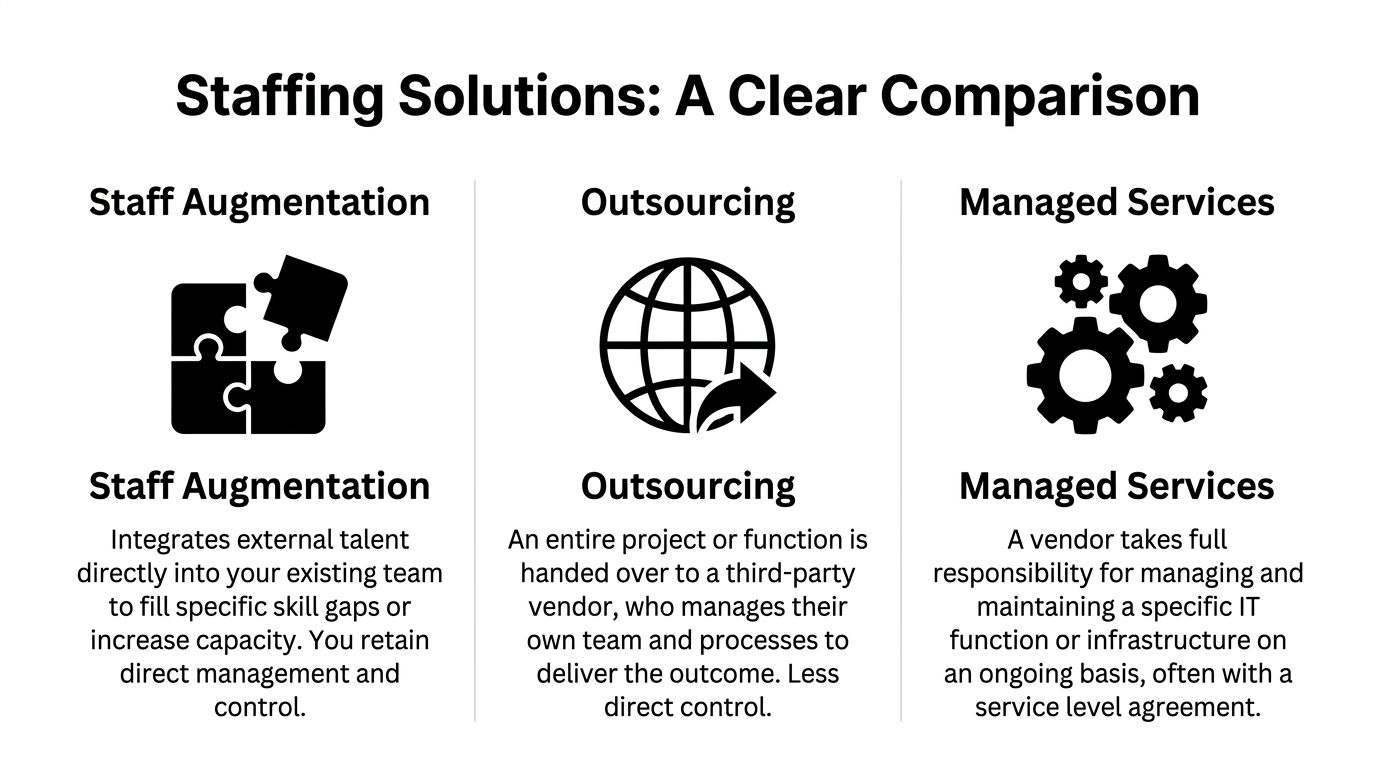
A simple analogy helps. Staff augmentation is like bringing in a specialized surgeon to join your operating team for a difficult procedure. Your hospital still runs the operation. Your protocols, your oversight, your patient relationship. Project outsourcing is hiring another clinic to perform the operation for you. Managed services is contracting a provider to continuously run a defined medical function, like lab operations or imaging support.
That distinction matters because control, accountability, and team integration change with each model.
What staff augmentation actually means
With staff augmentation services, external specialists work inside your delivery system. They join standups, use your tools, follow your engineering standards, and report into your day-to-day process. You keep management responsibility.
That structure is useful when your team already knows what needs to be built and just lacks bandwidth or specialist depth. It’s less useful when the internal team doesn’t have enough leadership time to direct the work.
For companies that need embedded engineering support inside their own operating model, Dr3am IT services are one example of a technology-specific support option.
Side by side decision criteria
| Criteria | Staff Augmentation | Project Outsourcing | Managed Services |
|---|---|---|---|
| Who manages the work | Your internal leaders manage day-to-day execution | Vendor manages delivery to a defined scope | Vendor manages an ongoing function |
| Team integration | External talent works inside your team | Vendor team works mostly as a separate unit | Provider runs a service layer with defined responsibilities |
| Control over priorities | High | Moderate to lower | Lower at the task level, higher at the service-outcome level |
| Best use case | Skill gaps, delivery spikes, specialist roles | Defined project with clear outputs | Ongoing operations, support, monitoring, maintenance |
| Knowledge stays where | More likely to remain with internal team if managed well | Often concentrated with vendor team | Shared through documentation and service processes |
| Commercial structure | Time-based staffing engagement | Statement of work or milestone-based engagement | Recurring service agreement with service expectations |
| Main risk | Weak onboarding or unclear ownership | Misaligned scope or limited transparency | Dependency on provider for an operational function |
How to choose the right model
Choose staff augmentation when you want more execution power without giving up delivery control. Choose outsourcing when the outcome matters more than who performs each task. Choose managed services when your goal is stable ongoing operations, not building temporary project capacity.
Decision shortcut: If your architects, product owners, and engineering managers are still steering the work, augmentation is usually the right lens. If you want someone else to own the lane, look at outsourcing or managed services.
A lot of confusion comes from trying to force one model to act like another. Augmented engineers won’t save a project that lacks internal direction. A managed services provider won’t replace a product delivery team. An outsourced team won’t automatically preserve internal technical knowledge.
The smartest buyers decide on the operating model first, then select the vendor.
The Strategic Case for Augmenting Your Tech Team
The lazy pitch for staff augmentation says you can plug experts in, move faster, and spend less. That’s only half true.
The stronger case is strategic. You use augmentation when the business needs capability now, but permanent hiring would add too much delay, too much fixed cost, or the wrong long-term shape to the organization. The weak case is using it as a substitute for leadership, planning, or engineering discipline.

Where augmentation creates real leverage
Some projects are a natural fit.
AI initiatives often need niche expertise for a specific phase. You may need data engineering support to clean inputs, an ML engineer to productionize pipelines, or an MLOps specialist to handle deployment and observability. Once that foundation is in place, your core team may be able to own the platform with less external help.
Cloud work has a similar pattern. A migration may require architecture design, platform engineering, identity and access planning, cost governance, and cutover support. Those skills don’t always need to sit on payroll permanently, but they do need to be available at the right moments.
Augmentation also makes sense when workload volatility is the problem. Product teams hit release windows. Infrastructure teams hit migration phases. Security teams hit audit or remediation cycles. In each case, the issue isn’t always a broken hiring plan. It’s that demand arrives in bursts.
The risk most buyers underestimate
Generic articles usually stop at speed and access. They skip the messy part. Integration is hard.
Some data suggests 20 to 30% higher turnover in augmented tech roles, and a Gartner note referenced by Cloud Employee’s discussion of staff augmentation risks says 35% of AI projects fail due to poor cultural fit in offshore augmentation. Those numbers matter because AI and cloud programs depend heavily on context, trust, and fast decisions.
If external engineers don’t understand how your team communicates, how architecture decisions are made, or what “done” means in your environment, velocity drops fast. You don’t feel it immediately in the contract. You feel it in rework, slow reviews, and unclear ownership.
The biggest failure pattern isn’t lack of skill. It’s adding capable people into a system that doesn’t know how to absorb them.
That’s why the “plug-and-play” framing is dangerous. Good augmented talent still needs a real operating model.
What works in practice
The better approach is selective, not broad. Bring in specialists around defined constraints. Pair them with internal owners. Make knowledge transfer part of the engagement from the start.
A strong setup usually includes:
- A named internal lead: One person owns scope, priorities, and acceptance.
- Embedded workflows: Augmented staff join the same sprint rituals, ticketing flow, and review process as everyone else.
- Decision documentation: Architectural choices, assumptions, and exceptions get recorded as the work happens.
- Planned exit path: The team knows how responsibility moves back in-house before the engagement ends.
Later in the engagement, this kind of operational discipline matters more than sourcing speed.
A useful walkthrough on scaling teams and technology capacity is available through Unlimited Growth.
For a quick visual perspective on how teams use external talent in development environments, this overview is worth a look.
Where a technology partner changes the outcome
There’s also a practical difference between getting people and getting aligned execution. In AI, cloud, and security work, many companies don’t just need resumes. They need help defining what role is required, how that person should integrate, and what business result should be measured.
That’s where a technology partner can be more useful than a pure staffing intermediary. For example, Dr3amsystems provides AI-driven solutions, secure cloud migrations, managed support, and domain-specific practices across Dr3am IT, Dr3am Cloud, Dr3am AI, Dr3am Security, Dr3am Hosting, and Dr3am Marketing. In a staff augmentation context, that matters because the work can be tied to implementation standards, security expectations, and operating outcomes rather than just seat filling.
That’s the strategic value. Augmentation should strengthen your delivery model, not just enlarge it.
Navigating Pricing Models and Contract Essentials
Once you’ve decided augmentation fits the operating model, the next failure point is commercial structure. A lot of engagements go wrong because the contract only defines rate cards and start dates. It doesn’t define expectations clearly enough to protect delivery quality.
Most augmentation agreements are time-based cost models, usually hourly or monthly, and top providers often report project completion rates of 85 to 95% when they manage KPIs closely. They can also deliver 30 to 50% savings compared with full-time hires when benefits, taxes, and replacement costs are included, according to Software Modernization Services on staff augmentation pricing and KPIs.
That sounds attractive, but the headline rate rarely tells the full story.

Pricing models that actually show up in deals
Hourly or daily time and materials works best when scope may evolve. It gives you flexibility, especially in discovery-heavy AI and cloud work where requirements sharpen as the team learns more. The trade-off is that governance has to be tighter because effort can drift if priorities aren’t clear.
Monthly retainer-style staffing works better when you know you need steady capacity over a longer stretch. It simplifies planning and gives the augmented team enough runway to become productive inside your environment. The downside is obvious. If internal priorities shift and you haven’t built a clean ramp-down clause, you can end up paying for underused capacity.
Some firms also blend the two. A stable monthly allocation covers baseline engineering support, while specific bursts of specialist work sit on a flexible time-and-materials basis.
What belongs in the contract
Experienced buyers separate themselves. They don’t negotiate only on rate. They negotiate on operating clarity.
Use this checklist:
- IP ownership: Your agreement should state clearly that code, documentation, workflows, and other work product created during the engagement belong to your company.
- Security obligations: Define access controls, data handling expectations, approved environments, and incident response procedures before onboarding begins.
- Performance measures: Tie the engagement to practical KPIs such as output quality, responsiveness, participation in ceremonies, documentation quality, and transition readiness.
- Replacement terms: If a person isn’t a fit, the replacement process should be clear and fast.
- Offboarding requirements: Access removal, credential handling, asset return, and documentation handoff should be explicit.
- Knowledge transfer duties: Don’t leave this implied. Make it contractual.
Practical rule: If a contract makes onboarding easy but offboarding vague, the buyer is carrying too much risk.
For organizations comparing providers and talent channels, this perspective on partnering with a staff recruiting agency is useful because it highlights how recruitment support differs from broader delivery accountability.
How to read the economics correctly
Cheaper isn’t always lower cost.
If the provider sends strong engineers but your team spends excessive time clarifying tickets, reviewing incomplete work, or re-explaining architecture, the hidden cost shows up in internal distraction. Likewise, a low monthly rate can become expensive if documentation is weak and knowledge leaves with the contractor.
That’s why the commercial model should reflect the type of work. For a platform migration, you may want explicit milestones around environment readiness, testing support, and transition artifacts. For embedded product development, you may care more about sprint participation, code quality, and handoff discipline.
The pricing conversation should also start with role definition. A senior cloud architect, a DevOps engineer, and a QA automation specialist don’t create value in the same way, so they shouldn’t be bought as interchangeable units of labor.
Teams that want to structure those conversations around scope, cost, and expected business outcomes can review pricing options at Dr3amsystems.
Your Onboarding and Governance Success Checklist
The contract is signed. That’s when the core work starts.
Most augmentation failures don’t happen because the engineer lacks technical skill. They happen because onboarding is shallow, internal ownership is fuzzy, and nobody plans for knowledge retention until the final week.

Days one through thirty
Use the first month to build operational fit, not just access.
Start with business context
Show the augmented team member what the project is for, who depends on it, and what failure would look like. Technical tasks make more sense when the business stakes are visible.Map the working environment
Don’t just hand over credentials. Explain your Git workflow, ticketing rules, release process, security guardrails, code review expectations, and escalation paths.Assign an internal owner
Every external specialist should know exactly who can answer architectural, product, and process questions. Shared ownership sounds collaborative, but it usually slows decisions.Define a first-week win
Give them something meaningful but bounded. A first automation task, a test suite improvement, a deployment workflow fix, or a well-scoped service enhancement works better than vague “ramp-up” time.
Governance that keeps teams aligned
Augmented talent should not sit in a side lane. If they do, you lose the very integration advantage that justifies the model.
Use lightweight governance:
- Weekly delivery review: Focus on blockers, changes in scope, and near-term priorities.
- Architecture checkpoints: Review major decisions before they become expensive to reverse.
- Access audits: Confirm that permissions still match role and scope.
- Feedback loop: Give direct feedback early on communication style, documentation quality, and team fit.
A broader modern guide to contingent labor management can help leaders think through workforce governance beyond the immediate project lens.
Culture and communication are operational issues
Many companies treat culture as a soft issue. In augmented teams, it’s an execution issue.
If your internal staff uses shorthand, unwritten assumptions, or hallway decisions, external contributors will miss critical context. That creates avoidable delays. The fix is simple but disciplined: document decisions, write clear acceptance criteria, and make communication channels explicit.
Write down the rules your veteran team carries in its head. That single step removes a surprising amount of friction.
A few habits help fast:
- Use one system of record: Don’t split action items across email, chat, and verbal updates.
- Document exceptions: If security, infrastructure, or product rules have edge cases, capture them.
- Normalize questions: Teams get into trouble when augmented staff stay quiet to avoid seeming slow.
Plan the exit before the midpoint
Knowledge transfer should start early enough that it becomes routine. By the midpoint of the engagement, you should know what needs to remain in-house and who will own it.
That usually means:
- walkthroughs of architecture decisions
- concise operating runbooks
- handoff notes for recurring tasks
- internal shadowing on critical workflows
This is especially important in cloud and AI work, where hidden logic often sits in deployment scripts, data assumptions, or tribal debugging knowledge.
If your company wants a guided start to this process, get started with Dr3amsystems includes an initial consultation model focused on goals, automation opportunities, and execution planning.
How to Measure Staff Augmentation Success and ROI
A lot of teams judge augmentation by one question: Was it cheaper than hiring?
That’s too narrow. The better question is whether the engagement improved delivery capacity without degrading quality or weakening internal capability.
The most useful scorecard combines three dimensions: productivity, quality, and strategic impact. Devico’s guide to staff augmentation metrics identifies productivity measures such as code commits and completed tasks, a weighted Quality Score built from defect rates, revisions, and specification adherence, and Speed of Onboarding of 7 to 14 days compared with 60 to 90 days for traditional hiring.
Productivity without context is misleading
Output metrics matter, but they need interpretation.
If an augmented engineer closes many tickets while avoiding the difficult integration work, the numbers look healthy while the project gets harder for everyone else. That’s why productivity should be tied to the type of work being done. For engineering teams, useful signals often include completed backlog items, throughput on agreed deliverables, and whether the person is helping remove bottlenecks.
A specialist added for cloud automation should reduce repetitive operational work. A QA automation resource should raise test coverage in the areas that matter. A DevOps engineer should improve release reliability and reduce handoff friction between development and operations.
Quality is where weak engagements get exposed
This is the metric category many teams underweight.
A Quality Score is useful because it combines multiple signals rather than relying on a single count. Defects found in review, avoidable revisions, and adherence to requirements reveal whether the team is adding durable value or creating hidden cleanup work. If output goes up while defects and revision churn rise, the engagement isn’t producing healthy ROI.
Use a simple review lens:
| Metric area | What to look for |
|---|---|
| Productivity | Consistent delivery against assigned work |
| Quality | Low rework, fewer avoidable defects, cleaner handoffs |
| Integration | Participation in reviews, standups, and team decision-making |
| Knowledge retention | Documentation quality and internal understanding of delivered work |
Strategic ROI is the part executives care about
The strongest staff augmentation outcomes show up in business execution, not just in engineering metrics.
If onboarding is fast, the team reaches useful output sooner. If the engagement transfers knowledge effectively, your internal capability improves instead of staying dependent on outside help. If the right specialist unblocks a migration or automation effort, the business captures value earlier.
That’s also why narrow labor accounting misses the point. A well-run engagement can shorten the path to a release, reduce operational drag, strengthen internal practices, and leave the organization with better technical documentation than it had before.
Measure whether the augmented team made your core team stronger. If the answer is no, the ROI story is incomplete.
For technology leaders, a practical review cadence works best. Assess contribution early, quality in the middle, and transition readiness before the end. Those three checkpoints catch most problems while there’s still time to fix them.
Frequently Asked Questions
When should a company choose staff augmentation services instead of full-time hiring
Choose staff augmentation when the need is urgent, specialized, or tied to a project phase rather than a permanent operating requirement. It fits well when your internal team can lead the work but lacks capacity or a specific skill set.
It’s less effective when the actual issue is missing internal product ownership, weak architecture leadership, or confusion about priorities. In that case, adding people won’t solve the underlying delivery problem.
Is staff augmentation only about reducing cost
No. Cost matters, but it’s not the whole business case.
True ROI goes beyond the rate card. It includes time-to-productivity of 2 to 4 weeks versus 3 to 6 months for hires, total cost including hidden fees, and longer-term value from institutional knowledge build-up, as discussed in Mismo’s guide to staff augmentation ROI. If an engagement helps your team deliver sooner and retain useful expertise, that value can outweigh a simple labor comparison.
Who should manage augmented staff day to day
Your internal team should. That’s one of the defining features of the model.
If the vendor is effectively managing priorities, assigning work independently, and owning the output as a separate delivery unit, you’re moving closer to outsourcing. That’s not necessarily bad, but it’s a different operating structure and should be chosen intentionally.
How do you protect intellectual property and sensitive systems
Handle this in the contract and the onboarding process. IP ownership should be explicit. Access should be role-based. Security expectations should be documented before work starts. Offboarding should include credential removal, environment checks, and handoff of documentation.
This is especially important in AI, cloud, and security work, where contractors may touch code repositories, infrastructure tooling, data pipelines, or sensitive operational procedures.
Can startups use staff augmentation services effectively
Yes, if they use it with discipline.
Startups often benefit because they need senior capability before they can justify full-time headcount in every specialty. The risk is overreliance. If core product knowledge sits entirely with external contributors, the company can move quickly at first and then struggle later when it needs continuity.
The fix is to keep product direction internal and insist on documentation and handoff habits early.
What’s the difference between a staffing vendor and a technology partner
A staffing vendor primarily helps fill roles. A technology partner helps define the work, shape the team, and connect talent to a broader delivery model.
That distinction matters in complex initiatives. AI programs, cloud migrations, security modernization, and managed operations often require more than a resume match. They need architecture judgment, integration planning, governance, and ongoing operational support. A partner with services across implementation and managed support can help align staffing decisions with business outcomes, rather than treating every need as a seat to fill.
If you’re evaluating Dr3amsystems, start with a practical conversation about the work itself. The team supports AI-driven solutions, secure cloud migrations, managed support, and related delivery needs across strategy, implementation, and optimization. A free consultation can help clarify whether staff augmentation, project delivery, or an ongoing service model fits your goals, risk profile, and internal operating capacity.