
The software development outsourcing market is projected to reach approximately $564.2 billion in 2025 and grow to $977 billion by 2031 at a 9.60% CAGR, according to Keyhole Software’s outsourcing statistics roundup. That number matters less as a market headline and more as a boardroom signal. Companies aren't outsourcing only to lower payroll. They're doing it because internal hiring alone can't keep up with AI, cloud modernization, cybersecurity, data engineering, and product delivery at the speed the business now expects.
The mistake first-time buyers make is treating software development outsourcing like procurement. It isn't. It's an operating model decision. If you approach it as a rate-shopping exercise, you'll probably get exactly what you paid for. If you approach it as a way to add execution capacity, specialist skills, and delivery discipline, it can change how fast your company moves.
The less obvious truth is this: your success won't depend only on picking a capable vendor. It will depend on whether your own organization is mature enough to lead outsourced work well. Clear scope, governance, decision rights, security boundaries, and executive sponsorship matter as much as code quality. In AI and cloud projects, they often matter more.
Why Software Development Outsourcing Is a Strategic Imperative
Analysts expect outsourcing spend to keep rising through the end of the decade. For executive teams, the practical takeaway is simple. More companies now treat external engineering capacity as part of core execution, not as a temporary purchasing decision.
That shift is driven by pressure inside the business. AI programs, cloud modernization, cybersecurity requirements, integration work, and product delivery are all competing for the same internal people. Even well-run teams hit a limit. The question is rarely whether the roadmap matters. The question is whether the company has enough delivery capacity and enough specialized skill to execute on time.
Talent constraints changed the decision
For many leadership teams, this is no longer a build-versus-buy discussion. It is a speed-versus-capability decision.
Internal teams already own production support, architecture decisions, technical debt, audit demands, stakeholder requests, and ongoing releases. Add a major AI or cloud initiative, and bottlenecks appear fast. Hiring can help, but hiring is slower than many executives expect. By the time a company recruits, onboards, and aligns niche talent, the business window may have narrowed.
A useful framing comes from ARPHost's discussion of the IT skills gap and the outsourcing imperative. The constraint is not only headcount. It is access to the right skills at the right time, under delivery conditions that the internal team can support.
Strategic value beats reactive hiring
Strong outsourcing relationships extend internal capability. They do not replace accountability.
A capable partner can help a company:
- Add specialist expertise where it matters most: AI integration, cloud architecture, data engineering, platform work, and security hardening are hard to staff quickly with full-time hires alone.
- Protect internal leadership bandwidth: Your team stays focused on business priorities, architecture, risk decisions, and stakeholder alignment instead of absorbing every delivery task.
- Increase execution capacity without waiting on hiring cycles: Important programs can start sooner with a blended team model.
- Reduce transition risk: Modernization, migration, and integration programs benefit from teams that have handled similar work repeatedly.
There is a real trade-off. Outsourcing can increase speed, but it also increases the need for clarity. A weak internal operating model will create delays no matter how capable the vendor is.
For CEOs and CTOs making a first major outsourcing decision, this distinction is critical. The strategic risk is not merely choosing the wrong vendor. It is entering the relationship without clear scope, decision rights, security rules, executive sponsorship, and product ownership on your side. That is especially true in AI and cloud projects, where requirements shift, compliance concerns surface early, and architecture decisions have long-term cost implications.
The companies that get strong ROI from outsourcing are usually good clients before the project starts. They know which work should remain internal, where outside specialists can accelerate delivery, and who will make trade-off decisions when timelines, budget, and scope come into conflict. If that groundwork is still missing, a structured planning step such as technology strategy consulting can help leadership teams define the roadmap, the boundaries of partner ownership, and the business outcomes the engagement needs to produce.
Choosing Your Engagement Model Onshore Nearshore and Offshore
Choosing an outsourcing model is a lot like choosing a vehicle for a demanding route. A sports car is fast but unforgiving. An SUV handles rough terrain better but costs more. A sedan balances comfort and efficiency. None is universally right. The route decides.
Software development outsourcing works the same way. Your model should match the work, the risk level, and the amount of collaboration required.
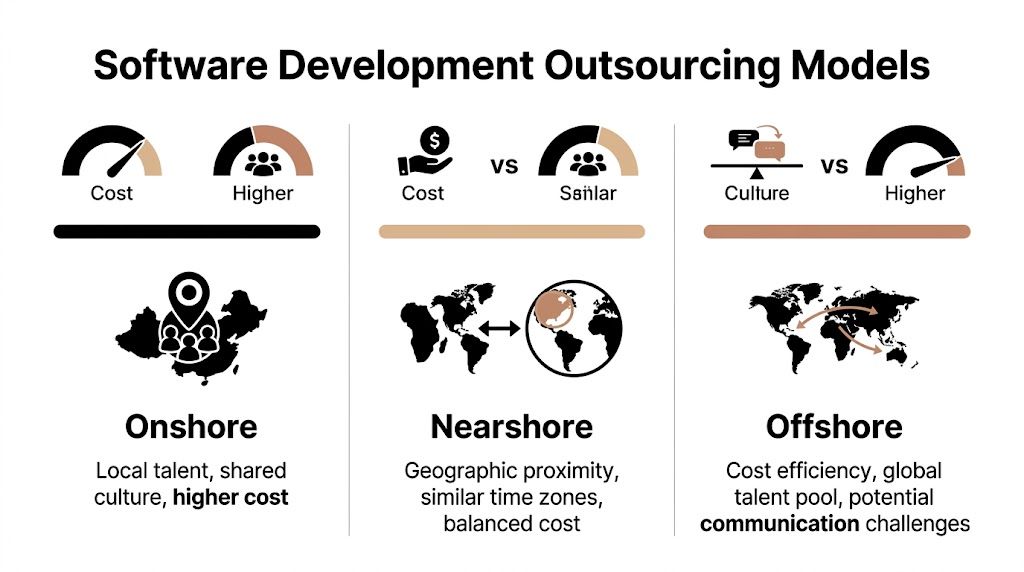
Location models and their trade-offs
The first decision is geographic.
| Model | Best fit | Main advantage | Main trade-off |
|---|---|---|---|
| Onshore | Sensitive projects, high collaboration, complex stakeholder alignment | Easier communication and shared business context | Higher cost |
| Nearshore | Teams that need overlap in working hours and frequent coordination | Better time-zone alignment with balanced cost | Smaller talent pool than global offshore options |
| Offshore | Defined workstreams, dedicated delivery capacity, cost-sensitive scale | Broad talent access and cost efficiency | More discipline required around communication and governance |
Onshore works well when requirements shift often or when legal, regulatory, or executive visibility is unusually high. Nearshore is often the most practical middle ground for companies that want regular collaboration without the full cost of local staffing. Offshore can be highly effective when leadership has strong product ownership and the partner has mature delivery operations.
Engagement structures and when to use them
The second decision is structural, and it often confuses many buyers because they mix location with engagement type.
Common structures include:
- Staff augmentation: You add engineers, architects, QA specialists, or DevOps resources to your existing team. This works when your internal leadership is strong and you need capacity fast.
- Dedicated team: You engage a stable team that operates as a long-term extension of your organization. This suits ongoing platforms, multiple releases, and product roadmaps.
- Project-based delivery: You define an outcome, timeline, and scope, and the partner delivers against that package. This works best when scope is clear and change is controlled.
Here's the practical rule. If your internal product and engineering leadership is strong, augmentation can work well. If it isn't, augmentation often exposes the weakness instead of solving it.
Practical rule: Don't hire external developers to compensate for internal ambiguity. They can write code. They can't invent your priorities.
Matching model to business reality
A first-time buyer should decide based on four variables:
Complexity of the work
Cloud migrations, data platforms, and AI-enabled workflows usually need closer architectural coordination than a contained feature build.Decision velocity inside your company
If your team takes a long time to approve scope changes, review work, or resolve blockers, a cheaper model can become expensive fast.Security and compliance exposure
The more sensitive the environment, the more important access controls, segmentation, and documented operating procedures become.Need for continuity
If the project will evolve into platform ownership, support, optimization, and enhancements, a dedicated team model usually outperforms a short project engagement.
A lot of organizations end up with a blended approach. Architecture, security, and stakeholder-heavy functions may stay local or nearshore. Build capacity, testing, and specialized engineering may sit offshore. That's often the most durable setup for enterprise software.
If you're weighing those options for a product build or modernization program, custom enterprise software development is the kind of engagement area where model choice has a direct effect on delivery speed, maintainability, and long-term supportability.
Evaluating Outsourcing Costs Risks and True ROI
Hourly rates are the visible tip of the iceberg. The larger financial picture sits underneath. Management time, onboarding, rework, documentation quality, release friction, security review, transition planning, and delayed decisions all affect the actual cost of software development outsourcing.
That's why the cheapest proposal is often the most expensive one to operate.

Cost savings are real but incomplete
There is a hard financial case for outsourcing. 59% of companies cite cost savings as their primary reason for outsourcing, and average ROI reaches 2.8x within 12 to 18 months, with some firms seeing up to 72% reductions in labor costs through dedicated offshore teams, according to Kinetic Staff’s 2025 outsourcing statistics guide.
Those numbers are useful, but they don't answer the executive question. The better question is: what are you buying?
In good engagements, you're buying some mix of:
- faster delivery
- access to scarce skills
- lower opportunity cost for your internal team
- more release capacity
- better execution on technical initiatives you can't afford to delay
Calculate total cost of ownership, not vendor price
A workable TCO review includes more than the contract.
Look at these categories:
- Visible spend: partner fees, tools, cloud environments, QA infrastructure, security review, and support commitments
- Internal management load: product owner time, architecture oversight, standups, backlog refinement, acceptance testing, vendor management
- Transition costs: knowledge transfer, environment setup, access provisioning, process alignment, documentation cleanup
- Failure exposure: rework, missed releases, production defects, compliance mistakes, and momentum loss
A low rate can be neutralized quickly if your team spends too much time clarifying requirements or repairing weak handoffs.
Risk sits in execution details
Most outsourcing failures don't start with bad intent. They start with preventable operating gaps.
The common risk categories are straightforward:
| Risk area | What it looks like in practice | What reduces it |
|---|---|---|
| Scope creep | backlog expands without decision control | stronger discovery, tighter change approval |
| Technical misalignment | code is delivered but doesn't fit architecture | early architecture reviews and reference patterns |
| Security exposure | access is granted too broadly or too early | least-privilege access, defined environments, audit trails |
| Communication friction | teams work hard but interpret priorities differently | shared rituals, written acceptance criteria, fast escalation paths |
| Dependency bottlenecks | internal teams block external progress | named owners for approvals, integrations, and reviews |
A partner can move quickly only when your organization can answer questions quickly.
ROI should be tied to business outcomes
The strongest ROI cases are not framed as labor arbitrage. They are framed as business acceleration.
Examples include:
- a platform migration that avoids prolonged disruption
- a product roadmap that ships on time because specialist help was added
- an operations workflow that cuts manual processing effort
- a data or AI initiative that improves decisions and throughput
Outcome-oriented partners stand apart from pure staffing vendors through their approach. In practice, leaders should ask whether the partner can connect engineering work to a measurable operating result. That may be cycle time, reliability, support burden, release frequency, or business process improvement.
One example of that outcome focus is Dr3amsystems' work across AI, cloud, security, hosting, and managed IT, including engagements described as delivering 60% reductions in processing time and zero-downtime transitions. If your priority is financial discipline, a useful adjacent lens is IT cost reduction strategies, especially when outsourcing is part of a wider modernization program rather than a standalone staffing decision.
The Ultimate Vendor Selection Playbook
Most vendor evaluations fail because buyers ask broad questions and get polished answers. Every firm says it communicates well, writes quality code, and cares about partnership. None of that helps you decide.
Selection gets easier when you treat it like operational due diligence, not a chemistry check.

Start with proof of delivery, not pitch language
A credible vendor should be able to walk you through how it plans, builds, tests, secures, and supports work. Ask for process evidence. Ask how requirements are clarified. Ask how code review works. Ask who owns release readiness. Ask what happens when a dependency slips.
A practical screening sequence looks like this:
Technical fit
Can the team work in your stack, or in the target stack you need to adopt? If AI, cloud, or security work is involved, ask for the exact disciplines that will be assigned.Problem fit
Have they solved this kind of business problem before? Building an app isn't the same as modernizing a regulated workflow, migrating a production system, or operationalizing machine learning.Operating fit
Can they work the way your company needs them to work? Good engineers can still fail in a weak operating model.Commercial fit
Is the pricing model aligned with the engagement shape? Fixed scope, retainer, dedicated team, and outcome-based structures each create different incentives.
Questions that reveal maturity
Generic interviews produce generic results. Better questions surface delivery discipline.
Use prompts like these:
- Walk me through your first 30 days. What gets documented, who attends workshops, and what artifacts do you produce?
- Show me how you manage change requests. If priorities shift, what happens to budget, timing, and accountability?
- Explain your escalation path. When a blocker threatens delivery, who intervenes and how fast?
- Describe how you handle security reviews. Not in theory. In workflow terms.
- Tell me how you measure team productivity without rewarding the wrong behavior.
For additional screening criteria, this vendor due diligence checklist is a useful external reference because it forces buyers to check operational, legal, technical, and commercial details instead of relying on sales confidence.
Evaluate the relationship before you need the relationship
The first workshop often tells you more than the proposal.
Watch for these signals:
- Good sign: They challenge unclear requirements early.
- Bad sign: They say yes to everything before discovery.
- Good sign: They identify dependencies you haven't considered.
- Bad sign: They avoid discussing risk until contracting is done.
- Good sign: They can explain trade-offs in plain business language.
- Bad sign: They hide behind jargon.
Here's a useful benchmark for your own team. If a vendor asks disciplined questions and your internal stakeholders can't answer them, pause the buying process and fix internal alignment first.
A short video can also help leadership teams calibrate what they want from a provider before entering final selection rounds.
Choose a partner that can work above the ticket queue
A vendor becomes valuable when it can connect technical work to operating outcomes. That means understanding revenue pressure, process bottlenecks, compliance constraints, and realities of executive reporting.
If you're compiling a shortlist, IT outsourcing companies is the kind of category page that can help benchmark what capabilities matter. Look for evidence of business alignment, not just developer availability. In AI and cloud work especially, you want a partner that can participate in roadmap conversations, not only sprint execution.
Creating a Governance Model That Guarantees Success
Most outsourcing advice overemphasizes vendor selection and underestimates client-side readiness. That's backward.
Deloitte found that the biggest breakdowns in outsourcing come from weak operating models and low vendor management maturity on the client side. Better outcomes are linked to a defined sourcing strategy at 57%, operating model alignment at 49%, and strong governance at 28%, as summarized by DesignRush’s review of outsourcing statistics: software development outsourcing statistics.
That should reset the conversation. The vendor matters. Your governance matters more.

What a workable governance model includes
Governance doesn't mean bureaucracy. It means making decisions in a predictable way.
A practical model usually includes:
- Named business owner who defines priority and resolves scope questions
- Technical owner who approves architectural direction and integration decisions
- Delivery lead on both sides who manages sprint flow, blockers, and reporting
- Security and compliance touchpoints for access, review, and audit requirements
- Executive steering cadence for major risks, budget shifts, and milestone decisions
If any of those roles are missing, the vendor will end up filling in blanks that should stay on your side of the table.
Build your operating rhythm early
The best time to define governance is before sprint one. Not after confusion appears.
Use a cadence that separates tactical work from strategic oversight:
| Meeting type | Purpose | Participants |
|---|---|---|
| Daily or regular delivery sync | unblock tasks and align on current work | delivery leads, product, engineering |
| Weekly operational review | inspect progress, scope changes, risks, and dependencies | client owner, vendor lead, key stakeholders |
| Monthly steering review | review roadmap, budget posture, business outcomes, and escalations | executives and program leaders |
That rhythm prevents three common failures. Decisions don't stall. Risks don't stay hidden. And small misunderstandings don't expand into contract disputes.
Good governance doesn't slow delivery. It stops preventable confusion from becoming expensive rework.
SLAs should measure outcomes, not activity
Weak SLAs often focus on response times alone. That isn't enough for modern software development outsourcing, especially in AI and cloud work.
Better service agreements include:
- Delivery quality indicators: accepted work, escaped defects, rework patterns
- Operational reliability: incident handling, release discipline, environment stability
- Decision responsiveness: time to approve scope, access, and blockers
- Business-facing measures: throughput, automation impact, or process improvement where relevant
Many first-time buyers frequently stumble. They assume the vendor should "own delivery." In reality, delivery is shared. If your product owner takes a week to answer a requirement question, that's not vendor underperformance. That's governance failure.
Change management is part of governance
Outsourcing changes internal behavior. Teams need to document better, hand off more cleanly, and make decisions with more discipline.
That usually requires a few non-technical habits:
- Document acceptance criteria before development begins
- Define escalation thresholds in writing
- Record architecture decisions
- Treat transition planning as real work, not overhead
- Make stakeholder attendance mandatory for key review points
A mature client organization doesn't push all responsibility outward. It creates the conditions for a partner to succeed. That's the difference between a vendor relationship that feels expensive and one that compounds value over time.
Accelerating Your AI and Cloud Goals with Outsourcing
AI and cloud initiatives are where software development outsourcing either becomes strategic or falls apart.
These projects usually involve moving parts that internal teams rarely have available all at once. Architecture, data engineering, security, platform operations, integration work, change management, and production support all have to line up. If one discipline is weak, the whole program slows down.
A realistic modernization story
Consider a mid-market company running a legacy workflow that still depends on manual reviews, aging infrastructure, and fragmented reporting. Leadership wants faster processing, stronger visibility, and a path toward AI-assisted decision support.
Hiring every role internally would take time the business doesn't have. So the company keeps ownership of product direction, policy decisions, and sensitive business rules in-house. It outsources the execution layers that require specialized depth: cloud migration planning, data pipeline design, application refactoring, security hardening, and model integration.
That setup works when responsibilities are explicit:
- internal leadership owns priorities and approvals
- the partner owns delivery planning, implementation, and technical execution
- both sides share governance and release readiness
The result isn't "outsourcing AI." It's using outside expertise to make AI and cloud execution possible without overloading the core team.
Where outside specialists add the most value
The highest-value use cases are usually the least generic.
Examples include:
Cloud migrations with continuity requirements
A company wants to modernize infrastructure but can't tolerate disruption to customer or employee workflows.Data pipeline and reporting foundations
Before any machine learning effort can succeed, the business needs reliable data movement, normalization, access control, and observability.AI-assisted operations
Teams want to reduce manual effort in routing, classification, summarization, or exception handling, but they need help integrating models into real processes.Security reinforcement during modernization
New systems, APIs, and cloud services increase exposure if identity, logging, segmentation, and monitoring aren't designed up front.
The fastest route to AI value usually starts with infrastructure discipline, not model experimentation.
Choosing capability over generic capacity
Specialist practices are essential. A partner that only supplies developers may help with velocity, but AI and cloud programs often need coordinated expertise across architecture, hosting, security, managed support, and business process design.
One option in that category is Dr3amsystems, which organizes its services across Dr3am IT, Dr3am Cloud, Dr3am AI, Dr3am Security, Dr3am Hosting, and Dr3am Marketing, with engagements starting in a free consultation and extending through implementation and ongoing optimization. For leaders mapping an initiative before vendor engagement, how to implement AI in business is the kind of planning resource that helps define use cases, dependencies, and governance before money is spent in the wrong place.
What success looks like in practice
In strong AI and cloud outsourcing engagements, the business sees a few concrete shifts.
Product teams stop waiting on scarce specialists. Infrastructure work moves in parallel with application delivery. Security gets built into the migration path instead of bolted on later. Operational teams get cleaner processes and more reliable systems.
That matters because AI and cloud programs don't fail only on technology. They fail when teams underestimate orchestration. Software development outsourcing becomes valuable when it closes that orchestration gap with the right skills, operating discipline, and accountability model.
Your Next Steps and Critical Questions Answered
Analysts and advisors keep seeing the same pattern in outsourcing failures. The vendor was not always the root problem. Weak client readiness was.
For a first major software development outsourcing decision, sequence matters because each decision constrains the next. Start with the business objective and the constraint that matters most, speed, specialist capability, modernization, resilience, or cost discipline. Then choose the engagement model that fits the work, evaluate total cost and delivery risk, select a partner with the right operating maturity, and put governance in place on your side before kickoff.
Executives who skip that order usually pay for it in rework, slower decisions, and expensive transition friction. AI and cloud projects amplify that risk because architecture, data access, security review, and model governance create more dependencies than a standard application build.
A short executive checklist
Use this before final partner discussions:
- Clarify the outcome: State the business result you expect, not just the technical deliverable.
- Decide what stays internal: Keep product direction, approval authority, and high-risk business logic under clear internal ownership.
- Define success in business terms: Measure progress through release capacity, process improvement, service reliability, or revenue enablement.
- Prepare governance before kickoff: Name decision-makers, set meeting cadence, define escalation paths, and agree on reporting.
- Plan transition realistically: Onboarding, access setup, documentation, and knowledge transfer need budget, time, and executive attention.
Critical questions leaders still ask
How do we reduce hidden risk in AI or cloud outsourcing?
A useful reference point comes from TechExactly’s outsourcing guide, which recommends budgeting extra for transition work and defining SLAs that reflect AI productivity and delivery quality. The practical takeaway is direct. Fund the handoff properly, define productivity carefully, and don't assume transition work is administrative.
How should we handle IP in a hybrid team model?
Set ownership, repository controls, access permissions, and documentation standards in the contract and in day-to-day operating rules. Limit access by role. Review who can merge code, deploy changes, export data, and approve architecture decisions.
How do we measure outsourced team productivity without creating bad incentives?
Avoid a scorecard built around tickets closed or hours logged. Measure accepted work, release quality, predictability, defect escape rate, rework, and business impact. For AI initiatives, add metrics that show whether the system improves the process it was funded to improve.
When should we not outsource?
Do not outsource a project your leadership team cannot prioritize, your stakeholders cannot make decisions on, or your internal experts cannot explain without relying on tribal knowledge. In those cases, fix internal readiness before searching for a vendor. A capable partner can accelerate delivery, but no partner can compensate for missing ownership, unclear scope, or stalled decisions inside the client organization.
If you're weighing software development outsourcing for AI, cloud migration, managed support, security, or custom application delivery, Dr3amsystems offers a free consultation to clarify goals, identify automation opportunities, and map a practical roadmap before execution begins.