
Global spending on digital transformation is projected to reach almost $4 trillion by 2027, with a 16.2% CAGR, according to IDC figures summarized by Practical Logix (enterprise digital transformation in 2025). That number matters because it changes the conversation. Digital transformation for enterprises is no longer a side program owned by IT. It is now a core operating decision about how the business will compete, integrate data, govern risk, and scale without breaking what already works.
Most first-time transformation programs fail for a simple reason. Leaders treat them like software upgrades when they are closer to redesigning a city’s transportation grid. Buying a faster car does not fix congestion, route planning, maintenance, or traffic control. In the same way, adding cloud tools or AI features does not transform an enterprise unless the underlying workflows, data flows, and decision rights change with them.
Beyond the Buzzword What Transformation Means in 2026
In 2026, the phrase gets overused because it sounds strategic even when the work underneath is vague. For a CTO, the useful definition is narrower. Digital transformation for enterprises means redesigning how systems, teams, and processes work together so the business can move faster with less friction and better control.
That usually includes replacing brittle handoffs, reducing duplicate data, standardizing integrations, and building an architecture that can absorb future changes without another expensive rebuild. Technology is part of it. Operating model change is the harder part.
A practical way to frame it is this. Transformation does not start with tools. It starts with business pressure.
What enterprises are trying to fix
In most organizations, the symptoms are familiar:
- Disconnected platforms: ERP, CRM, finance, operations, and support data sit in separate systems.
- Slow process cycles: Work waits for manual approvals, spreadsheet merges, or exception handling.
- High change cost: Every new integration feels like a custom project.
- Unclear accountability: Business units want speed. Security, compliance, and infrastructure teams need control.
This is why many CTOs are revisiting architecture, integration, and governance at the same time. A helpful outside perspective on the AI side of that shift is Digital Transformation with AI: Your Guide to Modernizing Your Business, which captures how modernization efforts increasingly tie process redesign to intelligence and automation rather than just system replacement.
The work behind the label
A real program usually involves decisions like these:
- Keep, wrap, or replace: Some legacy systems still do their job well. Others should be isolated behind APIs. A few need retirement.
- Centralize or federate data: Not every workload belongs in one platform. But every critical process needs a reliable data path.
- Standardize before automating: Automating a broken process only helps it fail faster.
- Sequence for business continuity: Revenue systems, customer operations, and regulated workflows cannot tolerate reckless cutovers.
Transformation succeeds when leaders stop asking, “Which tool should we buy?” and start asking, “Which business constraints are we removing first?”
For teams evaluating the practical side of modernization, the insights at https://dr3amsystems.com/dr3am-insights/ are useful because they keep the focus on architecture, operational trade-offs, and execution rather than abstract trend language.
The Business Case for Enterprise Digital Transformation
The strongest business case is not “everyone else is doing it.” It is that the current operating model is too slow, too expensive to maintain, and too hard to scale. Boards and executive teams increasingly recognize that reality. A 2025 C-Suite Survey found that 82% of executives rank digital transformation as a high priority, while 85% expect AI to have transformational or high impact over the next five years. The same survey highlights operational efficiency at 64% and AI implementation at 62% as major priorities (top digital transformation trends).
That tells a CTO something important. The business case already exists at the leadership level. The harder job is translating executive urgency into a program that produces useful outcomes without creating operational chaos.
Efficiency is the first lever
Most enterprises begin with efficiency because the waste is visible. Teams rekey data between systems. Analysts build shadow reports because source data is inconsistent. Support staff spend hours on low-value steps that should have been automated years ago.
When those bottlenecks are removed, the benefit is not abstract. Processing gets faster, errors drop, and staff can focus on higher-value decisions. That is why tangible operating gains often become the first proof point in a transformation program.
Customer experience improves when back-end systems improve
Many leadership teams talk about customer experience as if it were a front-end design problem. It usually is not. Customer friction often starts deeper in the stack.
A delayed order update, an inaccurate invoice, or an inconsistent support response usually traces back to fragmented systems and weak process orchestration. Modernization improves customer experience when it fixes those back-end dependencies.
Competitive advantage comes from responsiveness
Enterprises rarely lose ground because they lacked a dashboard. They lose ground because they could not adapt quickly enough.
A more modern architecture helps in three practical ways:
- New services launch faster because core systems are easier to integrate.
- Operational changes are safer because teams can test and deploy without rewriting everything around them.
- Leadership gets cleaner signals because data moves more reliably across functions.
That responsiveness matters more than any single technology choice.
Better decisions require better data movement
The final driver is decision quality. If your finance, operations, supply chain, and customer systems disagree, leaders waste time debating whose report is correct. A transformation effort that improves data consistency and workflow design gives the business a better basis for acting quickly.
The return on transformation often starts with speed and cost, but it compounds through better decisions and fewer operational surprises.
For organizations formalizing that business case in an enterprise setting, https://dr3amsystems.com/pro-enterprise/ reflects the kind of service scope many CTOs need on a first major program. Strategy, cloud execution, AI enablement, and managed support have to fit together, not run as separate projects.
Building Your Transformation Engine Core Technologies
A transformation program needs an engine, not a pile of disconnected tools. In practice, that engine has four parts: cloud infrastructure, data pipelines and analytics, AI and machine learning, and cybersecurity. If one of those is weak, the rest of the program slows down.
AI and big data analytics already sit at the center of many enterprise stacks. Market.us data summarized by Scoop shows 58% adoption for big data analytics and 39% of enterprises scaling AI, with associated outcomes including 40% increased operational efficiency and 36% faster time-to-market (digital transformation statistics). The lesson is not “buy more AI.” The lesson is that intelligence creates value when the rest of the architecture can support it.
Cloud is the operating foundation
Cloud is not just rented infrastructure. In an enterprise program, cloud gives teams a way to standardize environments, improve resilience, and reduce the dependency chain around on-premises change windows.

A modern cloud foundation usually supports:
- Environment consistency: Development, testing, and production become easier to align.
- Elastic capacity: Teams can handle demand changes without long hardware cycles.
- Service integration: APIs, event flows, and managed services reduce custom infrastructure work.
- Recovery design: Resilience can be designed into the platform rather than bolted on later.
That does not mean every system should move at once. Many enterprises keep selected workloads where they are for regulatory, performance, or commercial reasons. The point is to create a target architecture that reduces complexity over time.
For leaders evaluating the cloud layer specifically, https://dr3amsystems.com/dr3am-cloud/ is one example of a service model built around secure migration, hosting, and infrastructure modernization rather than lift-and-shift alone.
Data pipelines are the fuel line
Data is where many enterprise programs stall. Teams deploy new applications but leave reporting logic, business rules, and master records fragmented across departments. The result is faster software sitting on top of unreliable information.
A strong data layer does three jobs well:
| Data concern | What good looks like | Why it matters |
|---|---|---|
| Source integration | Core systems exchange data through governed interfaces | Reduces manual reconciliation |
| Data quality | Definitions, ownership, and validation are explicit | Prevents decision disputes |
| Delivery | Data reaches dashboards, workflows, and models on time | Supports operations, not just reporting |
The sequence matters. If the enterprise lacks clear ownership of core business entities, AI projects tend to disappoint. Models can only act on the quality and structure of the data they receive.
AI should automate decisions, not just tasks
Most organizations start AI in the wrong place. They chase a visible use case before they clean up the process around it.
The better approach is to place AI where three conditions are true:
- The workflow repeats often
- The decision logic can be improved with data
- The output can be governed and reviewed
This could mean document classification, exception routing, support triage, forecasting assistance, or workflow recommendations. It does not need to be a flashy use case to be valuable.
One provider that packages this as part of a broader transformation stack is Dr3amsystems, through practices such as Dr3am AI, Dr3am Cloud, Dr3am Security, managed support, and secure migration services. The relevant point for a CTO is not branding. It is that transformation execution usually works better when AI, cloud, security, and support are planned together instead of handed off across unrelated vendors.
Security has to be built in
Security teams often inherit transformation decisions after architecture is already set. That creates delays, friction, and redesign work.
A stronger pattern is to embed security into the transformation engine from the start:
- Access design: Who can reach what, under which conditions
- Data protection: Classification, encryption strategy, and retention control
- Monitoring: Event visibility across cloud, identity, endpoints, and applications
- Third-party review: Vendor, integration, and hosting risk assessed before rollout
If security is treated as a final approval gate, projects slow down. If security is designed into architecture and delivery, projects move with fewer surprises.
A Practical Roadmap for Transformation Success
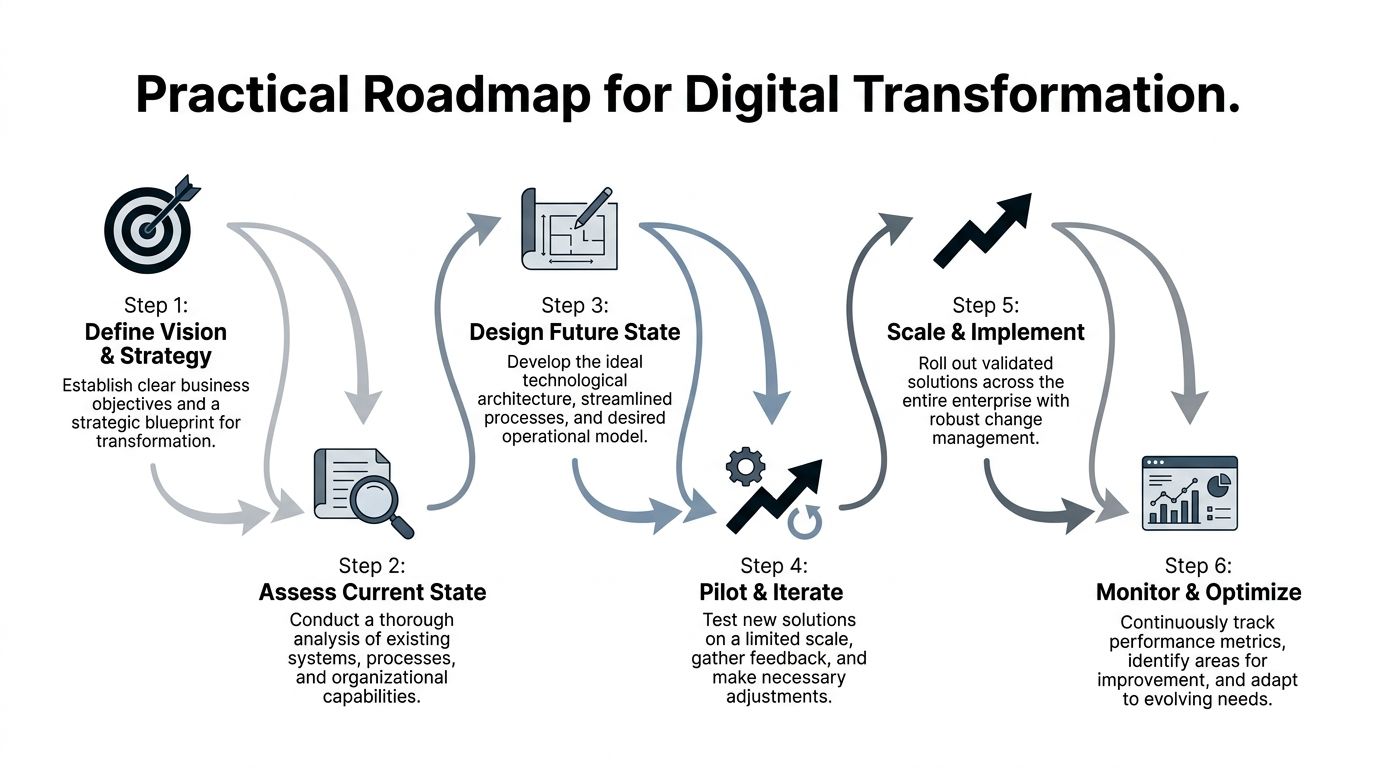
The biggest mistake on a first major transformation project is trying to do everything in one motion. Enterprises need an ordered roadmap that reduces risk while still producing visible progress.
A useful sequence starts with assessment, moves into focused pilots, then scales only after architecture and operating rules are stable enough to support wider rollout.
Phase 1 Define vision and assess current state
The first phase is not brainstorming. It is disciplined diagnosis.
Start by identifying which business outcomes matter most. Faster cycle times, lower support load, cleaner reporting, improved resilience, better compliance posture. Pick the few that leadership will use to judge success.
Then audit the current environment. That means more than making an application inventory. Map where work really flows, where data is duplicated, which interfaces break often, and where teams rely on manual workarounds.
This phase should answer practical questions:
- Which systems are mission critical
- Which processes create the most drag
- Which integrations are fragile
- Which risks could block a cutover or migration
A free consultation can be useful at this point if it produces a real roadmap instead of generic recommendations. The right external partner helps teams clarify goals, uncover automation opportunities, and define a migration sequence that protects daily operations.
Phase 2 Run small pilots that prove value
Do not begin with the most politically sensitive system in the company. Start where the process is important, measurable, and bounded.
Good pilot candidates often include internal workflows with known friction, such as intake, routing, reporting, document handling, or repetitive approval chains. The pilot should produce one clear result and teach the team something reusable about architecture, governance, or adoption.
Cloud-native infrastructure often enables this approach because it supports modular, API-driven stacks. Exploding Topics reports that 45% of organizations make scaling cloud capabilities a top priority, and associates that with 30% higher operational efficiency through automation of manual processes (digital transformation stats).
The practical takeaway is simple. A modular foundation makes small wins easier to scale.
Phase 3 Scale what worked and integrate deliberately
Once a pilot works, the temptation is to rush rollout. Resist that.
Scaling requires more than deployment. It requires stable data definitions, reusable integration patterns, support ownership, access controls, and a change plan that business teams can absorb.
Before broad rollout, confirm:
- Architecture repeatability: Can the same pattern serve multiple teams or workflows?
- Operational ownership: Who monitors it, supports it, and approves changes?
- Data trust: Do upstream and downstream systems agree on the records being exchanged?
- Failure handling: What happens when a dependency fails or a workflow needs manual override?
This is also where many enterprises decide whether to keep building internally, rely on a primary partner, or split responsibilities across specialists.
A short explainer is useful if your team needs a plain-language walkthrough before planning the next phase.
Phase 4 Optimize and govern continuously
Transformation does not end at go-live. The operating model after launch determines whether the gains hold.
Use a review rhythm that includes business owners, architecture, security, operations, and delivery leadership. Look at process friction, support load, adoption issues, cost drift, and backlog priorities. Then make the next round of improvements based on those findings.
The healthiest enterprise programs treat transformation as a managed capability. They do not relaunch a new initiative every time a bottleneck appears.
Governing Change and Measuring Real ROI
A modern platform can still fail if the organization around it stays unchanged. Governance matters because transformation introduces new routes for data, new process owners, new risk points, and new expectations for teams who have worked the old way for years.
A useful analogy is transportation infrastructure. Building a new highway system is not enough. You also need traffic laws, signage, driver education, maintenance rules, and incident response. Enterprise transformation works the same way. New architecture needs operating rules.
Governance keeps speed from becoming disorder
Governance does not mean slowing everything down with committees. Good governance defines where decisions belong, which controls are mandatory, and how exceptions are handled.
The most effective governance models usually cover these areas:
- Architecture control: Standards for integration, identity, environments, and data flows
- Security review: Baselines for access, logging, protection, and incident handling
- Change ownership: Named business and technical owners for each critical workflow
- Vendor management: Clear responsibilities across platform, implementation, hosting, and support teams
Security has a special role here because it touches every stage of transformation. A cloud migration, AI deployment, analytics platform, or API expansion all change the attack surface. That is why a service layer like https://dr3amsystems.com/dr3am-security/ fits best when it is involved early, alongside architecture and delivery, not only at the end of a project.
Teams adopt new systems faster when leaders define the new rules clearly, train people on the changed workflow, and make escalation paths obvious.
Measure business outcomes, not technical activity
Many transformation dashboards are full of delivery metrics that executives cannot use. Number of applications migrated, number of workflows digitized, or number of integrations completed may matter to the project team, but they do not prove business value.
A better measurement model ties technology work to business performance.
| Business Area | KPI | Example Metric |
|---|---|---|
| Operations | Process efficiency | Processing time reduction |
| Finance | Cost control | Lower manual handling effort |
| Customer service | Service quality | Faster resolution and fewer handoff delays |
| Technology | Platform resilience | Fewer incidents tied to legacy dependencies |
| Data | Decision support | Faster access to trusted cross-functional reporting |
| Security | Risk management | Improved control coverage across modernized systems |
What ROI should include
Return on investment should consider three layers.
First, direct operating gains. That includes labor saved, cycle time reduced, and fewer errors to correct.
Second, avoided cost. Legacy systems often create hidden expense through custom maintenance, outage exposure, unsupported components, and slow project delivery.
Third, strategic capacity. When teams spend less time holding fragile processes together, they can deliver higher-value changes.
This is why tangible outcomes matter. Processing time reduction is a strong measure because operators feel it, finance can assess it, and leadership can connect it to customer and margin impact.
Avoiding Common Pitfalls and Legacy System Hurdles
The hardest part of digital transformation for enterprises is rarely adoption of new technology by itself. It is fitting new technology into an environment built over years of exceptions, workarounds, and dependencies that nobody wants to disturb.
That pressure is especially strong in the mid-market. An Insight survey found that 49% of mid-market businesses rate integrating new technology with legacy systems as very or extremely challenging, and 45% struggle with identifying suitable technologies (small and midmarket businesses recognize importance of digital transformation but struggle with limited resources). That finding is important because it shifts the core problem into focus. The issue is often not willingness to modernize. It is the operational risk of doing it badly.
The common failure pattern
Leaders often assume the primary challenge is selecting the right platform. It usually is not.
The more common failure pattern looks like this:
- Executive sponsorship is shallow: Leaders approve budgets but do not resolve cross-functional conflicts.
- The program is technology-first: Teams buy tools before they redesign the process.
- Legacy realities are ignored: Hidden dependencies appear late and disrupt timelines.
- Change management is underfunded: Users receive new systems without enough training or support.
- Cutover planning is rushed: Teams discover too late that “weekend migration” is not realistic.

The mid-market trap
Mid-market enterprises sit in an awkward position. They often have enterprise-grade complexity without enterprise-grade slack. Their ERP, CRM, finance, and operational systems may be tightly intertwined, but their internal teams do not have much room for long-running disruption.
That creates a trap. Leadership wants modernization. Operations needs continuity. IT has to deliver both.
A pragmatic response includes:
- Prioritize interfaces before replacement
Wrap key legacy systems with stable integration layers where possible. - Separate business-critical cutovers from experimental change
Do not combine a core migration with a new operating model if both are unproven. - Map manual fallback paths
If an automated workflow fails, staff need a controlled way to continue operations. - Use phased transitions
Zero-downtime is not magic. It comes from careful sequencing, testing, and rollback discipline.
For teams working through that exact problem, Legacy systems modernization is a useful companion read because it focuses on the practical modernization challenge rather than repeating abstract transformation language.
Legacy modernization works best when teams treat continuity as a design requirement, not a post-launch aspiration.
Your Partner in Accelerated Transformation
A first major enterprise transformation does not need more hype. It needs clear business outcomes, honest trade-offs, disciplined sequencing, and execution that protects operations while moving the organization forward.
That means choosing where to standardize, where to integrate, where to keep legacy systems in place for a period, and where to automate only after the underlying process is stable. It also means governing the human side of change with the same seriousness as the technical architecture.
The right partner helps across that full span. From roadmap design to secure cloud migration, data and AI implementation, cybersecurity, hosting, and managed support, enterprises need coordinated delivery rather than isolated projects. For organizations ready to turn planning into action, https://dr3amsystems.com/get-started/ is the practical next step to start shaping a roadmap around business goals, migration constraints, and measurable ROI.
Digital transformation for enterprises is not a one-time installation. It is a sequence of choices that determines how the business will operate for years. The companies that handle it well are not the ones that move recklessly. They are the ones that modernize with control.
If your team is planning modernization, cloud migration, AI implementation, or a zero-downtime transition, Dr3amsystems offers a free consultation to clarify goals, identify automation opportunities, and shape a roadmap that aligns technology decisions with business value.