
The companies moving fastest right now aren’t treating digital transformation for businesses as a side program inside IT. They’re treating it as operating model redesign. The scale of that shift is hard to ignore. The global digital transformation market is valued at USD 1,107.06 billion in 2025 and projected to reach USD 1,864.94 billion by 2031, at a 9.1% CAGR, according to MarketsandMarkets.
That number matters for one reason. It signals that your competitors, partners, and customers are already changing how they buy, serve, build, and decide. If your business still runs on disconnected systems, brittle workflows, and manual handoffs, the issue isn’t just inefficiency. It’s strategic exposure.
A business on legacy infrastructure often looks healthy from the outside. Revenue still comes in. Teams still get work done. But the internal model starts to fail under pressure. This situation is akin to a ship with a powerful engine but a wooden hull, trying to cross an ocean filled with steel vessels. It can move, but every wave creates risk. Every new market demand, security requirement, or customer expectation hits harder than it should.
The Inevitable Shift to Digital Transformation
Digital transformation for businesses isn’t a software shopping exercise. It’s the work of redesigning how the company operates so systems, data, people, and decisions can move at the speed the market requires.

Why legacy stability becomes modern fragility
Legacy systems can create a false sense of control. They’re familiar, heavily customized, and often tied to core processes like finance, customer records, inventory, or service delivery. The problem is that familiarity doesn’t equal fitness.
When a CTO starts mapping where delays happen, the same patterns appear. Data lives in separate systems. Teams export spreadsheets to reconcile records. Reporting arrives too late to guide decisions. New applications take too long to integrate because every change touches older dependencies. Security becomes harder because the environment wasn’t built for today’s access patterns.
Digital transformation usually fails when leaders frame it as a tool rollout instead of a business redesign.
What the shift actually requires
The strongest transformation programs start with a hard operational question. Where does the business lose time, trust, or margin because systems can’t support the way the company needs to run today?
For some firms, the pressure point is customer experience. For others, it’s cost control, compliance, fulfillment, quoting, or cross-functional visibility. The specific trigger changes by industry, but the pattern doesn’t. Businesses win when they reduce friction across the full chain from input to decision to action.
That’s why partner selection matters early. Most internal teams know where the pain is. Fewer have the bandwidth to audit legacy architecture, sequence modernization, manage cloud migration risk, build AI-enabled workflows, and keep production operations stable at the same time. Practical guidance on that kind of sequencing shows up in good technology strategy insights from Dr3amsystems, especially when the goal is measurable business value rather than broad transformation theater.
Defining Your Strategic Goals and Success Metrics
A transformation program without clear business goals turns into an expensive collection of technical activity. Teams migrate workloads, buy platforms, and launch pilots, but nobody can answer a basic leadership question. What changed in the business because of the investment?
That question matters because outcomes are achievable when the objective is clear. A recent survey found that 56% of CEOs noted profit increases from their digital transformation investments, and 41% achieved higher ROI within two years of adoption, according to Exploding Topics.
Start with business intent, not tooling
The right first move isn’t choosing Azure over AWS, replacing your ERP, or rolling out another analytics dashboard. It’s deciding what the business needs to improve first.
In practice, most executive teams care about a few categories:
- Operational efficiency: reduce handoffs, cycle times, and rework
- Revenue quality: improve conversion, retention, and channel performance
- Customer experience: remove friction across service and support interactions
- Decision velocity: get reliable data into operating conversations faster
- Risk control: improve security, governance, and resilience
These aren’t abstract ambitions. They need to become measurable success conditions. If your stated goal is “better operations,” your program will drift. If your goal is “reduce approval bottlenecks in order-to-cash and cut manual exception handling,” the roadmap becomes much easier to manage.
Build KPIs that reflect actual operational change
Many transformation dashboards are padded with vanity metrics. App downloads, number of automations launched, or platform adoption counts don’t tell a COO or CEO whether the business improved.
Use KPIs that connect technology changes to commercial or operating performance.
| Business Area | Strategic Goal | Example KPI | Success Target |
|---|---|---|---|
| Operations | Remove manual bottlenecks in core workflows | Processing time for high-volume transactions | Faster cycle times with sustained service quality |
| Marketing | Improve decision quality across campaigns | Contribution of digital channels to qualified pipeline | Stronger attribution and better budget allocation |
| Customer Service | Reduce service friction | Time to resolution across priority issue types | Faster response and fewer repeat contacts |
The target should be specific to your baseline. Don’t borrow another company’s metric and pretend it fits your operating model. A manufacturer, SaaS company, healthcare group, and retailer can all pursue digital transformation for businesses, but they won’t define success the same way.
Practical rule: Every KPI should tie to one executive owner, one operational team, one baseline, and one review cadence.
Tie every initiative to a financial or strategic result
A good test is simple. If you paused the project and asked the CFO why it still matters, the answer should be immediate.
Examples of strong alignment look like this:
- Customer data integration supports better retention and cross-sell decisions.
- Workflow automation reduces manual effort in high-volume processes.
- Cloud migration improves resilience and shortens release cycles.
- Security modernization lowers operational risk around access, data movement, and compliance.
- AI deployment helps teams process information and act on it faster.
For marketing and growth teams, this is also where data-driven marketing becomes useful. Not as a buzzword, but as a discipline for connecting customer signals, campaign actions, and revenue outcomes more cleanly.
Some organizations benefit from formalizing these priorities into a transformation scorecard before they approve major spend. Others need outside help to pressure-test assumptions, especially when multiple departments define “success” differently. For companies running multi-team modernization efforts, the enterprise planning approach at Dr3amsystems is relevant because it treats architecture, execution, and ROI as one operating conversation rather than separate workstreams.
Your Practical Digital Transformation Roadmap
Gartner has found that only a fraction of digital initiatives deliver at scale. The pattern is familiar. Companies start too many workstreams at once, underinvest in adoption, and discover late that architecture decisions made for speed now block progress.
A roadmap works when it controls risk, protects operations, and gives the business proof of value in stages.
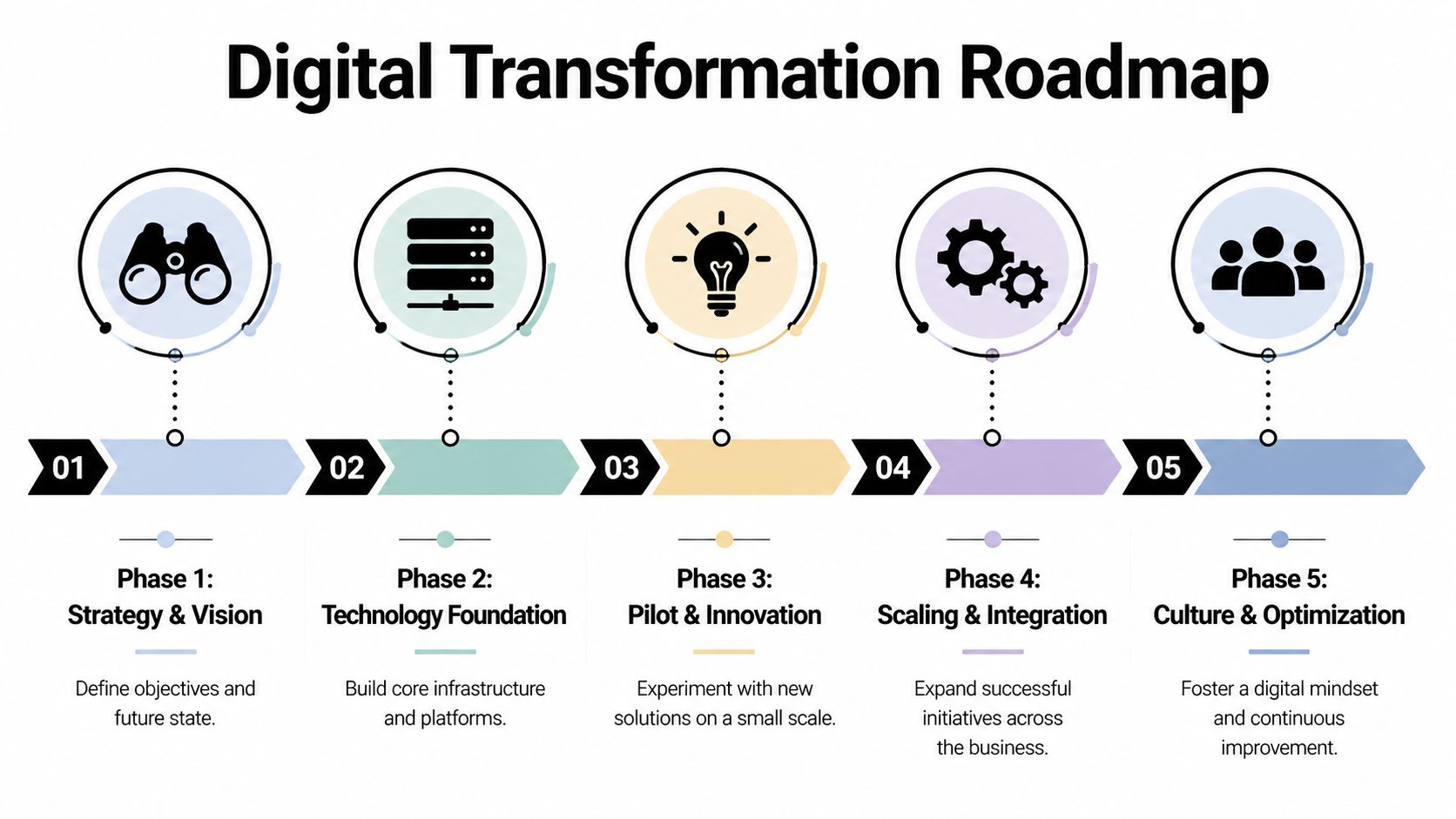
Phase 1 Strategy and discovery
The first phase is operational diagnosis. CTOs need a current-state view that is detailed enough to support sequencing decisions, not just executive messaging.
Map the application estate, integration dependencies, data flows, security controls, support model, and process bottlenecks. Then connect that technical map to business-critical capabilities such as order management, service delivery, onboarding, claims handling, pricing, or reporting. In practice, this is also the point where transformation teams need to identify who owns each workflow and which teams will have to change how they work.
A useful discovery phase answers questions like these:
- Which systems are business-critical: what cannot fail without revenue, service, or compliance impact
- Where work slows down: which processes rely on manual rekeying, spreadsheet workarounds, or repeated approvals
- What data is fragmented: where reporting, forecasting, or customer insight depends on inconsistent records
- Which risks are exposed: where unsupported tools, access gaps, or undocumented processes create avoidable failure points
The deliverable should be a decision document with priorities, dependencies, owners, target outcomes, and a realistic first wave. If that output cannot guide funding and delivery choices, the discovery work was too abstract.
Phase 2 Legacy modernization and cloud migration
Modernization usually fails when teams treat every legacy system as a replacement project. That is expensive, slow, and often unnecessary.
Selective modernization works better. Some applications should be retired. Some should be refactored or re-platformed. Some can remain in place for a period behind better integration layers while higher-value constraints are addressed first. The trade-off is straightforward. Speed favors lift and shift. Long-term efficiency favors redesign. Strong programs choose deliberately instead of pretending one migration pattern fits every workload.
As IMD notes, cloud adoption is now widespread, and hybrid models support agility for enterprises with mixed infrastructure requirements. For CTOs, the point is not cloud for its own sake. The point is better resilience, faster release cycles, and lower friction in operating the estate.
A disciplined modernization phase usually includes:
- Application rationalization: decide what to keep, replace, refactor, or retire
- Landing zone design: define identity, network, policy, monitoring, and backup standards before migration begins
- Migration sequencing: move lower-risk workloads first, then business-critical systems with rollback paths and testing in place
- Integration planning: use APIs, middleware, or event-driven patterns to avoid recreating old silos in a new platform
Teams that need implementation support at this stage often look for engineering depth across migration planning, managed infrastructure, and post-cutover operations. The delivery model outlined in Dr3am IT services fits that requirement because it combines architecture and execution instead of splitting accountability across multiple vendors.
Phase 3 Data enablement and AI integration
Once the core platform direction is set, the next bottleneck is usually data quality and process consistency.
AI and automation produce measurable gains only when core records, business rules, and handoff points are reliable enough to support them. If finance, operations, sales, and service all define the same customer or transaction differently, the output will be disputed no matter how advanced the tooling looks.
This phase usually includes four workstreams:
Data model cleanup
Standardize entities such as customer, order, product, account, and case. This sounds basic because it is. It is also where many reporting disputes begin.Pipeline design
Build repeatable ingestion and movement between source systems, operational platforms, and analytics environments. The stack varies. The requirement does not.Workflow automation
Target high-volume processes with clear rules, repetitive decisions, and frequent manual touchpoints. Good candidates include document handling, exception routing, approvals, and case updates.AI augmentation
Apply machine learning or AI services where classification, forecasting, summarization, or document processing improves cycle time or decision quality.
The trade-off in this phase is speed versus control. Teams that rush into AI with weak governance get outputs that users do not trust. Teams that wait for perfect data architecture often stall. A better path is phased deployment. Fix the critical data paths first, ship automation in a narrow operating area, measure the result, then expand.
Partners such as Dr3amsystems are useful here because the work spans strategy, data engineering, implementation, and optimization. In client environments, that combination has supported outcomes such as faster processing times and stable transitions during broader platform change. It also reduces a common failure mode. The architecture team, cloud team, automation team, and business owners stop working from separate assumptions.
Do not ask where AI can be added. Ask where decisions are delayed because teams cannot process the volume, variation, or timing of incoming work fast enough.
Phase 4 Embedded security and governance
Security and governance need to be built into delivery from the first design decision. Retrofitting them later increases cost and creates rework across identity, integrations, logging, and deployment pipelines.
That means defining access models, encryption standards, monitoring requirements, change controls, incident expectations, and system ownership early. It also means making governance usable. If every policy requires manual review, delivery slows down and teams start finding side paths. Clear standards, automated enforcement, and defined exception handling produce better results than centralized bottlenecks.
This phase is less about adding controls than setting operating rules the business can maintain under pressure.
Phase 5 Change management and adoption
Technology deployment does not complete transformation. Behavior change does.
New systems alter workflows, approval paths, reporting visibility, and accountability. Frontline managers often absorb the biggest shift because they have to run the new process while service levels still matter. If the roadmap ignores that reality, resistance will appear through delayed adoption, shadow processes, or selective use of the new tools.
Effective change management usually includes:
- Leadership alignment: executives explain the purpose, sequence, and expected business effect in the same terms
- Manager enablement: frontline leaders understand what is changing in workflows, KPIs, and decision rights
- Role-based training: users learn the system in the context of their day-to-day tasks
- Feedback loops: teams can report friction points early enough to fix them before bad habits harden
- Adoption reviews: leaders measure usage, process compliance, and operational improvement, not just deployment status
This phase is frequently neglected because it looks less technical than migration or AI. It is still one of the main drivers of ROI. A phased roadmap works best when each delivery wave includes technical change, process redesign, and adoption support together. That is how transformation gains hold after launch.
Enterprise Transformation Examples in Action
McKinsey has repeatedly found that transformation outcomes vary widely across companies. In practice, the gap usually comes down to execution discipline, process redesign, and whether leaders treat adoption as part of delivery rather than an afterthought.

Manufacturing with too many manual handoffs
Manufacturers rarely need another dashboard first. They need fewer breaks between planning, production, procurement, quality, and fulfillment.
A common pattern looks like this: demand data lives in ERP, maintenance updates sit in a separate system, supplier changes arrive by email, and plant supervisors track exceptions in spreadsheets. The cost shows up in missed production slots, excess inventory, and slow responses to disruptions.
The strongest first step is usually integration and data standardization across a narrow set of workflows. Once planners and operators trust the same numbers, teams can automate purchasing triggers, production scheduling, quality escalations, and exception routing. That is where ROI starts to become visible. Less rework, faster cycle times, and fewer manual interventions.
This is also where an outside delivery partner changes the pace of the program. Dr3amsystems can help define the first workflow that is worth automating, build the supporting integrations, and package those capabilities into custom business applications for operations teams instead of forcing staff to work across disconnected tools.
Retail with disconnected customer signals
Retail transformation usually stalls at the customer data layer. Commerce, service, loyalty, marketing, and store operations all hold part of the picture, but none of those systems reliably share identity, history, or intent.
The result is predictable. Campaigns target the wrong segments, service teams lack context, and merchandising decisions rely on partial demand signals. Revenue leakage is not dramatic in one place. It spreads across conversion, retention, and margin.
A phased approach works better than a full-stack replacement. Start with identity resolution and a small number of cross-channel use cases, such as abandoned cart recovery, inventory-aware promotions, or service-triggered retention offers. Then measure whether the new process improves conversion, repeat purchase rate, and support efficiency before expanding further.
Teams that skip this sequencing often rediscover the persistent challenge of legacy code after contracts are signed and timelines are already slipping.
A short overview of enterprise thinking in this area is useful before teams commit to architecture choices:
Finance and operations teams under compliance pressure
Finance-led transformation follows a different logic. Speed matters, but control matters first.
Close cycles, approvals, reconciliations, and auditability create hard constraints on what can change and when. That pushes security design, access controls, logging, and test coverage earlier in the roadmap than many technology teams expect. It also changes the rollout sequence. High-risk workflows need tighter staging, clearer rollback plans, and stronger exception handling.
In these environments, good transformation work is measured by fewer manual reconciliations, faster approvals, cleaner audit trails, and lower operational risk. The companies that get results tend to start with one process that hurts, prove value under real operating conditions, and then scale with the playbook already tested.
Navigating Common Pitfalls and Transformation Hurdles
Most failed transformation efforts don’t collapse because the cloud platform was wrong or the automation tooling was weak. They fail because the organization underestimated what people, incentives, and legacy complexity would do to the plan.

Cultural resistance is usually a design problem
A key barrier to transformation is cultural resistance, often fueled by skills gaps and lack of leadership alignment, according to District Angels. That’s why even technically strong rollouts can stall after launch.
Employees resist for understandable reasons. New systems change established habits. Automation can feel like surveillance or replacement. Better reporting creates visibility some teams have never had to work under. If leaders don’t explain the operational reason for change, people fill in the gap with their own assumptions.
The solution isn’t motivational messaging. It’s role clarity, manager coaching, and practical training tied to daily work.
The skills gap can quietly sabotage good technology
Many businesses adopt tools faster than they build internal capability. That’s especially dangerous with AI, analytics, security, and cloud administration. The software may be live, but the team still doesn’t know how to use it well, govern it, or troubleshoot it under pressure.
This is even more pronounced in smaller firms and underserved environments where digital literacy and technical depth aren’t evenly distributed. In those cases, adoption support matters as much as implementation.
Legacy code keeps the old operating model alive
Transformation plans often assume the business can move faster once a new platform is chosen. Then reality appears. Critical workflows still rely on old code, informal scripts, or undocumented dependencies. That’s one reason the persistent challenge of legacy code deserves more attention during planning.
A few patterns show up repeatedly:
- Hidden dependencies: nobody fully mapped what talks to what
- Custom logic everywhere: old business rules live inside brittle applications
- Testing gaps: teams can’t verify impact confidently before release
- Ownership confusion: the people who know the old system best may be gone
When that happens, leaders often make one of two mistakes. They either freeze change entirely, or they push migration too aggressively and create avoidable disruption.
Legacy systems aren’t just technical artifacts. They often encode years of undocumented policy, exception handling, and institutional memory.
Security can’t be bolted on later
As systems become more connected, the attack surface expands. But security problems in transformation programs usually begin with process, not just tooling. Access grows faster than governance. Integrations multiply without ownership. Sensitive data moves into more places than anyone intended.
That’s why identity, access policies, monitoring, and governance have to be built into the operating model early. For organizations reviewing risk posture during modernization, Dr3am Security services fit this stage because the issue is ongoing control, not one-time compliance documentation.
Accelerate Your Transformation with an Expert Partner
The hardest part of digital transformation for businesses isn’t understanding the concept. Most CTOs, CEOs, and COOs already know what needs to improve. The challenge is sequencing the work so the company gets operational gains without breaking critical systems, overloading internal teams, or losing trust inside the business.
That’s where an external partner becomes useful. Not because leadership should hand off ownership, but because execution gets cleaner when architecture, migration, automation, security, and support are coordinated instead of split across disconnected vendors.
What a capable partner should actually help with
You don’t need another firm that produces a maturity deck and disappears. You need people who can translate strategy into implementation decisions, then stay involved long enough to make adoption real.
Look for a partner that can support:
- Infrastructure modernization: managed IT, cloud architecture, hosting, and migration sequencing
- AI and automation: workflow design, data pipelines, machine learning integration, and operational use cases
- Security and governance: access controls, monitoring, policy alignment, and risk reduction
- Application delivery: custom apps, integration layers, and business-specific digital workflows
- Ongoing support: managed services that keep production stable while teams keep improving
For organizations also reworking commercial growth motions alongside operations, vendor fit matters outside infrastructure too. If marketing transformation is part of the agenda, this practical guide on how to choose a digital marketing agency is a useful reminder that execution capability and alignment matter more than broad promises.
A practical next-step checklist
The best first move is usually smaller than leaders expect. Not smaller in importance. Smaller in scope.
Schedule a consultation
Get an outside view of your current architecture, bottlenecks, and risk points.Define the first measurable outcome
Pick one process, capability, or business metric that matters enough to earn executive attention.Design the roadmap around dependencies
Sequence modernization, data work, security, and change management in the order your business can absorb.Protect operations while change happens
Build around continuity, rollback options, training, and support.Review adoption, not just deployment
The project isn’t done when the system goes live. It’s done when the business starts running better.
Dr3amsystems’ service model spans Dr3am IT, Dr3am Cloud, Dr3am AI, Dr3am Security, Dr3am Hosting, and Dr3am Marketing, with a free consultation used to clarify goals, identify automation opportunities, and shape a roadmap around business value. That combination matters because most transformations fail at the handoff between strategy, implementation, and ongoing optimization.
If you're planning digital transformation and want a clearer path from legacy complexity to measurable business outcomes, start with a conversation with Dr3amsystems.