
For a startup, choosing your hosting is like picking the right launchpad. A rickety, fixed platform will leave you struggling to get off the ground. But a dynamic, scalable one? That’s how you soar. This is the real promise of cloud hosting for startups—it's not just a place to park your website, but a powerful, flexible engine built for growth.
Why Cloud Hosting Is Your Startup’s Secret Weapon
Thinking about buying traditional servers can feel like purchasing an entire factory just to build a single prototype. You’re locked into expensive hardware, paying for capacity you might not use for months, if ever. Cloud hosting completely flips that script for new businesses. It gives you an on-demand, flexible production plant that grows precisely when you do.
This shift away from physical hardware isn’t just a trend; it's become the new standard for building modern companies. A striking 87% of startups are built using cloud-native architectures right from the start. They’re launching and scaling without the burden of massive upfront investments, which lets them skip the old barriers and focus on what really matters: innovation.
This approach allows small, nimble teams to deploy applications fast and leave the infrastructure headaches behind. As you can see from the latest market research, this is a massive and growing space fueled by high-growth companies. You can discover more insights about cloud computing statistics and learn how startups are driving this expansion.
Cloud Vs Traditional Hosting A Startup Showdown
To really see the difference, let’s put them side-by-side. For a startup, the choice often comes down to agility and financial sense.
| Feature | Cloud Hosting | Traditional Hosting |
|---|---|---|
| Initial Cost | Low (pay-as-you-go) | High (upfront hardware purchase) |
| Scalability | On-demand, nearly instant | Manual, slow, requires new hardware |
| Flexibility | High (easy to change resources) | Low (locked into specific hardware) |
| Maintenance | Handled by the provider | Your responsibility (or you hire someone) |
| Speed to Market | Fast (minutes to deploy) | Slow (weeks or months to set up) |
The verdict is clear: the cloud gives you the runway to experiment, fail fast, and grow without being anchored by physical equipment.
The Core Advantages for Founders
The benefits of cloud hosting for startups go way beyond just saving money on servers. They translate directly into a competitive edge, helping you move faster, operate smarter, and scale at a moment's notice.
Unmatched Agility: Need to deploy a new feature or an entire application? You can do it in minutes, not weeks. The cloud gives you the freedom to experiment, pivot, and respond to market feedback at a speed traditional infrastructure just can’t keep up with.
Cost-Efficiency at its Best: Instead of guessing your capacity needs and overspending, you adopt a pay-as-you-go model. This means you only pay for the resources you actually use, which stops you from pouring precious capital into idle servers.
Infinite Scalability: When your product goes viral or that big marketing campaign finally takes off, your infrastructure can automatically scale to handle the surge. You'll never have to worry about your site crashing on your biggest day.
For a startup, every dollar and every minute counts. Cloud hosting optimizes both, turning big capital expenses into predictable operating costs and freeing your team to build a great product, not babysit hardware.
But navigating the cloud on your own can be complex. That’s where having a technology partner like Dr3amsystems makes all the difference. Our Dr3am Cloud and Dr3am Hosting services are designed to turn these abstract benefits into measurable results. We specialize in secure, zero-downtime migrations and ongoing optimization, making sure your infrastructure is not just running, but actively driving your bottom line from day one. By creating a clear digital transformation roadmap, we help you use the cloud with confidence and build a solid foundation for growth.
Choosing Your Cloud Deployment Model
Picking the right cloud hosting model for your startup is a bit like choosing where to set up your first office. Do you grab a flexible, pay-as-you-go desk in a co-working space? Or do you build a custom headquarters from the ground up? Each option—Public, Private, and Hybrid cloud—strikes a different balance between cost, control, and security. The right choice really comes down to what your startup needs right now and where you plan to go.
This decision lays the groundwork for how you'll grow. For most startups, the need to scale up (or down) quickly is a top priority, which often makes the choice pretty clear.
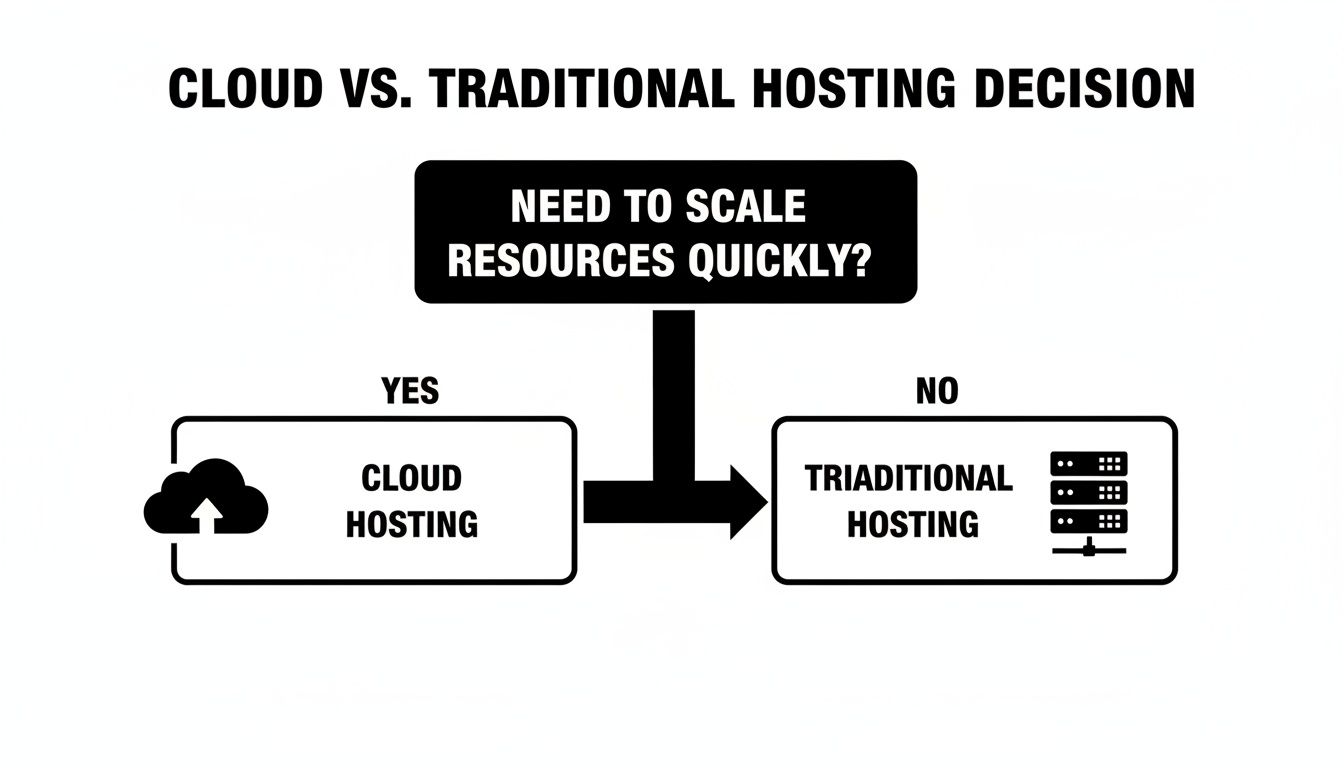
As you can see, if you need the ability to scale on demand, the cloud is the way to go. So, let’s unpack what your options look like once you're on that path.
Public Cloud: The Flexible Co-Working Space
Think of the public cloud as your startup's co-working space. You're renting resources from a massive provider like Amazon Web Services (AWS) or DigitalOcean, sharing the overall infrastructure with other companies, or "tenants."
This is the go-to model for most startups, and for good reason. You get instant access to world-class computing power without having to buy a single server. It’s incredibly cost-effective because you only pay for what you use, just like renting a desk instead of an entire building. This pay-as-you-go model is a lifesaver for early-stage companies trying to stay lean. The trade-off? You don't own the building, so you have less control over the deep-level infrastructure and you're in a shared environment.
Private Cloud: The Custom-Built Headquarters
The private cloud, on the other hand, is like building your own custom headquarters. The entire infrastructure is dedicated solely to your startup. This gives you unparalleled control over the hardware, the software, and every layer of security.
This model is a must for startups in heavily regulated industries like fintech or healthcare, where strict data privacy and compliance rules are non-negotiable. While it delivers top-tier security and customization, the price tag is significantly higher. You’re on the hook for buying, managing, and maintaining everything, which demands serious capital and a skilled in-house team.
The key is aligning your cloud model with your business goals. A public cloud prioritizes speed and cost-efficiency for rapid market entry, while a private cloud prioritizes control and security for sensitive operations.
Hybrid Cloud: The Best of Both Worlds
So what if you need the iron-clad security of a private HQ but also the cost-saving flexibility of a shared space? That’s where the hybrid cloud comes in. This model blends public and private clouds, letting you run your most sensitive workloads on a private server while using the more affordable public cloud for everything else.
A hybrid approach offers a fantastic balance of power and practicality, but it’s not without its challenges—managing two distinct environments can get complicated fast. This is where having an experienced partner like Dr3amsystems makes all the difference. We help you map out a strategy that connects your tech choices directly to business value, ensuring your cloud setup truly supports your ambitions. Our Dr3am Cloud practice can provide the enterprise-grade expertise needed to build a hybrid solution that's both secure and smart with your budget.
To explore this further, take a look at our guide on how to choose a cloud provider for a deeper dive into the selection criteria.
Mastering Cloud Costs And Security
For any startup, two things are absolutely critical: managing your cash flow and earning your customers' trust. When you move to the cloud, those priorities don't change—they just take on a new form. This is where mastering your cloud costs and locking down your security becomes non-negotiable.

The cloud's pay-as-you-go model is a game-changer for startups, freeing you from buying expensive hardware upfront. But that same flexibility can bite you if you're not paying attention. The goal isn't just to spend money; it's to actively manage and optimize every dollar.
Practical Cloud Cost Optimization
Keeping your cloud bill under control isn't about complex financial acrobatics. It's about building good habits and using the right tools. Think of it like tuning a high-performance engine—small, consistent tweaks can lead to massive gains in efficiency and huge long-term savings.
Here are a few a no-nonsense strategies you can implement right away:
- Right-Size Your Instances: Are you paying for a V8 engine when a four-cylinder gets the job done? Dig into your performance data and shrink any oversized virtual machines to fit what you actually need.
- Set Up Budget Alerts: This is your early warning system. All the major cloud providers let you create billing alarms that ping you when you hit certain spending thresholds. It’s the simplest way to prevent month-end bill shock.
- Leverage Reserved Instances: Got a workload that’s predictable and here to stay? Committing to a one- or three-year plan for reserved instances can slash your costs by up to 75% compared to on-demand prices.
- Automate Shutdowns: Don't let your dev and test environments run up the bill after everyone's gone home. Automate them to shut down overnight and on weekends. Paying for idle machines is just throwing money away.
We're seeing this play out across the industry. Small and mid-sized businesses are expected to dedicate over half their tech budgets to the cloud by 2025. It's the pay-as-you-go model that makes this possible, which is why the SME cloud market is projected to have the highest growth rate all the way through 2034.
The Cloud Cost Optimization Checklist For Startups
To make this even more concrete, here’s an actionable checklist. Use this to systematically review your cloud environment and find opportunities to cut costs without hurting performance.
| Strategy | Description | Impact on ROI |
|---|---|---|
| Instance Rightsizing | Continuously analyze CPU and RAM usage to select the most cost-effective instance type for each workload. | High: Directly reduces monthly operational expenses (OpEx) and improves resource efficiency. |
| Storage Tiering | Move infrequently accessed data from high-performance (and expensive) storage to cheaper, archival tiers. | Medium: Lowers data storage costs over time, especially as data volume grows. |
| Spot Instances | Use heavily discounted, spare compute capacity for fault-tolerant workloads like batch processing or CI/CD jobs. | High: Can cut compute costs by up to 90% for non-critical, interruptible tasks. |
| Tagging & Accountability | Implement a consistent tagging policy to attribute costs to specific projects, teams, or features. | Medium: Creates visibility and accountability, encouraging teams to be more cost-conscious. |
| Waste Cleanup | Regularly identify and delete unused resources like unattached EBS volumes, old snapshots, and idle load balancers. | High: Eliminates "zombie" assets that contribute to billing without providing any value. |
Running through this checklist quarterly can have a surprisingly big impact on your bottom line, freeing up capital that can be reinvested into growing your business.
Demystifying The Shared Responsibility Model
Now, for security. A huge mistake startups make is assuming the cloud provider handles everything. That's not how it works. The relationship is a partnership defined by the shared responsibility model.
Here’s the simple version: The provider is responsible for the security of the cloud—think physical data centers, the hardware, and the core network. You, on the other hand, are responsible for security in the cloud.
That means you're on the hook for securing your own data, configuring firewalls, managing who has access, and keeping your software patched. A simple misconfiguration on your part can open a massive security hole, even on the world's most secure infrastructure.
For startups moving at a breakneck pace, vulnerabilities often creep in during rushed deployments or because the team lacks deep security expertise. This is where being proactive is your best defense. Security isn't just an IT expense; it's a direct investment in your brand's reputation and your customers' trust. A single data breach can be a company-killer.
This is exactly why having a technology partner in your corner is so powerful. At Dr3amsystems, our Dr3am Security practice doesn't treat security as an afterthought—we build it into your cloud foundation from day one. We use AI-driven tools to find and shut down threats before they become problems, giving you a tough security posture that doesn't break the bank.
We believe secure cloud hosting for startups is the bedrock of confident growth. You can learn more about our complete cybersecurity solutions for businesses and see how we help protect what matters most.
Your Step-By-Step Cloud Migration Plan
Moving to the cloud isn't just about flipping a switch. Think of it as a strategic journey—when planned right, it’s a smooth road trip, not a blind leap of faith. For a startup, this is your chance to build a solid foundation for whatever comes next. The key is a clear, phased approach that keeps things running smoothly while setting you up for long-term wins.

We can break the whole process down into three manageable stages. Each step builds on the last, making sure your migration is a smart business decision, not just a technical shuffle. This roadmap helps you sidestep the common traps and get it right from the start.
Stage 1: Pre-Migration Planning and Assessment
Before you move a single byte of data, you need to know exactly what you're moving and why. This initial planning phase is, without a doubt, the most critical part of the entire project. Rushing this stage is the number one reason cloud projects blow their budgets or fail to deliver on their promises.
First up, you need to conduct a thorough audit of your current applications and infrastructure. What are you running? Which systems are mission-critical? This inventory gives you a clear map of all the moving parts, dependencies, and potential bumps in the road.
Next, you have to get crystal clear on your goals. Are you migrating to:
- Slash operational costs?
- Boost scalability and performance?
- Strengthen your security?
- Give your development team more agility?
Having clear, measurable objectives turns your migration from a vague idea into a focused project with a clear destination. This clarity is precisely what a partner like Dr3amsystems establishes during a free consultation, ensuring your technology roadmap aligns perfectly with your business value.
Stage 2: Choosing Your Migration Strategy
With your goals locked in, it’s time to decide how you'll actually get your applications into the cloud. There are a handful of proven strategies, but two really stand out for startups looking for efficient cloud hosting for startups.
Lift-and-Shift (Rehosting): This is the simplest path forward. You’re essentially copying and pasting your current servers and apps into the cloud with very few tweaks. It’s fast and low-risk, perfect for getting to the cloud quickly. The trade-off? You won't be taking full advantage of all the cool cloud-native features right away.
Re-platforming: Think of this as the middle ground. You move your applications but make a few smart adjustments to leverage cloud services, like swapping out your old database for a managed one. This approach delivers more benefits than a simple lift-and-shift without the headache of a complete rewrite.
If you want to dig deeper into these methods, you might find our guide on cloud migration best practices helpful—it explores these options in much more detail.
Stage 3: Post-Migration Optimization
Getting your applications running in the cloud isn't the finish line. In many ways, it's just the beginning. This final stage is all about continuous monitoring, optimization, and security tuning to make sure you're squeezing every bit of value from your new setup.
Right after the move, your focus should be squarely on performance. Are your apps running as expected? Any bottlenecks? This is also the time to triple-check your security configurations—firewalls, access controls, and data encryption all need to be buttoned up tight.
At Dr3amsystems, we live and breathe this ongoing optimization. We specialize in delivering secure, zero-downtime transitions and then stick around to manage the infrastructure, keeping it cost-effective and rock-solid. A successful migration isn't just about moving data; it's about building a resilient, scalable, and secure platform that empowers your startup to grow with confidence.
Scaling Your Infrastructure For Rapid Growth
Once your startup is comfortably settled in the cloud, the real excitement begins: scaling. Building an infrastructure that not only runs but is also primed for rapid growth is what separates the startups that thrive from those that buckle under pressure. It's all about creating a system that can handle success when it arrives—often when you least expect it.
Think of your cloud infrastructure like a smart, modern restaurant. On a slow Tuesday, it runs with a lean staff and just a few tables. But on a packed Friday night, it instantly expands by adding more cooks, servers, and tables to handle the rush without missing a beat. This is the essence of a scalable cloud architecture.

This dynamic capability is built on a few core concepts every founder should get to know. These are the tools that let your infrastructure absorb sudden traffic spikes, ensuring your application stays fast, responsive, and available for every single user.
Key Concepts For Building A Resilient System
To design a system that scales gracefully, you need to think beyond just throwing bigger servers at the problem. Modern cloud hosting for startups depends on intelligent automation and distributed systems to build in resilience and efficiency from the ground up.
- Auto-Scaling: This is your restaurant automatically adding more tables and staff as the dinner rush hits. Auto-scaling groups monitor your application's load and add or remove server instances based on real-time demand. This ensures you always have just enough power to handle the traffic without overpaying for idle resources.
- Load Balancing: The load balancer is the restaurant’s expert host, seamlessly guiding incoming diners to available tables. It distributes incoming traffic across multiple servers, preventing any single one from getting overwhelmed and ensuring a smooth experience for everyone.
- Containerization (Docker & Kubernetes): Think of containers as pre-packaged meal kits. Docker wraps up your application and all its dependencies into a neat, portable container. Then, Kubernetes acts as the master chef orchestrating thousands of these kits, deciding exactly where and when to deploy them for maximum efficiency.
Architecting for scale isn't just about surviving a traffic spike; it's about building a fault-tolerant system where the failure of one component doesn't bring down the entire application. This resilience is the bedrock of customer trust.
From Architecture To Hands-On Execution
Understanding these concepts is one thing, but putting them into practice is a completely different ballgame. A poorly configured auto-scaling rule can send costs spiraling out of control, while a mismanaged Kubernetes cluster can quickly turn into a complex nightmare. This is often where the gap between theory and successful execution appears for busy startup teams.
The operational complexity is precisely why partnering with an expert team is so valuable. At Dr3amsystems, our Dr3am IT and dedicated managed support services provide the hands-on expertise you need to architect, implement, and maintain a truly scalable infrastructure. We take on the day-to-day operational burdens, from proactive monitoring to performance tuning, so your critical systems always run smoothly.
Our goal is simple: manage the technical complexities so you don't have to. With our team keeping your infrastructure reliable and cost-efficient, your engineers are free to focus on what they do best—building a great product and driving innovation. This collaboration turns your cloud from a simple hosting solution into a powerful, automated engine for sustainable growth.
How Managed Services Put You in the Fast Lane
Getting the most out of the cloud isn't just about renting some server space. World-class cloud hosting for startups is a continuous cycle of fine-tuning performance, staying ahead of security threats, and getting strategic advice that actually grows your business. When you switch from a DIY approach to working with an expert, the cloud stops being just another utility bill and becomes your biggest growth engine.
This is where managed services completely change the game. Instead of scrambling to fix problems after they’ve already happened, a dedicated partner is watching over your systems 24/7 and performing proactive maintenance. It’s all about staying ahead of trouble, making sure your infrastructure is always running at its absolute best.
More Than Just Keeping the Lights On
A real technology partner does a lot more than just manage servers. They bring strategic value to the table, making sure your cloud setup is perfectly aligned with what you're trying to achieve as a business. Think of them as an extension of your own team, bringing the kind of enterprise-level expertise that’s usually way too expensive for a startup to hire full-time.
This frees up your own people to do what they do best: building a great product and innovating, not getting stuck in the weeds of complex infrastructure.
This kind of partnership is all about delivering results you can actually measure. At Dr3amsystems, for instance, we’ve helped clients slash their data processing times by 60% and pull off tricky zero-downtime transitions. These aren’t just technical wins; they create a real competitive edge and give your customers a much better experience. We offer complete guidance—from initial strategy to hands-on implementation and ongoing improvements—through our specialized Dr3am Cloud, Dr3am IT, and Dr3am Security practices.
A managed service provider turns your cloud investment into a predictable, high-ROI asset. It’s the difference between merely running on the cloud and actively succeeding with it.
The Real-World Benefits of a Partnership
Choosing a managed services partner like Dr3amsystems gives you a whole toolkit of capabilities designed to help you succeed faster. In every project, we focus on reliability, cost efficiency, and ROI to make sure your technology is a solid foundation for sustainable growth.
Here’s what that looks like in practice:
- Proactive Security: We actively hunt for and neutralize threats before they can cause damage, keeping your business-critical data locked down and safe.
- Cost Optimization: Our team constantly reviews how you’re using the cloud to find ways to save money and cut out wasteful spending, so you get more bang for your buck.
- Hands-On Execution: We don't just give advice; we roll up our sleeves and do the work needed to keep your critical systems running without a hitch while pushing for constant improvement.
We always start with a free consultation to get clear on your goals, find opportunities for automation, and build a roadmap that ties every technical decision directly to business value. By working with expert managed IT support services, your startup can scale with confidence, responsibly adopt AI, and build a long-term technology strategy that sets you up for success.
Frequently Asked Questions
When you're wading into the world of cloud hosting, a lot of practical questions pop up. Let's tackle some of the most common ones we hear from founders.
How Much Should a Startup Budget for Cloud Hosting?
There's no magic number here—it all boils down to what you actually use. That said, a lean startup can usually get off the ground with a budget somewhere between $50 and $300 per month using a major public cloud.
The trick is to start small and watch your spending like a hawk. Set up budget alerts on day one, and make a habit of reviewing your resource usage. This keeps you from overprovisioning and paying for power you don't need.
Can We Switch Cloud Providers Later?
Absolutely. But moving from one cloud to another isn't something you do on a whim. It takes serious planning to pull off without causing downtime or losing data.
This is exactly why smart startups avoid vendor lock-in from the very beginning. By building your applications with open-source tools and container technologies like Docker and Kubernetes, you build in portability. Your app isn't tied to one provider's proprietary services.
The best cloud strategy is one that doesn’t trap you. Building with portability in mind from the start gives you the freedom to choose the best services and pricing as you grow.
This is where having a partner like Dr3amsystems can make a huge difference. We live and breathe multi-cloud strategies and know how to execute migrations without a second of downtime, keeping your infrastructure agile as your business grows.
What Is the Biggest Mistake Startups Make with Cloud Hosting?
Easy. Neglecting cost management. It's incredibly simple to spin up new resources in the cloud, and founders often get caught up in the excitement. They forget to turn things off, and then get hit with a massive "bill shock" at the end of the month.
Another classic pitfall is misunderstanding the shared responsibility model for security. Too many founders assume the cloud provider handles everything, but that's not the case. You are responsible for securing your application and data in the cloud, and misconfigurations can leave you wide open to attack.
Ready to build a cloud foundation that’s scalable, secure, and won’t break the bank? The experts at Dr3amsystems are here to help. We offer everything from initial strategy and secure cloud migrations to AI-driven optimization and dedicated managed support.
Schedule your free consultation today and let’s build a roadmap that ties your technology directly to your business goals.