
A release goes live on Thursday. By Friday morning, support has a queue, sales is escalating a demo failure, and engineering is debating rollback versus hotfix. Nobody is arguing about whether testing matters. The argument is about why quality still depends on heroics.
That’s the moment most CTOs start looking seriously at automation qa services.
Not because they want more scripts. Because they want fewer release surprises, tighter feedback loops, and a delivery system that doesn’t collapse every time the team ships faster. Good QA automation doesn’t sit on the side of delivery. It becomes part of delivery.
The leaders who get the most from automation treat it as an operating model decision. They tie test coverage to CI/CD, align automation with risk, and measure quality in business terms. That means release confidence, lower rework, fewer production incidents, and less wasted engineering time.
Beyond Bug Hunting The Strategic Role of QA Automation
The old view of QA was simple. Test near the end, find bugs, delay the release if things look bad.
That model fails in modern delivery. Teams push code continuously, systems depend on APIs and cloud services, and a defect can move from one microservice to another before a manual test cycle even starts.

Why leadership teams are changing course
By 2025, 75% of over 500 surveyed DevOps teams were using automated testing, and nearly half had fully integrated it into CI/CD pipelines. At the same time, 55% cited insufficient time for thorough testing and 44% cited high workloads, which is exactly why many organizations turn to strategic partners instead of trying to brute-force the problem internally (Katalon’s 2025 test automation statistics).
That combination matters.
Automation is no longer a nice-to-have for engineering maturity. It’s how teams keep pace without letting quality drift. If your developers ship daily but your QA process still behaves like a gated monthly release function, you’ve built a delivery bottleneck into your architecture.
What modern automation qa services should actually do
A serious QA automation program should support three executive goals:
- Increase release velocity by moving repeatable tests into the pipeline.
- Reduce operational risk by catching regressions before they hit customers.
- Improve planning accuracy because teams can trust the signal from their test suites.
Quality has to move left into design and code review, and right into production feedback. If it only appears at the end, it’s already too late.
That’s why the best automation qa services don’t just hand you Selenium scripts and walk away. They shape test strategy, integrate with delivery workflows, and align coverage with business-critical risk.
If your organization is still deciding where QA automation fits in the broader technology agenda, a structured architecture review helps. This is the kind of problem that belongs inside wider technology strategy consulting, not in a disconnected tool purchase.
The Tangible Business Case for Automation QA Services
Most internal pitches for QA automation fail for one reason. They focus on tools, not economics.
Your CFO doesn’t care whether your team prefers Cypress, Playwright, Selenium, or Postman. Your board cares whether delivery gets faster, incidents go down, and engineering time shifts from maintenance to product progress.
The hidden cost isn't testing. It's unstable testing.
Traditional automation often underperforms because teams underestimate maintenance. QA engineers spend 30-40% of their time on upkeep rather than innovation, and release cycles can slow by up to 40% when frameworks break under UI changes (analysis of the autonomous testing shift).
That’s the cost many CTOs miss.
They approve an internal automation initiative, get a burst of early progress, then watch the suite decay. Tests become flaky. UI changes break selectors. People stop trusting failures. Eventually the team keeps the dashboard for appearances and returns to manual verification before every release.
That is not automation. That is technical debt with a reporting layer.
The business case you should present
Think about QA automation like replacing a manual inspection line with an instrumented production line. The gain isn’t just labor reduction. It’s consistency, throughput, and better control of failure points.
A practical business case usually rests on four outcomes:
| Business outcome | What changes with strong automation qa services |
|---|---|
| Faster delivery | Teams validate changes inside the pipeline instead of waiting for late-stage test windows |
| Lower operating cost | Engineers spend less time on repetitive checks and bug rework |
| Better customer experience | Fewer escaped defects reach production and support teams |
| Stronger engineering morale | Developers get fast feedback and spend more time building, less time firefighting |
If you need help framing the financial and operational rationale, this template for building a compelling business case is useful because it forces the conversation toward costs, benefits, assumptions, and decision criteria instead of tool enthusiasm.
Where ROI becomes real
The return from automation doesn’t come from coverage alone. It comes from maintaining coverage without creating a parallel maintenance problem.
That’s why implementation quality matters more than pilot success. A weak internal framework can look good in month one and become a drag by month six. A disciplined service-led approach can avoid that trap by standardizing framework design, maintenance rules, and ownership from the start.
Practical rule: Never approve an automation initiative without a maintenance model. If nobody owns flaky tests, unstable environments, and selector strategy, your ROI evaporates.
This is also where broader operations automation matters. QA shouldn’t be isolated from workflow redesign, process orchestration, and platform modernization. Organizations that already think in terms of how to automate business processes usually make better QA decisions because they evaluate quality as part of end-to-end execution, not as a standalone testing project.
Choosing Your Service Model In-House Outsourced or Hybrid
The wrong delivery model will sink a good QA strategy.
I’ve seen teams buy the right tools, hire smart people, and still stall because they chose a structure that didn’t match their maturity. Some organizations need total internal control. Others need a partner to move fast. Most mid-market firms land somewhere in between.
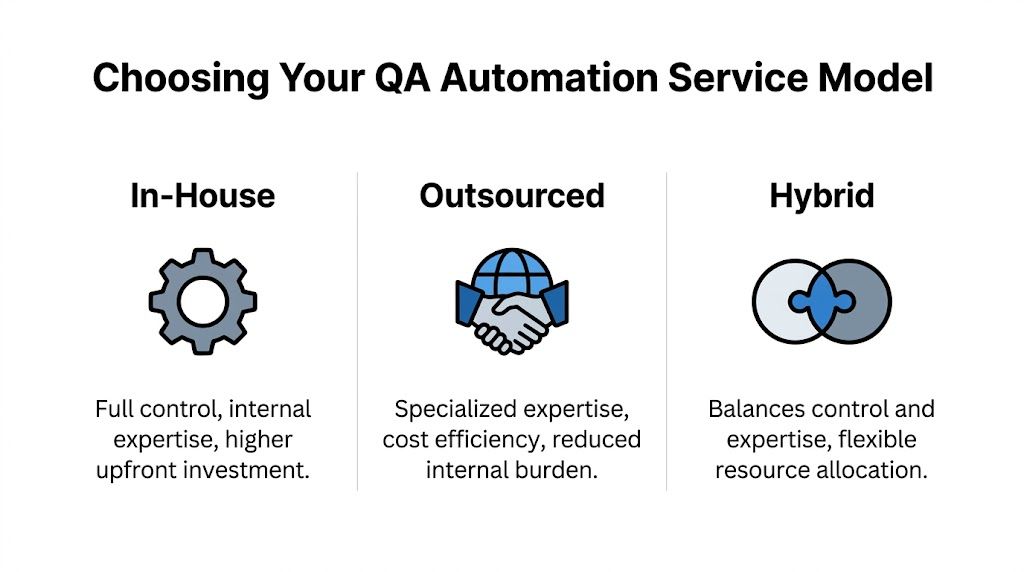
In-house gives control but adds overhead
An internal QA automation team makes sense when you already have mature engineering management, stable platform ownership, and the ability to retain specialized talent.
You control standards. You control priorities. You can align automation closely with architecture and release processes.
You also inherit every staffing and capability problem.
Internal teams need framework architects, SDETs or automation engineers, pipeline expertise, test data management, and enough senior oversight to prevent a pile of brittle tests. If your engineering managers are already stretched, this model can become expensive in attention even before it becomes expensive in payroll.
Best fit:
- High-regulation environments where test governance must stay close to internal controls
- Large product organizations with enough scale to justify dedicated QA platform ownership
- Teams with existing automation maturity that need to deepen, not start, the function
Fully outsourced moves fastest when you're behind
If your QA process is heavily manual, your release cadence is slowing, or your team lacks specialized automation skills, outsourcing is often the fastest path to results.
A capable partner brings tested delivery patterns, framework expertise, and operational discipline. That shortens the time between “we need automation” and “we have automation that the delivery team trusts.”
The tradeoff is integration. External teams can struggle if your internal stakeholders aren’t decisive, your environments are chaotic, or product knowledge sits in silos. Outsourcing works best when internal leadership still owns priorities and acceptance criteria.
Best fit:
- Organizations under immediate release pressure
- Lean internal teams that can’t justify a full QA automation buildout
- Companies modernizing legacy platforms while trying to keep delivery stable
Hybrid is usually the most sensible model
For most CTOs, hybrid is the strongest option.
You keep product context, architecture knowledge, and governance in-house. A partner accelerates framework design, pipeline integration, specialized testing, and scaling. Internal staff learn while the partner delivers.
That matters because automation is both a capability and a change-management exercise. Hybrid avoids the worst of both extremes. You don’t overload your internal team, and you don’t outsource so much context that quality becomes detached from engineering reality.
QA Automation Service Model Comparison
| Criteria | In-House Team | Fully Outsourced | Hybrid Model |
|---|---|---|---|
| Cost structure | Higher fixed investment | More variable, service-based | Balanced mix of fixed and variable |
| Speed to start | Slower | Faster | Fast with internal alignment |
| Control | Highest | Lower day-to-day control | High strategic control |
| Access to niche skills | Depends on hiring | Strong if partner is mature | Strongest overall mix |
| Scalability | Limited by headcount | Easier to scale through partner | Flexible scaling by workstream |
| Knowledge retention | Strong internally | Risk if transfer is weak | Better long-term transfer |
| Best use case | Mature engineering orgs | Teams needing rapid lift | Most mid-market and enterprise teams |
If your team doesn’t yet know how to govern AI-assisted testing, manage flaky suites, or embed automation into release workflows, don’t force an in-house purity model. Buy expertise and keep governance.
If you’re evaluating external support, compare providers that can work as either a full delivery team or an embedded extension of your staff. That flexibility matters more than vendor size alone. A good starting point is understanding how experienced firms structure IT outsourcing companies around delivery ownership, reporting, and shared accountability.
Core Components of a Modern QA Automation Service
A lot of buyers ask for automation qa services as if they’re purchasing one thing.
They aren’t.
They’re buying a system made up of architecture, tooling, process integration, data control, and specialized validation across the parts of the stack that create business risk.

Framework engineering comes first
If the framework is weak, everything built on top of it becomes expensive.
A modern service should define:
- Test architecture for UI, API, regression, and non-functional checks
- Execution rules for local, staging, and pipeline runs
- Reporting standards so failures are actionable
- Maintenance conventions for selectors, fixtures, and reusable components
Teams choose tools; however, tools are secondary to architecture. Selenium, Cypress, Playwright, Postman, Katalon, and Tricentis all have valid uses. The question isn’t which brand wins. The question is which stack fits your application environment, team skill level, and release model.
For example, API-heavy platforms often get more value from strong service-level automation earlier than from complex UI suites. That’s especially true when user interfaces change frequently but core business logic lives in backend contracts. If your team needs a clearer view of this layer, understanding what API testing is helps anchor the discussion in system reliability, not just frontend behavior.
CI/CD integration is not optional
A standalone automation suite is a reporting artifact. An integrated suite is an operating control.
Enterprise-grade QA automation benefits from the pipeline. Best practices require embedded QA engineering teams and test management platforms that automatically send results into existing workflows, keep tests updated with each code change, and support continuous quality improvement (Leapwork on QA automation and CI/CD integration).
That has two immediate effects.
First, developers get fast feedback while context is still fresh. Second, release managers stop relying on manual coordination to understand whether a build is fit for promotion.
Test data and environment discipline decide trust
Many teams blame tools when the problem is data.
Tests fail because environments drift, permissions differ, integrations are unstable, or seed data doesn’t match expected business states. That’s why serious automation services include test data management and environment strategy, not just test scripting.
A useful service should define:
- Data provisioning rules for repeatable scenarios
- Masked or compliant datasets where regulated workflows matter
- Environment stability checks so teams separate app failures from infrastructure noise
Without this layer, your suite becomes noisy and leadership stops trusting the signal.
Here’s a useful walkthrough on the broader QA field before going deeper into service design:
AI changes test creation and prioritization
AI is most valuable in QA when it improves decision quality, not when it blindly generates more tests.
Leading providers now evaluate and prioritize what should be automated first, focusing on the most critical, repeatable, and time-consuming test cases. With AI-driven risk assessment, enterprises reduce redundant testing, accelerate time-to-market, and lower technical debt (RadView on intelligent QA test automation).
That’s the right use of intelligence in QA.
Not “generate everything.” Prioritize what matters.
A mature service uses AI for tasks such as:
- Test case suggestion from requirements, user stories, and change sets
- Risk-based prioritization for high-impact business flows
- Maintenance assistance when applications evolve
- Coverage analysis to spot gaps and duplication
Specialized testing protects the parts executives care about
Basic regression coverage isn’t enough for enterprise systems.
A complete service should also handle:
| Testing area | Why it matters to the business |
|---|---|
| Performance testing | Protects user experience and operational stability under load |
| Security testing | Reduces exposure in customer-facing and regulated workflows |
| API testing | Verifies the contracts most modern systems depend on |
| Compliance-oriented validation | Supports auditability and control in regulated sectors |
The strongest QA program isn’t the one with the most tests. It’s the one that tells leadership, with credible evidence, whether the riskiest parts of the business are safe to release.
Your Implementation Roadmap From Strategy to Scale
Most QA automation failures don’t come from bad intent. They come from trying to automate everything at once.
A better approach is staged, opinionated, and tied to business risk from day one.
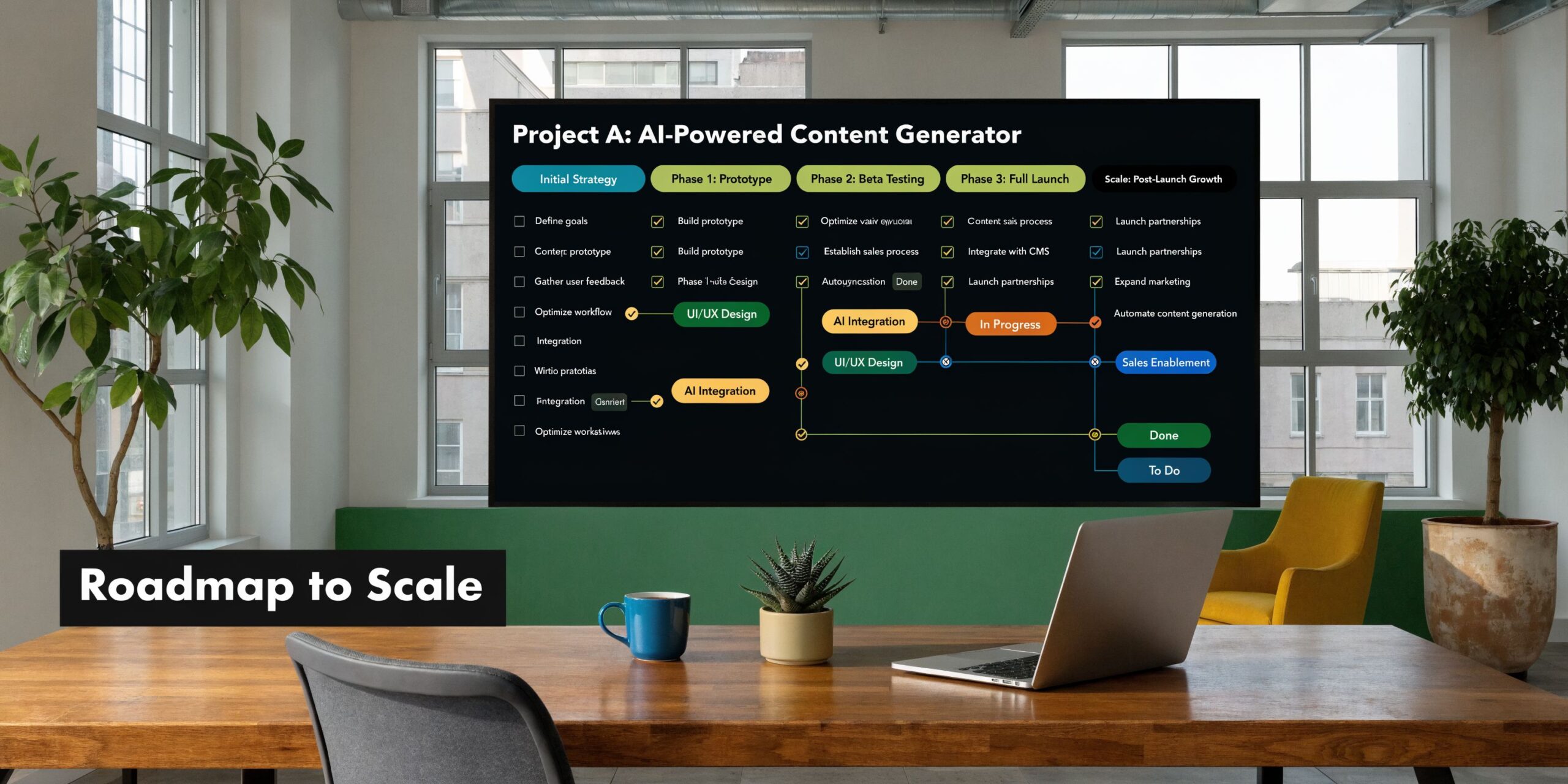
Phase 1 starts with risk, not tooling
Begin by mapping critical workflows, release pain points, defect patterns, and current delivery constraints.
You want to know where manual effort is highest, where bugs hurt the business most, and where automation can create quick confidence without creating a long maintenance tail.
This is also the moment to decide governance. Who owns test strategy. Who approves coverage. Who triages failures. Who maintains framework standards.
Phase 2 should prove value in one narrow lane
Pick a pilot that is repetitive, high-value, and operationally visible.
Good candidates include regression around billing, onboarding, transaction processing, core API workflows, or another business-critical path with frequent releases. Don’t start with the hardest UI in the company. Start where automation can prove reliability.
A solid pilot includes:
- A defined scope with clear pass-fail criteria
- Pipeline execution rather than ad hoc test runs
- Reporting that business and engineering leaders can both understand
- A maintenance plan before scaling begins
This is also where no-code or low-code options can help non-developer stakeholders participate in coverage design. For teams exploring that route, a no-code automation platform can be useful when paired with proper governance and technical oversight.
Phase 3 expands by value, not by volume
Once the pilot works, scale based on business impact.
Leading QA providers implement intelligent automation that evaluates which test cases deserve automation first, focusing on critical, repeatable, and time-consuming work. AI-driven risk assessment reduces redundant testing, speeds delivery, and lowers technical debt (RadView guidance appears earlier in this article’s source set and supports this approach).
The operating principle is simple. Don’t ask, “What else can we automate?” Ask, “What else should we automate next?”
That’s a very different portfolio decision.
Phase 4 turns automation into a managed capability
At scale, QA automation needs continuous optimization.
That means watching flaky tests, retiring low-value cases, refining data strategies, and using AI assistance carefully where it improves prioritization, maintenance, or generation quality. It also means treating the suite like a product with versioning, ownership, and service expectations.
A mature roadmap ends with these habits in place:
- Quarterly coverage review tied to product and architecture changes
- Failure trend analysis to separate app defects from automation defects
- Framework refactoring before debt accumulates
- Upskilling plans so QA staff can supervise AI-assisted workflows responsibly
Decision rule: Scale only after the team trusts the pilot results and understands the cost of maintaining what it has built.
Selecting the Right Partner A CTOs Checklist
Vendor selection for automation qa services should be brutal. Nice presentations don’t matter. Delivery maturity does.
You’re not hiring a testing shop to generate more activity. You’re choosing whether an external team can improve release confidence without creating another management burden.
Start with technical depth, not marketing language
Ask what frameworks they build, how they structure CI/CD integration, how they handle API-first systems, and how they reduce maintenance load over time.
If a provider talks mostly about “faster testing” and “improved quality” but can’t explain framework ownership, test data control, or failure triage, keep looking.
A credible partner should be comfortable discussing:
- UI versus API automation tradeoffs
- Regression strategy
- Performance and security test integration
- AI-assisted test generation governance
- Reporting into Jira, Azure DevOps, GitHub, or similar workflows
Demand domain understanding
Industry context matters more than generic QA expertise.
A partner working in finance, healthcare, or other controlled environments needs to understand compliance, release approvals, audit trails, and data sensitivity. A provider that has only tested consumer apps may struggle in operationally critical enterprise systems.
Discovery conversations provide significant insights. Strong partners ask about your business workflows, not just your tech stack.
Look for flexible engagement models
A rigid vendor model is usually a bad sign.
You want a partner who can operate as a delivery owner, an embedded team, or a hybrid extension depending on your internal maturity. That flexibility matters because QA capability needs often change after the first few quarters.
For example, some organizations need hands-on buildout early and governance support later. Others need specialized testing support on top of an existing internal framework.
Require operational transparency
If reporting is vague, outcomes will be vague.
A serious partner should provide dashboards, defect trends, release-readiness views, and clear ownership for issues. You should know which failures come from the application, which come from environment instability, and which come from the automation suite itself.
Ask to see examples of:
| Evaluation area | What a strong partner should show |
|---|---|
| Reporting | Clear, role-based dashboards and failure categorization |
| Governance | Named ownership for maintenance, triage, and change control |
| Communication | Regular cadences with engineering and leadership stakeholders |
| Risk handling | Escalation paths for blocked environments and unstable suites |
Verify results and adjacent capabilities
QA doesn’t live alone in enterprise delivery. It touches cloud, infrastructure, security, AI, data, and managed operations.
That’s why broader capability matters. Partners with strength across implementation and operations can support testing in the context of migration, modernization, security hardening, and platform scaling.
Dr3amsystems stands out here because the company combines AI-driven solutions, secure cloud migrations, and managed support across Dr3am IT, Dr3am Cloud, Dr3am AI, Dr3am Security, Dr3am Hosting, and Dr3am Marketing. That range matters when QA automation has to fit inside wider transformation work, not sit beside it. The company also highlights measurable results such as 60% reductions in processing time and zero-downtime transitions, which is the kind of operational outcome CTOs should look for in any implementation partner.
A QA vendor can write tests. A real partner helps you release with confidence, modernize safely, and keep the operating model stable after go-live.
Frequently Asked Questions about Automation QA
How should we upskill our QA team for AI-driven testing
Start with role redesign, not training catalogs.
Teams need stronger foundations in programming logic, data literacy, system thinking, model evaluation, and prompt engineering. 72% of teams integrate QA into CI/CD, while 45% plan expansions without clear guidance on essential new skills like AI model evaluation and prompt engineering (Testrig Technologies on AI and automation in quality engineering).testrigtechnologies.com/software-qa-trends-how-ai-and-automation-are-transforming-quality-engineering/)).
Use a simple sequence:
- Build baseline skills in scripting, APIs, and pipeline concepts
- Train leads first on AI oversight and validation practices
- Set review rules so AI-generated tests are checked for business relevance
- Tie learning to active projects instead of abstract coursework
Can automation QA work on legacy systems
Yes, but not with a copy-paste modern web strategy.
Legacy platforms often need API-level validation, database checks, process-level test orchestration, and selective UI automation around the most stable workflows. The mistake is trying to automate every old screen exactly as it exists today.
For legacy environments, prioritize repeatable high-risk processes, wrap them with stable regression coverage, and avoid fragile automation on interfaces that are likely to change during modernization.
What KPIs should we track to measure success
Keep the KPI set tight. Teams often over-report and under-learn.
Track a short list that maps directly to delivery and operating risk:
- Release readiness trend based on critical-path test pass rates
- Defect escape pattern to see what still reaches production
- Automation maintenance load so the suite doesn’t become its own cost center
- Execution speed inside CI/CD because feedback timing matters
- Coverage of business-critical workflows rather than raw test count
If you can’t explain each KPI in a leadership meeting, you have too many KPIs.
Should we automate everything we can
No.
Automate what is critical, repeatable, and expensive to validate manually. Leave exploratory work, volatile edge cases, and highly subjective user experience checks to people. Mature QA organizations don’t chase maximum automation. They chase the right automation mix.
If you’re evaluating automation QA as part of a broader modernization effort, Dr3amsystems is the kind of implementation partner worth talking to. The team brings AI-driven delivery, cloud expertise, security depth, managed support, and a pragmatic focus on ROI. A free consultation can help you identify the best starting point, whether you need a pilot, a hybrid operating model, or an end-to-end roadmap that improves quality without slowing the business.