
When we talk about SD-WAN security, we're not just talking about another layer of software. We're talking about a fundamental shift in how we protect our networks. It’s about weaving security functions directly into the network itself, moving away from clunky, hardware-centric models to a more agile, software-defined approach. This ensures every user and device gets consistent, robust protection, no matter where they are.
Why Traditional Network Security Is Failing
Think about how we used to build our networks. For decades, the "castle-and-moat" strategy was the gold standard. We built a strong, fortified perimeter around our central data center, assuming everything valuable was safely tucked inside. This worked just fine when your employees were in the office and your applications lived on-premise.
But that perimeter has dissolved. The reality for businesses in 2026 is that your people and your data are everywhere—in home offices, on mobile devices, and scattered across multiple cloud platforms. Trying to force all that traffic back through a central security checkpoint, a practice called traffic backhauling, just doesn't scale. It's like forcing a remote employee to drive to the main office just to log into a cloud app. It’s slow, frustrating, and a massive bottleneck.

The Shift Beyond the Perimeter
This is the exact problem SD-WAN security was designed to solve. Instead of an old fortress, picture a modern smart building with a sophisticated access card system. Security isn't just at the front gate anymore; it’s intelligent, distributed, and follows users wherever they need access.
SD-WAN architecture builds security right into the network fabric, giving you a far more flexible and effective way to defend your organization. Let's compare the old with the new to see what a difference this makes.
The table below gives a quick snapshot of how SD-WAN security fundamentally changes the game compared to legacy WAN setups.
Traditional WAN vs SD-WAN Security At a Glance
| Security Aspect | Traditional WAN | SD-WAN |
|---|---|---|
| Architecture | Centralized, perimeter-focused. Security hardware is typically located in the data center. | Distributed. Security is integrated at the branch, cloud, and endpoint, not just one location. |
| Policy Management | Siloed and complex. Each device (firewall, router) is configured separately. | Centralized and automated. A single console is used to push policies across the entire network. |
| Threat Visibility | Limited. It's difficult to see what's happening at branch offices or with remote users. | Comprehensive. Provides deep visibility into all traffic, regardless of its source or destination. |
| Traffic Handling | Inefficient. All traffic, including cloud-bound, is backhauled through the data center. | Optimized. Allows for secure, direct-to-cloud connections, avoiding unnecessary latency. |
| Agility | Slow to adapt. Adding new sites or changing policies can take weeks or months. | Highly agile. New security rules and sites can be deployed in minutes. |
As you can see, the difference isn't just technical—it's a complete change in philosophy. SD-WAN empowers IT teams to manage a distributed, modern workforce securely and efficiently.
This modern approach addresses the glaring weaknesses of traditional wide area networks (WANs) by:
- Unlocking Direct Internet Access (DIA): Branch offices and remote users can finally connect directly to cloud services like Salesforce or Microsoft 365 securely, without the performance hit of hair-pinning traffic through the data center.
- Centralizing Control: You get a single dashboard to create, manage, and enforce security rules across your entire network. No more inconsistencies or manual configuration errors.
- Boosting Application Performance: By intelligently steering traffic along the best possible path, SD-WAN ensures your critical apps are fast and responsive for a better user experience.
The objective has changed. We're no longer just trying to fortify a single location. The real goal now is to deliver secure, high-performance connectivity to the network edge, which is where business actually gets done.
Making this transition is about more than just technology; it requires a partner who understands the intersection of networking and security. At Dr3amsystems, we specialize in helping businesses build these secure, AI-driven network infrastructures. Through our Dr3am Security and Dr3am Cloud practices, we design and implement SD-WAN solutions that directly support your business objectives. Our process always starts with a free consultation to map out a strategy that prioritizes reliability, cost savings, and ROI, ensuring a zero-downtime journey to a more secure and resilient network.
Understanding the Modern Threat Landscape
To really nail down your security, you first have to know what you're up against. In the old days, our networks had a single, heavily guarded front door. But the game has changed. The distributed nature of SD-WAN means you now have dozens, or even hundreds, of potential entry points. This expanded attack surface is just the reality of doing business in a world of cloud apps and remote teams.
Think of it this way: your old corporate network was like a short, heavy chain kept inside a single vault—the data center. With SD-WAN, that chain now stretches out to every branch office, every remote employee's living room, and every cloud platform you rely on. All it takes is one weak link, maybe a poorly configured router at a small office, to put the entire chain at risk.
New Gateways, New Dangers
The biggest win with SD-WAN is Direct Internet Access (DIA), but it's also, without a doubt, its biggest security headache. When your branch offices can connect straight to the internet instead of routing everything back through headquarters, each one becomes its own little fortress to defend.
This creates some serious challenges:
- Inconsistent Security Rules: Trying to keep security policies perfectly aligned across every single location is a nightmare. A critical firewall update pushed at HQ can easily be missed at a remote site, leaving a gaping hole for attackers to waltz through.
- A Much Bigger Target: Every device with an internet connection—from an office printer to an IoT sensor on a factory floor—is another target. Attackers are actively and successfully targeting these edge devices to get their first foothold inside an organization.
- Smarter, Faster Threats: The threats themselves are constantly evolving. We're seeing the rising threat of infostealer malware, which is designed to quietly siphon off credentials and sensitive data before you even know it's there.
These aren't just hypotheticals. These are real, active campaigns happening right now. Without a solid SD-WAN security plan, the consequences can be devastating. You can find more on the latest attack vectors and defensive strategies in our Dr3am Insights.
Protecting a distributed network isn't about building higher walls; it's about building smarter fences. Your security has to be as agile and distributed as the network itself.
This is where having an experienced partner makes all the difference. At Dr3amsystems, our Dr3am Security practice focuses on getting ahead of threats, not just cleaning up after them. We design secure SD-WAN architectures from the ground up, ensuring your security policies are enforced consistently everywhere. We blend our enterprise expertise with intelligent security solutions to turn your network from a potential liability into a secure platform for your business.
Your Toolkit for Fortifying SD-WAN
Knowing the threats is one thing, but having the right tools to stop them is another entirely. Real SD-WAN security isn't about bolting on separate appliances after your network is built; it’s about weaving a multi-layered defense directly into the fabric of your WAN from day one.
Think of it as assembling your digital security toolkit. Each tool has a very specific job, and when they work in concert, they create a powerful barrier against attacks. Let’s open the box and look at the essential controls that form the backbone of any secure SD-WAN architecture.
Advanced Encryption
The first and most fundamental tool you'll pull out is advanced encryption. With data constantly zipping across public internet links between your offices, data centers, and cloud apps, it’s exposed and vulnerable. Encryption creates a secure, armored tunnel for that data, scrambling it into nonsense so that even if it's intercepted, it’s completely useless to an attacker.
Picture a remote employee working from a coffee shop. A bad actor on the same public Wi-Fi could try to sniff their traffic. But with strong end-to-end encryption, all they’ll capture is gibberish, making their man-in-the-middle attack a total failure.
Micro-segmentation
Next up is micro-segmentation. Imagine your entire network is a large ship. Older security models focused on building a strong hull around the whole vessel. The problem? One small breach, and the entire ship could flood. Micro-segmentation is like building watertight compartments throughout the ship.
By dividing the network into smaller, isolated zones, micro-segmentation contains the blast radius of an attack. A breach in one segment—like a compromised IoT device—cannot spread laterally to critical servers or financial databases.
This control is indispensable for containing threats. If malware infects a user's laptop in one segment, segmentation rules prevent it from jumping over to infect payroll systems or customer data stored in another. It’s a core principle we apply with our Dr3am Security services.
Next-Generation Firewalls
The market is clearly betting on this integrated approach. Projections show the SD-WAN security market exploding from USD 4.4 billion in 2025 to a massive USD 30.1 billion by 2035, with network firewalls leading the charge. This growth isn't surprising; it reflects the industry-wide move toward smarter, built-in security. You can get a closer look at this trend in this detailed report.
Next-Generation Firewalls (NGFWs) are the intelligent gatekeepers of your SD-WAN. They go far beyond old-school firewalls that just checked IP addresses and ports. NGFWs look at the actual content of your network traffic.
Here’s what they bring to the table:
- Application Awareness: They can identify and set policies based on the specific application being used, letting you block something like TikTok while always allowing Salesforce.
- Intrusion Prevention Systems (IPS): They actively scan for and block known attack signatures and malicious patterns as they happen.
- Deep Packet Inspection (DPI): They peer inside the data packets themselves to uncover hidden threats that a traditional firewall would completely miss.
Intrusion Detection and Prevention Systems (IDS/IPS)
Though often bundled into an NGFW, the IDS/IPS function is important enough to discuss on its own. Think of these as your 24/7 digital security guards, constantly patrolling the network perimeter and its internal pathways.
An IDS (Intrusion Detection System) spots suspicious activity and sounds the alarm. Its counterpart, the IPS (Intrusion Prevention System), takes the next logical step: it actively blocks the threat before it can do any harm. For instance, if an IPS recognizes a known ransomware signature in an incoming file, it won't just alert you—it will drop the connection immediately, stopping the attack dead in its tracks.
To make sure your SD-WAN is truly prepared for what's out there, running through a comprehensive security audit checklist is a great way to spot and fix vulnerabilities. At Dr3amsystems, we integrate these controls into a single, unified security architecture. We don't just deploy isolated tools; we build a cohesive, AI-driven defense where every component works together to deliver a stronger, more resilient network.
Uniting SASE and Zero Trust with SD-WAN
Once you have the core security functions of your SD-WAN in place, it's time to think bigger. We need to move beyond individual tools and start looking at overarching security frameworks that protect the entire organization. This is where two concepts, Secure Access Service Edge (SASE) and Zero Trust, come into play. When you weave them into your SD-WAN strategy, you create a much more intelligent, identity-focused security posture that's built for how we work today.
Think of SASE less as a single product and more as an architectural blueprint for modern network security. It’s a framework that merges your network (specifically SD-WAN) with a complete stack of cloud-delivered security services like secure web gateways (SWG), cloud access security brokers (CASB), and firewall-as-a-service (FWaaS). The whole point is to create a single, cohesive service that secures users and applications, no matter where they are.
The Rise of Identity-Driven Security
The industry is moving decisively in this direction. The global SD-WAN market alone is expected to jump from USD 7.87 billion in 2025 to a staggering USD 76.31 billion by 2034. The wider market for both SD-WAN and SASE is growing at a 21.9% CAGR. You can see a full breakdown of the numbers in this comprehensive market report.
This explosive growth is happening for a simple reason: connecting your network is only half the battle. Securing it is the other, more critical half.
This is precisely where the Zero Trust philosophy fits in. It’s a security model built on a beautifully simple premise: trust is a liability.
A Zero Trust framework operates on the principle of "never trust, always verify." It assumes that threats exist both outside and inside the network, so no user or device is trusted by default, regardless of its location.
Imagine a high-security office building. The front door requires a keycard, but so does the elevator to get to your floor. Then your office door needs another swipe, and maybe even the file cabinet inside requires a key. That’s Zero Trust in action. It's not about building a bigger wall around the perimeter; it's about placing checkpoints at every single access point inside.
Putting SASE and Zero Trust into Practice
So, what does this look like in the real world? When you apply a Zero Trust model over your SD-WAN fabric, every single connection request gets put under the microscope before it's allowed through. This approach is guided by three core principles:
- Always Verify Explicitly: Every access attempt must be authenticated and authorized. This isn't just about a username and password; it's about looking at all the signals—user identity, device health, location, and the specific service being requested.
- Enforce Least-Privilege Access: Users get the absolute minimum access required to do their job, and nothing more. If someone in marketing has no business touching engineering servers, they simply can't.
- Assume Breach: You operate as if a breach has already happened. This means you segment network access to contain threats, encrypt all traffic from end to end, and constantly monitor for suspicious activity. The goal is to shrink the "blast radius" if an attacker does get in.
Bringing these powerful concepts together is where having the right partner makes all the difference. At Dr3amsystems, our expertise is in designing and implementing these advanced SASE and Zero Trust architectures. We combine our Dr3am Security and Dr3am Cloud practices to build a formidable, identity-driven security posture for your business. Using our AI-driven solutions and managed support, we help organizations make the shift to a model that truly prioritizes reliability and ROI, ensuring you can confidently embrace a more secure and agile future.
Your SD-WAN Security Deployment Roadmap
Knowing the theory behind SD-WAN security is one thing; pulling off a successful deployment is another beast entirely. The real magic happens in the execution. A practical, well-planned roadmap is what turns your security strategy into a network that's not only secure but also performs exactly how your business needs it to.
Forget the risky "big bang" approach where you flip a switch and hope for the best. A smart migration is a deliberate, phased process. It ensures stability, lets you validate your new security rules, and keeps everyone from the C-suite to the branch office managers in the loop. This methodical approach is the secret to a smooth transition that doesn't disrupt the day-to-day flow of business.
Phase 1: Discovery and Assessment
You can't protect what you can't see. The first step is to get an incredibly detailed picture of your current environment—your network infrastructure, how your applications actually behave, and the security policies you have in place today. Think of it as an architect studying the existing foundation before designing a new building.
This initial audit is non-negotiable for a successful project. It means getting into the weeds:
- Mapping every single endpoint, from branch offices and data centers to your cloud instances.
- Analyzing application performance to set a clear "before" picture, which will be your baseline for success.
- Auditing all your current security controls, firewall rules, and access policies to see what’s working and what isn’t.
A thorough discovery phase eliminates ugly surprises later on. It’s also why we always begin with a free consultation—it allows us to get a handle on your goals, uncover these crucial details, and build a roadmap that makes sense for your specific business.
Phase 2: Policy Definition and Pilot Testing
Once you have your blueprint, it's time to write the new rules of the road. This is where you translate your business needs and security goals into concrete SD-WAN policies for traffic routing, access control, and threat prevention. This isn't just an IT task; you need to bring in stakeholders from across the company to make sure these new rules won't accidentally break a critical business process.
With policies defined, it's time to start small. A pilot test is your chance to see how your design works in the real world, but in a controlled, low-risk setting. This could mean rolling out the solution to a single, tech-savvy branch office or a specific team.
This trial run is invaluable. It lets you fine-tune configurations, squash any bugs, and collect actual performance data before you go all-in. More importantly, it proves the concept and builds the confidence you'll need from leadership for the wider rollout.
This process flow shows how a secure SD-WAN becomes the perfect launchpad for a full-blown SASE and Zero Trust architecture.
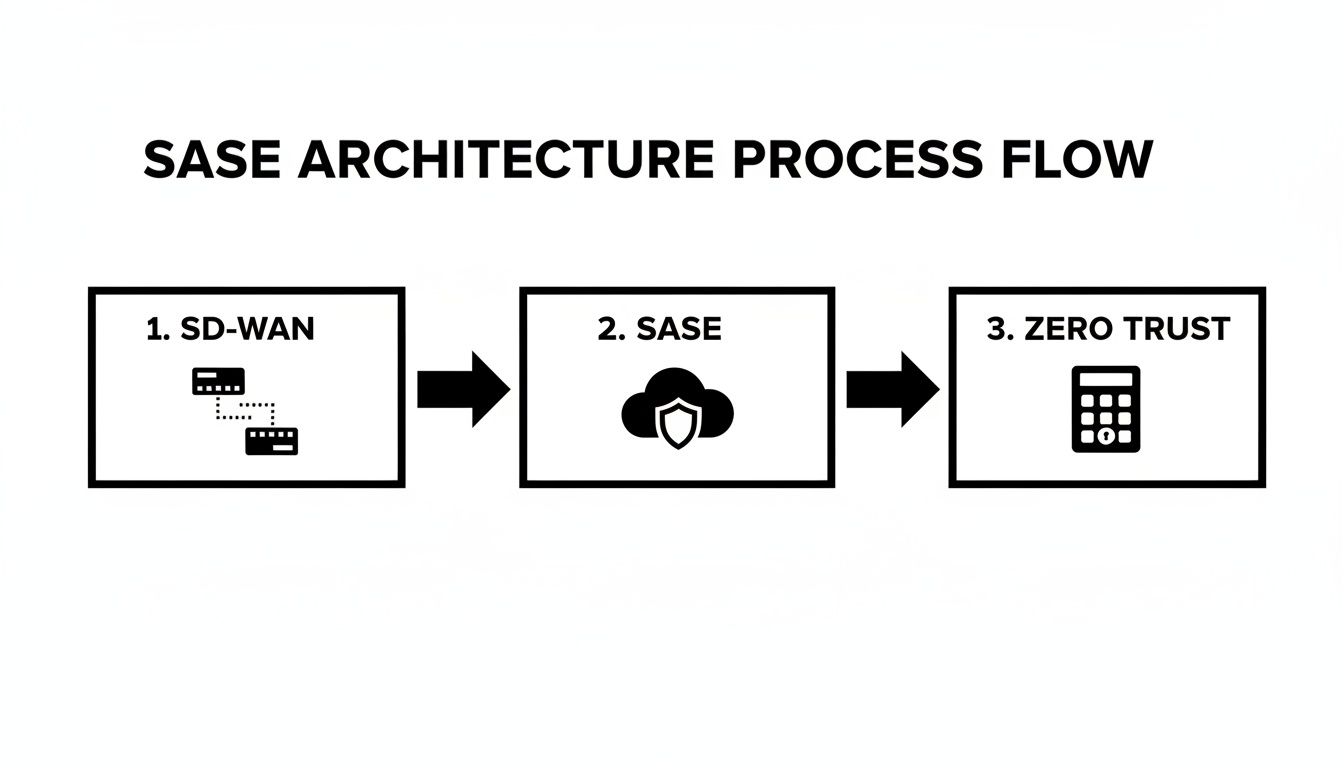
As you can see, SD-WAN isn't just a standalone project; it's the intelligent network fabric that makes more advanced, cloud-native security possible down the line.
To bring these phases together, here is a high-level checklist that outlines the critical tasks for a successful deployment.
SD-WAN Security Deployment Phase Checklist
| Phase | Key Tasks | Success Metric |
|---|---|---|
| Phase 1: Discovery | Map network topology. Audit existing security policies. Baseline application performance. Identify all user groups and access needs. | A comprehensive inventory of all network assets and a documented performance baseline are signed off. |
| Phase 2: Design & Pilot | Define new security and routing policies. Select a pilot site/user group. Configure and deploy pilot environment. | The pilot site operates successfully for 30 days with no major security incidents or performance degradation. |
| Phase 3: Rollout | Create a phased deployment schedule (by region, site type, etc.). Execute site-by-site migrations. Provide user training and support. | 95% of sites migrated on schedule with no P1/P2 tickets related to the transition. |
| Phase 4: Optimization | Monitor network and security telemetry. Fine-tune policies based on real-world data. Automate routine security tasks. Plan for future integrations. | A 20% reduction in security alerts and a 15% improvement in application latency are measured post-optimization. |
This checklist provides a structured framework, but remember that the key to success is adapting it to your organization's unique environment and challenges.
Phase 3: Phased Rollout and Optimization
With a successful pilot under your belt, you can confidently start the full rollout. Instead of that risky, all-at-once switch, you'll scale the deployment site by site, region by region. This approach lets your team manage the change, provide targeted support where it's needed, and solve any small issues before they become big problems.
Having a partner with a proven playbook is a game-changer here. The dedicated teams within our Dr3am IT practice have executed these complex migrations time and time again. We're laser-focused on delivering tangible outcomes, like zero-downtime transitions, because we provide both the expert strategy and the hands-on engineering to keep your business running without a hitch. Our job is to make sure your new SD-WAN is not just installed, but truly optimized for performance, cost, and long-term value.
Finding a Partner for the Long Haul
Getting your SD-WAN security up and running is one thing. Keeping it that way, day in and day out, is another challenge entirely. This isn't a project you just check off a list; it’s a constant effort to keep your organization resilient as threats evolve. The real value of your SD-WAN investment depends on having a partner who understands how to turn its powerful features into real-world business advantages.
That’s where a true technology partner becomes invaluable. The goal shouldn’t be to just buy hardware or a few software licenses. You need someone in your corner for the entire journey—from the initial whiteboard strategy session to implementation and the ongoing management that keeps you safe. A good partner helps you match your SD-WAN security framework to your actual business goals, making sure the whole system is reliable, affordable, and gives you a great return.
From Implementation to Optimization with Dr3amsystems
This is exactly the kind of strategic partnership we’ve built at Dr3amsystems. Our specialized teams—Dr3am Security, Dr3am Cloud, and Dr3am IT—don't operate in silos. They work together to give you a complete, cohesive solution. We know your network is the lifeblood of your company, and our job is to keep it secure, fast, and ready for whatever you have planned next.
Our clients get expert advice and practical, hands-on help to ensure their most important operations never skip a beat. We’re obsessed with delivering results you can actually see and measure, and our executive testimonials show we know how to handle complex projects without a hitch.
Our track record speaks for itself. We've delivered 60% reductions in processing time for clients and managed zero-downtime transitions during critical migrations. We focus on reliability and a clear ROI in everything we do.
This practical, results-driven mindset means we don’t just install technology and walk away. We build solutions that last. We give your organization the tools and confidence to embrace the cloud and strengthen your technology strategy for the future.
Your Custom Roadmap to a Secure Network
Every successful SD-WAN security project starts with a solid plan. That's why we kick off every engagement with a free consultation. In this meeting, our experts will sit down with you to:
- Clarify Your Goals: We start by understanding what you need to accomplish as a business, not just what technology you think you need.
- Find Automation Opportunities: We'll pinpoint where our AI-driven tools can help simplify your workflows and cut down on manual effort.
- Design a Custom Roadmap: We'll map out a clear, step-by-step plan that connects your technology needs to real business value, giving you a secure and cost-effective way forward.
Whether you're looking to update old systems, build out sophisticated data pipelines, or lock down your security, we have the enterprise-level experience to get it done right. And with our dedicated managed support, you can be confident your network will stay optimized, secure, and ready for the road ahead.
Ready to build a more resilient and secure network? Book your free consultation with Dr3amsystems today and let us design a roadmap that drives sustainable growth for your business.
Your Top Questions on SD-WAN Security, Answered
When we talk with IT leaders about SD-WAN, the same handful of questions always come up. Here are some straightforward answers to help you cut through the noise and understand what this technology means for your business's security.
What's the Real Difference Between SD-WAN Security and SASE?
This is a great question because the two are so closely related. The easiest way to think about it is that SD-WAN security is focused on the network itself—the "how" of data transport. It’s about building a smarter, more efficient highway for your traffic using encrypted tunnels, firewalls at the edge, and intelligent routing.
SASE (Secure Access Service Edge) is the next logical step. It takes that smart SD-WAN highway and merges it with a full stack of cloud-based security services. Think of it as adding advanced security checkpoints, threat scanning, and access control for every vehicle on that highway, no matter where it's coming from or going. SASE is a bigger architectural picture, with SD-WAN as a foundational element.
Can We Just Use Our Existing Routers and Firewalls for SD-WAN?
Technically, you might be able to. Some modern network hardware has basic SD-WAN features baked in. But in our experience, you’d be missing out on the core advantages.
A true SD-WAN solution relies on purpose-built edge devices that are centrally managed. This is what gives you that powerful, application-aware routing and deeply integrated security. Trying to bolt SD-WAN functionality onto older gear often leads to a clunky, hard-to-manage system that doesn't deliver the full performance or security benefits.
The goal is to align your infrastructure with your security goals. A partner-led assessment clarifies whether your existing hardware can support a robust SD WAN security posture or if an upgrade is needed for long-term ROI.
How Exactly Does SD-WAN Make Things More Secure for Remote Staff?
This is where SD-WAN really shines, especially now with so many people working from anywhere. In the past, remote workers had to use slow, clunky VPNs that routed all their traffic back to a central corporate data center. This is called "backhauling," and it creates huge bottlenecks and a poor user experience.
SD-WAN flips that model on its head. It can create a secure, direct path from the remote user straight to the cloud applications they need, bypassing the data center entirely. When you combine this with a Zero Trust security approach, every connection is verified before access is granted. This drastically shrinks your attack surface—a compromised laptop at a coffee shop can no longer easily pivot to your core network.
Have more questions about your own setup? You can find more in-depth answers on our comprehensive FAQ page.
Ready to see how this works in the real world? The team at Dr3amsystems can walk you through it. We use an AI-driven approach and dedicated managed support to help you modernize your network with a clear, confident plan. Book your free consultation with Dr3amsystems today and let's map out a strategy that connects your technology directly to your business goals.