
Think of your incident management process as the 911 call for your technology. It's the pre-planned, step-by-step playbook your team executes when an IT service unexpectedly goes down or its quality drops. This isn't just about scrambling to fix a bug; it's a core business process that safeguards revenue, protects customer trust, and keeps the lights on. A partner like Dr3amsystems helps businesses accelerate outcomes by designing and implementing these critical processes, ensuring reliability and cost efficiency from day one.
Why a Formal Incident Management Process Is Non-Negotiable
Years ago, a system outage was considered just an "IT problem." Today, it's a full-blown business crisis. When a critical app fails, sales can stop dead, customer support phones light up, and your brand's reputation takes a direct hit.
An incident management process is what moves your team from chaotic, reactive firefighting to a calm, coordinated response. It's about bringing order to the chaos.
This structured approach is about more than just speed—it’s about gaining control and predictability when things feel anything but predictable. Without a plan, teams burn precious minutes just trying to figure out who's in charge, what to do first, and who needs to be told what. A formal process gets rid of that guesswork. Partnering with a technology expert like Dr3amsystems ensures this process is built on a foundation of best practices, leveraging AI-driven solutions and managed support to keep critical operations running smoothly.
The Core Goals of Incident Management
When you strip it all down, a solid incident management process is built to achieve a few key things. Each objective supports the others, creating a powerful cycle of resilience and constant improvement.
Let’s break down the main objectives. This table gives a quick overview of what you're trying to accomplish and why it matters to the business.
Core Goals of Incident Management at a Glance
| Goal | Description | Business Impact |
|---|---|---|
| Restore Service Swiftly | The top priority is always getting the service back online for users as fast as humanly possible. | Minimizes direct revenue loss and stops customer frustration from escalating. |
| Minimize Business Disruption | The goal is to contain the damage—limiting financial hits, lost productivity, and brand reputation harm. | Protects profitability, maintains operational momentum, and safeguards customer loyalty. |
| Learn and Improve | Every incident is treated as a learning event to find the root cause and prevent it from ever happening again. | Builds a more robust and reliable system over time, reducing future incidents and their associated costs. |
Ultimately, a mature process doesn't just fix today's issue; it helps you prevent tomorrow's.
A great incident management process turns a crisis into a learning opportunity. It transforms reactive problem-solving into proactive resilience, ensuring that each disruption makes the organization stronger and better prepared for the future.
Distinguishing Incidents from Problems
It’s incredibly important to draw a clear line between an incident and a problem. They aren't the same thing, and confusing them leads to chaos.
An incident is the fire itself—the service is down, performance is sluggish, a security alert just fired. The entire focus is on putting out the fire and restoring service now.
A problem is what caused the fire. It’s the faulty wiring in the wall, the underlying bug in the code, or the misconfigured server that led to the incident. The focus here is on root cause analysis to find a permanent fix.
Think of it this way: the incident response team is the fire department, focused on immediate containment. The problem management team is the fire inspector, figuring out how to fireproof the building so it never happens again.
This separation is critical. It allows the incident team to focus entirely on restoration without getting bogged down, while a separate problem management effort can dig deep into the root cause. This dual-track approach is foundational to building long-term, stable systems.
For organizations looking to build this kind of operational muscle, partnering with experts can lay the right groundwork. Dr3amsystems specializes in designing these frameworks, backed by executive testimonials and a track record of delivering measurable results like 60% reductions in processing time. To see how this works in practice, learn more about our Dr3am IT managed support.
Walking Through the Incident Management Lifecycle
Every incident, no matter how big or small, has a natural life. It starts with a flicker of chaos and ends, hopefully, with restored calm. Getting a handle on this journey—the incident management lifecycle—is the first real step toward building a response that works. Think of it as a roadmap for your team, guiding them from the initial "uh-oh" moment to a final, stable resolution.
This isn't some rigid, bureaucratic checklist. It's a flexible framework that helps you make sense of the mess. By breaking a crisis down into manageable phases, you replace panic with a clear, methodical process, giving your team the confidence to move forward.
Phase 1: Detection and Logging
You can't fix a problem you don't know exists. The lifecycle officially kicks off with detection—the moment you become aware that something is wrong. This tip-off can come from anywhere.
- Automated Monitoring: An alert pops up from your observability platform. CPU usage is through the roof, or maybe error rates just breached a critical threshold.
- Customer Reports: The support line starts lighting up. A user can't log in, or the checkout process is broken. This is often the most painful way to find out.
- Internal Discovery: One of your own engineers, maybe while testing a new feature, discovers a core service isn't responding.
The second a problem is spotted, it needs to be logged in a central system, like your ITSM tool. This isn't just paperwork; it’s about creating a single source of truth. It captures the who, what, and when, and officially starts the clock for measuring how fast you respond.
Phase 2: Classification and Triage
Let's be honest: not all fires are the same size. A slow-loading internal dashboard is an annoyance; a complete e-commerce outage on Black Friday is a catastrophe. This is where classification and triage come in. It's the rapid-fire assessment of an incident's business impact and technical severity.
The point of triage isn't to solve the problem right then and there. It's about figuring out the blast radius. How bad is it? Who's affected? This helps you point your resources at the biggest fires first.
This quick decision-making process sets the tone for the entire response. A low-priority issue might get assigned to a single engineer to look at during business hours. But a high-priority, "all-hands-on-deck" crisis? That could trigger automated escalations to on-call seniors, leadership, and the communications team, no matter the time of day. Getting this right is everything.
Phase 3: Diagnosis and Investigation
Okay, the incident is logged and prioritized. Now the real detective work begins. During the diagnosis phase, the assigned technical team has one job: find out what broke and why. This is a methodical investigation, not a free-for-all guessing game.
Engineers will be digging through logs, scrutinizing recent code deployments, and staring at system dashboards to connect the dots. The trick is to separate the symptoms ("the website is slow") from the actual cause ("a database query is timing out"). A solid diagnosis is the only way to get to a solid fix.
Phase 4: Resolution and Recovery
This is where your team actually puts out the fire. Resolution is all about taking direct action to get the service back to a normal, healthy state. It’s crucial to understand the difference between a quick fix and a real solution.
- A workaround is about speed. It might mean restarting a server or rolling back the last deployment. The goal is to stop the bleeding and restore service now.
- A permanent fix tackles the root cause you found during the investigation, like patching a bug in the code or reconfiguring a faulty network setting.
Once the fix is deployed, you enter the recovery period. This is when the team watches the system like a hawk, making sure it’s stable and the fix actually worked.
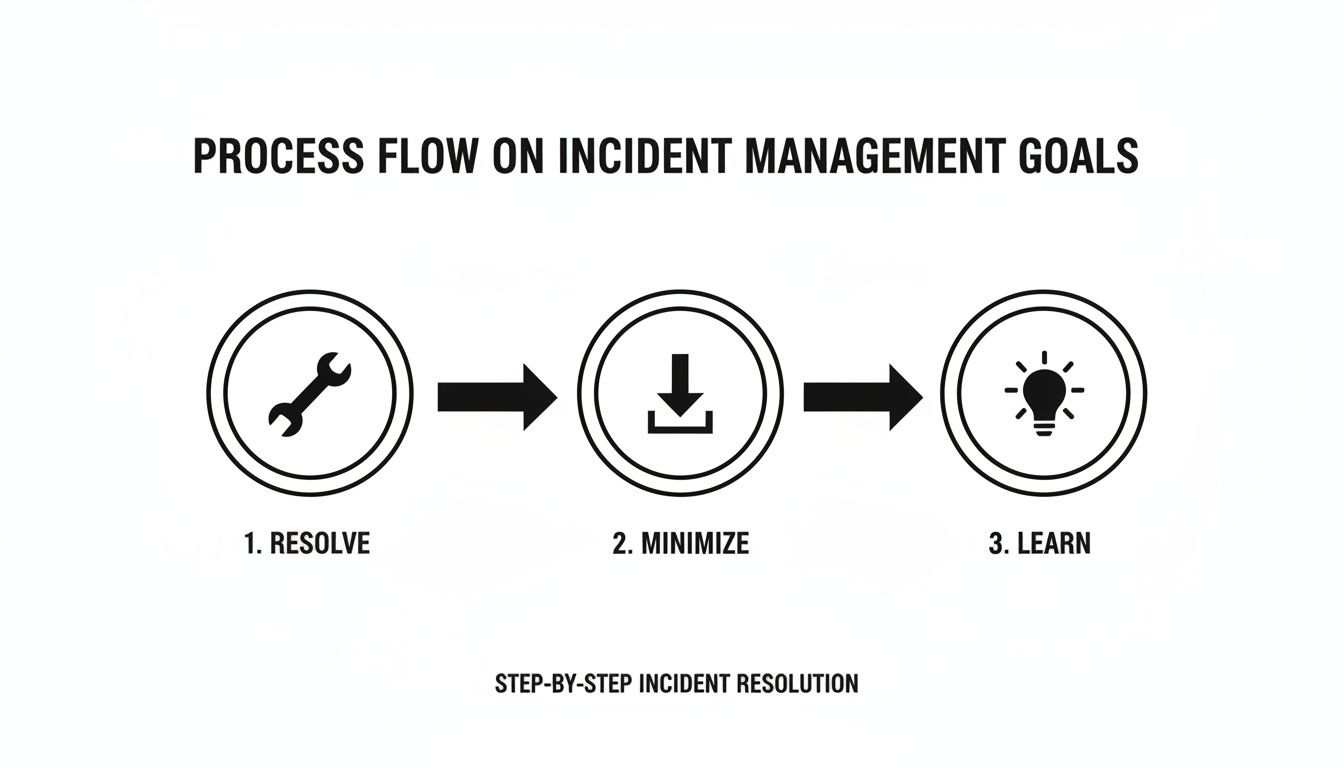
As you can see, the process doesn't just end with a fix. It's a continuous loop of acting and improving.
Phase 5: Closure and Post-Incident Review
Once the dust has settled and the service is humming along nicely, the incident is formally closed. But your work isn't done. The closure phase contains the single most important step for building a more resilient system: the post-incident review (PIR).
The PIR is a blameless meeting where the team gets together to talk honestly about what happened. What went well? What didn't? And most importantly, how do we make sure this never happens again? This meeting generates concrete action items to address the root cause, which ultimately leads to stronger systems.
This commitment to learning is what separates good teams from great ones. It turns every painful incident into a valuable opportunity to get better—a core principle we live by at Dr3amsystems. Our pragmatic, results-focused approach equips organizations to elevate their technology strategy for sustainable growth. To see more of our team's analysis on building resilient operations, check out the Dr3am Insights blog.
Building Your Incident Response Team
When an incident hits, the last thing you want is a "who's on first?" routine. A rock-solid incident management process isn't about a lone hero saving the day; it's a team sport, and every player needs to know their position and their plays by heart. Ambiguity is the enemy in a crisis. A well-defined team structure means everyone knows exactly what they're supposed to be doing, which clears the way for fast, decisive action the second an incident is declared.
Think of it like a pit crew at a Formula 1 race. Each person has one job—one handles the tires, another the fuel, a third wipes the visor. They don't huddle up to decide who does what. They just execute flawlessly to get the car back on the track in seconds. That’s the kind of precision you’re aiming for.
The Core Roles on Deck
While the exact lineup can change depending on your company's size and the nature of the problem, a few core roles are non-negotiable. They form the command structure that keeps the response from spiraling into chaos.
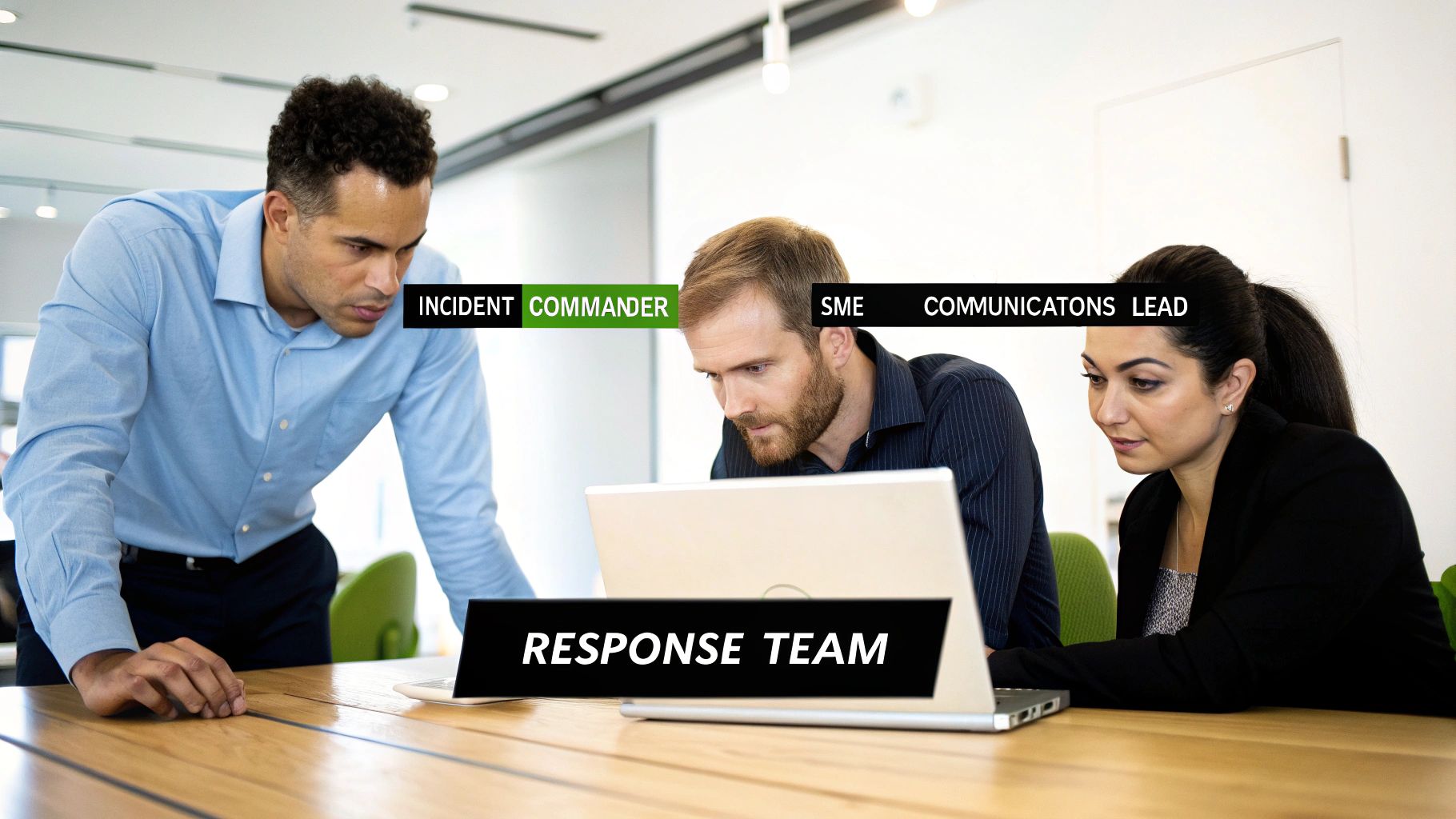
- Incident Commander (IC): This is your quarterback. The IC is the leader and the final decision-maker. They aren't usually the one in the weeds fixing things; instead, they coordinate the entire response, wrangle resources, and keep the team focused on the goal: resolution.
- Subject Matter Experts (SMEs): These are your technical wizards—the folks who live and breathe the affected systems. They're the ones in the digital trenches diagnosing the root cause and deploying the fix, whether that’s a database administrator, a network engineer, or the developer who wrote the code.
- Communications Lead: This person is the voice of the incident. They manage all information flow, making sure internal stakeholders (like execs and support teams) and external customers get timely, accurate updates. They prevent rumors, manage expectations, and keep everyone on the same page.
Getting this core team structure right is what turns a chaotic fire drill into a controlled, efficient response. And it pays off. The SANS 2023 Incident Response survey found that organizations are getting much quicker, with 76% of incidents now contained within 24 hours. That's a huge testament to having a rehearsed team and a clear process.
Defining Responsibilities with a RACI Matrix
To make sure these roles are crystal clear, smart organizations use a RACI matrix. It’s a simple but incredibly powerful tool that spells out who is Responsible, Accountable, Consulted, and Informed for every task in the incident lifecycle. It's the best way to eliminate gaps or overlaps in ownership when the pressure is on.
A RACI matrix isn't just a chart; it's a contract of clarity. It pre-answers the critical question, "Who does what?" so your team can pour all its energy into solving the problem, not navigating internal politics.
Here’s a quick look at how a RACI matrix might be structured for a typical incident.
Incident Management RACI Matrix Example
| Task/Phase | Incident Commander | Subject Matter Expert (SME) | Communications Lead | Service Desk |
|---|---|---|---|---|
| Incident Detection | A | I | I | R |
| Initial Triage | A | C | I | R |
| Technical Investigation | A | R | C | I |
| Implementing Fix | A | R | I | I |
| Internal Communication | A | C | R | I |
| External Communication | A | C | R | I |
| Incident Resolution | A | R | C | I |
| Post-Incident Review | R | C | C | I |
This table clarifies that while the Service Desk might be Responsible for detecting an issue, the Incident Commander is ultimately Accountable for the entire response.
Putting this kind of framework together takes real-world expertise—a deep understanding of both your technology and your business. For companies aiming to build a high-performing response team, getting expert guidance is a game-changer. The results-focused approach at Dr3amsystems helps organizations design and implement these kinds of robust operational frameworks, ensuring your team is ready to handle anything with confidence. After all, a strong team is the heart of a resilient incident management process.
Using AI and Automation to Accelerate Resolution
In any complex tech environment, trying to handle incident response manually is like trying to catch raindrops in a thunderstorm. It's just not going to work. The sheer volume of alerts and data coming from modern systems is more than any human team can keep up with. That's why smart organizations are weaving AI and automation directly into their incident management process, shifting from a reactive, firefighting mode to a proactive and intelligent one.
This isn't just about moving faster—it's about getting smarter. Instead of drowning in thousands of alerts, your team can use technology to cut through the noise, spot the real threats, and even resolve problems before a human ever has to touch a keyboard. It’s a crucial evolution that keeps your systems stable and frees up your best engineers to build new things instead of constantly putting out fires.
AI-Driven Monitoring and Alerting
One of the first big wins you'll see from AI is in intelligent monitoring. Traditional monitoring tools are notorious for creating alert fatigue. They scream about every minor hiccup, and pretty soon, engineers start tuning them out—which is exactly when they miss the one alert that actually matters.
AI-driven tools completely change this dynamic. They learn what "normal" looks like for your systems by analyzing historical performance data. This allows them to tell the difference between a harmless blip and a real anomaly that could signal an incident. They can correlate events happening across dozens of different systems to pinpoint a likely root cause in minutes, a job that would take an engineer hours of sifting through logs.
The real magic of AI here is its ability to find the signal in the noise. It turns a chaotic flood of data into a single, actionable insight so your team can focus on solving the problem, not just finding it.
Automated Runbooks and Self-Healing Systems
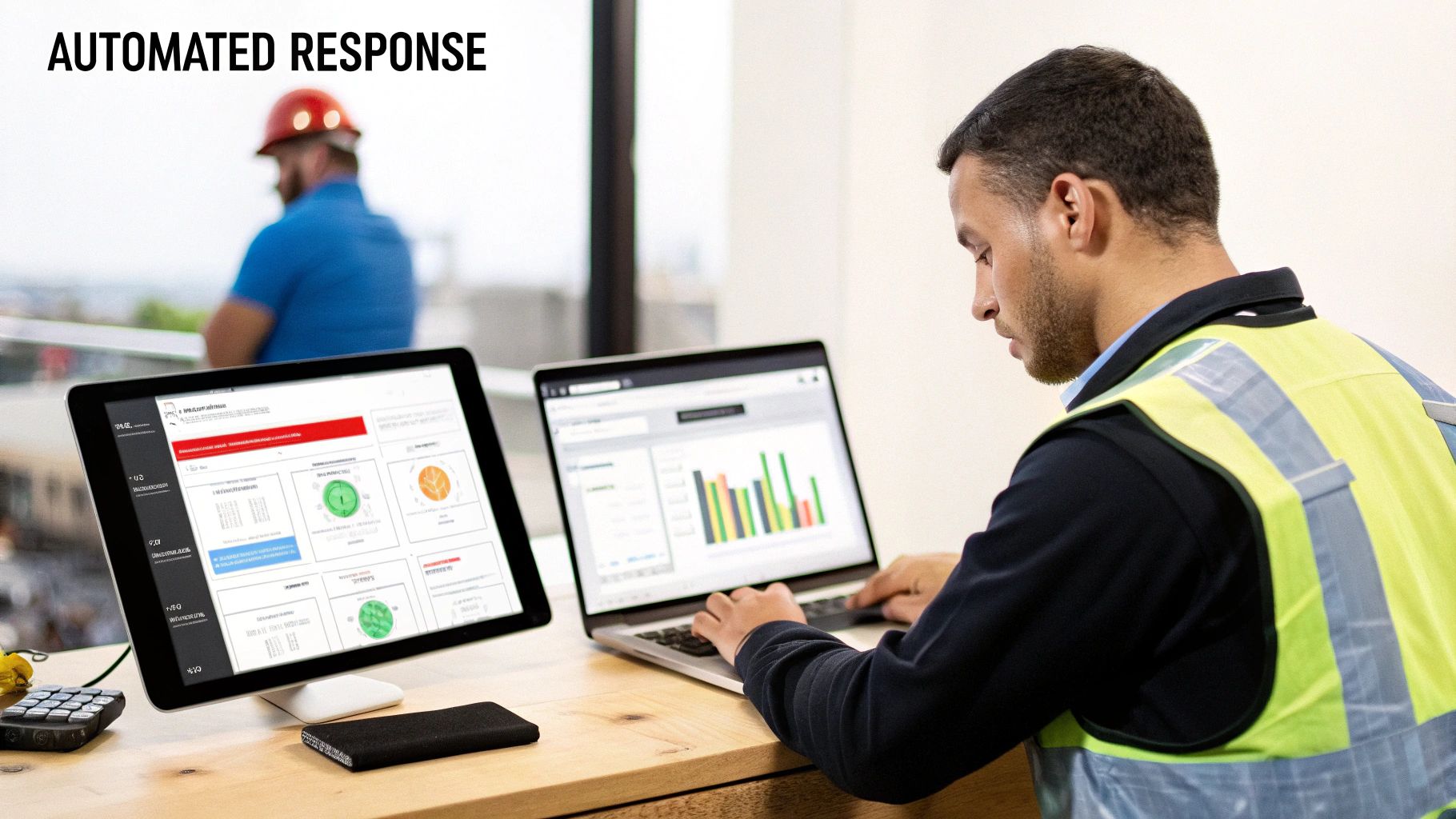
Once you’ve identified an incident, the clock starts ticking on resolution. This is where automation really shines. An automated runbook is basically a script of actions the system can run on its own, with no human needed. So, instead of waking up an on-call engineer at 3 AM to restart a server or roll back a bad deployment, the system just handles it.
Here’s a practical look at how it works:
- Trigger: An AI monitoring tool sees that a critical service's error rate has shot past its acceptable threshold.
- Execution: That alert automatically kicks off a runbook built for this exact scenario.
- Action: The runbook runs a series of commands—maybe it clears a cache that’s full, scales up resources to handle a traffic spike, or reroutes traffic to a healthy backup.
- Verification: The script then confirms that the service is back to a healthy state and closes the incident ticket. All of this can happen in seconds.
This "self-healing" capability is a cornerstone of any modern, resilient infrastructure. It slashes your Mean Time to Resolution (MTTR) and makes sure that common, predictable problems are fixed instantly. This saves your human experts for the tricky, novel issues that actually require their creativity.
Predictive Analytics for Proactive Prevention
Ultimately, the goal isn't just to fix incidents faster—it's to stop them from happening at all. Predictive analytics, powered by machine learning, makes this a real possibility. By analyzing subtle trends in your system's behavior, these tools can forecast potential problems long before they blow up.
For example, an AI model might notice a slow, steady increase in memory usage on a server. It’s not critical yet, but it’s on a clear path to causing an outage in 48 hours. That early warning gives your team a chance to step in and fix it during business hours, avoiding another disruptive late-night emergency.
Bringing these advanced tools into your workflow takes deep expertise in both cloud infrastructure and AI. This is exactly what Dr3amsystems does best. Our Dr3am AI and Dr3am Cloud practices are built to help organizations implement these powerful AI-driven solutions. We work with you to build a sophisticated incident management process that uses automation for quick fixes and predictive insights to stay ahead of problems.
To see how AI can transform your operations, explore our guide to AI-driven solutions and business outcomes. We can help you move beyond just firefighting and create a stable, self-optimizing foundation for real growth.
Putting Your Incident Management Framework into Action with Dr3amsystems
Knowing the theory of incident management is one thing. Actually building a framework that holds up under real-world pressure? That's a whole different ball game. It demands a clear plan, seasoned guidance, and a partner who knows how to connect the dots between technology and real business value. This is where we come in, helping you turn your strategy into a resilient, day-to-day reality.
The journey from a chaotic, reactive firefight to a disciplined, efficient response doesn’t happen overnight. It’s a deliberate process, and it always starts with a clear-eyed look at where you are today and where you need to be. We kick off every engagement with a free consultation to map out that exact path, making sure your implementation is set up for success from the very beginning.
A Phased Approach to Implementation
Trying to build a complete framework all at once is a recipe for disaster. That’s why we take a practical, step-by-step approach. Instead of trying to boil the ocean, we start small, prove the value quickly, and then expand from a solid foundation. This method lets your team adapt and learn without throwing a wrench in your daily operations.
Our implementation roadmap usually follows these clear, manageable steps:
Current State Assessment: First, we dig into your existing processes—or the lack thereof. We’ll identify the real pain points, find opportunities for smart automation, and get a handle on how incidents are currently impacting your business.
Define Clear Goals: What does a "win" look like for you? We'll work together to set measurable targets, like cutting your Mean Time to Resolution (MTTR) by 30% or nailing zero-downtime deployments for your most important apps.
Design a Scalable Process: Next, we design an incident management process that actually fits your organization. We’ll start with a single critical service to keep things focused, defining roles, communication plans, and escalation paths that make sense for your team.
Team Training and Enablement: A process is just a document until people know how to use it. We make sure your team is fully trained and confident in their new roles and responsibilities, turning that plan into muscle memory.
Starting Small and Scaling Intelligently
The secret to a successful rollout is a focused pilot program. By applying the new framework to just one critical service first, you create a controlled environment to test, tweak, and show some immediate wins. It's the best way to minimize risk and build momentum.
Once the process proves itself, we help you expand it to other services and teams. This gradual, iterative expansion ensures each step is solid before you take the next one, which leads to a much stronger and more widely adopted incident management process across your entire organization.
This kind of methodical growth is becoming a top priority for businesses everywhere. You can see it in the market numbers: the global incident and emergency management market was valued at USD 131.92 billion in 2024 and is expected to hit USD 218.04 billion by 2033. That massive growth, tracked by firms like Grand View Research, shows just how seriously companies are taking operational resilience.
An End-to-End Partnership with Dr3amsystems
Dr3amsystems offers more than just a blueprint; we're in the trenches with you, providing hands-on execution and ongoing fine-tuning. Our specialized practices make sure every part of your framework is solid, from the IT fundamentals to advanced security protocols.
Dr3amsystems doesn’t just design roadmaps; we build resilient operations. Our focus is on delivering measurable results—like 60% reductions in processing time—that directly connect your technology strategy to tangible business outcomes.
Our dedicated teams are here to provide end-to-end support:
- Dr3am IT delivers the expert managed support you need to keep critical operations running smoothly, handling everything from initial strategy to day-to-day management.
- Dr3am Security hardens your framework by weaving in robust security incident response protocols, making sure you’re ready for any kind of threat.
With a pragmatic, results-first mindset, we get your organization ready to handle incidents with confidence and precision. Whether you’re modernizing old systems or scaling up in the cloud, our expertise helps you build for reliability and cost efficiency. To see how we can help you build with confidence, check out our guide on Dr3am Cloud solutions. Let’s build a more resilient future for your business, together.
A Few Common Questions
Let's tackle some of the questions that often come up when teams start getting serious about incident management.
What’s the Difference Between Incident and Problem Management?
This is a classic, and for good reason. The distinction is crucial.
Think of it like this: incident management is the fire department. Their job is to rush to the scene, put out the flames, and get everyone to safety as fast as possible. They might use a temporary patch, like boarding up a window, just to secure the site. The immediate crisis is over.
Problem management, on the other hand, is the fire inspector and the construction crew who show up the next day. They investigate why the fire started—was it faulty wiring? They then do the deep work to fix that root cause, ensuring it never, ever happens again.
Incident management is all about speed and restoration. Problem management is about prevention.
How Do You Actually Measure Success Here?
You can't improve what you don't measure. In incident management, success really boils down to two key performance indicators (KPIs):
- Mean Time to Acknowledge (MTTA): This is your team's reaction time. How long does it take from the moment an alert fires to a human saying, "I've got this"? A low MTTA shows your team is alert and engaged.
- Mean Time to Resolve (MTTR): This is the big one—the total time from when an incident is first detected until it's fully resolved and the service is back to normal. A consistently dropping MTTR is the gold standard of a mature process.
The real goal isn't just a low number; it's a downward trend. Watching your MTTA and MTTR shrink over time is proof that your team isn't just getting faster at fixing things—they're getting smarter about the entire process.
How Can a Small Business Get Started Without a Huge Team?
You don't need a 24/7 command center and a dozen engineers to get this right. For small businesses, it’s all about starting simple and scaling smartly.
First, define what an "incident" actually means for your business. Is it the website being down? The payment processor failing? Get specific.
Next, designate a small on-call team—it could just be two or three people. Create a single, clear communication channel for emergencies, like a dedicated Slack or Teams channel. Document a basic, one-page playbook and promise yourselves you'll improve it after every single event.
For organizations that don't have the in-house staff, bringing in a technology partner can make all the difference. A partner like Dr3amsystems can step in to help design a practical, scalable process that fits your size and budget. Through focused practices—Dr3am IT, Dr3am Cloud, Dr3am AI, Dr3am Security, Dr3am Hosting, and Dr3am Marketing—the company provides end-to-end services spanning strategy, implementation, and ongoing optimization. It’s about building a solid foundation you can grow on, not boiling the ocean on day one.
Ready to build a more resilient operation? Dr3amsystems offers end-to-end services to design, implement, and optimize your incident management process, backed by enterprise-grade expertise. Start with a free consultation to create a roadmap that aligns your technology with your business goals. https://dr3amsystems.com