
To genuinely cut operational costs, today's tech leaders have to think beyond simple budget slashing. The real gains come from strategic moves like intelligent automation, cloud optimization, and smart outsourcing. This isn't just about saving money; it's about turning cost centers into engines for efficiency and innovation, all without killing your growth prospects.
A Modern Framework for Reducing Operational Costs
Real operational cost reduction isn't about arbitrary belt-tightening anymore. It's a calculated technology play. The smartest strategies I've seen involve building scalable infrastructure and AI-driven workflows that create savings that actually last. This means shifting your mindset—stop seeing operations as just a necessary expense and start seeing it as a source of strategic advantage.
For most CTOs and tech leaders I work with, this boils down to focusing on three core pillars where technology delivers the biggest bang for your buck.
Rethinking Operational Efficiency
The goal isn't just to make things cheaper to run. It's to build systems that are fundamentally more efficient, reliable, and can scale with you. This is where having a dedicated technology partner on your side can make all the difference. Companies like Dr3amsystems specialize in helping businesses map out and execute a clear plan, turning clunky legacy systems and inefficient processes into lean, modern operations.
This framework breaks down the core pillars for strategic cost reduction through technology.
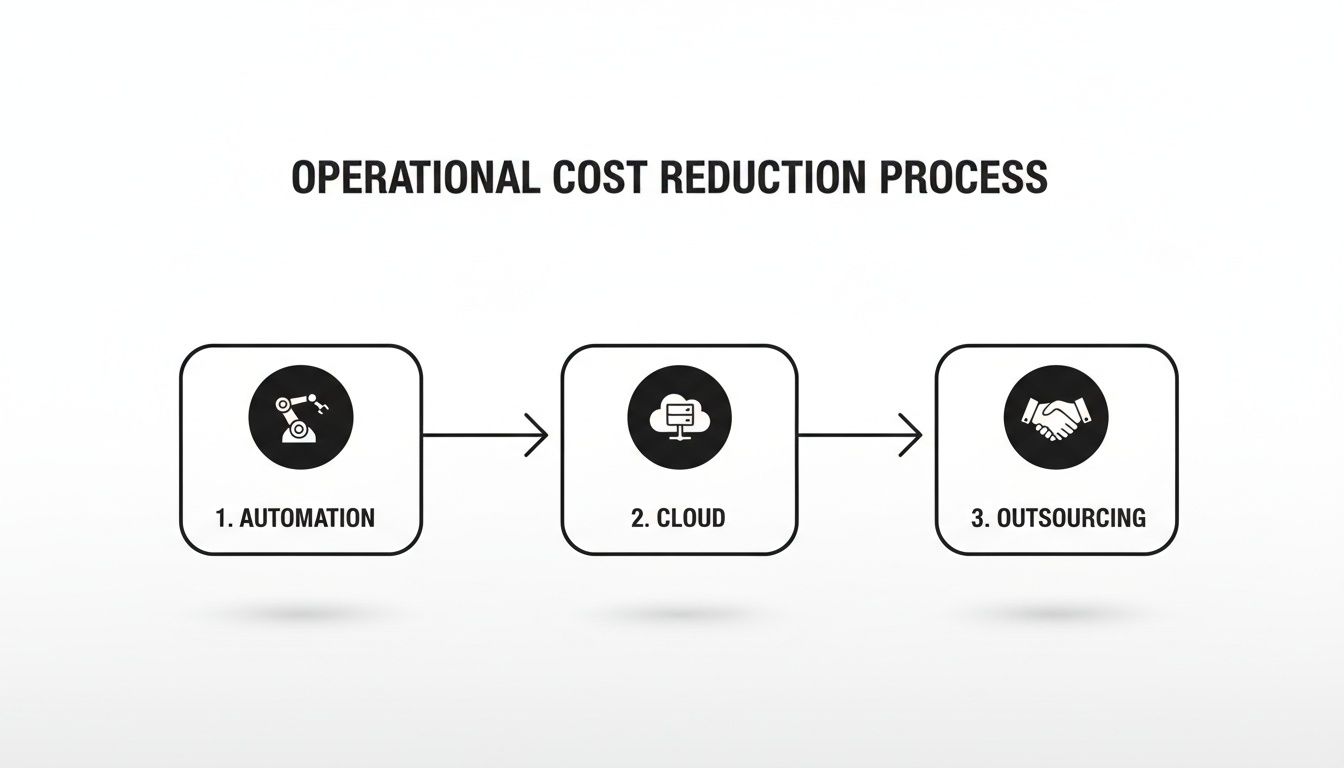
You can see how the flow from automation to cloud optimization and then to strategic outsourcing creates a complete approach. It's about building a technology foundation that's both resilient and cost-effective.
The way we approach cost-cutting has fundamentally changed. Gone are the days of blunt-force budget cuts that often hurt more than they help. Today, it’s about making surgical, technology-driven improvements.
Modern vs Traditional Cost Reduction Strategies
| Focus Area | Traditional Approach | Modern Approach with Dr3amsystems |
|---|---|---|
| Workflow Efficiency | Hiring more staff; manual process optimization. | Implementing AI-driven automation to handle repetitive tasks, freeing up human talent for high-value work. |
| Infrastructure | Owning and maintaining on-premise servers; reactive upgrades. | Migrating to the cloud for scalability; continuous cost optimization and rightsizing of resources. |
| Security & IT Support | Large in-house teams; purchasing multiple disparate security tools. | Strategic outsourcing to a managed security partner; using a unified platform for better visibility and lower overhead. |
| Data Processing | Manual data entry and analysis; slow, error-prone reporting. | Automating data pipelines and using AI for real-time analytics, leading to faster, more accurate insights. |
This shift from manual effort to intelligent systems is where true, sustainable savings are found. It's about working smarter, not just cheaper.
The Role of a Technology Partner
Making this transition happen requires specialized expertise that most in-house teams just don't have. A partner with deep, end-to-end capabilities can get you to your goals much faster and ensure your investments are sound. Dr3amsystems, for instance, has focused practices like Dr3am AI, Dr3am Cloud, and Dr3am Security that deliver real, measurable results—we’re talking 60% reductions in processing time and zero-downtime migrations.
It usually starts with a free consultation to get clear on your goals, find the low-hanging fruit for automation, and tie every tech decision back to clear business value. This first step is absolutely critical for spotting those high-impact areas where you can score quick wins and build momentum for the bigger projects. If you're looking for more on this, you can explore more insights from our team.
The key is to stop trimming the edges and start addressing the root causes of operational bloat: manual processes, underused cloud resources, and inefficient workflows. A good partner helps you prioritize reliability and ROI, ensuring that every dollar you save also sharpens your competitive edge.
By focusing on these modern strategies, you can build a leaner, more agile organization that’s truly ready for sustainable growth. In the next sections, we'll dive into the step-by-step roadmap to identify, prioritize, and implement these cost reductions across your people, processes, and technology stack.
Getting to the Root of Your Spending: The Operational Cost Audit
Before you can slash operational costs, you need a brutally honest look at where your money is actually going. It's a simple truth: you can't fix what you don't measure. A proper operational audit is your first, non-negotiable step to uncovering the hidden inefficiencies slowly bleeding your budget dry. This isn’t just about scanning invoices; it’s a deep, investigative dive into your people, processes, and technology to find the real sources of financial drag.
The whole point is to map out how work actually gets done, not just how it's supposed to. You'll quickly see where bottlenecks, redundant tasks, and manual workarounds are slowing everything down. All too often, I see teams create clever little workarounds that become permanent fixtures, creating invisible costs that just keep compounding. The goal here is to trade assumptions for a data-backed picture of your operational reality.

Uncovering the High Cost of Manual Work
Manual tasks are one of the biggest, yet most frequently ignored, operational costs. These repetitive, low-value activities don’t just eat up your team's time; they're magnets for human error. And every error introduces a new layer of costs tied to rework and quality control. Just think about the hours your finance team sinks into manually keying in data for compliance reports or the time HR spends wrestling with onboarding paperwork.
To start sniffing out these efficiency drains, ask some pointed questions:
- Which daily tasks involve someone copying and pasting data from one system to another? This is a dead giveaway of disconnected software and a perfect opportunity for automation.
- How much time do we spend pulling the same routine reports every week or month? Most of this can be automated, freeing up your analysts to actually analyze, not just compile.
- What does the approval process look like for simple, standard requests? If it involves multiple emails and manual follow-ups, you've found a major source of operational friction.
Bringing in a technology partner can massively speed up this discovery phase. For example, the free consultation offered by Dr3amsystems is built to do exactly this kind of diagnostic work. Their experts help you get crystal clear on your business goals, then trace them back to find specific automation wins in your current workflows. It’s all about building a practical roadmap that links technology directly to business value.
A common mistake is underestimating the cumulative impact of small, manual tasks. A 15-minute daily task performed by ten employees costs your business over 500 hours of productivity a year. Auditing these micro-inefficiencies is critical.
Diagnosing Your Workflow and Tech Bottlenecks
Looking beyond individual tasks, your audit needs to put your entire technology ecosystem under the microscope. Legacy systems, underused cloud resources, and a patchwork of poorly integrated apps are huge sources of operational bloat. A server humming along at 20% capacity is still a significant expense, and so is paying for premium software licenses that nobody uses.
Your audit should really question the health of your tech stack. Are you still paying to maintain expensive on-premise hardware that could be moved to a more flexible and cost-effective cloud setup? Are your teams fighting with clunky, outdated software that kills their productivity? These are the kinds of questions that expose deep-seated problems. This is also where an expert partner can make all the difference, as we cover in our guide on the benefits of managed Dr3am IT support.
Your Action Plan: The Audit Checklist
To give your audit some structure and make sure you don't miss anything, follow this simple checklist.
1. Map Your Core Business Processes
- Get a whiteboard and physically draw out the step-by-step flow for key operations like order fulfillment, customer support tickets, or the month-end close.
- Pinpoint every manual handoff, every time data is re-entered, and every approval delay.
- Put a number on it—estimate the time and people-power consumed at each stage.
2. Put Your Tech Stack on Trial
- Run a software license utilization report. You’ll be shocked at the redundant or completely unused apps you’re paying for.
- Dive into your cloud billing. Look for oversized instances, unattached storage, and idle resources.
- Get real about the maintenance costs and performance headaches of your legacy systems.
3. Talk to Your People
- Sit down with frontline employees and just listen. Ask them about their daily frustrations and what parts of their workflow feel clunky.
- Check in with department heads to understand their biggest operational hurdles. They often have a great high-level view of the pain points.
By methodically working through these areas, you’ll turn a vague goal like "reduce costs" into a concrete, data-driven plan. This audit is the foundation for everything that comes next. It gives you the evidence you need to prioritize high-impact projects, make a solid business case for investing in automation, and begin building a much leaner, more efficient organization.
Using AI and Automation for Radical Efficiency
Once your operational audit has laid bare the cracks in your workflows, it’s time to seal them with intelligent technology. This is where you shift from analysis to action, using AI and automation to unlock some serious efficiency gains. We're not talking about isolated projects here; this is about fundamentally redesigning how work gets done to directly slash operational costs.
The biggest wins always come from targeting those high-volume, repetitive tasks that drain your team's time and are magnets for human error. Instead of just tinkering around the edges, start thinking about entire end-to-end processes you can completely transform.
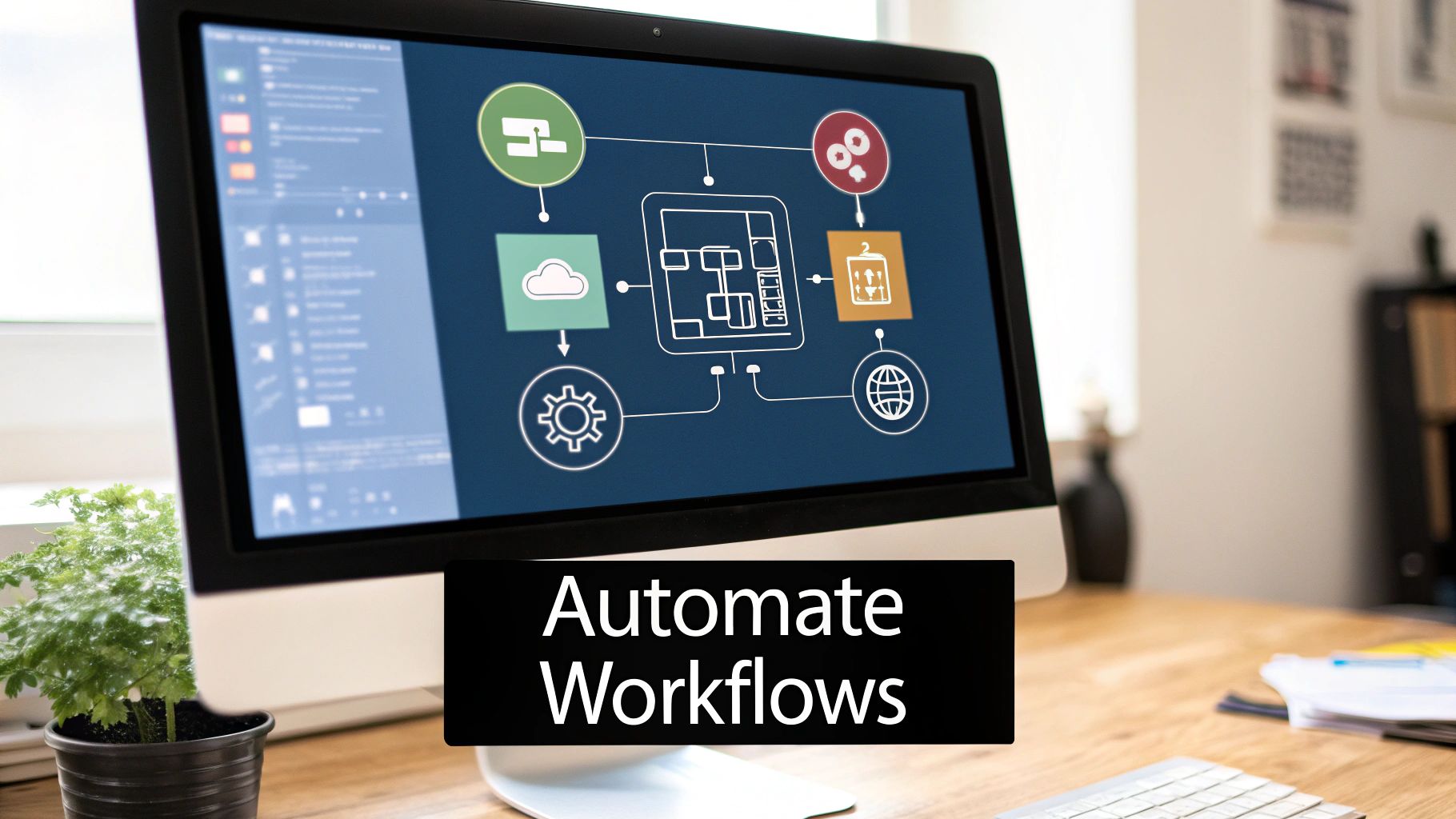
Pinpointing High-Impact Automation Opportunities
Let's get specific. Forget the generic concepts and talk about real-world use cases where AI-driven solutions deliver tangible returns. These are the areas where building a compelling business case is easy because the results speak for themselves.
Think about these common operational cost centers:
- Customer Service: AI-powered chatbots can handle a huge chunk of routine customer questions, from "Where's my order?" to password resets. This frees up your human agents to focus on the complex, high-value conversations that actually require their expertise.
- Financial Compliance: The manual grind of pulling data, running checks, and generating reports is incredibly time-consuming. You can automate this entire workflow, ensuring accuracy and cutting down the hours spent on tedious compliance tasks.
- HR and Onboarding: Manually entering data for new hires, managing benefits enrollment, and processing payroll is a classic efficiency killer. An automated system can handle the paperwork, creating a much smoother experience for new employees and giving your HR team their time back.
The common thread is simple: replace manual, rule-based work with intelligent systems. This doesn't just cut direct labor costs—it also minimizes the expensive mistakes that inevitably come with manual processing.
The Power of End-to-End Process Redesign
The most effective strategy is to weave AI across an entire workflow, not just tack it onto a single step. For instance, research shows that enterprises that go for a full process redesign combined with AI can see cost reductions of up to 25%. On the other hand, organizations that only dabble in fragmented, isolated AI initiatives often see savings of 5% or less. The difference is stark, with some customer service operations seeing 30% cost reductions and financial services cutting compliance costs by 40%. You can dig into more research on the impact of AI on business operations to see the numbers for yourself.
This holistic approach is exactly where a good technology partner adds immense value. A team like Dr3amsystems, through its Dr3am AI practice, doesn’t just deploy a tool; they help you re-engineer the entire process. By setting up the right data pipelines and machine learning models, they deliver measurable results, like the 60% reduction in processing time some of their clients have achieved.
The key is to shift your thinking from "automating a task" to "automating an outcome." When you focus on the entire business process, you uncover opportunities for compounding efficiencies that isolated point solutions can never deliver.
Building the Business Case for AI Investment
To get executive buy-in for an AI and automation project, you have to speak their language: ROI, efficiency gains, and risk reduction. Your operational audit gives you the "before" picture—the high costs of doing things the old way. Now, you need to paint a crystal-clear "after" picture.
Here’s a practical way to frame your business case:
- Identify the Pain Point: Start with a specific, measurable problem. For example, "Our finance team spends 120 hours every month manually reconciling invoices, which leads to a 5% error rate and delayed payments."
- Propose the Solution: Describe the AI-powered fix. "By implementing an AI-powered invoice processing system, we can automate data extraction, validation, and reconciliation."
- Quantify the Expected Outcome: Attach hard numbers to the benefits. "This will cut manual processing time by 90%, reduce the error rate to almost zero, and speed up our payment cycles by an average of seven days."
When you present a case that’s this clear, the investment becomes a logical business decision, not some speculative tech experiment. A partner can help you build this roadmap. Engagements with Dr3amsystems, for example, kick off with a free consultation designed specifically to clarify goals and find these high-value automation opportunities.
Beyond Cost Cutting to Strategic Advantage
While the immediate goal is to reduce operational costs, the long-term benefits of AI and automation are even more powerful. Freeing your team from repetitive work allows them to focus on innovation, strategy, and high-level problem-solving—the very activities that drive sustainable growth.
This is the real power of modernizing your operations. By bringing in AI-driven solutions, you’re not just making your business leaner; you’re making it smarter and more agile. This approach turns a cost-cutting initiative into a genuine competitive advantage. If you're ready to explore how this applies to your business, learn more about our dedicated AI and Automation Services. The focus is always on aligning technology with business value, ensuring every solution delivers a clear, measurable ROI.
Optimizing Cloud Spend Without Sacrificing Performance
The cloud’s scalability is a double-edged sword. It offers incredible flexibility, but without a tight grip on governance, that same elasticity can quickly lead to a major financial headache. Too many companies migrate to the cloud assuming the savings are automatic, only to watch their monthly bills spiral. Getting a handle on cloud cost optimization is non-negotiable for any modern tech leader, but it demands a disciplined, ongoing effort.
This isn’t about cutting corners or throttling performance. Far from it. The real goal is to pay for exactly what you need, precisely when you need it. It’s about rooting out waste by aligning your cloud resources with actual usage patterns, ensuring every dollar you spend on infrastructure is working as hard as possible.

Key Strategies for Immediate Cloud Savings
Getting your cloud spend under control can start with a few high-impact moves. These tactics hit the most common sources of waste and can deliver noticeable savings right away, without needing a massive architectural overhaul.
- Rightsizing Your Instances: Overprovisioning is probably the single most common mistake I see. Teams choose larger, more expensive instances "just in case," but that buffer often goes unused. Rightsizing is the simple practice of analyzing your actual CPU and memory data to match instances perfectly to their real-world workloads.
- Implementing Auto-Scaling: Most workloads have a natural rhythm—peaks and troughs. Think of an e-commerce site during a flash sale versus the middle of the night. Auto-scaling policies automatically add resources when demand spikes and, just as importantly, scale them back down during quiet periods. You stop paying for idle capacity.
- Leveraging Savings Plans and Reserved Instances: If you have predictable, always-on workloads, using savings plans or reserved instances is a no-brainer. You can lock in discounts up to 70% off on-demand pricing. This is the ideal approach for the stable, core components of your application stack.
This is an area where a technology partner can make a huge difference. The Dr3am Cloud practice at Dr3amsystems, for instance, focuses on not just secure migrations but also provides the ongoing optimization and support to keep costs in check. They help businesses analyze usage and implement these kinds of cost-saving measures without compromising on reliability.
The Role of Cloud in AI-Driven Operations
The relationship between cloud infrastructure and AI is also completely changing the cost conversation. Not long ago, the sheer cost of computing power was a massive barrier for mid-market companies wanting to experiment with sophisticated AI models. That barrier is dissolving fast.
Consider this: the inference cost for AI systems on par with GPT-3.5 plummeted by an incredible 280-fold between late 2022 and late 2024. At the same time, hardware costs have been dropping by 30% annually, while energy efficiency has improved by 40% each year. It’s no surprise that U.S. private AI investment hit $109.1 billion in 2024; the confidence in AI's ROI is soaring now that infrastructure costs are no longer a deal-breaker. You can discover more about the falling cost of AI infrastructure and see how it's impacting businesses.
This trend makes smart cloud optimization even more vital. By running your AI workloads on an efficiently managed cloud, you can access powerful capabilities that were once out of reach, all without the massive capital outlay.
Beyond Basic Tactics: Advanced Cloud Governance
Once you’ve locked in those initial quick wins, the next level of cloud cost management is all about building strong governance and continuous monitoring. This is how you turn a one-off project into a sustainable, long-term discipline.
The most common pitfall in cloud cost management is treating it as a one-time project. True optimization is an ongoing process of monitoring, analyzing, and adjusting. It requires a cultural shift where engineering teams are empowered and accountable for their cloud consumption.
This is also where a managed services approach can really shine. A partner like Dr3amsystems brings the dedicated expertise to keep your critical operations running smoothly while enabling that cycle of continuous improvement. Their Dr3am Hosting and managed support services ensure your cloud environment is not only cost-efficient but also secure and performing at its peak.
Here’s what building that governance framework looks like in practice:
- Establish Tagging Policies: Make tagging mandatory for every single cloud resource. This lets you allocate costs back to specific projects, departments, or teams, which is the foundation for accountability.
- Set Up Budgets and Alerts: Use your cloud provider’s tools to create automated alerts. These should notify stakeholders when spending gets close to or exceeds a predefined budget. It’s a simple, proactive way to prevent bill shock at the end of the month.
- Automate Cleanup of Unused Resources: Build scripts that automatically hunt down and terminate idle resources—think unattached storage volumes or forgotten test environments. These "zombie" assets can silently drive up your bill for months if left unchecked.
By combining these tactical optimizations with a solid governance framework, you can transform your cloud infrastructure from a potential budget-buster into a powerful and efficient engine for growth. If you are interested in this topic, check out our guide on Dr3amsystems cloud services.
The Real ROI of Strategic Outsourcing and Managed Services
Trying to build and manage every single tech function in-house is a classic operational cost trap. It’s a sure-fire way to spread your budget and talent thin, forcing you to become a jack-of-all-trades in areas like IT support, cybersecurity, and cloud management. These aren't your core business, but they are absolutely critical to its survival.
This is where bringing in a strategic partner for managed services completely flips the script. The goal isn't just about offloading tasks. It’s about tapping into enterprise-grade expertise and infrastructure without having to shoulder the enormous total cost of ownership (TCO) that comes with building it all yourself.
Breaking Down the Total Cost of Ownership
When you really look at the cost of an in-house team, the salaries are just the tip of the iceberg. You have to factor in recruitment costs, benefits, continuous training, pricey certifications, and the ever-growing stack of specialized tools and software licenses. It’s not uncommon for these hidden overheads to double the direct cost of a salary.
A dedicated technology partner changes this entire financial equation. With a managed services model, you get a full team of specialists—from security analysts to cloud engineers—for a predictable, fixed cost. This gives you a few immediate wins in cutting operational expenses:
- Reduced Hiring and Training Overhead: You get to skip the long, expensive cycle of recruiting, onboarding, and training specialized talent.
- Access to Enterprise-Grade Tools: You get the benefits of best-in-class security and management platforms without the five or six-figure price tag to purchase and maintain them.
- Predictable Operational Expenses: Volatile capital expenditures get converted into a stable, manageable operating expense you can actually budget for.
This model is a game-changer in specialized fields where top talent is both scarce and expensive. For instance, the Dr3am Security and Dr3am IT practices at Dr3amsystems bring the deep expertise needed to protect and manage critical infrastructure, letting your internal teams get back to focusing on innovation.
Freeing Your Team to Drive Business Value
Here’s one of the biggest, and most overlooked, benefits of outsourcing: the strategic reallocation of your internal team. When your best engineers are constantly being pulled into firefighting IT tickets or triaging security alerts, they aren't building the products and features that actually make you money.
By handing off those routine but critical functions to a managed services provider, you free up your most valuable people to work on high-impact projects. This directly accelerates your time-to-market and starts turning your technology department from a cost center into a genuine driver of business growth.
The real ROI of outsourcing isn't just in the money you save on salaries; it's in the innovation you unlock by letting your team do what they do best. A partner ensures critical systems run smoothly with zero-downtime transitions, giving your team the stability and focus they need to innovate.
This strategic shift is already paying off across multiple industries. In healthcare, for example, technology investments are seeing rapid returns. A recent study found that 73% of healthcare organizations have cut operational costs with AI, and nearly half saw a positive ROI in just one year. As these efficiencies take hold, 78% plan to increase their AI budgets. You can explore more insights into AI's financial impact on operations to see how this trend is playing out.
Choosing the Right Partner for Measurable Results
The success of any outsourcing engagement comes down to one thing: finding a partner that truly aligns with your business goals and delivers measurable results. This is about more than a service-level agreement. It’s about finding a team that operates as a true extension of your own.
A pragmatic, results-focused partner like Dr3amsystems kicks off every engagement with a free consultation to get crystal clear on your goals, uncover automation opportunities, and map out a plan that ties every action back to business value. They have end-to-end capabilities that span strategy, implementation, and ongoing optimization, giving you the hands-on execution needed to keep things running smoothly while continuously improving.
Whether you're looking to modernize legacy systems or bulletproof your security posture, the right partnership helps you adopt new tech with confidence and build a strategy for sustainable growth. To see how this works in practice, you can find a breakdown of our focused practices and the end-to-end services we provide.
Building a Culture of Continuous Cost Improvement
Getting your operational costs down is a great first step, but the real win is keeping them down for good. This isn't about a single, heroic project; it's about shifting the entire company's mindset. You want to build a culture where everyone, from the front lines to the leadership team, is actively looking for ways to be more efficient.
This kind of change doesn't just happen. It starts by making cost-awareness a visible, tangible part of daily work. After all, you can't improve what you don't measure, which makes establishing the right key performance indicators (KPIs) absolutely essential.
From Metrics to Mindset
When you start tracking the right numbers, cost management stops being some vague corporate goal and becomes a real-world, daily challenge. Giving your teams dashboards with live data is crucial; it provides instant feedback, showing them exactly how their decisions and actions affect the bottom line.
You don't need a hundred metrics. Start by focusing on a few that pack the most punch:
- Operational Expense Ratio (OER): The classic. This KPI gives you the 30,000-foot view by comparing your operating expenses to your revenue. It’s the ultimate health check for overall efficiency.
- Cost per Transaction: This is perfect for departments that handle a high volume of repetitive tasks. It lets you measure the real cost of processing one invoice, closing one support ticket, or onboarding one customer.
- Infrastructure Utilization Rate: A must-have in any cloud environment. This directly shows how much of your provisioned cloud resources you're actually using, immediately shining a light on waste from idle or oversized servers.
These numbers create your baseline. The real magic happens when you empower your teams to ask, "How can we make this number better?" every single day.
True operational excellence isn't a top-down mandate; it's a bottom-up habit. It’s when cost optimization becomes part of the daily conversation, driven by data and a shared commitment to doing things smarter.
Sustaining Momentum with a Technology Partner
Embedding this new discipline is tough, especially when your teams are already stretched thin focusing on their core jobs. This is where leaning on a technology partner can make all the difference. While your people drive the business forward, a dedicated partner can provide the relentless, ongoing focus needed to maintain and build upon your cost-saving wins.
This is exactly how we approach it at Dr3amsystems. Our services are designed to be end-to-end, covering everything from initial strategy to implementation and long-term managed support. We make sure the efficiency gains you fought for don't just stick around—they get better over time. With specialized practices like Dr3am AI for automating tedious processes and Dr3am Cloud for fine-tuning infrastructure, we become a persistent force driving your operational improvement.
It often starts with a free consultation to pinpoint those initial savings opportunities. From there, it grows into a long-term partnership built on delivering results. Dr3amsystems provides the expert guidance and hands-on execution to not only keep your critical operations humming but also to help you build that culture of continuous improvement, turning one-time cost savings into a permanent competitive edge.
Answering Your Top Questions
When it comes to cutting operational costs with technology, a few key questions always come up. Here are the practical, no-nonsense answers I give to fellow tech leaders.
Where’s the Best Place to Start with Automation?
Don't try to boil the ocean. Your best bet is to find a process that's high-volume but low-complexity. Think about those mind-numbing, repetitive tasks that your team dreads but that still eat up hours every week.
Good starting points usually look like this:
- Manual data entry for weekly financial reports
- Resolving the same basic IT support tickets over and over
- Processing standard employee onboarding paperwork
Nailing these "quick wins" gives you a fast, measurable ROI. That success makes it much easier to get buy-in from the rest of the leadership team when you're ready to tackle bigger, more complex automation projects. A good partner can help you spot these opportunities quickly. For example, Dr3amsystems starts every conversation with a free consultation to find these exact high-impact starting points and map out a realistic plan.
Does Moving to the Cloud Automatically Save Money?
Honestly? No. A simple "lift-and-shift" migration without any re-architecting or planning can easily end up costing you more than staying on-prem. I've seen it happen. You end up with overprovisioned servers and a lack of governance that spirals out of control.
The real savings in the cloud come from relentless, continuous optimization. That means right-sizing your instances, setting up auto-scaling so you only pay for what you use, and locking in savings plans for your predictable, steady-state workloads.
A solid cloud strategy isn't a one-and-done project; it requires ongoing management. This is where services like Dr3am Cloud and Dr3am Hosting really shine. They handle the secure migration and provide dedicated management to make sure you're actually getting the cost efficiency and reliability you were promised.
How Can I Justify the Upfront Cost of a New Tech Investment?
You have to shift the conversation from sticker price to long-term value. Build your business case around the Total Cost of Ownership (TCO) and the eventual ROI, not just the initial check you have to write.
Start by calculating the very real cost of doing nothing. How much are you spending on wasted labor hours? What's the financial impact of manual errors? What revenue opportunities are you missing because your best people are tied up in low-value work? Frame the investment as the solution to those existing, ongoing costs.
Bringing in a partner with a proven track record can also take a lot of the risk out of the equation. When you can point to clear, measurable outcomes—like the 60% reductions in processing time and zero-downtime transitions Dr3amsystems consistently delivers—the business case practically writes itself.
Ready to turn your operational cost centers into a real strategic advantage? Dr3amsystems has the end-to-end expertise to accelerate your business with AI-powered solutions, secure cloud migrations, and dedicated managed support. Schedule your free consultation today to get started.