
Bringing AI into your business isn't about chasing the latest tech trend; it's a strategic move that needs a solid plan. The whole point is to solve real problems and see a real return, which means starting with a high-impact business case, getting your data in order, and then picking the right tools for the job.
It all boils down to focusing on measurable outcomes.
Your AI Implementation Blueprint
Getting started with AI is a major shift in how you operate, not just another software rollout. The goal isn't just to "do AI" but to use it to create genuine value. This means cutting through the noise and building a practical roadmap where every technical step is tied directly to a business goal.
Success in AI isn't abstract. It's defined by concrete results you can actually measure, like:
- Cutting Operational Costs: Think about automating mind-numbing tasks like data entry or reconciling invoices. This frees up your people to focus on work that actually requires a human brain.
- Improving the Customer Experience: Using AI to offer personalized product recommendations or 24/7 chatbot support can make a huge difference in customer loyalty.
- Finding New Revenue Streams: AI can spot subtle patterns in your sales data that might point to a new market niche or a smarter pricing model you'd never see otherwise.
Pinpointing the Right Starting Point
Your first move is to find the best place to start. Look at your current operations and ask a simple question: Where are our biggest headaches, highest costs, or most obvious missed opportunities? Is it logistics? Customer support? Marketing analytics? A strong business case is the foundation of any AI project that actually goes somewhere.
This simple flow captures the essence of a good AI program: build the business case, prepare the data, and then—and only then—execute the plan.
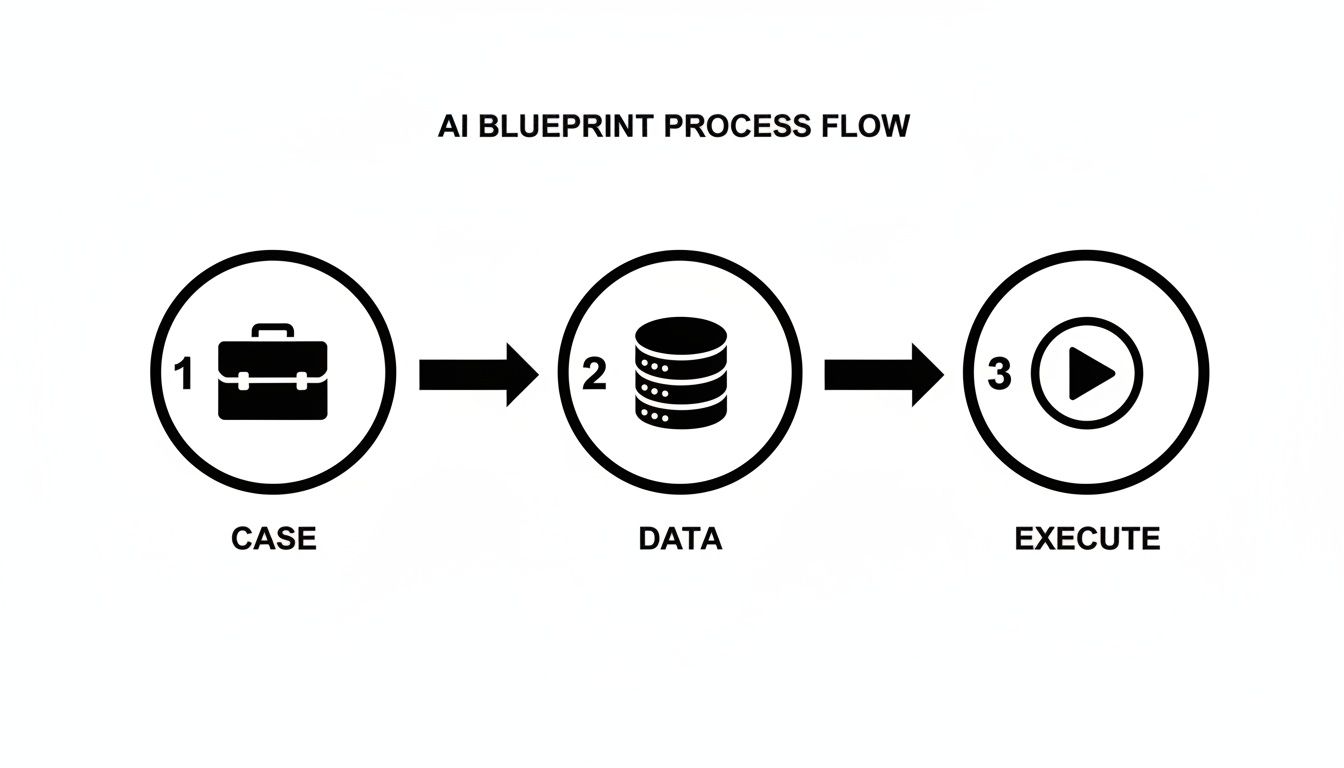
As you can see, the technology part comes last. It all has to be built on a clear strategy and good, clean data.
From Experimentation to Enterprise Scale
We're past the point of AI being a niche experiment. Today, 88% of companies are using it in at least one part of their business, according to research from McKinsey.
But there's a huge difference between dabbling in AI and truly scaling it across the organization. The companies pulling ahead are the ones who are fundamentally redesigning how they work, not just automating a task here or there.
To give this process more structure, let's break down the typical journey into distinct phases. The table below outlines the AI implementation lifecycle, from the initial idea to measuring its long-term impact.
The AI Implementation Lifecycle
| Phase | Objective | Key Activities | Success Metric |
|---|---|---|---|
| 1. Strategy & Scoping | Identify a high-value business problem AI can solve. | Stakeholder workshops, use case prioritization, ROI analysis, feasibility study. | A signed-off business case with clear financial projections. |
| 2. Data Readiness | Ensure data is accessible, clean, and sufficient for the model. | Data discovery, pipeline development (ETL/ELT), data quality checks. | Data quality score meets the minimum threshold for the project. |
| 3. Model Development | Build, train, and validate a performant AI model. | Feature engineering, model selection, training cycles, performance testing. | Model accuracy/performance exceeds the baseline benchmark. |
| 4. Deployment & Integration | Integrate the model into live business systems or workflows. | API development, MLOps setup, user acceptance testing (UAT). | Successful deployment with zero critical bugs and positive UAT feedback. |
| 5. Measurement & Iteration | Monitor performance and continuously improve the solution. | KPI tracking, model monitoring for drift, A/B testing, feedback loops. | The project meets or exceeds its initial ROI and business KPIs. |
This lifecycle ensures that you're building a solution that not only works technically but also delivers on the original business promise.
A partner with a pragmatic, results-focused approach can be the difference between a stalled science project and a genuine business transformation. An initial, no-cost consultation can clarify goals, uncover automation opportunities, and design a roadmap that aligns technology with real business value.
Think of this strategic overview as your blueprint. It makes sure you’re not just buying a piece of software but architecting a real change. Crafting this kind of plan takes a mix of sharp business sense and deep technical knowledge. For a closer look at building this out, check out our guide on developing a digital transformation roadmap.
An expert partner like Dr3amsystems can provide the end-to-end services needed to bridge that gap, handling everything from the initial strategy and build to ongoing management. This ensures your AI initiatives start on solid ground and are set up to deliver value for the long haul.
Building a Rock-Solid Foundation for AI
An ambitious AI strategy is only as strong as the groundwork it's built on. You can have the most brilliant algorithms, but they're completely useless without two things: clean, accessible data and robust, scalable infrastructure. This is the unglamorous but absolutely critical work you can't afford to get wrong.
Before you even start dreaming about models, you have to get real about your data. This begins with a practical data audit—a no-holds-barred look at what information you actually have, where it lives, and if it's even usable for AI. It means asking tough questions. Is your customer data trapped in a dozen disconnected systems? Is that sales data complete, or is it a mess of duplicates and errors?

This discovery phase is where so many initiatives stumble. We see it all the time: companies get excited about AI's potential without first building the systems needed to make it work. There's a real preparedness gap. While 42% of companies feel their AI strategy is solid, they admit their infrastructure, data, and risk management are lagging. As senior leadership starts demanding tangible results, building on enterprise-grade systems is no longer a "nice-to-have." You can see more on this in Deloitte's State of AI in the Enterprise report.
Setting Up Reliable Data Pipelines
Once you have a handle on your data, you need an efficient way to move it. That’s where data pipelines come in. Think of them as the digital plumbing that constantly collects, cleans, and delivers data right to your AI models. A well-designed pipeline is what ensures your algorithms are always learning from fresh, high-quality information.
Building these pipelines is a core skill for any business that's serious about AI. The process involves pulling from all your different data sources—your CRM, ERP, marketing platforms—and transforming that raw information into a clean, structured format that a machine learning model can actually understand. A good pipeline automates this entire workflow, preventing the "garbage in, garbage out" problem that derails so many projects. If you want to get into the nuts and bolts, our guide on how to build effective data pipelines is a great place to start.
Choosing Your Infrastructure: On-Premise vs. Cloud
With your data flowing, the next big decision is where all this work is going to happen. Your infrastructure choice dictates everything from cost and scale to security and speed. You've basically got three main options, and each one comes with its own set of trade-offs.
On-Premise: You own and manage all the hardware yourself in your own data center. This gives you maximum control and security, which is a must-have for some highly regulated industries. The downside? Huge upfront costs and the need for a skilled team to keep it all running.
Cloud: Using a provider like AWS, Azure, or Google Cloud means you get instant access to serious computing power without buying any hardware. The pay-as-you-go model is incredibly flexible, letting you scale resources up or down on a dime. For most businesses just starting their AI journey, this is the most cost-effective path forward.
Hybrid: This model is exactly what it sounds like—a mix of on-premise and cloud resources. You might keep highly sensitive data on your own servers but use the cloud’s immense processing power for training massive AI models. It offers a nice balance of control and flexibility but definitely adds a layer of management complexity.
For most businesses, the agility and cost-efficiency of the cloud are simply too good to pass up. The ability to spin up a powerful GPU cluster for a few hours to train a model and then shut it down is a true game-changer. It puts enterprise-grade AI infrastructure within reach for everyone.
This foundational stage is precisely where a technology partner like Dr3amsystems makes a huge difference. With deep expertise in their Dr3am Cloud practice, the team designs and implements AI-ready data architectures that are both powerful and cost-efficient. They make sure your strategy is built on a foundation that won't crack under pressure, handling the secure cloud migrations and providing the managed support needed to turn your AI vision into a reality.
3. Picking the Right AI Tools for the Job
Alright, your data is clean and your infrastructure is mapped out. Now comes the part that can feel a bit like staring at a massive, complicated menu: choosing the actual AI tools. You’ll hear a lot of jargon and see an alphabet soup of models and platforms, but don’t get overwhelmed.
Ultimately, this decision boils down to a classic trade-off between customization, cost, and how fast you need to get moving. You're really just picking one of three paths: building a custom solution from the ground up, buying a ready-made product, or adapting an existing open-source model to fit your needs.
Each route has its place. The best choice for you depends entirely on what you're trying to achieve, what you can afford to spend, and the technical skills you have on your team.

A Simple Decision Framework: Buy vs. Build vs. Adapt
Let's cut through the noise. Making the right call here just requires an honest look at your goals and what you have to work with. Think of it as a practical decision tree.
Here’s how I break it down for clients:
Buy (Off-the-Shelf APIs): This is your express lane. If your problem is common—like needing to analyze sentiment in customer reviews or translate text—just use a pre-built API from a major cloud provider. It’s cost-effective, you won’t need a specialized AI team, and you can get results almost instantly. The trade-off? You give up deep customization for pure speed and simplicity.
Adapt (Open-Source Models): This is the sweet spot for many businesses. You grab a powerful, pre-trained open-source model and fine-tune it with your own company data. This works perfectly when you need some specialization but can't justify the massive expense of starting from scratch. A great example is adapting a general language model to understand your industry's unique jargon for a customer service chatbot.
Build (Custom Models): Only go down this road if your project is truly unique and central to your company's competitive advantage. Think of a financial firm building a proprietary fraud detection algorithm that understands its very specific transaction patterns. This is by far the most expensive and time-consuming path, demanding a serious data science team. But for that investment, you get total control and a solution no one else has.
This choice can be paralyzing, which is where getting some outside perspective helps. A specialist can quickly assess your situation and map it to the right approach, saving you from overspending on a custom build when an API would have done the job, or vice versa.
Why MLOps Is a Must-Have, Not a Nice-to-Have
No matter which path you take, one thing is absolutely non-negotiable for any serious AI project: Machine Learning Operations (MLOps).
MLOps is essentially the operational discipline for managing the entire lifecycle of an AI model—from its initial development and training all the way through to deployment and ongoing monitoring. It’s the engine that keeps your AI running smoothly in the real world and prevents your initial investment from falling flat.
Here’s the reality: without a solid MLOps framework, AI models decay. This is a real phenomenon called "model drift." The market changes, customer habits evolve, and a model trained on last year's data quickly becomes less accurate and, eventually, useless.
MLOps creates the automated systems to constantly retrain, test, and redeploy your models, making sure they stay sharp, reliable, and effective.
Think of it this way: deploying an AI model without MLOps is like launching a brand-new ship with no crew, no navigation system, and no maintenance plan. It might look great leaving the harbor, but it’s not going to get very far.
For a closer look at the foundation that supports these operations, our guide on how to choose a cloud provider can help you select the right platform for your AI workloads. Building a robust MLOps strategy is how you turn a promising AI prototype into a scalable, enterprise-grade solution that delivers value day in and day out.
Weaving AI into Your Daily Business Workflows
An AI model sitting on a server is just a clever piece of code. Its real value only gets unlocked when you plug it into your daily operations—getting its insights into the hands of the people who can act on them. This is where the rubber meets the road, where we move from a cool tech project to a genuine business asset.
The goal is to weave AI so seamlessly into your business fabric that it becomes invisible. This isn't just about hooking up an API. It's about rethinking how your software presents information, redesigning processes around intelligent automation, and building feedback loops so the model gets smarter with every real-world interaction.
From Model to Mainstream Application
Making AI a natural part of your team's day-to-day means focusing on practical, user-friendly integration. You want the AI's output to feel like a natural extension of the workflow, not some clunky, extra step.
Here are a few ways this plays out in the real world:
- API-Driven Enhancements: This is the workhorse of AI integration. Your model lives behind an API that your existing software—your CRM, ERP, or marketing platform—can call. For instance, a lead scoring model can automatically push an updated "lead score" right into a contact's profile in Salesforce, giving your sales team an immediate signal on where to focus.
- Intuitive User Interfaces: Don't just dump a raw probability score on your users. The key is to present AI insights in a way that’s immediately actionable. A product recommendation engine shouldn't be a separate dashboard; it should appear as a "You Might Also Like" carousel, baked right into your e-commerce product pages.
- Automated Workflow Triggers: The most powerful integrations often happen completely behind the scenes. Imagine an AI model that flags a customer at high risk of churning. This could automatically trigger a workflow that assigns a retention specialist, sends a personalized discount offer, and schedules a follow-up call, all without a single person lifting a finger.
Overcoming Resistance with Smart Change Management
The human element is a massive piece of this puzzle. You can build the most brilliant AI solution in the world, but if your team doesn't trust it or understand how to use it, it will fail. This is why change management isn't optional—it's essential.
You have to show people how this new tool makes their job better, not just different.
When you roll out that new lead scoring model, don't just tell the sales team, "Here are your new scores." Show them how it helps them zero in on the hottest leads first, so they spend less time chasing dead ends and more time actually closing deals. This frames AI as a powerful assistant, not a replacement.
This is where a good technology partner can make all the difference. The team at Dr3amsystems, for example, specializes in bridging the gap between cutting-edge AI and the legacy systems most businesses run on. Backed by testimonials from executives, they have a proven history of delivering tangible results, like achieving 60% reductions in processing time and pulling off zero-downtime transitions. To see how this works in practice, you can explore some of the best business process automation tools that make this shift possible.
Making AI a Core Business Function
We've passed the point of AI being a novelty. A recent study found that 57% of small and mid-sized businesses are now actively investing in AI technology. They aren't just running experiments; they are embedding AI into core functions to get a leg up on the competition.
The research shows just how deep this integration goes: 55% of SMBs have implemented AI in product development, another 55% in employee training, and 54% in operations and supply chain management. It’s clear the trend is moving toward making AI a fundamental part of how business gets done. You can discover more insights from this AI usage study on Business.com to see how your peers are putting this technology to work.
Governing AI and Measuring What Matters
Once you move past the pilot phase and start weaving AI into the fabric of your business, the game changes. It's less about the "wow" factor of the tech and more about managing real-world risk and proving its value. This is where AI governance and performance measurement take center stage.
If you don't get this part right, you’re flying blind. You could be facing serious data privacy breaches, accidentally deploying biased models that make unfair decisions, or falling out of compliance with key industry regulations. On the flip side, without clear metrics, you'll find it incredibly difficult to justify more funding and get buy-in from leadership.
Building Your Responsible AI Framework
"Responsible AI" isn't just a buzzword; it’s a practical set of guardrails to ensure your AI systems are safe, ethical, and secure. Think of it as building trust with your customers by being transparent and accountable for how your models make decisions.
A solid governance framework needs to tackle a few critical areas head-on:
- Data Privacy: How are you protecting the sensitive customer data that fuels your models? This means locking down access and using techniques like anonymization.
- Model Bias: Are your algorithms fair? You need a process to constantly check for and correct biases so your AI doesn't inadvertently discriminate against certain groups.
- Regulatory Compliance: Are you staying on the right side of industry rules like HIPAA in healthcare or specific financial regulations? Knowing your legal obligations is non-negotiable.
Securing Your AI Systems
Your AI models and the data they consume are incredibly valuable assets—and they're also a target. Malicious actors have developed new ways to attack AI systems, from feeding them poisoned data to skew their outputs, to trying to reverse-engineer a model to steal your intellectual property.
That's why robust security protocols are essential. Here at Dr3amsystems, our Dr3am Security practice is built around creating a resilient security posture that protects your entire AI ecosystem. We cover everything from the cloud infrastructure and data pipelines to the deployed models themselves. To see what that looks like in practice, you can explore our overview of comprehensive cybersecurity solutions for businesses.
Building AI responsibly isn't just about avoiding lawsuits; it's a massive competitive advantage. Customers trust and stick with companies that are transparent about their AI and committed to doing the right thing. It builds brand loyalty and secures your investment for the long haul.
Measuring What Actually Drives Business Value
With your governance and security in place, you can shift your focus to measurement. The trick is to look past technical jargon like model accuracy and zero in on KPIs that mean something to the business. Honestly, your executive team doesn't care about a model's F1 score; they want to know how it's impacting the bottom line.
Forget vanity metrics. True success is found in tangible improvements to core business operations.
A good way to structure this is with a straightforward ROI measurement framework. It helps you connect the dots between your AI's performance and real financial outcomes, so you're always tracking what matters.
AI Project ROI Measurement Framework
This table gives you a starting point for defining and tracking the actual business value of your AI projects.
| Metric Category | Example KPI | How to Measure | Business Impact |
|---|---|---|---|
| Operational Efficiency | Cost-per-Transaction | Track the total cost of a process (like invoice processing) and divide it by the number of transactions. | Direct cost savings and the ability to scale processes without adding headcount. |
| Revenue Growth | Customer Lifetime Value (CLV) | Analyze purchasing habits and churn rates for customer groups targeted by AI-powered personalization. | Higher revenue per customer and a much better return on your marketing spend. |
| Quality & Risk Reduction | Operational Error Rate | Measure how often mistakes happen in a process (e.g., order fulfillment) before and after AI is live. | Fewer costly reworks, happier customers, and a lower risk of compliance fines. |
| Customer Experience | Net Promoter Score (NPS) | Survey customers who use AI tools (like a chatbot) to see how satisfied they are with the experience. | Better customer loyalty, higher retention, and more positive word-of-mouth. |
Taking this data-driven approach gives you the complete story. It lets you demonstrate exactly how your investment in a secure, well-governed AI system is making the business healthier, more efficient, and more profitable. It’s how you transform a promising pilot into an engine for sustainable growth.
Answering Your Toughest AI Implementation Questions
When you’re looking at bringing AI into your business, the high-level strategy is one thing, but the practical, on-the-ground questions are what really matter. Leaders need straight answers, not just buzzwords. Here are some of the most common questions we hear from CTOs, operations heads, and CEOs as they start planning their AI adoption.
Where Should a Small or Mid-Sized Business Start with AI?
Don't try to boil the ocean. The best place to start is with a high-impact, low-complexity problem. Your goal is to get an early win on the board that proves the value of AI and builds momentum for bigger projects down the road.
Look for the repetitive, data-heavy tasks that are bogging down your sharpest people. These are almost always hiding in plain sight in departments like finance, customer service, or logistics.
A few great "first projects" we often see are:
- Automating invoice processing. This cuts down on mind-numbing manual data entry and gets you paid faster.
- Deploying a simple chatbot. Let it handle the common, tier-one support questions so your human agents can focus on the tough cases.
- Analyzing past sales data. This can help you build surprisingly accurate demand forecasts and tighten up your inventory management.
The trick is to pick something with a clear, measurable outcome. A quick, focused consultation with a partner like Dr3amsystems can help you spot these "quick win" opportunities. We'll help you map out a tight, focused project that delivers a tangible success, giving you the internal buy-in you need to keep going.
What Is the Biggest Mistake Companies Make When Implementing AI?
Hands down, the most common and expensive mistake is treating AI like it's just another IT project. It’s not. It’s a fundamental business transformation. When you see it as just tech, one of two things usually happens: a team of brilliant data scientists builds a model that solves a problem nobody actually has, or a powerful tool gets deployed that no one uses because it doesn't fit their workflow.
Another classic misstep is underestimating the prep work. An AI model is only as good as the data you feed it. Jumping straight into building models without cleaning up your data and getting your infrastructure in order is like trying to build a skyscraper on a swamp.
Successful AI implementation is a holistic effort. It requires aligning your technology, people, and processes from the very beginning. You’re not just plugging in a new tool; you’re redesigning how work gets done.
This is exactly the kind of pitfall Dr3amsystems helps clients avoid. We start every engagement by focusing on your business goals, ensuring the tech is built specifically to deliver real value. Our end-to-end approach means we make sure the foundation is solid before a single model gets deployed, saving you from costly rework later.
How Do I Build a Business Case for AI Investment?
A strong business case for AI has to be grounded in tangible ROI, not just cool tech. You need to speak the C-suite's language, and that language is money.
First, pinpoint the specific business problem you're trying to solve. Then, do the math to figure out what that problem is costing you today—whether that's in wasted labor hours, lost sales from inefficiency, or the direct cost of operational mistakes. This is your baseline.
With that baseline established, you can project the specific gains you expect from an AI solution. Use concrete metrics that will resonate with leadership. For example:
- A 40% reduction in processing time for new customer onboarding.
- A 15% lift in lead conversion rates thanks to smarter lead scoring.
- A 25% drop in fulfillment errors by using an automated quality check system.
Frame the whole thing as an investment in operational excellence and competitive advantage, not just another line item on the IT budget. We have a ton of experience helping clients build these data-backed business cases, providing realistic ROI models that get executive buy-in and unlock the necessary funding.
Should We Build an In-House AI Team or Work with a Partner?
Let's be blunt: building a skilled, well-rounded in-house AI team is a long, expensive, and incredibly competitive process. For most businesses, especially those just starting, partnering with a specialized firm is faster, more reliable, and carries far less risk.
A good technology partner gives you immediate access to a deep bench of experts in AI, cloud engineering, data science, and security. It saves you from the six-figure salaries and months-long recruiting cycles needed to hire top-tier talent.
When you work with a partner like Dr3amsystems, we become a strategic part of your team, handling the complex stuff—from strategy and implementation to ongoing management. This frees up your people to focus on what they do best: running your business. You get the benefits of AI without the painful and expensive learning curve, keeping your operations running smoothly while we help you continuously improve.
Ready to move from thinking about AI to actually doing it? The journey starts with a smart, practical plan. At Dr3amsystems, we specialize in turning ambitious AI goals into real-world business results. Our expert teams in Dr3am AI, Dr3am Cloud, and Dr3am Security provide the end-to-end partnership you need—from strategy and secure implementation to dedicated managed support.
Start with a free consultation to design a roadmap that connects technology directly to business value. Visit us at https://dr3amsystems.com to see how we can help you accelerate your AI journey with confidence.