
Automating your business processes is more than just checking off a list of repetitive tasks. For a CTO or COO, the real goal is to construct an AI-driven operational engine—a system that doesn't just cut costs but generates real, lasting business value.
Why You Need a Business Automation Roadmap
Jumping into automation without a clear plan is a recipe for wasted effort. You might get a few small wins, but you'll never achieve the scale or impact you're looking for. A strategic roadmap is what elevates business process automation (BPA) from a collection of disjointed projects into a unified engine for growth.
Think of it this way: the roadmap ensures every automation initiative is directly tied to a measurable business outcome. It prevents your teams from burning resources on shiny new tools that solve low-priority problems.
This forces you to think bigger than just replacing manual work. You're fundamentally redesigning how your business operates. A solid roadmap helps you prioritize the right projects, get stakeholders on board, and build a technical foundation that can handle whatever comes next. It’s the difference between patching holes and building a new ship.
The Growing Urgency for Automation
The push to automate isn't just a trend; it's a competitive necessity. The global business process automation market, valued at USD 13 billion, is on track to hit USD 23.9 billion by 2029. That's an annual growth rate of 11.6%, driven by real-world results.
We're already seeing this in action. A recent survey showed that 56% of businesses are actively using AI to sharpen their operations, with a heavy focus on workflow automation. This isn't just about incremental gains. We've seen firsthand how strategic automation can deliver massive improvements, like the 60% reduction in processing time achieved through our Dr3am AI and Dr3am Cloud practices.
A classic mistake I see all the time is companies rushing to automate a broken process. Your roadmap should always start with optimizing the workflow itself. If you just automate inefficiency, all you've done is made yourself inefficient faster.
To build a roadmap that actually works, you need to ground it in a clear, structured framework. We've found that the most successful initiatives are built on four key pillars that guide the journey from a simple idea to a fully scaled, enterprise-wide program.
Here’s a quick overview of what those pillars look like in practice:
The Four Pillars of a Successful Automation Strategy
| Pillar | Objective | Key Outcome |
|---|---|---|
| Process Discovery | To identify and map high-volume, rule-based tasks across departments like finance, HR, and operations. | A prioritized backlog of automation opportunities ranked by feasibility and potential impact. |
| ROI Modeling | To build a rock-solid business case by quantifying potential gains in efficiency, error reduction, and speed. | A clear financial projection that justifies the investment and secures executive buy-in. |
| Technology Alignment | To select the right tools for the job—from RPA and workflow engines to complex machine learning pipelines. | An architecture that is fit-for-purpose, scalable, and aligns with your existing tech stack. |
| Continuous Improvement | To establish KPIs and feedback loops to monitor performance, identify issues, and refine automated workflows over time. | A self-optimizing system that consistently delivers and improves upon its initial business case. |
Following this structured approach ensures your efforts are both effective and sustainable.
This is also where bringing in a technology partner can be a game-changer. An experienced team like Dr3amsystems can help you clarify your goals, uncover automation opportunities you hadn't even considered, and design a roadmap that connects every technical decision directly back to business value. By working with a team that has deep expertise across the modern IT landscape—from AI-driven solutions to secure cloud migrations and dedicated managed support—you can confidently modernize legacy systems, deploy advanced AI, and scale your infrastructure for sustainable growth.
Explore the comprehensive services Dr3amsystems offers to see how we can help accelerate your automation journey.
Finding and Prioritizing Your Best Automation Opportunities

Knowing where to start with automation is often the biggest hurdle. The line between a high-impact win and a project that stalls out is drawn right at the beginning—in how you identify which processes to tackle first. The goal isn't to boil the ocean and automate everything at once. It's about finding those early wins that deliver real, immediate value and build the momentum you need for a broader transformation.
It’s an old saying, but it holds true: you can't fix what you can't see. That’s why the first real step is always a thorough process audit. This means getting in the weeds and mapping out the actual workflows that power your business, especially in departments like finance, HR, and operations where repetitive, rules-based tasks tend to pile up.
Look for the classic signs of a process begging for automation: high volume, low complexity, and a heavy reliance on someone manually keying in data or shuffling information between systems. These are the time sinks that drain your team's energy without adding much strategic value.
Conducting a Process and Workflow Audit
To get started, you need an honest picture of how work actually gets done—not how the manual says it should be done. Go talk to the people on the front lines who perform these tasks every single day. Their ground-level insights are gold for spotting the hidden inefficiencies and bottlenecks that don't show up on a process diagram.
During your audit, focus on gathering concrete metrics for each process you're considering:
- Frequency: How often does this happen? Daily, weekly, monthly?
- Time Commitment: How many total hours does the team spend on this process each week? Be realistic.
- Error Rate: What's the real cost of human error? Factor in the time spent finding and fixing mistakes.
- System Dependencies: How many different applications or systems does a person have to touch to complete this one task?
This data-driven approach shifts the conversation from "I think this is slow" to "We know this takes X hours and costs us Y." This is the foundation for a business case that stakeholders can’t ignore. An expert partner can be a huge help here. For example, the Dr3am IT and Dr3am AI practices at Dr3amsystems specialize in these deep-dive audits, using their experience to pinpoint opportunities where technology aligns with tangible business outcomes.
Calculating ROI and Building the Business Case
With your audit data in hand, you can start translating process improvements into a clear return on investment (ROI). A strong business case is about more than just cutting costs; it should tell a story about gains in efficiency, quality, and speed.
When building your ROI model, focus on three key areas:
- Reduced Labor Hours: This is the most straightforward calculation. If automating invoice processing saves 20 hours per week for an employee earning $50 per hour, that’s a direct savings of $1,000 every single week.
- Lower Error Rates: Put a number on the financial impact of mistakes. If manual errors in order entry cause a 2% return rate on products, automating that process could drastically cut costs related to shipping, restocking, and lost revenue.
- Increased Output: Think in terms of capacity. If your team can now process 500 customer support tickets a day instead of 300, you’ve boosted operational capacity by over 60% without adding a single person to the payroll.
The most effective business cases tell a simple, powerful story: "By investing X in automation, we will free up Y hours, reduce errors by Z%, and increase our output, which directly hits our bottom line."
Prioritizing with a Simple Matrix
Once you have a list of potential projects and their business cases, it's time to get strategic. Not all automation opportunities are created equal. A simple prioritization matrix is a fantastic tool for getting everyone on the same page and visualizing where to focus first.
Grab a whiteboard and plot your opportunities on a graph with two axes: Potential Impact (from low to high) and Implementation Complexity (from low to high).
- Quick Wins (High Impact, Low Complexity): These are your top priorities, no question. Think automated data entry or report generation. They deliver visible results fast, which builds crucial confidence in the entire automation program.
- Major Projects (High Impact, High Complexity): These are the bigger, more strategic initiatives, like an AI-driven fraud detection system. They require serious planning but offer game-changing value in the long run.
- Fill-Ins (Low Impact, Low Complexity): These are smaller, "nice-to-have" automations. Keep them on the back burner and tackle them when you have available resources.
- Re-evaluate (Low Impact, High Complexity): Steer clear of these, at least for now. The effort simply isn't worth the reward.
This structured approach ensures you’re making data-backed decisions, not just chasing random ideas. A free consultation with a partner like Dr3amsystems can help you build this exact matrix, bringing clarity to your goals and designing a roadmap that makes sure your first steps into automation are successful ones.
Designing a Future-Proof Automation Architecture
Once you’ve zeroed in on the best automation opportunities, the conversation has to shift to the underlying technology. A mistake I see all the time is companies grabbing a single, popular tool—let’s say an RPA platform—and then trying to solve every single problem with it. That’s like having only a hammer in your toolbox.
A truly durable automation architecture isn't a single product. It’s a thoughtfully combined set of technologies that work together. The goal is to build a foundation that’s not just powerful today, but also scalable, secure, and ready for whatever new challenges pop up tomorrow.
Think of it as building a central nervous system for your operations. You need the right components to handle different functions, from simple repetitive tasks to complex, decision-driven workflows.
The Core Components of a Modern Automation Stack
To build a solid foundation, you first need to understand the main tools available. While the market is crowded with options, most enterprise automation programs are built on a mix of three key technologies. Each one solves a very different kind of problem.
Robotic Process Automation (RPA): This is your digital workforce. RPA bots are perfect for dealing with legacy systems that don't have modern APIs. They mimic human actions—clicking, typing, copying, and pasting—to move data between older desktop applications or web portals. Think of it as a bridge to your older tech.
Integration Platform as a Service (iPaaS): This is the glue for your modern, cloud-based apps. An iPaaS solution like MuleSoft or Workato provides pre-built connectors that make it easy to link systems like Salesforce, NetSuite, and HubSpot. It ensures data flows between your critical platforms smoothly and automatically.
Workflow Automation Engines: These are the conductors of your business processes. They orchestrate complex, multi-step journeys that involve both people and systems. A great example is managing an employee onboarding process—from the offer letter being signed to IT provisioning a laptop and HR scheduling orientation.
Getting the mix right is everything. An experienced partner like Dr3amsystems can be invaluable here, providing end-to-end services spanning strategy, implementation, and ongoing optimization to ensure your architecture is not just effective now, but also secure and ready for the future.
Weaving in AI for Intelligent Automation
While those core tools handle the predictable, rules-based work, the real game-changer is adding a layer of artificial intelligence. AI elevates your architecture from simply doing tasks to actually understanding and learning from them. This is where you move from incremental efficiency gains to transformative capabilities.
Imagine an AI model that can read an invoice, understand the context, and extract the right information no matter how the document is formatted. Or picture an RPA bot guided by a predictive model, intelligently migrating complex data between systems without errors or downtime. That’s intelligent automation.
A truly future-proof architecture doesn't just connect systems; it infuses them with intelligence. The goal is to build a platform that learns, adapts, and becomes more valuable over time, handling ambiguity and making decisions that once required human intervention.
Here’s a quick breakdown to help you decide which tool fits which job.
Comparing Core Automation Technologies
This table offers a high-level look at the primary automation technologies. Use it as a starting point to match your specific business problem with the right tool. Each has its strengths, and often, the best solution involves using them in combination.
| Technology | Best For | Common Use Case | Implementation Complexity |
|---|---|---|---|
| RPA | Automating repetitive, manual tasks in legacy systems without APIs. | Extracting data from old desktop software and entering it into a web form. | Low to Medium |
| Workflow Automation | Orchestrating multi-step processes involving human approvals and system actions. | Managing the entire employee onboarding sequence, from HR to IT setup. | Medium |
| iPaaS | Connecting modern, cloud-based applications to sync data in real-time. | Ensuring a new lead in your CRM automatically creates a contact in your email tool. | Low to Medium |
| AI/ML | Handling unstructured data, making predictions, and automating complex decisions. | Intelligent document processing to extract key info from variable invoices. | High |
As you can see, there's no single "best" tool—only the best tool for a particular task. Building this kind of integrated, intelligent architecture requires a deep understanding of both cloud infrastructure and AI models.
It’s all about creating a cohesive system where each component plays to its strengths. Your automation efforts are only as strong as the foundation they're built on. To learn more about how a well-designed cloud backbone supports these advanced capabilities, check out our insights on building a scalable and secure cloud strategy. This will ensure your automation program is built on solid ground from day one.
Bringing Your Automation Plan to Life: From Pilot to Full-Scale Rollout
Having a solid architectural blueprint is one thing; turning it into a living, breathing solution that works across the entire enterprise is another challenge entirely. A successful rollout isn't a "big bang" event. It’s a carefully staged journey designed to manage risk, get real-world feedback, and prove the technology can actually deliver on its promise.
This is how you move from a plan on paper to a reliable, high-impact reality, one step at a time.
First up is the Proof of Concept (PoC). The goal here is simple and narrow: prove that the core tech can do the specific task you need it to do, in your environment. This isn't about fancy integrations or user training. It's about technical validation. Can that RPA bot actually log into your ancient ERP and pull that one critical report? A PoC gives you a low-cost, low-risk "yes" or "no" answer.
Once you’ve proven the tech works, you move to a pilot program. This is your first real-world test drive. You take the end-to-end automated process and give it to a small, hand-picked group of actual users. Their job is to break it. They’ll find the workflow kinks, the confusing UI elements, and the integration hiccups you missed. Their feedback is pure gold for refining the solution and building out your change management plan.
Creating Structure with a Center of Excellence
As you get ready to expand beyond that initial pilot group, you need to bring in some governance. Otherwise, you end up with "shadow automation"—siloed, inconsistent, and often insecure projects popping up all over the place. This is where a Center of Excellence (CoE) comes in.
Think of the CoE as the central command for your entire automation strategy. It’s a dedicated team responsible for setting the standards, best practices, and guardrails that keep everyone aligned.
A good CoE typically owns:
- Tool Selection: Deciding on a standard, approved set of automation technologies for the whole company.
- Development Standards: Creating templates and guidelines to ensure every automation is built to be reliable, maintainable, and secure.
- Opportunity Pipeline: Managing the backlog of potential automation ideas and prioritizing them based on real business value.
- Performance Monitoring: Tracking the ROI and operational metrics for every deployed automation to prove it’s actually delivering results.
This centralized oversight ensures your automation efforts are cohesive and directly support the company's biggest goals. The diagram below shows the kind of technology stack a CoE would oversee, blending different tools to tackle different problems.
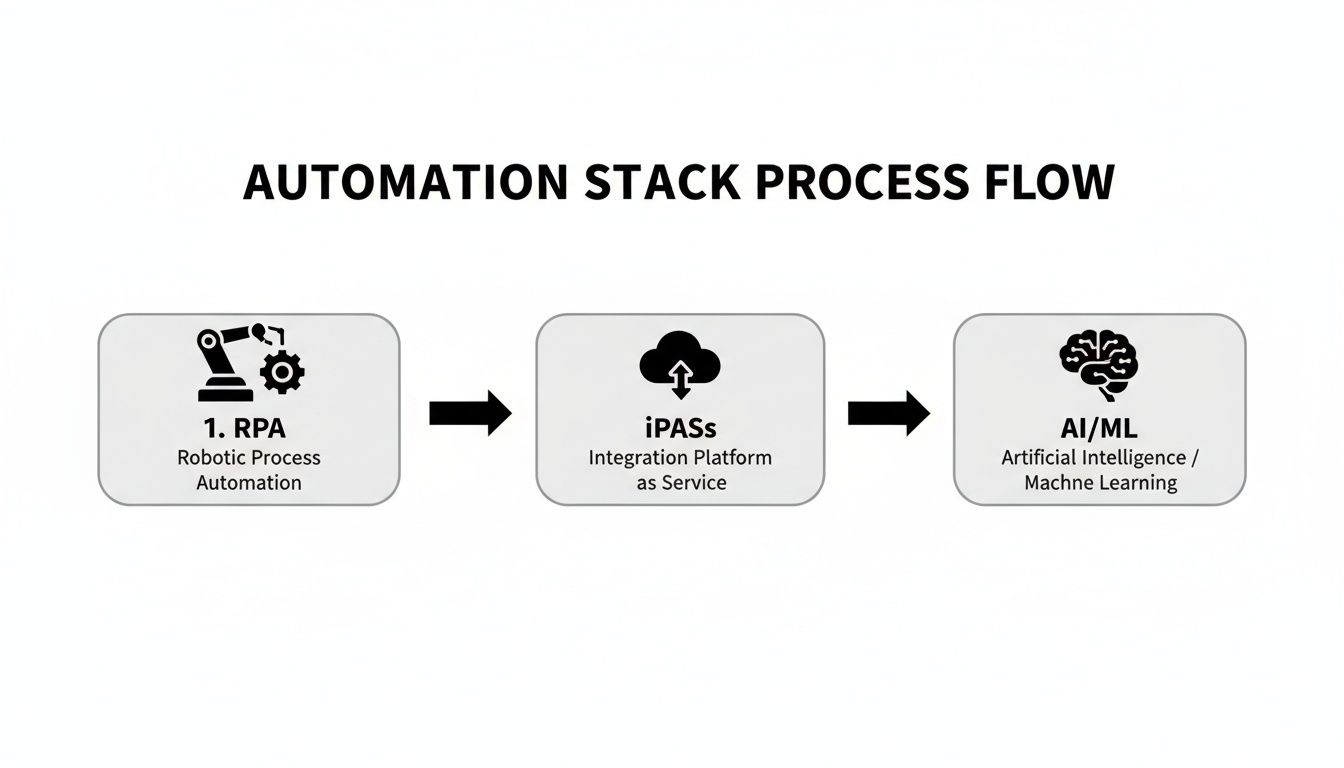
You can see how different tools play specific roles—RPA for screen-scraping old systems, iPaaS for connecting cloud apps, and AI/ML for adding a layer of intelligence to make decisions.
Build Security and Compliance in from Day One
Let's be clear: security can't be an afterthought. When you're automating processes that touch sensitive financial or customer data, you have to embed robust security and compliance controls right from the start. This means security reviews during the design phase, not after deployment, and making sure every workflow is built to comply with regulations like GDPR or SOC 2.
Maintaining stability as you scale is a huge challenge. This is where having a partner with deep expertise in mission-critical infrastructure pays off. Our own Dr3am Security and Dr3am Hosting teams, for instance, specialize in engineering zero-downtime transitions. The goal is to bring new automations online without ever interrupting the core business operations they support.
The real measure of success isn't just the efficiency you gain; it's the trust you build. If the system is buggy, unreliable, or insecure, people will abandon it and go right back to their old manual spreadsheets. That's how these initiatives fail.
The push for automation is happening for a reason. Already, 58% of enterprises have adopted some form of automation, and that number climbs to 84% in large organizations. They’re chasing tangible results: 58% are looking for better product quality, 49% want to boost productivity, and 47% need to lower labor costs. And it's working—globally, 60% of organizations see a positive ROI within the first 12 months.
This is why we focus on delivering measurable outcomes, like achieving 60% reductions in processing time for our clients. By focusing on reliability and a clear return on investment, you can scale your automation program with confidence.
Learn more about how we deliver these kinds of results with our AI and automation services.
Driving Adoption and Measuring Long-Term Success
Let's be honest: the most technically perfect automation will fall flat if the people it’s supposed to help don’t actually use it. A winning automation program is as much about people and change as it is about code and servers. This is where you focus on the human side of the equation, turning potential fear and resistance into real enthusiasm and proving the long-term value of your investment.
The first step is clear and constant communication. Your employees need to hear the "why" behind the automation, straight from leadership. Frame it as a digital assistant—a tool to get rid of the soul-crushing, repetitive tasks so they can spend their brainpower on creative, strategic work that actually matters.
You have to tackle the job security conversation head-on. Don’t avoid it. Show your teams a clear path forward, emphasizing opportunities for them to learn new skills and take on higher-value responsibilities. When people see automation as a way to upgrade their role, not eliminate it, they’ll become your biggest champions.
Establishing KPIs That Tell the Whole Story
To truly prove the value of your automation efforts, you have to measure what matters. Cost savings are an obvious win, but they're just one part of the picture. A great automation program lifts the business in many different ways.
Your key performance indicators (KPIs) need to paint a complete picture of the impact:
- Cycle Time Reduction: How much faster is the process now? Tracking the end-to-end time for something like new customer onboarding or invoice processing gives you a hard number on speed and efficiency gains.
- Error Rate Reduction: Look for a drop in manual mistakes. A lower error rate in data entry, for instance, means fewer costly fixes down the line and happier customers.
- Employee Satisfaction: This one is huge. Use simple pulse surveys to see how teams feel about their new, automated workflows. A jump in satisfaction is a great sign that you’ve removed a major source of daily frustration.
The ultimate goal is to foster a culture of continuous improvement, where automated workflows are constantly monitored, analyzed, and refined. This isn't a "set it and forget it" activity; it's an ongoing cycle of optimization.
Training for a Collaborative Future
Real training isn’t just showing someone which buttons to push. It's about teaching your team how to work alongside their new digital coworkers. The entire focus should be on building their confidence and showing them exactly how automation makes their jobs easier and more impactful.
Hands-on workshops are a fantastic way to do this. Let employees play with the new systems in a safe environment. It takes the mystery out of the technology and gives them a chance to ask questions and provide feedback. When people feel like they’re part of the process, they take ownership of the outcome.
This is also where a dedicated support partner can be a game-changer. With managed support from Dr3amsystems, your internal teams can stay focused on the big picture and driving user adoption. We’ll handle the complex technical monitoring and continuous optimization, making sure your automations are always performing at their best so your people can enjoy the benefits without being buried in maintenance.
By focusing on both your people and the performance metrics, you create a powerful cycle of success. Engaged employees use the tools well, which leads to better KPI data, which in turn proves the ROI and justifies more investment. To dig deeper into building a tech-forward culture, check out the valuable perspectives in our Dr3am Insights blog.
Steering Clear of Common Automation Pitfalls
Even the most carefully planned automation projects can run into trouble. Knowing where the landmines are hidden is the best way to sidestep them, ensuring your investment pays off instead of turning into an expensive learning experience.
The single biggest mistake we see? Automating a broken process. If a workflow is clunky or full of bottlenecks, putting a robot in charge just means you're doing the wrong things faster. It’s a classic case of garbage in, garbage out.
Another frequent misstep is a technology mismatch. Trying to force a simple RPA bot to handle a process that really needs deep system integrations and multiple human approval steps is a recipe for disaster. It creates more manual workarounds than it solves. Just as critical, and often overlooked, is underestimating the human side of the equation—poor change management can kill a project before it even gets off the ground, leaving expensive, powerful tools gathering digital dust.
Don't Let Governance and Security Become an Afterthought
Without a clear governance framework, automation can quickly spiral into chaos. When different teams start building their own one-off solutions, you end up with a "shadow IT" problem—a tangled web of unmonitored bots and integrations that create massive operational and security vulnerabilities. This is why a central strategy, often managed by a Center of Excellence (CoE), is non-negotiable for keeping things on track and aligned with business goals.
This is exactly where an experienced technology partner proves its worth, helping you see around corners from day one.
The automation initiatives that truly succeed are built on proactive risk management. They don't wait for problems to appear; they anticipate everything from technical debt to user resistance and build a plan to address it head-on.
Working with a team like Dr3amsystems helps turn this complex journey into a clear, high-return initiative. Our dedicated practices, Dr3am AI and Dr3am Security, are designed to help you build a resilient and secure automation program from the ground up. Our experts make sure your critical operations stay reliable and cost-efficient, whether we're modernizing old systems or deploying sophisticated machine learning models.
We focus on a practical roadmap where every technical choice is tied directly to measurable business value. This approach helps you avoid the common traps and get to your desired outcomes faster. To see exactly how we bake security into every layer of our solutions, take a closer look at our Dr3am Security practice.
Your Top Questions About Business Process Automation, Answered
When you start talking about automation, a few questions always pop up. It's only natural. Let's tackle some of the most common ones I hear from enterprise leaders.
The big one is always about jobs. "Will this replace my team?" The short answer is no. Think of it as augmentation, not replacement. The whole point is to take the soul-crushing, repetitive work off your team's plate. This frees them up for the stuff that actually requires a human brain: strategic thinking, creative problem-solving, and building real customer relationships.
What Should We Automate First?
Don't try to boil the ocean. Look for the quick wins.
I always tell clients to hunt for processes that are high-volume, mind-numbingly repetitive, and strictly rule-based. These are your golden tickets to an early ROI. You'll usually find them hiding in plain sight in departments like:
- Finance: Think invoice processing or accounts payable.
- HR: Employee onboarding paperwork is a classic example.
- IT: Simple help desk ticket routing and resolution.
Starting here does a few critical things. It gets a win on the board fast, which builds momentum and makes it much easier to get buy-in for bigger projects down the road. It also keeps the initial risk low, since these processes are far simpler to map out and automate.
What Kind of ROI Can We Realistically Expect?
This is where the rubber meets the road. While every project is different, it's not unusual for companies to see a positive return in the first 12 to 18 months.
The ROI isn't just about cutting labor costs, either. You're getting value from faster processing times, a massive reduction in human error (which has its own cleanup cost), and the ability to scale operations without proportionally scaling your headcount.
Any technology partner worth their salt should be obsessed with results. At Dr3amsystems, we've helped clients achieve outcomes like a 60% reduction in processing time. That’s not just a vanity metric; it’s a direct line to a faster, healthier ROI. The goal is always to connect your investment to a tangible business outcome, right from the start.
Ultimately, a well-executed automation program pays for itself by building a more efficient and resilient business.
Ready to move from strategy to reality? The team at Dr3amsystems can help. We kick things off with a free consultation to map out your goals, pinpoint those high-impact automation opportunities, and build a practical roadmap. Contact us today to get started.