
A real cloud migration roadmap isn't some generic checklist you download off the internet. It's a detailed, living blueprint that maps out exactly how your organization will move applications and data to the cloud. Critically, it has to tie every technical step back to a specific business goal, making sure the entire effort cuts risks, keeps costs in check, and actually delivers the value you're after.
Why Generic Cloud Migration Roadmaps Don't Cut It Anymore

The conversation has moved on. We're not just talking about lifting and shifting a few servers anymore. We're talking about a core business move designed to make you more agile, innovative, and competitive. The market growth alone tells the story. The global cloud migration services market is on a trajectory to leap from USD 12.92 billion in 2025 to a massive USD 48.86 billion by 2031. This isn't just a trend; it's a fundamental shift in how businesses operate. You can read more about this explosive market growth and its implications.
That explosion in demand shines a spotlight on a hard truth: a one-size-fits-all plan is a recipe for failure in today's messy, complex IT environments. Generic roadmaps are dangerous because they completely ignore the unique DNA of your business, leading to expensive blunders and wasted potential.
The Pitfalls of an Off-the-Shelf Plan
Think about it. A generic cloud migration roadmap simply can't see the full picture. It’s blind to your organization’s most critical details, like:
- Legacy System Dependencies: We’ve all seen them—those old, monolithic apps with a spiderweb of tangled dependencies. A standard checklist will never uncover these, and you'll find out the hard way when things go dark.
- Security and Compliance Mandates: Whether you're in finance, healthcare, or retail, you have specific regulatory rules to follow. These can't be an afterthought; they must be designed into the migration from day one.
- AI and Data Integration Goals: If you're moving to the cloud to finally get serious about machine learning, your plan needs to be obsessed with data pipeline architecture. A generic plan won't even mention the specific cloud services you'll need.
- Cost Optimization Nuances: Without a proper deep-dive into your current workloads, you're just guessing. A generic plan almost guarantees you'll overprovision resources and watch your cloud bill spiral out of control.
A successful cloud migration is less about following a template and more about building a strategic blueprint. It must align every technical decision with a tangible business outcome, ensuring the final architecture supports long-term growth and innovation.
Building a Roadmap That Gives You an Edge
A modern cloud migration roadmap is a dynamic, business-first document. It changes the entire conversation, turning what could be a high-risk IT project into a strategic advantage that sets your operation up for the future. This is where having a technology partner who’s been there before, like Dr3amsystems, is invaluable.
We always start with a free consultation to get crystal clear on your goals, identify smart automation opportunities, and design a roadmap that connects technology directly to business value. By drawing on our specialized Dr3am Cloud and Dr3am AI practices, we make sure your plan is built to solve your specific challenges.
This approach transforms a complicated technical project into a clear path toward real results. We've seen clients achieve 60% reductions in processing time and pull off zero-downtime transitions—outcomes that don't happen by accident. For more expert advice on building effective technology strategies, check out our other guides.
Getting Your Foundation Right: The First Steps to a Successful Migration
Every successful cloud migration I've ever been a part of started with one thing: a deep, honest look at the current state of affairs. This isn't just about making a list of servers. This is where you lay the groundwork for the entire project, and skipping this phase is like building a house on a shaky foundation. It’s where migrations are won or lost.
You have to dig in and really understand your IT ecosystem. This means cataloging every application, untangling the web of dependencies between them, and getting a clear-eyed view of your security posture. This isn't just a box-ticking exercise for the tech team; it’s about connecting every piece of technology to a real business reason. If you don't have this clarity, you’re just guessing, and that leads to blown budgets, surprise security holes, and a migration that ultimately doesn't deliver what the business expects.
Taking Inventory and Finding the Hidden Connections
First things first, you need a complete picture of what you actually have. Document every server, application, database, and network appliance. But a simple list is just the start. The real work—and the part where so many projects get tripped up—is mapping out all the hidden dependencies that tie everything together.
That e-commerce platform might look simple on a diagram, but what about its connection to that ancient inventory system in the back office? Or the third-party payment gateway? Or the on-prem data warehouse the finance team uses for reports? You miss just one of those connections, and you could bring the whole business to a grinding halt the day after you go live.
- Profile Your Applications: Don't just write down names and versions. You need to know their performance profile, how much CPU and memory they chew through, and when they're busiest.
- Map the Dependencies: Use a combination of automated discovery tools and, just as importantly, actually talking to the people who use the systems. Your goal is a clear map of what talks to what, and why.
- Classify Your Data: Figure out where your most sensitive information lives—customer data, financial records, PII. This is non-negotiable for staying compliant and secure in the cloud.
A classic mistake I see all the time is underestimating the complexity of older, legacy systems. What looks like a simple app often has a decade's worth of undocumented integrations bolted on. A thorough discovery process turns these potential show-stopping surprises into manageable tasks on your project plan.
This audit is also the perfect time to do some house cleaning. You'd be surprised how many organizations find that up to 20% of their applications are redundant, obsolete, or barely used. Shutting those down before you migrate simplifies everything and gives you an immediate cost saving.
Connecting Your Tech Goals to Real Business Outcomes
Once you have a solid technical inventory, you need to tie it all back to the business. Why are we even doing this? "Because we want to be in the cloud" is not a business case. Your reasoning needs to be anchored to specific, measurable outcomes that the C-suite can get behind.
Think in terms of concrete goals like these:
- Slash operational costs by a target of 15% in the first year.
- Boost application performance to cut customer page load times by 40%.
- Strengthen disaster recovery to guarantee a recovery time objective (RTO) of less than one hour.
- Speed up development cycles by giving developers the ability to spin up new environments in minutes, not weeks.
These aren't just wish-list items; they become the Key Performance Indicators (KPIs) that prove the project's success. They create a clear "why" that will guide every decision you make along the way. To get a better sense of how this works in practice, you can explore our insights on building a comprehensive IT strategy.
Calculating the True Total Cost of Ownership (TCO)
Finally, you need a realistic financial model. A proper TCO analysis for the cloud goes way beyond comparing your current data center bills to a cloud provider's estimate. A real TCO has to factor in all the direct and indirect costs—and the benefits.
| Cost & Benefit Category | On-Premises Considerations | Cloud Considerations |
|---|---|---|
| Direct Costs | Hardware purchases, software licensing, data center rent, power, cooling, IT labor. | Subscription fees, data transfer fees, storage costs, support plans. |
| Indirect Costs | Downtime losses, manual deployment processes, slow scalability, security patching labor. | Migration project costs, training for new skills, potential for overprovisioning. |
| Benefits | Full control over hardware. | Increased agility, improved security, pay-as-you-go pricing, scalability, reduced IT overhead. |
Doing this level of detailed analysis prevents sticker shock down the road and helps you build a financial case that will withstand tough questions. This is where the pragmatic, results-focused approach of a partner like Dr3amsystems pays off. We look beyond obvious costs to find automation opportunities and design a roadmap that delivers measurable ROI, ensuring your migration is a strategic investment, not just another IT budget item.
Designing Your Resilient and Secure Cloud Blueprint
Once you've locked in your strategy, it's time to get your hands dirty and start architecting your future in the cloud. This is the blueprinting phase, where the high-level business goals of your cloud migration roadmap translate into a tangible, technical design. The decisions you make here will echo for years, defining the resilience, security, and cost-efficiency of your new environment.
This isn't just about picking AWS, Azure, or Google Cloud. It's about deciding how each application will live and breathe in its new home. You need a detailed plan covering everything from the migration method for each app to untangling dependencies and baking in security from the ground up.
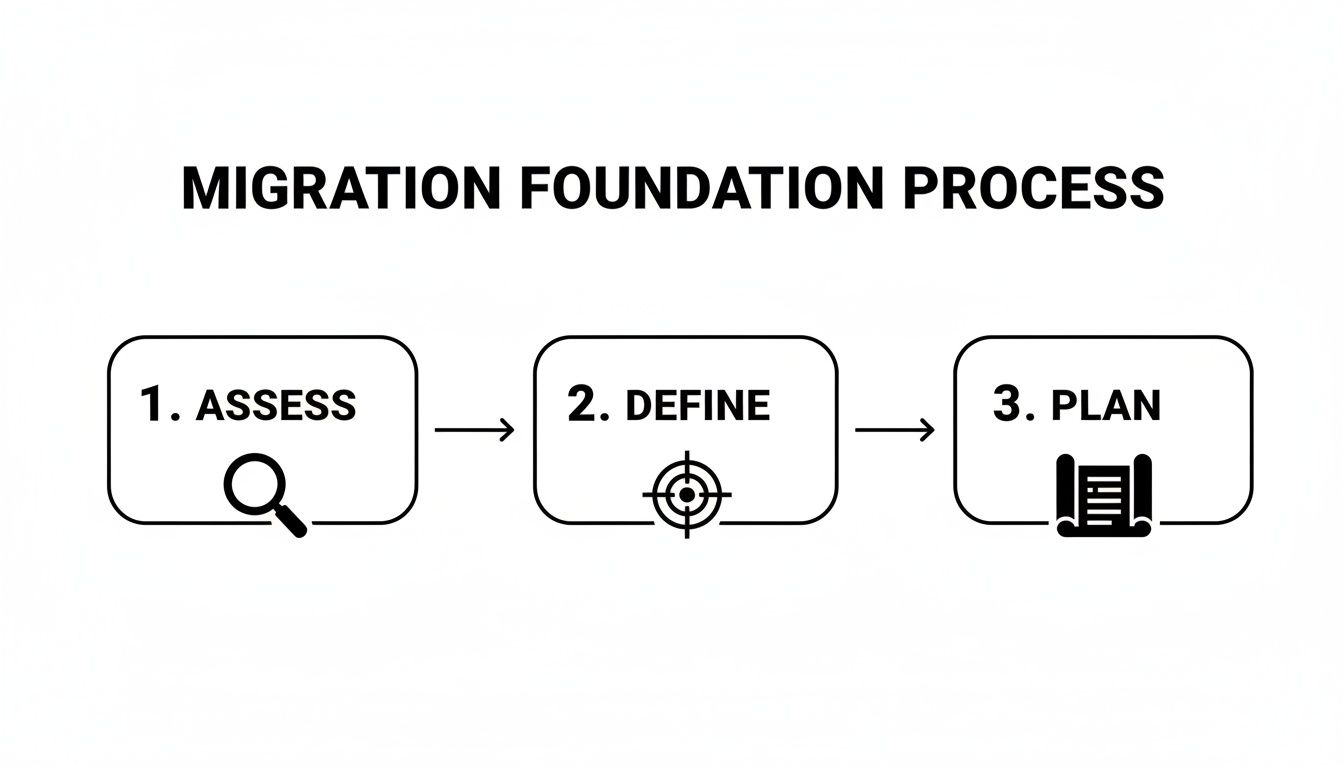
As you can see, a successful design always follows a structured path—from knowing what you have (assess), to defining what you want (define), and finally, to building the detailed plan to get there.
Choosing Your Cloud Migration Strategy (The 6 Rs)
Not all applications are created equal, so a one-size-fits-all migration approach is a surefire way to waste time and money. The "6 Rs" framework is the industry-standard way to think about this, giving you a menu of options for each workload. In my experience, the most successful migrations use a mix of these strategies to strike the right balance between speed, cost, and long-term business value.
Here's a breakdown to help you decide which path makes sense for your applications.
| Strategy | Description | Common Use Case | Pros | Cons |
|---|---|---|---|---|
| Rehost | "Lift-and-Shift." Move applications as-is with minimal to no changes. | Legacy systems, non-critical apps, or when speed is the top priority. | Fastest migration path; requires minimal resources. | Doesn't take advantage of cloud-native features; can lead to high operating costs. |
| Replatform | "Lift-and-Tinker." Make a few cloud-specific optimizations during the move. | Moving from a self-managed database to a managed cloud database service (e.g., Amazon RDS). | Quick wins with some cloud benefits; lower operational burden. | Still not fully cloud-native; may miss deeper optimization opportunities. |
| Refactor | "Re-architect." Substantially redesign the application to be cloud-native. | Core, business-critical applications where scalability and resilience are paramount. | Maximum benefits in performance, cost, and agility. | Most complex, time-consuming, and expensive approach upfront. |
| Repurchase | "Drop-and-Shop." Replace an existing application with a SaaS solution. | Moving from on-premise CRM/HRM to platforms like Salesforce or Workday. | Reduces management overhead; often provides modern features. | Can lead to data migration challenges and vendor lock-in. |
| Retire | Decommission applications that are no longer needed. | Redundant or obsolete software discovered during the assessment phase. | Immediate cost savings on hardware, software, and maintenance. | Requires careful communication to ensure business processes aren't disrupted. |
| Retain | Leave certain applications on-premise or in their current environment. | Highly specialized legacy systems or apps with strict compliance/residency rules. | No migration cost or risk; keeps critical systems stable. | Misses out on cloud benefits; can create a complex hybrid environment to manage. |
Choosing the right "R" is a balancing act. A mission-critical, customer-facing application is often a perfect candidate for refactoring to unlock its full potential. On the other hand, a simple internal legacy tool might be a textbook rehost. Your assessment data is your guide here.
Mapping Dependencies and Planning Migration Waves
One of the easiest ways to derail a cloud migration is to miss a critical dependency. I’ve seen it happen: a single forgotten API call or database link brings down a whole suite of applications, causing chaos. This is why meticulous dependency mapping is absolutely non-negotiable.
Once you have a crystal-clear map of how everything talks to everything else, you can start grouping applications into logical migration waves. Trying to move everything at once is a recipe for disaster. A phased approach, however, is smart and manageable. It allows your team to:
- Start small: Pick low-risk, low-dependency applications for the first wave to build confidence and test your processes.
- Group logically: Move tightly coupled systems together in the same wave to minimize disruption and avoid breaking things.
- Iterate and improve: Learn from each wave. What went well? What didn't? Use those lessons to refine your approach for the more complex systems down the line.
A well-planned wave strategy transforms a monolithic, high-risk project into a series of manageable, low-risk sprints. It’s the key to delivering value faster and giving your team the experience they need to tackle the really tough stuff later.
This methodical approach is catching on. The North American cloud migration market is projected to hit USD 5.2 billion in 2025, with a steady 22.0% CAGR through 2035. This boom is driven by enterprises finally moving off aging systems to get the agility they need for today’s distributed workforces. You can see more on these North American cloud migration market trends.
Embedding Security From Day One
In any modern cloud roadmap, security can't be an afterthought—it has to be woven into the very fabric of your design. Building a "secure-by-default" environment means you're integrating security controls and compliance frameworks from the absolute beginning, not bolting them on at the end.
This is where having a dedicated security practice, like our own Dr3am Security team, makes a world of difference. We don’t just run a checklist after the fact; we embed robust controls directly into your cloud architecture from the start.
This includes fundamentals like:
- Identity and Access Management (IAM): Defining granular, role-based permissions based on the principle of least privilege.
- Network Security: Properly configuring Virtual Private Clouds (VPCs), subnets, and firewalls to isolate workloads and control traffic flow.
- Data Encryption: Enforcing encryption for all sensitive data, both at rest and in transit.
- Compliance Automation: Using infrastructure-as-code (Terraform, CloudFormation) to programmatically enforce compliance with standards like GDPR, HIPAA, or PCI DSS.
This proactive stance doesn't just reduce risk—it also makes audits smoother and ensures you’re meeting your regulatory obligations from day one. To see how our cloud services can help you build a blueprint for a secure, zero-downtime transition, you can learn more about our Dr3am Cloud practice.
From Blueprint to Reality: Executing Your Migration

This is where the rubber meets the road. All the meticulous planning, discovery, and strategy sessions lead to this moment: the execution phase. A great plan is one thing, but translating it into a functioning, high-performance cloud environment is another. It’s a delicate dance of technical skill, clear communication, and smart risk management.
Successfully getting through this stage means moving from theory to practice with confidence. The journey starts with a small, controlled pilot project, moves through the critical cutover window, and finishes with a clean handoff to your operations team.
Start Small: The Pilot Project
Before you even think about moving a mission-critical application, you need to test your entire process on a smaller scale. Think of a pilot project as your migration dress rehearsal. It’s your chance to validate every tool, methodology, and team assumption in a low-risk setting.
Pick a non-critical but still representative application for this first move. The goal here isn't just to see if the app works in the cloud—it's to stress-test your entire migration workflow from start to finish.
What you're really validating in the pilot:
- Toolchain Functionality: Do your automation scripts, monitoring tools, and security scanners actually work as expected in the new environment? Now is the time to find out.
- Process Gaps: Document every single step. This is where you’ll spot the bottlenecks and refine your communication plan for the more complex waves ahead.
- Team Readiness: This is the best hands-on training your team will ever get. It builds real-world skills and confidence before they have to tackle the high-stakes systems.
A successful pilot confirms your roadmap is solid. More importantly, it provides invaluable lessons that will make every subsequent migration wave faster, smoother, and far less stressful.
The Power of AI-Driven Automation
Modern migrations have moved beyond manual, error-prone checklists. The arrival of AI-driven tools is fundamentally changing how execution gets done. These platforms automate the tedious work, predict potential problems, and bring a level of precision that human effort alone just can't match.
AI and machine learning now automate key migration processes, from the initial assessment right through to post-migration optimization. This is a big reason why the online/live migration segment captured a massive 62.2% of the public cloud migration market share in 2023—its ability to ensure business continuity is a huge draw. If you're curious, you can find more insights on cloud migration trends and how AI is reshaping the industry.
This is where bringing in an experienced partner makes a measurable difference. Our expertise in secure cloud migrations and AI-driven solutions is how we deliver results like 60% reductions in processing time and true zero-downtime transitions for our clients.
Navigating the Cutover and Your Rollback Plan
The cutover is the moment of truth. It's the point where you flip the switch from the legacy system to your new cloud environment. A smooth cutover is the direct result of painstaking planning, not luck. You need a detailed, minute-by-minute script that outlines every action, every checkpoint, and every person's exact responsibility.
Just as important is your rollback plan. No matter how confident you are, you absolutely must have a pre-tested, documented plan to revert to the old system if something goes wrong. A solid rollback plan is your ultimate safety net, guaranteeing business continuity.
Your rollback strategy needs to define:
- Clear Triggers: What specific issues (e.g., critical performance lag, data corruption) will force a rollback? No gray areas.
- Step-by-Step Procedures: A precise checklist of actions to restore the original environment and reroute user traffic.
- Communication Protocol: Who needs to know, and when, if a rollback is triggered?
This is where the hands-on execution and enterprise-grade expertise of a dedicated partner become invaluable. Our Dr3am AI practice, for example, helps organizations build intelligent systems that can automate much of this validation, further de-risking the entire cutover process. You can see how we can help by exploring our AI-driven solutions and services.
By combining a smart pilot, AI-powered tools, and a bulletproof cutover plan, you can execute your migration with the precision needed to deliver on your roadmap's promises. This sets the stage for a clean handover and the long-term work of optimizing your new cloud foundation.
Governing and Optimizing Your New Cloud Environment
Getting your apps and data to the cloud isn't the finish line. It's the starting line for a whole new way of operating. The real, long-term value of your cloud migration roadmap comes from what you do after the cutover.
Without strong governance and a real commitment to continuous optimization, the agility and cost savings you were banking on can vanish into thin air. This final phase is all about setting the rules of the road for your new environment, making sure your cloud investment pays dividends for years to come.
Mastering Cloud Costs with FinOps
One of the biggest post-migration shocks I see companies face is an unexpectedly high cloud bill. The pay-as-you-go model is a double-edged sword; it's incredibly flexible, but it can lead to runaway costs without serious discipline. This is exactly where FinOps, or cloud financial operations, comes in.
FinOps isn't just a tool; it's a cultural shift that brings your tech, finance, and business teams together. The shared goal? Squeezing the maximum business value from every single dollar spent on the cloud.
Here are a few essential FinOps practices you should put in place from day one:
- Enforce Strict Resource Tagging: This is non-negotiable. Every resource must be tagged so you can accurately track and allocate costs to the right teams, projects, or products. It’s the only way to get a clear picture of where the money is really going.
- Set Up Budget Alerts: This simple step can save you from major month-end surprises. Configure alerts to automatically notify you when spending for a service or project gets close to its limit.
- Automate Cost Controls: A huge source of waste is non-production environments left running 24/7. Use simple scripts to automatically shut down development and staging environments outside of business hours. This alone can slash costs for those workloads by over 50%.
Your cloud migration roadmap doesn't end at the cutover. It must include a detailed plan for Day Two operations. Establishing strong FinOps practices from the very beginning is the single most important step you can take to ensure the long-term financial health of your cloud investment.
Continuous Performance and Security Management
Beyond the budget, your new cloud environment demands constant attention. The cloud is always changing, with new services popping up and new threats emerging daily. Your governance model has to be just as dynamic to keep pace.
This means you have to move beyond old-school, periodic audits and embrace a model of continuous monitoring. Set up real-time dashboards to track key application performance metrics, like latency and error rates. You want to spot issues long before they ever impact your users.
Security can't be a "set it and forget it" task, either. You'll need to implement Cloud Security Posture Management (CSPM) tools. These platforms continuously scan your environment for misconfigurations, vulnerabilities, and compliance gaps, hardening your defenses around the clock.
Partnering for Long-Term Success
Let's be honest: managing a complex cloud environment is a full-time job that requires very specialized skills. For a lot of organizations, trying to handle all the day-to-day management in-house just distracts the team from their core mission: building great products and driving the business forward.
This is where bringing in a dedicated partner for managed support becomes a strategic advantage.
By partnering with a technology expert like Dr3amsystems, you offload that ongoing operational burden. Our Dr3am IT and Dr3am Hosting practices provide the hands-on execution needed to keep your critical operations running smoothly. We handle the monitoring, patching, cost optimization, and security, freeing up your team to focus on what’s next.
This kind of partnership ensures your cloud architecture doesn't just sit there; it evolves. We help you adopt new cloud services responsibly and keep your technology strategy tightly aligned with your business goals, turning a successful migration into sustainable growth.
Common Cloud Migration Roadmap Questions
Even with the best-laid plans, a few key questions always pop up before a big cloud move. It's smart to tackle these concerns early, as it gets everyone on the same page and builds the confidence needed to get started. These are the ones I hear most often from leadership teams.
How Long Does a Typical Cloud Migration Take?
This is the classic "how long is a piece of string" question. The honest answer? It really depends on the complexity of your current setup and the migration path you choose.
A straightforward "lift-and-shift" of a few less critical apps could be wrapped up in as little as 1-3 months. But for a large-scale enterprise project—one that involves refactoring dozens of tangled, interdependent systems—you should realistically expect a timeline of over a year.
The trick is to stop thinking of it as one monolithic project. A smart roadmap breaks the migration into manageable waves. This way, you start seeing real business value quickly, which helps build momentum and prove the concept to the rest of the organization. This is where a partner like Dr3amsystems comes in, helping to structure these phased roadmaps to deliver quick wins without disrupting the business.
What Are the Biggest Risks in a Cloud Migration?
The big three worries that keep executives up at night are almost always the same: surprise costs, security holes, and business downtime. The good news is that with a solid plan, you can get ahead of every single one.
The best way to de-risk a cloud migration is to plan for failure before it happens. That means being obsessive during the discovery phase, building security in from the very beginning, and having a rollback plan you’ve actually tested.
Here’s a practical way to think about each risk:
- Unexpected Costs: This is usually a sign that the initial discovery wasn't deep enough. You can head this off with a detailed Total Cost of Ownership (TCO) analysis and by weaving in FinOps practices from day one. Think resource tagging and budget alerts—get them running the moment you start spinning up resources.
- Security Gaps: Don't treat security as a feature you bolt on later. It needs to be part of the blueprint from the start. A secure-by-default architecture means you're addressing compliance and threats before they become live vulnerabilities.
- Business Downtime: This is where proven live migration techniques and a rock-solid rollback plan are non-negotiable. Working with a partner like Dr3amsystems, who has a history of zero-downtime transitions, is really the only way to guarantee business as usual.
Should We Choose a Single Cloud or a Multi-Cloud Strategy?
There’s no single "right" answer here—it all comes down to what you're trying to achieve as a business.
Going all-in with one cloud provider simplifies things. Your team gets to build deep expertise, and management is more straightforward. On the other hand, a multi-cloud or hybrid approach helps you avoid vendor lock-in and lets you pick and choose the absolute best service for a specific task, regardless of the provider.
Honestly, most companies find themselves in a hybrid or multi-cloud reality over time, even if they don't start there. Your roadmap needs a clear-eyed analysis of your application portfolio, data sovereignty rules, and long-term vision to make the right call. An experienced partner can provide an objective breakdown of the pros and cons, helping you design an architecture that works for you today and won't box you in tomorrow. As you map out potential budgets, you can find helpful information on our cloud services pricing.