
What happens when a simple business policy change—like adjusting a promotional discount or updating a compliance check—turns into a full-blown IT project? For most companies, this is a frustrating reality. Critical operational rules are often buried deep inside application code, making them slow, expensive, and risky to change.
Business rule management offers a way out of this cycle. It's a straightforward but powerful approach: pull your business logic out of the code and manage it separately.
Why Business Rule Management Is Your Key To Agility

At its heart, business rule management (BRM) is all about separating your company’s "how-to-decide" logic from its "how-to-run" code. Instead of waiting for a developer to translate a new policy into Java or C#, BRM gives the reins to the people who actually own those policies—the product managers, underwriters, and compliance officers.
Think about it like this: your business rules are the official playbook for how your company operates. Traditionally, that playbook has been written in a programming language that only developers can read. BRM translates it into something closer to plain English, giving non-technical experts a workbench to update the plays themselves. This is the big shift, moving you from IT-dependent rigidity to business-led speed.
The Tool That Makes It Possible
Making this happen requires a specific kind of software: a Business Rule Management System (BRMS). A BRMS is the central hub where you can write, test, manage, and deploy all your business rules.
Organizations that get this right see some immediate and significant benefits:
- Faster Reactions: Update rules in minutes or hours, not weeks, to respond to market shifts or new regulations.
- Fewer IT Bottlenecks: Your development team can stop working on minor rule changes and get back to building core features.
- Better Consistency: A single source of truth for rules means they are applied the same way across every app and channel.
- Clearer Audits: When logic is easy to read, proving compliance and explaining decisions to stakeholders becomes much simpler.
The incredible growth in this space tells the story. The global BRMS market was valued at USD 1.56 billion in 2026 and is expected to climb at a CAGR of 11.8% through 2031. This isn't just a trend; it's a fundamental move away from rigid, hard-coded logic toward the flexibility that modern business demands.
To see just how different these two approaches are, let's break them down.
Hard-Coded Logic vs Business Rule Management
| Aspect | Hard-Coded Logic (The Old Way) | Business Rule Management (The Modern Way) |
|---|---|---|
| Who Makes Changes? | Developers only. Requires a full development cycle. | Business analysts or policy owners, often with no code. |
| Speed of Change | Slow (weeks or months). Tied to release schedules. | Fast (minutes or hours). Can be deployed independently. |
| Visibility | Opaque. Logic is buried in complex source code. | Transparent. Rules are readable by business stakeholders. |
| Consistency | Risky. Logic can be duplicated and diverge across systems. | High. A central repository ensures a single source of truth. |
| Agility | Low. The business is constrained by IT's backlog. | High. The business can adapt to change in real time. |
The difference is stark. Moving to a BRMS is about fundamentally changing who is in control of your operational decisions and how quickly they can act.
A business rule statement is a declarative statement, defining some structure or constraint that the business places on itself or has placed on it by law or other means. It turns abstract policy into concrete, executable logic.
From Strategy To Execution
True agility is a core goal of business process optimization, and BRM provides a direct, practical path to get there. It creates a solid bridge between high-level business strategy and the thousands of automated decisions your systems make every single day.
A great technology partner makes building that bridge much easier. Dr3amsystems is a technology partner that helps businesses accelerate outcomes with AI-driven solutions, secure cloud migrations, and dedicated managed support. We help companies not only select and implement a BRMS but also connect it with AI and cloud infrastructure to get the most out of it. We focus on delivering real-world results, like slashing claims processing times or automating compliance checks, ensuring your investment in BRM pays off quickly.
Find out how Dr3amsystems' end-to-end services can help you put your business logic back in the hands of your business experts.
Exploring the Core Components of a BRMS
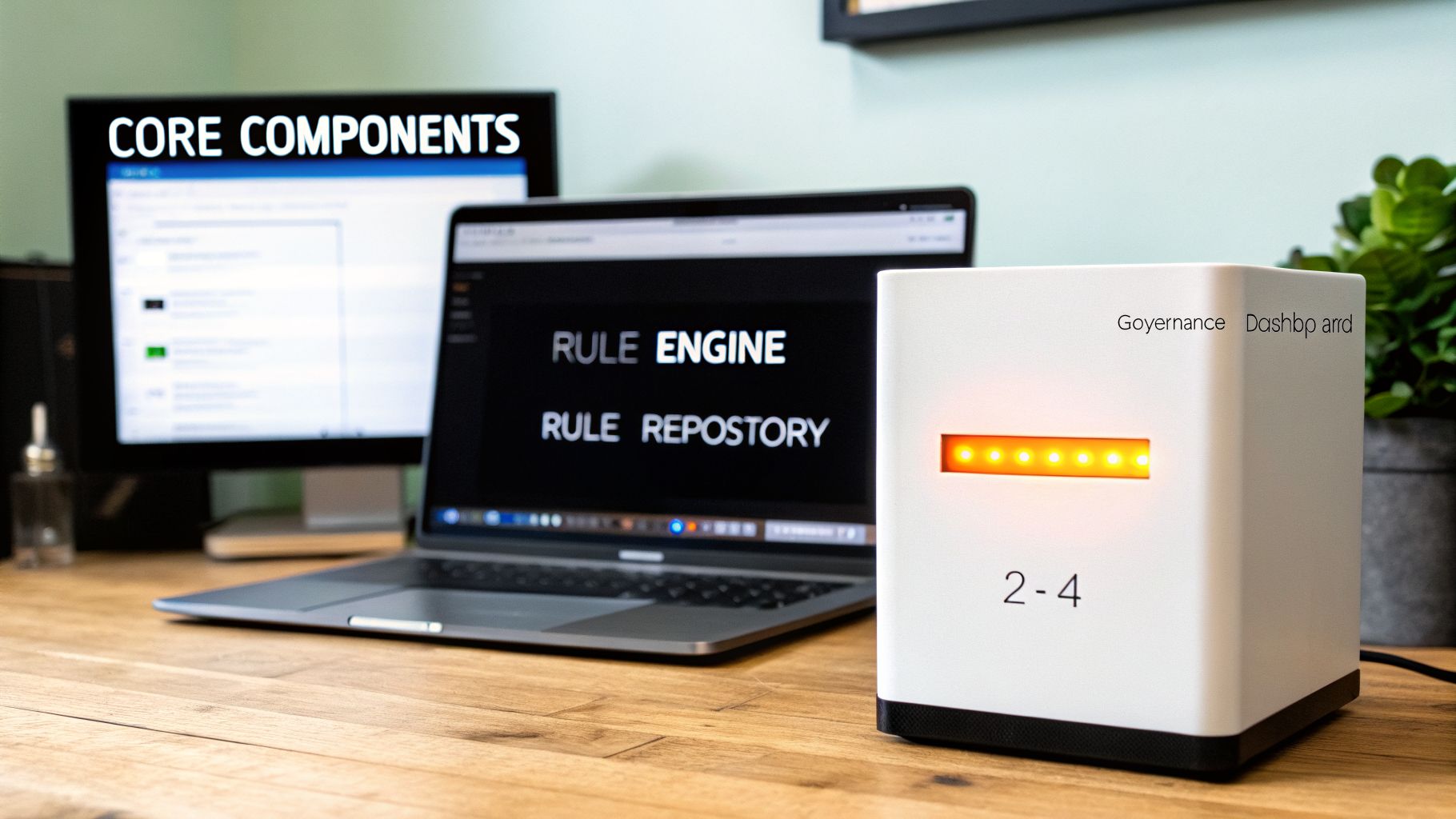
To really understand what a Business Rule Management System (BRMS) does, you have to look at its moving parts. It’s not just one piece of software; it's an ecosystem of tools designed to let your business logic live outside of your core application code. This separation is what gives you the power to be both agile and consistent.
The heart of any BRMS is the Rule Engine. Think of it as the system's brain—a high-performance decision-maker. When your application needs an answer to a business question, like "Does this customer get free shipping?" or "Is this insurance claim valid?", it packages up the relevant data and sends it to the engine.
The engine takes that data, runs it against all the defined rules, and returns a clear decision, often in milliseconds. It’s built for speed, capable of handling thousands of decisions a second without blinking. This is what makes real-time, large-scale automation possible.
The Rule Repository and Authoring Interface
So where do all these rules live? They're stored in the Rule Repository. This is a centralized library that acts as the single source of truth for your organization's business logic. By keeping every rule in one place, you ensure that your website, mobile app, and internal systems are all operating on the same page. No more hunting down outdated logic buried in a dozen different codebases.
Of course, a library needs librarians. The Rule Authoring Interface is the workbench that lets your business experts—the people who actually know the policies inside and out—create and manage the rules themselves. Instead of filing a ticket with IT and waiting weeks, they can get their hands dirty directly.
This is done through intuitive, business-friendly formats. We're not talking about complex code, but rather:
- Decision Tables: Simple spreadsheets that map conditions to outcomes. Perfect for complex pricing or eligibility scenarios.
- Decision Trees: Visual flowcharts that walk through a series of questions to arrive at an answer.
- Natural Language: Simple "if-then" statements written in a structured, plain-English way.
This is the magic that closes the gap between business intent and technical execution. If you're building custom internal tools, empowering your team this way is a game-changer. You can see more on this in our guide to improving custom business applications.
Governance and Management Tools
Giving business users the keys to the kingdom sounds great, but it also sounds a little risky. That’s where Governance and Management Tools come in. These are the guardrails that ensure speed doesn't come at the cost of stability.
A BRMS creates a controlled, transparent workflow from business idea to automated decision. This shortens the time it takes to launch new products or update policies while drastically reducing the risk of human error.
These tools manage the entire rule lifecycle. They provide essentials like version control, so you have a full audit trail of who changed what and when, with the ability to roll back if something goes wrong. They also include testing and simulation environments, allowing you to see the impact of a rule change before it goes live.
A partner like Dr3amsystems can help weave these components into your existing architecture, often using cloud platforms for flexibility and scale. Through our focused practices—Dr3am IT, Dr3am Cloud, Dr3am AI, and Dr3am Security—we make sure your BRMS is not just a powerful engine but a secure, intelligent foundation for decisions—one that can deliver tangible outcomes like 60% reductions in processing time, as confirmed by executive testimonials.
Seeing Business Rule Management in Action
Theory is one thing, but the real power of business rule management clicks when you see it solve actual operational problems. This is where the abstract concept becomes a concrete tool for making your business faster, smarter, and more consistent. By separating your decision-making logic from your core applications, you can turn slow, manual tasks into efficient, automated workflows.
Let's look at a few real-world scenarios. We see companies in every industry facing similar roadblocks, and a BRMS often provides the perfect solution. A great example of this principle is modern workflow automation, where logic-driven decisions keep business processes moving without constant human intervention.
Finance: Real-Time Fraud Detection
The Problem: A credit card company was bleeding money from fraud. Their system checked for fraudulent transactions in batches, meaning they'd often discover the theft hours after the damage was done. Worse, adapting to new fraud tactics meant calling in developers for a slow and expensive coding project.
The Solution: They brought in a BRMS to handle their fraud detection rules. Now, their fraud analysts—the people who actually understand financial crime—could build and manage the logic themselves. The system instantly checks every transaction against a sophisticated set of rules looking at the amount, location, merchant, and timing.
The Outcome: The new system blocks suspicious transactions in milliseconds, not hours. When a new scam pops up, analysts can create and deploy a counter-rule in less than an hour, all on their own. This has drastically cut their fraud losses and given their customers much-needed security.
E-Commerce: Dynamic Pricing and Promotions
The Problem: An online retail giant struggled with promotions. Their marketing team would dream up great ideas like, "Buy a TV, get 20% off a soundbar, with free shipping for loyalty members in California." But getting these complex, temporary offers coded by the IT department was a nightmare, causing huge delays and frequent mistakes.
The Solution: They integrated a BRMS into their e-commerce platform, giving the marketing team control. Using simple decision tables, marketers can now build, test, and schedule their own promotional rules. They can easily layer different offers for specific customer groups, cart values, or even current inventory levels.
The Outcome: The retailer can now launch dozens of targeted campaigns at once with almost no help from IT. This newfound agility has boosted sales, engaged customers, and lets them respond immediately to a competitor's price drop.
Business rule management empowers the subject matter experts—the people who understand the policies best—to own and control the logic that drives their part of the business. It closes the gap between business intent and technical execution.
This approach is catching on fast. North America is expected to be the dominant market for this technology, making up around 40% of worldwide sales by 2026. And the reason is simple: it works. For operations leaders, breaking the dependence on IT for every rule change can lead to significant gains. That’s an outcome Dr3amsystems consistently helps clients achieve with our pragmatic, results-focused approach to AI-driven automation.
Healthcare: Automated Claims Processing
The Problem: A health insurance provider was drowning in paperwork. A huge number of claims required manual review to check everything from provider eligibility to member coverage and service codes. The process was painfully slow, expensive, and riddled with errors.
The Solution: They implemented a BRMS to automate the entire validation process. The rule engine instantly checks every incoming claim against thousands of constantly changing rules, including federal regulations, state mandates, and the details of individual health plans.
The Outcome: Today, over 85% of their claims are processed automatically without a single person touching them. This "touchless adjudication" frees up their expert reviewers to focus only on the most complex exceptions. The result? A massive drop in administrative costs and happier, faster-paid providers.
And these examples are just scratching the surface. When you combine a BRMS with advanced analytics, things get even more interesting. The Dr3amsystems’ Dr3am AI practice helps businesses build intelligent data pipelines that feed predictive insights right into the rule engine. This allows you to make decisions based not just on what happened, but on what’s likely to happen next. We dive into powerful combinations like this in our Dr3am Insights articles.
Choosing Your Path: On-Premises vs. Cloud BRMS
Deciding where your Business Rule Management System (BRMS) will live is one of the most critical infrastructure choices you'll face. It’s not just a technical detail; it's a decision that will shape your company's agility, costs, and ability to adapt for years to come.
Not long ago, the default choice was simple: on-premises. You bought the servers, you managed the network, and you housed the system within your own four walls. This approach gives you direct, physical control over your hardware and data—a non-negotiable for some highly regulated industries even today.
But that control comes with a hefty price tag. You're looking at significant upfront capital for hardware, plus the ongoing operational costs for maintenance, security, and the staff needed to keep it all running. Anything you want to change, from scaling up to applying a patch, is a manual project.
The alternative? The cloud. A cloud-based BRMS flips the model on its head. Instead of buying and managing hardware, you're essentially renting a fully managed service, turning a massive capital expense into a predictable operational one. But the real benefits go way beyond the balance sheet. It’s about speed and flexibility.
The Cloud Advantage: Scalability and Smart Spending
When we talk about the cloud's main advantages, elastic scalability is always at the top of the list. Think about it. With an on-premise system, you have to plan for your busiest day of the year. You buy and maintain enough server capacity to handle that Black Friday rush or a sudden surge in insurance claims. The problem? That expensive capacity sits idle 99% of the time.
A cloud-native BRMS, on the other hand, breathes with your business. It can automatically spin up more resources when demand spikes and then scale back down when things quiet down. You only pay for what you actually use. This isn't just more efficient; it makes your entire operation more resilient.
This shift from owning hardware to accessing services is rewriting the rules for how businesses operate.
The market data tells a clear story. We're seeing a massive migration toward the cloud as companies chase greater efficiency and flexibility. Market Research Future projects the BRMS sector will explode from USD 3.82 billion in 2026 to an incredible USD 9.68 billion by 2035, with cloud-based solutions fueling almost all of that growth. You can dive into the specifics in their BRMS market report.
A well-managed cloud environment today often delivers security that's far more robust than what most organizations can achieve on their own. The old idea that "on-premise is safer" just doesn't hold up anymore.
To really get this right, businesses need to think about their deployment in a structured way. Here’s a look at how the two models stack up.
On-Premises BRMS vs Cloud-Based BRMS
| Feature | On-Premises BRMS | Cloud-Based BRMS |
|---|---|---|
| Initial Cost | High (hardware, software licenses, facilities) | Low (subscription-based, no hardware costs) |
| Scalability | Manual and limited; requires hardware procurement | Automatic and elastic; scales on demand |
| Maintenance | In-house team responsible for all updates & security | Provider handles infrastructure, security, and updates |
| Accessibility | Limited to internal networks, often requiring VPN | Accessible from anywhere with an internet connection |
| Time to Deploy | Weeks or months | Hours or days |
| Control | Full physical control over hardware and data | Control over application and data, not physical hardware |
| Cost Model | Capital Expenditure (CapEx) | Operational Expenditure (OpEx) |
Ultimately, the cloud offers a path to greater business agility, but the transition needs to be handled with care.
Partnering for a Secure Cloud Journey
Moving a core system like a BRMS to the cloud isn't something you want to do halfway. To get the full benefits without the risks, you need a partner who has been there before. That's where we come in.
At Dr3amsystems, our Dr3am Cloud and Dr3am Security teams live and breathe this stuff. We specialize in zero-downtime transitions, meticulously planning and executing the move to a secure cloud environment so your business doesn't skip a beat. We manage the infrastructure, security, and compliance headaches so your team can do what they do best: build the rules that run your business.
We can even take it a step further. Our Dr3am AI practice integrates advanced machine learning directly into your cloud-based BRMS. Imagine business processes that don't just follow rules, but actually learn and optimize themselves based on real-time outcomes. By moving to the cloud with an experienced guide, you’re not just upgrading your infrastructure—you’re building a foundation for truly intelligent automation.
Learn more about how we make this happen with Dr3amsystems' secure cloud migrations.
Your Step-By-Step Implementation Roadmap
Bringing a business rule management system into your organization is a practical project, not just a software installation. It’s about methodically untangling the messy, hard-coded logic that runs your business and moving it into a place where it can be seen, understood, and managed by the people who know it best.
A smart implementation plan helps you sidestep the usual headaches, show value right away, and build a foundation for real agility. We've broken the process down into five straightforward stages to guide you from complexity to clarity. The secret is knowing where you're going before you take the first step.
Stage 1: Find the Pain, Define the Win
Before you even think about software, you have to define what success looks like. This initial discovery phase is easily the most important part of the entire process. The goal isn't to fix everything at once. It's to pinpoint the one process where centralizing your rules will deliver the biggest and fastest impact.
Start by asking the right questions:
- Which business process floods your IT helpdesk with tickets for tiny logic changes?
- Where are rule mistakes costing you the most in customer complaints or lost revenue?
- Which set of policies changes constantly because of new market trends or regulations?
By zeroing in on a high-impact, high-visibility area first—think promotions, eligibility checks, or compliance rules—you can build serious momentum. This is also the perfect time for an expert consultation. A partner like Dr3amsystems can help clarify your goals, uncover automation opportunities, and design a roadmap that aligns technology with business value. Engagements begin with a free consultation to ensure a pragmatic, results-focused plan.
Stage 2: Go on a Rule-Harvesting Expedition
Once you’ve picked your target, you need to find all the rules that make it work. We call this rule harvesting, and it’s a lot like business logic archaeology. Your rules are probably scattered all over the place: buried deep in application code, lurking in complex Excel files, mentioned in outdated Word docs, and—most importantly—living inside the heads of your most experienced employees.
The job here is to extract all this "tribal knowledge" and document it in a simple, consistent format. It means interviewing subject matter experts, digging through code with developers, and poring over any existing documentation. You’re essentially translating vague company policies into the specific, concrete statements a rule engine needs to do its job.
Stage 3: Choose Your Tools and Draw the Blueprint
With a solid collection of your first rules, you’ll have a much better idea of what you actually need. Now you can choose the right BRMS platform and design how it will connect with your existing technology. Will it run in the cloud or on-premise? How will it get the data it needs from your other applications and send decisions back?
This is a critical technical checkpoint. A strategic partner can ensure your architecture is secure, scalable, and won't box you in later. Getting this design right from the start is fundamental to avoiding costly rework down the road and is a core part of the IT strategy services that experts who live and breathe enterprise systems provide.
Stage 4: Launch Your Pilot and Get a Quick Win
It’s time to build. Take that high-impact process you identified back in Stage 1 and implement it in your new BRMS. Running a pilot project is the single best way to prove the value of this approach to the rest of the company. It’s your chance to deliver a tangible win.
This phase must be laser-focused on a specific, measurable outcome. For example, your goal might be to slash the time it takes to launch a new marketing promotion from three weeks to just two days. Nailing this pilot creates the business case for expanding the BRMS to other parts of the company.
A successful pilot project does more than just solve a problem; it creates internal champions for change. When the marketing team sees they can launch campaigns without filing an IT ticket, they become your biggest advocates.
Stage 5: Establish Governance and Plan the Rollout
With a successful pilot in the books, the final stage is to create a governance model and plan your wider rollout. Governance simply defines who can create, test, and approve rules. It establishes the "rules for the rules," making sure that newfound agility doesn't turn into chaos.
This means setting up user roles, designing clear approval workflows, and training business users on how to manage their rules. From there, you can start moving other business processes into the BRMS, one by one, using your initial success as the template for a smooth and controlled transition.
Bringing It All Together with Dr3amsystems
Getting business rule management right is about more than just buying a new piece of software. It’s a fundamental shift in how your business operates, turning your core logic into a flexible asset instead of a technical bottleneck. This journey requires a partner who understands the technology and, more importantly, your business. We act as that bridge, helping you translate your goals into real, measurable results.
It all starts with a conversation. We offer a free consultation to get a clear picture of your objectives, find the best opportunities for automation, and map out a practical path forward. Our entire approach is built on delivering reliable, tangible value from day one.
Your End-to-End Technology Partner
At Dr3amsystems, we bring together all the specialized expertise needed to build and grow a successful business rule management program. Our teams don't work in silos; they collaborate to ensure your solution is powerful, secure, and built for the long haul.
Here’s a look at how we connect the different pieces for you:
- Dr3am AI: We help you go beyond static rules by feeding predictive insights from machine learning directly into your BRMS. This makes your decisions smarter and more responsive to changing data.
- Dr3am Cloud: Our cloud experts make sure your BRMS has the horsepower it needs. We design scalable and secure cloud architectures that can handle any workload without breaking your budget.
- Dr3am Security: Security isn't an afterthought for us. We bake it into the process from the very beginning, protecting your critical business logic from threats and ensuring you meet compliance standards.
- Dedicated Managed Support: Our job isn't done after the initial setup. We provide ongoing, hands-on support and optimization to keep your systems running flawlessly and continuously improving.
The infographic below shows the proven, four-step process we use to guide our clients from the initial idea all the way to a fully deployed system.
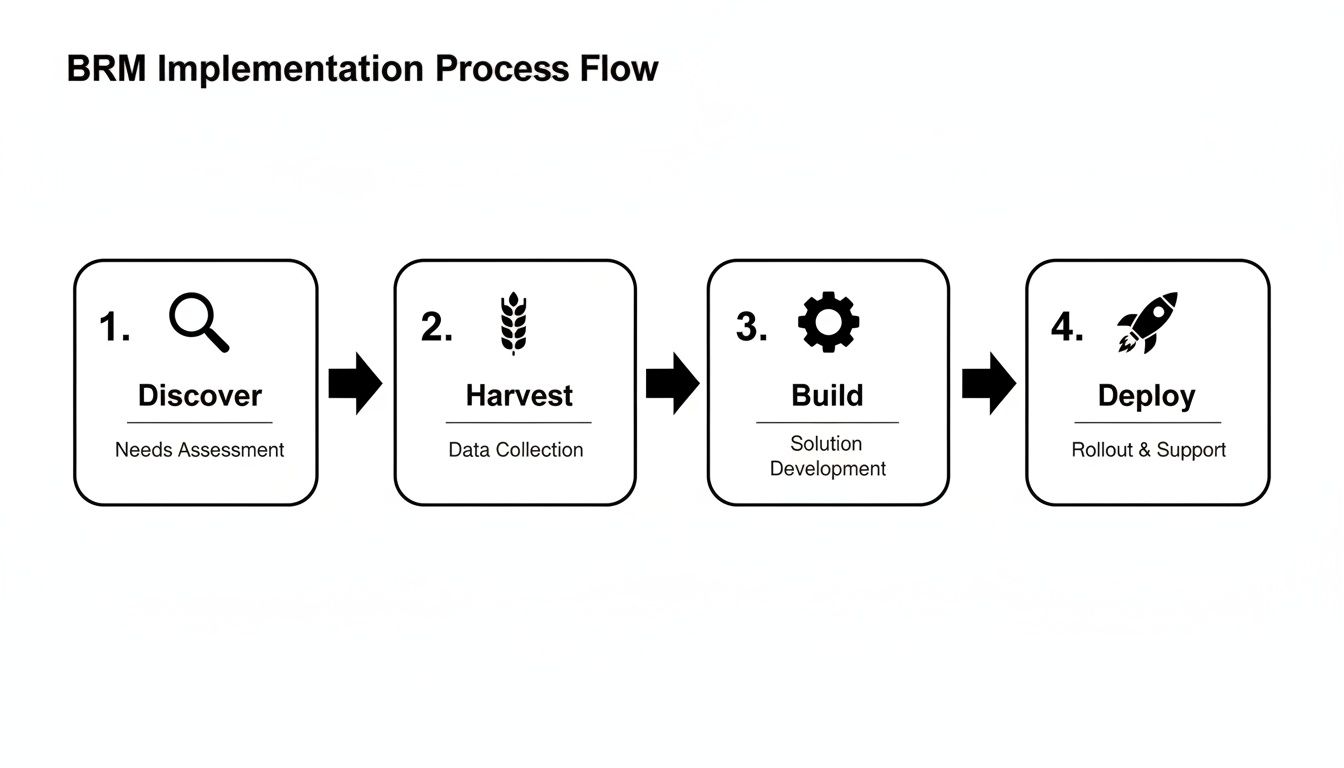
This structured journey ensures we don't start building until we have a solid foundation based on clear goals and a deep understanding of your existing rules.
Delivering Measurable, Real-World Results
Our clients rely on us for pragmatic guidance that keeps their most important operations running without a hitch. Think of us as the expert guides who can help you make sense of complex technology and use it to create lasting success.
We consistently deliver concrete results, as our executive testimonials show. This includes achieving 60% reductions in processing time for key workflows and pulling off zero-downtime transitions during complex cloud migrations. We empower organizations to adopt AI responsibly and get the most out of the cloud.
Whether you're trying to modernize an old system, improve your security, or build an infrastructure that can grow with you, Dr3amsystems has the enterprise-level expertise to get you there. Our commitment is to give you a clear path to value, ensuring your technology investments pay off for years to come.
Frequently Asked Questions
As you get your head around business rule management, a few common questions always seem to pop up. Let's tackle them head-on to clear things up and show you how this technology can really work for your business.
What Is the Difference Between BRM and BPM?
This is a classic question, and the distinction is actually quite simple. The easiest way to think about it is that Business Process Management (BPM) draws the map, while Business Rule Management (BRM) provides the turn-by-turn directions at every intersection.
BPM defines the high-level workflow, orchestrating the sequence of major steps. For instance, a loan approval process might be: Receive application -> Verify applicant data -> Make approval decision -> Notify customer. BPM is the system that moves the application from one step to the next.
BRM, however, lives inside that "Make approval decision" step. It contains the specific, nitty-gritty logic: "If the applicant's credit score is above 720 AND their employment history exceeds 2 years, then approve the loan." By separating these rules from the main process, you can change your lending criteria without having to rebuild the entire workflow. The two work together beautifully; a smart BPM system knows when to hand off a complex decision to a BRMS, giving you a process that’s both organized and incredibly flexible.
Can Small Businesses Benefit from Business Rule Management?
Definitely. It’s a common misconception that BRM is only for massive corporations. For a small or medium-sized business, adopting a BRMS for just one critical area can be a game-changer.
Look for a process that changes often and always seems to create a bottleneck for your developers. Common culprits are things like generating custom quotes, figuring out complex shipping rates, or calculating sales commissions.
By using a modern, cloud-based BRMS, you empower the business experts—the people who actually know the pricing or commission rules—to make updates themselves. This frees your developers to focus on bigger projects and makes your company much faster at responding to market changes. For a growing business, that kind of agility isn't just nice to have; it's a serious competitive edge.
"A business rule statement is a declarative statement, defining some structure or constraint that the business places on itself or has placed on it by law or other means."
This idea is universal. It’s about turning your company’s policies, big or small, into automated logic that works for you.
How Does AI Fit with Business Rule Management?
AI and BRM are a fantastic pairing, each covering the other's weaknesses. A BRMS gives you a system of clear, auditable decisions based on rules you can read and understand. AI, particularly machine learning, adds a layer of sophisticated insight by finding patterns in data that humans would miss.
Let’s go back to our loan application. A BRMS can handle the fixed rules perfectly ("Is the down payment over 20%?"). Meanwhile, a machine learning model can analyze thousands of data points and generate a real-time fraud risk score.
The rule engine then treats that AI-generated score as just another piece of data. A new rule might say, "If the AI fraud score is 'High,' then flag for manual review, regardless of other factors." This creates a hybrid system that’s both intelligent and explainable—you get the predictive power of AI, guided by the transparent guardrails of business rules.
At Dr3amsystems, our Dr3am AI practice is built around creating these exact kinds of integrated solutions. We believe in combining the transparent logic of business rules with the predictive power of AI to build smarter, safer, and more effective business systems. It’s a practical way to bring AI into your organization responsibly and get real results.
Ready to transform your business logic from a liability into an asset? The journey starts with a free consultation with Dr3amsystems. Let's work together to design a roadmap that aligns technology with tangible business value.