
Think of your business operations like the plumbing in an old, complex building. Over time, little things start to go wrong—a slow drain here, a leaky joint there. Left unchecked, these small issues multiply, slowing the entire system down, wasting water, and leading to major problems. Business Process Improvement (BPI) is the craft of finding those leaks and clogs—methodically overhauling your operations for peak efficiency.
The Urgent Need for Operational Excellence

This isn't a one-and-done project. True BPI is a continuous cycle of refining how work gets done, whether it’s streamlining customer onboarding, fixing supply chain bottlenecks, or speeding up financial reporting. The goal is always the same: cut out waste, reduce errors, and make things run smoothly. In today’s market, this isn't just a "nice-to-have"—it's a critical part of staying competitive.
The shift to digital-first operations has made this a top priority for any leader who values agility. Manual, clunky, or disconnected workflows that were once minor annoyances are now huge liabilities. They kill innovation, burn out your team, and deliver a frustrating customer experience. The stakes are incredibly high; one study found that 53% of customers will leave after a single bad experience.
Why BPI Is a Strategic Imperative
At its heart, BPI is about making every single action your business takes more effective and more valuable. When you get this right, the positive effects ripple across the entire company.
Think about the direct, strategic gains:
- Enhanced Efficiency: By mapping out and removing pointless steps, you accomplish more with the people and tools you already have, which directly lowers your operational costs.
- Improved Quality: When processes are standardized and clear, human error and inconsistencies plummet. The result is a better, more reliable product or service.
- Greater Agility: A well-oiled machine can turn on a dime. Optimized operations give you the freedom to react quickly to market shifts and jump on new opportunities before competitors do.
- Increased Customer Satisfaction: This is the big one. Faster response times, fewer mistakes, and a seamless journey for your customers naturally create loyalty and advocacy.
This is exactly where an experienced technology partner becomes your greatest asset. They bring the expertise to diagnose your operational "plumbing" and implement modern, robust solutions. A partner like Dr3amsystems, for instance, uses AI-driven solutions and secure cloud migrations to bring your systems into the modern era, delivering results you can actually measure.
Partnering for Measurable Results
Trying to overhaul your business processes all on your own can feel overwhelming. It demands a rare mix of big-picture strategy, deep technical know-how, and a genuine understanding of how teams actually work. The right partner serves as a catalyst, turning ambitious plans into concrete reality.
Dr3amsystems is a technology partner that helps businesses accelerate outcomes with AI-driven solutions, secure cloud migrations, and dedicated managed support. Backed by executive testimonials, the team delivers measurable results such as 60% reductions in processing time and zero-downtime transitions.
Through focused practices—Dr3am IT, Dr3am Cloud, Dr3am AI, Dr3am Security, Dr3am Hosting, and Dr3am Marketing—the company provides end-to-end services spanning strategy, implementation, and ongoing optimization. Engagements begin with a free consultation to clarify goals, uncover automation opportunities, and design a roadmap that aligns technology with business value. It’s what turns BPI from a buzzword into a powerful engine for your business.
Understanding Core BPI Methodologies
To really improve how your business runs, you need the right tool for the job. You wouldn't bring a hammer to fix a software bug, and the same logic applies to operational problems. Different issues demand different solutions.
When it comes to business process improvement, there are a few foundational methodologies that have stood the test of time. The big three are Lean, Six Sigma, and Business Process Management (BPM). Each one offers a unique lens for looking at your operations, and understanding them is the first step to making real, lasting change.
Lean: Decluttering the Pipes
At its heart, Lean is all about one thing: eliminating waste. It got its start in manufacturing, but its principles are so universal they can be applied to virtually any workflow. The core idea is simple: look at every single step in a process and ask, "Does this actually add value for the customer?"
If the answer is no, it's waste. Lean practitioners get really good at spotting these inefficiencies, which often fall into a few key categories:
- Overproduction: Making more of something than you need right now.
- Waiting: Dead time where people or projects are just sitting around.
- Unnecessary Motion: Wasted movement of people or equipment that adds no value.
- Defects: Errors that force you to do work over again or scrap materials.
Adopting a Lean mindset is like decluttering your operational pipelines. You methodically clear out anything that's slowing down the flow or doesn't serve a clear purpose. This frees up your resources to focus only on the things your customer actually cares about.
Six Sigma: The Precision Engineering Approach
Where Lean is focused on speed and flow, Six Sigma is obsessed with quality and consistency. It’s a heavily data-driven methodology that uses statistical analysis to hunt down and eliminate the root causes of errors. The name itself points to a statistical benchmark: operating at a level that produces no more than 3.4 defects per million opportunities.
Six Sigma is the "precision engineering" of BPI. It's less about making a process faster and more about making it flawlessly repeatable, every single time. It provides the statistical rigor needed to identify subtle variations that cause major quality issues down the line.
Think about a company that manufactures critical medical devices. A Lean approach could help them build devices faster, but a Six Sigma approach would ensure every single device is built to the exact same, life-saving specification with almost zero variation. It's the go-to method for industries where precision and reliability are everything.
Business Process Management: The Master Blueprint
If Lean and Six Sigma are specialized toolkits, then Business Process Management (BPM) is the master blueprint for the entire operation. BPM isn't a one-off project; it’s a holistic and ongoing discipline for managing and improving an organization’s end-to-end business processes.
BPM gives you that high-level, overarching framework to see how everything connects—from customer onboarding to supply chain logistics. It often uses technology to map, automate, and monitor these processes, giving you the visibility to see how they all interact and where the biggest opportunities for improvement lie.
To help you decide which approach is right for you, here’s a quick breakdown of how they compare.
Comparing BPI Methodologies: Lean vs Six Sigma vs BPM
| Methodology | Core Focus | Primary Goal | Best For |
|---|---|---|---|
| Lean | Eliminating Waste | Increase speed and efficiency | Reducing lead times, lowering inventory, and cutting operational costs. |
| Six Sigma | Reducing Defects | Improve quality and consistency | Minimizing errors in manufacturing, ensuring compliance, and increasing reliability. |
| BPM | End-to-End Process Oversight | Systematically manage and optimize all workflows | Gaining visibility across the organization, automating complex processes, and driving continuous improvement. |
These classic methodologies are more powerful than ever, especially when paired with today's technology.
A modern partner like Dr3amsystems takes these foundational principles and elevates them with AI-driven analysis and secure cloud automation. For instance, Dr3am AI can analyze process data to pinpoint inefficiencies for a Six Sigma project or automate repetitive tasks to eliminate waste as part of a Lean initiative. To see what's possible, you can explore the various end-to-end services Dr3amsystems provides.
How to Find and Prioritize Improvement Opportunities

Alright, you’re sold on the theory. But where do you actually start? The problems in your business—the little inefficiencies and major roadblocks—aren't always waving a red flag. They're often hidden in plain sight, and learning to spot them is the first real step in any business process improvement effort.
The best place to look is right in front of you. Listen to your people and pay attention to your customers. Are you hearing about constant delays, repetitive errors, or just general frustration from your team? Those are smoke signals. If customer satisfaction is dipping or complaints are on the rise, that’s a direct sign a process is failing them. These aren't just grievances; they are your starting points.
Visualize Your Workflows to Find Bottlenecks
One of the most eye-opening things you can do is process mapping. It sounds technical, but it’s really just about drawing out a workflow, step by step, from beginning to end. The simple act of creating this visual forces you to confront how work actually gets done, not how you think it gets done.
Suddenly, you can see it all: the redundant steps, the places where work piles up, and the detours that make no logical sense. A similar method, value stream mapping, adds another layer by asking a critical question for each step: "Does the customer care about this?" It helps you separate the "value-add" activities from the "non-value-add" ones, like waiting for approvals or fixing mistakes. You'll likely be shocked by how much time is wasted on things that deliver zero value.
Digging Deeper with Root Cause Analysis
Spotting a problem is one thing; understanding why it happens is the real key to fixing it for good. Too often, we treat the symptoms instead of the disease. This is where root cause analysis comes into play.
A brilliantly simple tool for this is the "5 Whys." When a problem pops up, you ask "Why?" repeatedly until you've dug down past the surface-level excuses to the foundation of the issue.
Let's walk through an example:
- The problem: A customer shipment was late.
- Why? The order wasn’t processed in time.
- Why? The manager's approval was delayed.
- Why? They didn't see the approval email.
- Why? Their inbox is slammed with hundreds of automated system alerts.
- And why is that? (The Root Cause) The system is configured to send alerts for every minor status update, creating so much noise that critical items get buried.
See? The late shipment wasn't the real problem. It was a symptom of a poorly designed notification system. Fixing that prevents countless future delays.
Prioritizing for Maximum Impact
Once you have a list of problems to solve, you might feel the urge to fix everything at once. Don’t. That’s a fast track to getting overwhelmed and achieving nothing. The secret is smart prioritization, and you can do it with a simple impact vs. effort matrix.
Think of it like a four-quadrant grid. On one axis, you plot the potential impact of the fix (low to high). On the other, you plot the effort it will take to implement (low to high). This visual sorting exercise gives you a clear, strategic path forward.
This grid sorts your projects into four distinct buckets:
- Quick Wins (High Impact, Low Effort): Do these now. They deliver fast, visible results and build momentum for the bigger fights ahead.
- Major Projects (High Impact, High Effort): These are your game-changers. Plan them carefully as strategic initiatives that need dedicated resources.
- Fill-Ins (Low Impact, Low Effort): Knock these out when you have downtime or between larger projects.
- Thankless Tasks (Low Impact, High Effort): Avoid these. The return just isn't worth the cost.
This discovery phase is where an experienced partner can make all the difference. A free consultation with Dr3amsystems can help you cut through the noise, uncover those high-value opportunities, and build a roadmap that actually works. We bring proven analytical methods to the table and design solutions—from AI automation to modernizing core systems through specialized practices like Dr3am IT—that connect directly to your business goals.
The Modern BPI Toolkit: AI and Cloud Automation
The classic rulebook for business process improvement is getting a major rewrite. While the foundational methods we've discussed are still incredibly valuable, today's technology—specifically Artificial Intelligence (AI) and cloud computing—is changing what's possible. This isn't just about simple automation anymore. It's about building systems that are not only faster but fundamentally smarter.
At Dr3amsystems, this is the world we live in: helping companies move beyond manual, error-prone workflows and into the realm of intelligent, self-optimizing operations.
Think about shifting from constantly fixing problems to preventing them from ever happening. With AI, you can forecast demand with uncanny accuracy, use natural language processing (NLP) to resolve customer issues in seconds, or have analytics that spot a process deviation before it turns into a crisis. This predictive capability is what separates good operations from truly great ones.
Technology has sparked a fundamental shift in business process improvement. It allows companies to evolve from merely fixing problems to building systems that anticipate and prevent them, creating a durable competitive advantage. Dr3amsystems helps organizations adopt AI responsibly to elevate their overall technology strategy for sustainable growth.
AI: The Engine of Intelligent Operations
When we talk about AI in operations, we’re not referring to a single magic bullet. It’s a collection of powerful capabilities that can be applied to nearly any process you have. Tools like specialized AI-powered Process Optimization Agents can even work on their own to find and implement improvements, taking classic BPI to a whole new level.
Here’s a glimpse of how AI is changing the game:
- Predictive Analytics: This is the difference between looking in the rearview mirror and seeing what’s coming up on the road ahead. Instead of only analyzing past data, machine learning models can forecast future outcomes. This lets you get ahead of inventory needs, schedule maintenance before a breakdown, or adjust staffing before a bottleneck even forms.
- Intelligent Automation: We've moved far beyond basic Robotic Process Automation (RPA). Modern AI can understand unstructured data, make complex judgment calls, and even grasp the intent behind a customer's email. This means work that once demanded a human touch can now be automated reliably.
- Process Mining: Imagine getting a perfect, data-driven map of how your business actually runs. AI algorithms do this by analyzing system logs, instantly showing you the real-world paths your processes take. This uncovers hidden inefficiencies and compliance gaps that would otherwise go unnoticed.
The market has taken notice. Industry analysis projects the BPM automation market to grow at a compound annual growth rate (CAGR) of over 20% through 2030, driving the entire industry toward USD 61.17 billion. This growth is a direct result of AI's power to eliminate manual mistakes and manage complex business workflows with sophistication.
The Cloud: The Foundation for Scalability
If AI provides the brains, the cloud provides the power and agility to put those brains to work. Cloud platforms are the ideal foundation for modern BPI, giving you the scalable, secure, and cost-effective infrastructure that advanced tools require.
For example, a secure cloud migration with Dr3amsystems means you can deploy powerful data pipelines and machine learning models without a huge upfront investment in servers. As your needs grow or change, the infrastructure can scale up or down instantly. You only pay for the computing power you actually use. This kind of flexibility is essential for continuous improvement.
A partnership with Dr3amsystems brings all these pieces together. Through our Dr3am AI and Dr3am Cloud practices, we design and build complete solutions that deliver tangible results. We’ve helped clients achieve outcomes like a 60% reduction in processing time and execute zero-downtime transitions, all by aligning the right technology with clear business goals. To see how we make these powerful solutions a reality, explore our approach to Dr3am AI.
Measuring Success and Calculating Your ROI
Once you’ve started refining your operations, you’ll inevitably face the big question: “Is any of this actually working?” A successful business process improvement project isn't built on gut feelings; it’s proven with cold, hard data.
This is where you build your business case. Proving the value of your efforts means having a clear way to measure success and calculate your return on investment (ROI). After all, you can't improve what you don't measure. By tracking the right metrics, you make the benefits of your work undeniable.
Core KPIs for Tracking BPI Success
To get a clear before-and-after snapshot of your process health, you need to focus on a handful of key performance indicators (KPIs). These are the numbers that prove faster processing, lower costs, and happier customers are a direct result of your efforts.
Think of it in three main buckets:
- Operational Metrics: These KPIs tell you how efficient the process itself is. Look at cycle time (the total time it takes to get something done from start to finish) and throughput (how many tasks you complete in a given period). Seeing cycle time drop is a clear win.
- Financial Metrics: This is where you connect your improvements directly to the bottom line. Track your cost-per-transaction or cost-per-item processed. As your process gets more efficient, this number should fall, which directly impacts your profit margins.
- Customer Metrics: At the end of the day, your internal improvements should make life better for your customers. Metrics like Customer Satisfaction (CSAT) scores or a Net Promoter Score (NPS) are perfect for showing that your behind-the-scenes work is creating a much better experience for them.
From Metrics to ROI: The Bottom-Line Impact
With these KPIs in hand, calculating your ROI becomes much more straightforward. Think about the tangible gains. If you managed to cut the cycle time for a key process by 25%, how many more orders can your team now handle without hiring anyone else? That's a direct boost to both capacity and revenue.
A successful BPI project pays for itself by turning operational gains into financial results. Faster processing times lead to higher throughput, lower operational costs boost margins, and improved customer satisfaction drives retention and growth. This is where the value of your investment becomes crystal clear.
This focus on measurable outcomes is why the Business Process Management (BPM) market, valued at USD 15.07 billion in 2023, is expected to surge to USD 50.35 billion by 2032. Companies are seeing real, quantifiable results, like a 20% average reduction in process cycle times, which directly translates to higher productivity. You can see more data on this trend by reviewing the full BPM market research here.
This is exactly the kind of value a partner like Dr3amsystems brings to the table. We’re laser-focused on outcomes that hit your ROI, using AI-driven automation and secure cloud migrations to deliver results like a 60% reduction in processing time. For a deep dive into measuring the financial impact of these changes, this practical guide on boosting cloud ROI metrics and KPIs is an excellent resource. Our experts help you lock in the right metrics from day one, ensuring every decision is tied to measurable business value.
Your Roadmap to Transformation with Dr3amsystems
Taking on a business process improvement initiative can feel like a monumental task, but you don't have to go it alone. The right technology partner is more than just a vendor; they're a guide and an engineer who can turn your high-level goals into a clear, actionable plan. This is exactly where we come in.
Our entire approach is grounded in a practical, results-first mindset. We don't just hand you a piece of technology. We start every engagement with a free consultation to understand your vision, find the automation opportunities you might be missing, and map out a strategy focused on reliability, cost-efficiency, and a return you can actually measure.
A True Partnership for Lasting Change
Think of Dr3amsystems as an extension of your own team—one with specialized expertise and the hands-on capacity to get things done. We know that real improvement isn't a one-and-done project. It’s about building a solid foundation for optimizing your operations continuously.
Our core practices—Dr3am AI, Dr3am Cloud, and Dr3am Security—are designed to work together, creating a unified solution that fits your specific challenges. This integrated approach means every step, from initial strategy to implementation and ongoing support, is perfectly synchronized. Whether we’re modernizing an old system, building out a sophisticated data pipeline, or reinforcing your security, our job is to keep your operations running flawlessly while you grow.
The image below breaks down the key metrics we use to track success and calculate your ROI, focusing on improvements in cycle time, costs, and customer satisfaction.
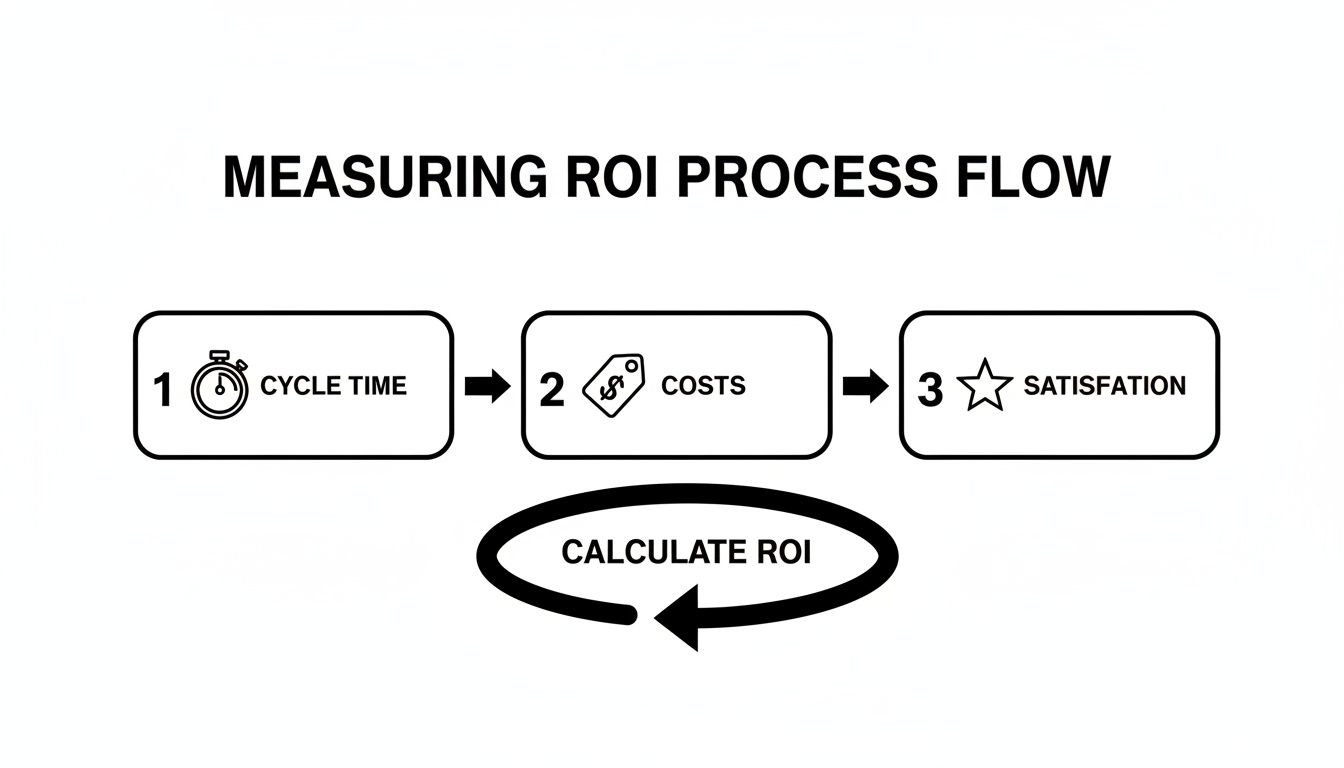
As you can see, this isn't just about abstract gains. It's about connecting operational improvements directly to financial value and customer experience, which is what builds a powerful business case for BPI.
From Vision to Value
Our track record speaks for itself. We have executive testimonials and proven results, like helping clients achieve 60% reductions in processing time and executing complex migrations with zero downtime. We bring that same level of enterprise-grade expertise to every project, helping you adopt AI responsibly and use the cloud with total confidence.
With Dr3amsystems, business process improvement becomes a story of transformation. We help you move from identifying problems to implementing intelligent, automated solutions that elevate your entire technology strategy for the long term.
Don't let operational bottlenecks dictate your future. Let us help you design a technology roadmap that turns your vision of efficiency into a concrete reality.
Take the first step today. Book a free consultation with our experts to clarify your goals, and we'll work with you to build a plan that delivers immediate impact and drives long-term success.
Frequently Asked Questions About BPI
Even with a great plan, a few lingering questions are perfectly normal before kicking off a business process improvement project. Let's tackle some of the most common ones we hear from leaders about to start their BPI journey.
How Do We Get Started with BPI if We Have Limited Resources?
You don't need a massive budget to get started. The trick is to be strategic.
Think in terms of an impact-versus-effort matrix. Your goal is to find that one process—that single bottleneck—that is high-impact but relatively low-effort to fix. Nailing this first gives you a quick, tangible win. It builds momentum and makes it much easier to get the green light for bigger projects down the road.
A focused first step proves the entire concept without a huge upfront investment. For instance, a free consultation with a partner like Dr3amsystems can quickly pinpoint this ideal starting point, matching a specific, solvable problem with a clear tech solution that shows measurable ROI right away.
What Is the Role of a Technology Partner in BPI?
Think of a technology partner like Dr3amsystems as both a guide and an enabler. They bring deep, specialized knowledge in areas your team might not have, like AI-driven automation, secure cloud architecture, or modern data platforms. That expertise is your best defense against common pitfalls and expensive mistakes.
A good technology partner’s job is to make sure your investment actually pays off. They bridge the gap between your business goals and the technical work required, turning your vision for efficiency into a reliable, scalable reality.
They’ll help you choose the right tools—from machine learning models to intelligent automation platforms—and make sure everything works together smoothly within your existing operations. This kind of partnership ensures your BPI efforts are built on a rock-solid foundation that’s ready for growth.
How Do You Ensure Employees Adopt the New Processes?
Real change sticks when the people doing the work are on board. The best way to achieve this is to bring employees into the mapping and redesign stages from the very beginning. When they help shape the new workflow, they become its biggest champions, not its biggest obstacles.
Always explain the "why" behind any change. Frame it around how it will make their day-to-day work less frustrating and more meaningful. At its core, successful business process improvement should make an employee's job easier, not harder. Finally, back it all up with excellent training and dedicated support to build their confidence and smooth out any bumps in the road.
Can BPI Be Applied to Non-Manufacturing Industries?
Absolutely. It’s a common misconception that BPI is just for factories. While many of the classic methodologies got their start on the assembly line, the core principles apply to any business.
At the end of the day, every business is just a collection of processes.
It doesn’t matter if you’re in finance, healthcare, retail, or professional services. Onboarding a new client, processing an insurance claim, handling IT support tickets, or managing accounts payable—all of these are workflows just waiting to be analyzed, optimized, and automated. A partner with experience across different industries can adapt these proven BPI principles to solve your unique operational challenges.
Ready to turn these answers into action? Dr3amsystems provides the expert guidance and hands-on execution needed to elevate your technology strategy and drive sustainable growth. Book your free consultation today to design a roadmap that delivers real business value.