
The real magic of business process automation lies in its core benefits: serious cost savings, laser-focused accuracy, stronger compliance, and the ability to grow without breaking a sweat. When you let automation handle the repetitive, rule-based grunt work, it’s like having a digital specialist on your team. This frees up your people to focus on innovation and high-value projects, giving you a powerful competitive edge.
Why Automation Is Your Next Competitive Advantage

In a market that demands more output with tighter budgets, standing still means falling behind. Business leaders are always on the hunt for a genuine advantage, and Business Process Automation (BPA) has proven to be a strategic game-changer for building real, sustainable growth.
Think of BPA as a smart digital assistant that’s woven directly into your daily operations. Its main job is to take over the predictable, mind-numbing tasks that drain your team’s energy—things like data entry, pulling reports, processing invoices, or onboarding new customers.
By handing these jobs over to technology, you unleash your team's real talent. Instead of being buried in administrative tasks, they can pour their expertise into strategic planning, building customer relationships, and solving complex problems. That's the work that actually moves the needle.
More Than Just Efficiency
Sure, efficiency is a huge part of it, but the true value of automation runs much deeper. It fundamentally changes how your organization works, making it more resilient and quick to adapt. The benefits create a positive ripple effect, touching every corner of your business, from finance and HR to sales and customer service.
These are the key benefits that build your competitive advantage:
- Drastic Cost Savings: Automation cuts down on manual labor costs, slashes the expense of human error, and makes sure you're using your resources wisely, all of which directly boost your bottom line.
- Pinpoint Accuracy and Consistency: Automated systems do the same task perfectly every single time. This eliminates the typos and slip-ups that can cause compliance headaches or damage customer trust.
- Enhanced Regulatory Compliance: With built-in rules and detailed audit trails, automation guarantees your processes stick to industry regulations, significantly lowering your risk.
- Scalable and Flexible Growth: Automated workflows can handle a huge spike in volume without you needing to hire more people. This means you can scale your operations smoothly and affordably.
When you implement smart automation, you’re not just speeding up old processes—you’re creating entirely new ways to innovate and lead your market. The goal is to build a system where technology and human talent work together seamlessly.
Getting these results requires a clear strategy and the right technology partner. At Dr3amsystems, we help businesses accelerate outcomes with AI-driven solutions, secure cloud migrations, and dedicated managed support. We start with a free consultation to clarify goals and design a roadmap that delivers measurable results, such as the 60% reductions in processing time and zero-downtime transitions we've achieved for clients. Our pragmatic, results-focused approach equips organizations to leverage technology for sustainable growth. You can explore our strategies for fostering unlimited growth for your business to learn more.
Understanding The Engines Driving Modern Automation
To really get a feel for what business process automation can do, it helps to look under the hood at the technologies making it all possible. Automation isn't just one thing; it's a collection of distinct tools, and each one has a specific job. Knowing the difference helps you pick the right tool for the right task, which is key to getting the results you want.
Think of it like a specialized pit crew for your business. Each member has a unique skill, and when they work together, they can accomplish far more than any single person could on their own.
Robotic Process Automation: The Digital Employee
First up is Robotic Process Automation (RPA). The best way to think about RPA is to imagine an employee who does the same repetitive digital tasks all day, every day, without ever making a mistake. That’s an RPA bot. These software "robots" are programmed to copy human actions inside computer systems.
They log into apps, copy-paste data, move files around, fill in forms, and pull information from structured documents like spreadsheets or databases. RPA is the real workhorse of automation. It’s perfect for high-volume, rules-based tasks that don't need any complex thinking.
A classic example is invoice processing. An RPA bot can be set up to:
- Open an email that has an invoice attached.
- Pull out key data like the invoice number, date, and amount.
- Punch that data directly into your accounting software.
- Forward the invoice to the right person for approval.
This simple process frees your finance team from hours of tedious data entry, letting them focus on higher-value work like financial analysis and strategy.
Workflow Orchestration: The Master Conductor
While RPA is great at handling individual tasks, workflow orchestration is what manages the entire process from beginning to end. If RPA is a musician playing a specific instrument, workflow orchestration is the conductor making sure the whole orchestra plays together in perfect harmony. It coordinates the handoffs between different people, systems, and even RPA bots.
This engine creates a smooth, continuous flow, automatically moving work from one step to the next. For instance, think about onboarding a new hire. An orchestrated workflow can automatically kick off a whole series of actions: IT gets a ticket to set up a laptop, HR sends out the welcome packet, and the new hire's manager gets a reminder to schedule training.
Workflow orchestration is the connective tissue of modern automation. It ensures that complex, multi-step processes run smoothly and efficiently, eliminating bottlenecks and keeping everyone in the loop.
Without it, you can end up with a bunch of efficiently automated tasks that are still part of a clunky, disjointed process. Orchestration gives you the big-picture control needed for true end-to-end automation.
AI-Driven Automation: The Strategic Brain
Finally, we have AI-driven automation, which is the most advanced of the three. This is where automation starts to get genuinely smart. While RPA just follows a strict set of rules, AI uses technologies like machine learning (ML) and natural language processing (NLP) to handle jobs that require judgment, interpretation, and learning.
AI can make sense of unstructured data, like the text in an email or the transcript of a customer support call. It can spot patterns, make predictions, and even change what it does based on new information. This allows it to take on complex decisions that used to be strictly for humans. For example, an AI system can analyze a customer's entire purchase history to offer personalized product recommendations or flag fraudulent transactions by spotting unusual activity.
Choosing the right mix of these technologies is where expert guidance makes a real difference. The Dr3am AI practice at Dr3amsystems specializes in designing the perfect blend of RPA, workflow orchestration, and AI to solve specific business problems. By matching the right technology to your goals, we help companies build intelligent automation systems that deliver a clear ROI and a serious competitive edge. You can learn more about how we deploy AI-driven solutions for tangible results and accelerate your business outcomes.
How Automation Directly Impacts Your Bottom Line
When you're looking at any new technology, there's always one question that matters most: what's the return on my investment? The day-to-day operational perks of automation are great, but the financial wins are what really move the needle. Business process automation (BPA) makes a direct, measurable impact on your bottom line by going straight to the source of most inefficiencies.
This isn't just theory. You'll see it in lower operating costs, faster revenue cycles, and a team that can suddenly get a lot more done. When you automate a process, you're trading a variable, error-prone manual task for a fixed, predictable, and incredibly efficient digital one. It’s a fundamental shift that builds a more profitable and resilient company.
Let’s break down exactly how those financial gains actually happen. We'll get into the weeds on direct cost reductions, productivity gains that boost output without growing the team, and how you can get cash in the door faster.
Slashing Direct Operational Costs
The first and most immediate financial win from BPA is a steep drop in direct costs. Manual processes are expensive, and it's not just about salaries. The hidden costs of human error add up fast. A single misplaced decimal or an incorrectly keyed-in order number can snowball into expensive rework, unhappy customers, and even compliance fines.
Automation wipes out these costs systematically. By taking over the repetitive, mind-numbing work like data entry, invoice processing, and report generation, it immediately lowers the labor costs tied to those activities. More importantly, automated systems do the work with near-perfect accuracy, which cuts down the huge expenses that come from fixing mistakes.
The results speak for themselves. An incredible 86% of businesses see productivity improvements from automation, while 59% achieve direct cost cuts. On top of that, 92% enhance their compliance just by using Robotic Process Automation (RPA). It’s why the global market for digital process automation shot up from $6.76 billion in 2018 to a projected $12.61 billion by 2023. You can see more on these trends by exploring automation statistics and their impact on businesses.
Boosting Productivity And Output
Saving money is one thing, but automation also helps your business make more money by unlocking your team's true potential. When your people are freed from monotonous administrative tasks, they can finally focus on high-value work that drives growth—things like strategic planning, building customer relationships, and developing new products.
This is where you see productivity soar without adding to your headcount. An automated system can process thousands of transactions in the time it takes a person to handle a few dozen. This shrinks cycle times for everything, from closing a sale to getting a customer's order out the door.
The real goal of automation isn't just to do the same work faster. It's to create the capacity for your team to do more valuable work. It turns your workforce from task-doers into strategic problem-solvers.
This flowchart shows the main engines that power these gains: RPA, Workflow, and AI.
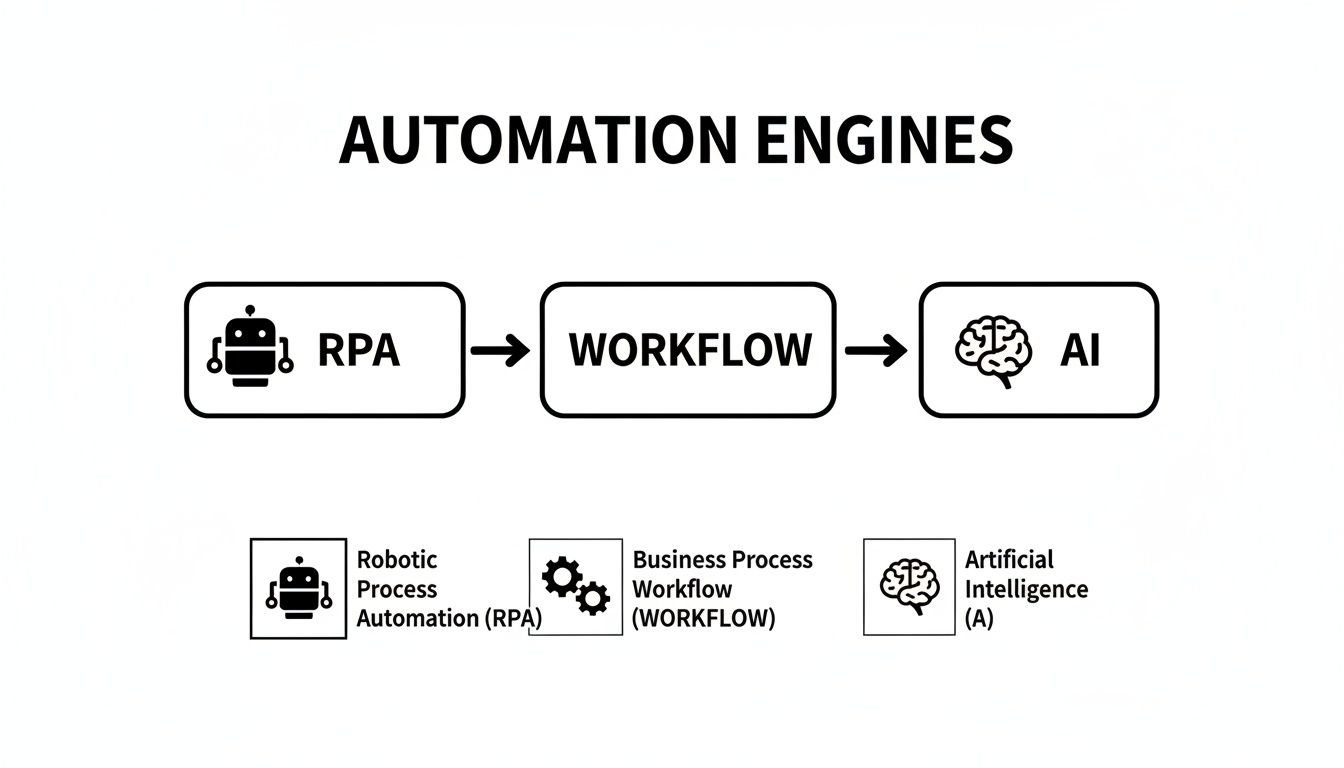
Each one has a specific job, from RPA handling the simple, repetitive stuff to workflow tools orchestrating complex processes and AI making smart, data-driven decisions.
The table below gives you a clearer picture of how these gains translate into real-world ROI across different parts of the business.
Projected ROI Across Key Business Functions
| Department | Automated Process Example | Estimated Annual Cost Reduction | Productivity Gain |
|---|---|---|---|
| Finance | Automated Accounts Payable Invoice Processing | $150,000 | 70% faster invoice cycles |
| HR | New Employee Onboarding Workflow | $50,000 | 50% less admin time per hire |
| IT/Operations | Automated User Access Provisioning | $75,000 | 95% reduction in manual tickets |
| Sales | Automated Lead Qualification & Routing | $120,000 | 25% increase in qualified leads |
| Customer Service | AI-Powered Chatbot for Tier-1 Support | $200,000 | 40% fewer live agent escalations |
As you can see, the impact isn't isolated to one area. Well-designed automation creates a ripple effect of efficiency and savings that strengthens the entire organization.
Accelerating Cash Flow And Financial Health
A healthy business runs on healthy cash flow. Unfortunately, manual financial processes—especially in accounts receivable and payable—often create bottlenecks that tie up your working capital. Invoices sit on desks waiting for approval, payments get delayed over simple data entry mistakes, and getting a clear financial picture can be a slow, painful process.
Automation cuts through these problems directly.
- Automated Invoicing: Systems can generate and send invoices the moment a job is done, dramatically shortening the time it takes to get paid.
- Intelligent Accounts Payable: AI-powered tools can catch, read, and route vendor invoices for approval automatically. This ensures you pay on time and can even grab early payment discounts.
- Real-Time Reporting: With data pulled together automatically, leaders get an accurate, up-to-the-minute view of the company’s finances, allowing for smarter, faster decisions.
By speeding up these critical financial workflows, automation tightens your cash conversion cycle and makes your company far more financially stable. At Dr3amsystems, our end-to-end services span strategy, implementation, and ongoing optimization, with a focus on delivering these tangible results. We specialize in designing high-impact automation that produces measurable ROI, like the 60% reductions in processing time we've achieved for our clients.
For more perspectives on making technology work for your bottom line, feel free to check out our latest articles on the Dr3am Insights blog.
Building a More Agile and Excellent Operation
While the bottom-line savings are what often get leaders interested in automation, the real, lasting impact comes from the operational improvements. This is where you transform how your business actually runs day-to-day, building a much stronger, more agile foundation for whatever comes next.
When you automate your core workflows, you're not just finding a cheaper way to do things—you're building a better, more reliable, and scalable organization from the inside out. It's a fundamental shift that makes your entire business more resilient and ready to adapt.
Drastically Improving Accuracy and Data Integrity
Let's be honest: manual data entry is a minefield of risk. One tiny typo, a misplaced decimal, or the wrong customer ID can snowball into major headaches—costly rework, inaccurate reports, and strategic plans built on shaky ground. Human error is a given in repetitive work, but the damage it causes can seriously erode profits and, just as importantly, customer trust.
Business process automation gets to the heart of this problem. By setting up automated workflows for things like data entry, processing orders, or pulling reports, you take human error almost completely out of the equation. An automated system does the task with perfect precision every single time. The result is clean, reliable data flowing into your CRM, ERP, and other critical platforms.
Reliable data is the bedrock of sound decision-making. When you can trust your numbers, you can make strategic choices with confidence, knowing they are based on an accurate picture of your business.
This improved accuracy creates a positive ripple effect everywhere. Your financial forecasts become more dependable, inventory counts get tighter, and customer records are far more trustworthy. You end up with a level of operational integrity that manual work just can't deliver.
Enhancing Your Compliance and Security Posture
Meeting regulatory standards like GDPR, HIPAA, or SOC 2 isn't optional, but proving you're compliant can be a huge administrative drain. It means meticulous records and stressful audit prep, made even tougher by manual processes that often lack a clear, consistent paper trail.
Automation is a game-changer here. It creates a perfect, unchangeable audit trail for everything that happens. Every single step in an automated workflow is logged, timestamped, and traceable, giving you a complete history of who did what and when. This makes audit requests much less painful and dramatically cuts down your compliance risk.
This is a core focus of the Dr3am Security practice here at Dr3amsystems. We build automated workflows with security and compliance baked in right from the start. This includes:
- Access Controls: Making sure only authorized people can see or touch sensitive information.
- Automated Retention Policies: Automatically managing how long documents are kept to comply with data storage rules.
- Risk Flagging: Spotting and escalating potential compliance issues before they blow up into major problems.
By embedding these rules directly into your processes, you shift compliance from a reactive headache to a proactive strength.
Building Scalability for Future Growth
What happens when your business gets a sudden flood of new orders? For many, the answer is to throw more people at the problem—a slow, expensive, and often unsustainable fix. Manual processes tie your workload directly to your headcount, which makes it incredibly difficult to scale up quickly without breaking the bank.
This is where one of the most powerful benefits of automation really shines: scalability. Automated systems are built to handle huge increases in volume without needing more human effort. A workflow that processes 100 invoices a day can just as easily handle 1,000 without you needing to hire more staff. You effectively decouple your growth from your operating costs.
This kind of flexibility is essential for any business planning to expand. With a technology partner like Dr3amsystems, you can design and scale infrastructure confidently. Our team prioritizes reliability and cost efficiency, ensuring your critical operations run smoothly while enabling continuous improvement. To see how we build these kinds of adaptable systems, take a look at our approach to secure and scalable cloud migrations.
Boosting Employee Morale and Innovation
Finally, let's talk about the impact on your most important asset: your people. Nobody gets excited about spending their days on mind-numbing, repetitive tasks. That kind of work is a fast track to burnout, disengagement, and high turnover. When you automate those tedious processes, you're not just making things more efficient—you're making work better for your team.
By freeing your people from administrative grunt work, you allow them to focus on the strategic initiatives that actually matter. They can spend their brainpower on creative problem-solving, building stronger relationships with customers, and driving real innovation. This shift doesn't just improve morale and job satisfaction; it unlocks the full potential of your workforce, turning them from task-doers into true value-creators.
Seeing Automation Success in the Real World

The theory behind automation is compelling, but the real magic happens when you see it solve actual business problems. The benefits aren't just abstract concepts on a slide deck; they're tangible results that completely change how companies operate. When we move from theory to reality, you can see exactly how the right automation strategy tackles specific, high-stakes challenges.
These examples aren't just about doing things faster. They show how automation builds a genuine competitive advantage—whether through speed, risk reduction, pinpoint accuracy, or a better customer experience. It all comes down to applying the right tool to the right problem.
Finance: From Days to Hours
Picture a financial services firm drowning in a sea of loan applications. The old-school manual approval process is a slog, taking days to move an application from one desk to another. It's not just slow and expensive; it’s a minefield of human error that can create serious financial risk.
By bringing in an AI-driven automation workflow, the company completely flips the script. The new system instantly pulls applicant data from all the different documents, checks it against company rules, and performs an initial risk check. It’s smart enough to immediately flag applications for approval, denial, or a closer look by a human expert.
The results are night and day:
- Loan processing time plummets from three days to a few hours.
- Data entry errors disappear, which makes risk assessments far more accurate.
- Loan officers can stop chasing paperwork and start focusing on complex cases and building client relationships.
This is exactly the kind of high-impact outcome Dr3amsystems delivers through its Dr3am AI practice, turning a slow, risky process into a fast, reliable engine for growth.
Manufacturing: Precision in the Supply Chain
Now, let's look at a large manufacturer grappling with inventory chaos. Manual tracking means they're constantly running out of critical parts—halting production lines—while other components are overstocked, tying up cash. Without a real-time view, the whole operation is stuck in a cycle of inefficiency and waste.
The solution? Using Robotic Process Automation (RPA) to automate inventory monitoring and reordering. Bots now work around the clock, tracking stock levels in every warehouse, syncing that data with production schedules, and automatically cutting a purchase order the moment a part hits its reorder threshold.
This move from reactive fire-fighting to proactive inventory control is what operational excellence looks like in practice. The system doesn't just count boxes; it anticipates needs, making sure the right materials are in the right place at the right time.
The result is a far more resilient supply chain with drastically fewer stockout incidents and much lower carrying costs.
Healthcare: Reimagining the Patient Experience
Finally, think about a healthcare provider where checking in a new patient is a nightmare of clipboards and paperwork. It’s a frustrating first impression for patients and a huge source of data entry errors that can mess up everything from medical care to billing.
By putting a workflow orchestration solution in place, the provider automates the entire onboarding journey. Patients can now pre-register online, and the system handles the rest—verifying their insurance, scheduling their first appointment, and populating their electronic health record (EHR). It’s a smoother, more welcoming experience for the patient and a massive win for data accuracy.
These real-world scenarios are where the promise of automation becomes proven success. At Dr3amsystems, our enterprise-grade expertise across our focused practices—including Dr3am Cloud and Dr3am Security—helps organizations get these kinds of game-changing results. Backed by executive testimonials, our team delivers measurable outcomes like 60% reductions in processing time with secure, zero-downtime transitions.
Building Your Roadmap To Automation Success
Knowing automation can help your business is one thing; actually making it happen is another entirely. A clear, well-thought-out roadmap is what separates successful projects from stalled ones. It’s your guide for turning a good idea into a real initiative that delivers tangible value.
Think of it this way: automation isn't a single event. You don’t just flip a switch and everything runs itself. It's a journey of finding the right opportunities, setting smart goals, and building confidence with a few early victories. Without a plan, you risk wasting time and money on projects that never quite deliver on their promise.
And the pressure to get it right is mounting. Around 80% of business leaders already see the value in BPA, and the adoption of AI-powered tools jumped 22% between 2023 and 2024 alone. By this year, 66% of companies were already automating processes to boost revenue and cut costs, fueling a market expected to hit USD 500 billion. You can dig deeper into the rapid growth of business process automation.
Your Five Steps To A Successful Launch
Getting started with automation doesn't have to be overwhelming. This five-step approach provides a practical framework to move from your initial concept to a fully scaled program that continuously improves your business and keeps you competitive.
Identify High-Impact Processes: First things first, look for the easy wins. Start by identifying tasks that are repetitive, manual, and high-volume. These are often the biggest bottlenecks and sources of human error—things like processing invoices, onboarding new hires, or managing inventory data. The goal here is to find the low-hanging fruit where a small automation effort can make a big, visible impact quickly.
Define Clear Goals and KPIs: What does a "win" actually look like? Before you write a single line of code or sign a contract, you need to define specific, measurable goals. Don’t just aim to "improve efficiency." Instead, set a target like "reduce invoice processing time by 60%" or "eliminate data entry errors in customer records." These numbers are your proof when it comes time to show the return on your investment.
Choose the Right Technology Partner: You don’t have to go it alone. The world of automation is complex, and having an expert guide can make all the difference. A partner like Dr3amsystems can handle everything from building the initial strategy to implementing the technology and providing dedicated managed support. Their focused practices—including Dr3am IT, Dr3am Cloud, Dr3am AI, Dr3am Security, Dr3am Hosting, and Dr3am Marketing—ensure you get end-to-end services that align technology with business value.
Launch a Pilot Program: Avoid the temptation to automate everything at once. Pick one well-defined process and start with a pilot program. This lets you test your approach on a small scale, iron out any wrinkles, and—most importantly—get a tangible result you can show to stakeholders. A successful pilot builds the momentum you need to get buy-in for bigger projects down the road.
Scale and Optimize Your Wins: Once your pilot is a proven success, it’s time to expand. Take the lessons you learned and apply them to other high-impact areas of the business. Remember, automation isn't a "set it and forget it" project. It’s a cycle of continuous improvement where you constantly look for new opportunities to refine processes and build on your success.
The best automation roadmaps aren't really about the technology itself. They're about connecting that technology to real business outcomes. It all starts by finding the exact spots where AI and automation can create the most value for your company.
Following a strategic path like this ensures every step you take is deliberate and contributes to real, sustainable growth. A technology partner is key here. To get help clarifying your goals and building a custom roadmap, you can schedule a free consultation with Dr3amsystems and start your automation journey with confidence.
Common Questions About Automation Answered
Diving into automation naturally brings up some important questions. Let's tackle a few of the most common ones I hear from business leaders, with practical, no-nonsense answers.
Where Do I Even Begin with Business Process Automation?
The best advice I can give is to start small but smart. Don't try to automate your entire company overnight. Instead, find a single process that's a notorious pain point.
Look for something that's highly repetitive, follows clear rules, and consistently causes delays or errors. A simple pilot project like this lets you prove the concept and show real, measurable results fast. That initial win makes it much easier to get buy-in for bigger projects down the road. A good partner like Dr3amsystems can help you pinpoint that perfect starting process during a free consultation, ensuring your first step is a successful one.
Is Automation Going to Replace Our Team?
This is probably the number one concern, and it's completely understandable. The reality is, automation is here to enhance your team, not replace it. Think of it as taking the robotic work off your team's plate.
When you automate the tedious, mind-numbing tasks, you free up your people to focus on what humans do best: critical thinking, creative problem-solving, and building customer relationships. This isn't just about efficiency; it's about making your team's work more meaningful and strategic. Employees get to develop new skills and become drivers of growth, not just cogs in a machine.
By handing routine work over to technology, you're not just making a process faster. You're elevating your people, allowing them to work on a higher, more valuable level.
How Can We Tell if Our Automation Efforts Are Actually Working?
You can't improve what you don't measure. The success of any automation project comes down to tracking the right Key Performance Indicators (KPIs) that you define from the very beginning.
Some of the most critical metrics to watch include:
- Cost Savings: Look at direct savings from reduced overtime, fewer errors that waste materials, and lower day-to-day operating expenses.
- Efficiency Gains: Are processes moving faster? We've seen clients achieve 60% reductions in cycle times. Are you getting more output without adding headcount?
- Stronger Compliance: This shows up as fewer red flags during audits, tighter data security, and a better track record of meeting regulatory standards.
At Dr3amsystems, we work with clients to lock in these metrics before we even start. This makes sure every automation project is tied directly to tangible business goals and delivers results you can see on a spreadsheet.
Ready to build a smarter, more efficient business? The expert team at Dr3amsystems can help you design and implement AI-driven automation solutions that deliver measurable ROI. Start with a free consultation to build your roadmap.