
At its heart, the Agile methodology is about delivering real value to your customers—faster. It’s a framework built for adapting to change and improving product quality on the fly, driven by iterative progress and customer collaboration rather than rigid, long-term plans.
What Is Agile and Why Should You Care?
Before we unpack its advantages, let's get on the same page about what Agile actually is. It’s far more than a project management buzzword; it's a fundamental shift in mindset. Agile was born out of the frustration with slow, traditional methods that just couldn't keep up with the pace of modern business.
Think of it like building a house. The old-school "Waterfall" approach is to spend months creating a perfect, exhaustive blueprint. Once approved, you spend the next year building, with no room for changes. The big reveal happens at the very end. But what if, during that year, the family's needs changed or a new, better building material became available? You're stuck. The house might be built to the original spec, but it's no longer the right house.
Agile flips that script completely. Instead of one massive project, you build and review the house in stages—or sprints. First, you see the foundation and give feedback. Then you review the framing. Then the electrical and plumbing. At every step, you're course-correcting, ensuring the final home isn't just built correctly, but that it's the right home for you, right now.
To get a clearer picture of these two philosophies, here’s a direct comparison.
Agile Methodology vs Traditional Waterfall Model
| Aspect | Agile Methodology | Traditional Waterfall Model |
|---|---|---|
| Planning | Adaptive and iterative; planning is continuous. | Upfront and exhaustive; the full plan is created before work begins. |
| Development Cycle | Short, repeatable cycles (sprints) of 1-4 weeks. | A single, sequential cycle for the entire project. |
| Feedback | Gathered continuously from stakeholders after each sprint. | Gathered primarily at the end of the project during user acceptance testing. |
| Flexibility | High; changes can be incorporated between sprints. | Low; changes are difficult and costly to implement once the plan is set. |
| Delivery | Incremental; working features are delivered frequently. | A single, final product is delivered at the end of the project timeline. |
| Risk | Risk is managed in small increments; issues are identified and fixed early. | High risk; major issues may not be discovered until late in the process. |
This table shows the stark difference in approach. Agile is built for a world where change is the only constant, while Waterfall assumes a predictable path from start to finish—a scenario that rarely exists in today's market.
The Core Agile Mindset
This way of working is fueled by a few core practices that create a steady rhythm of delivery and improvement. It’s not about chaos; it’s about disciplined execution within a flexible framework.
On the ground, this looks like:
- Sprints: These are short, focused bursts of work, typically lasting 1-4 weeks, where a team commits to completing a specific chunk of functionality. This creates a predictable cadence for getting things done.
- User Stories: Forget dense technical documents. User stories are simple descriptions of a feature from the end-user's point of view. This keeps the entire team laser-focused on delivering genuine customer value.
- Daily Stand-ups: A quick, 15-minute daily huddle. The goal isn't to report status to a manager, but for the team to sync up, identify roadblocks, and plan their next 24 hours. It’s the heartbeat of an Agile team.
This cycle of iteration, collaboration, and adaptation is what makes Agile work.
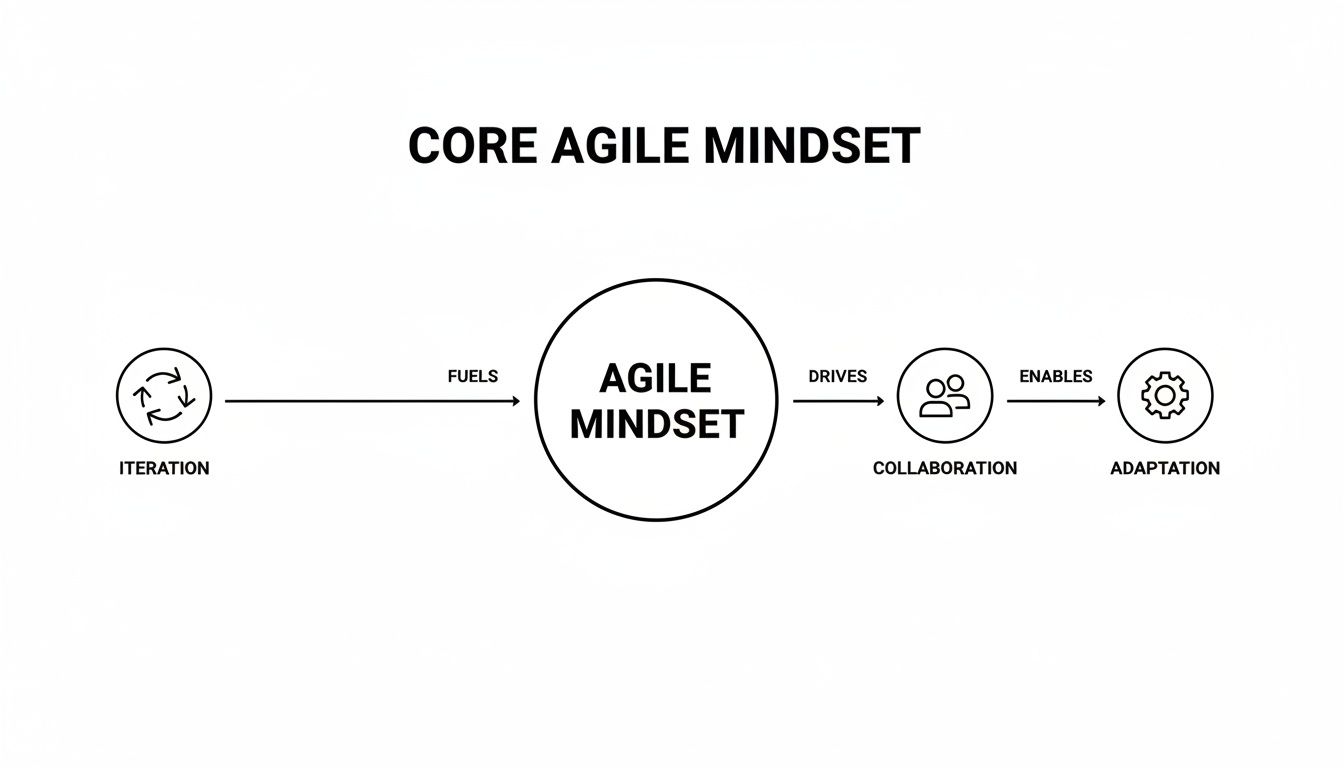
As the diagram shows, a commitment to consistent iteration naturally fosters collaboration. That collaboration, in turn, is what gives teams the power to adapt quickly when new information comes to light or priorities shift. If you want to go deeper, exploring these Agile Development Best Practices is a great next step.
This mindset is what allows us to deliver tangible business results. At Dr3amsystems, we embed these principles into all of our end-to-end technology services, from complex AI integrations to major cloud migrations. By focusing relentlessly on delivering working solutions and responding to change, we’ve helped clients achieve outcomes like 60% reductions in processing time and execute zero-downtime platform transitions. It’s a practical, results-driven approach that ensures every technology investment creates measurable value.
Gain a Competitive Edge with Faster Time to Market

In a competitive market, being first often means winning. The single biggest reason many organizations switch to Agile is its power to dramatically shrink the time it takes to get a product into customers' hands. Forget the old waterfall model, where you could be waiting months or even years for one big, final release.
Agile throws that approach out the window. It works by breaking down huge projects into small, manageable cycles called sprints. Instead of a distant finish line, your team delivers a functional, valuable piece of the product every few weeks. You get to see real progress, fast.
Launching an MVP to Learn and Earn Faster
So, what does this look like in practice? The journey often begins with a Minimum Viable Product (MVP). An MVP isn't a half-finished product—it's the simplest, most essential version that solves a core problem for your first wave of users. By releasing an MVP, you get a working solution out the door as quickly as humanly possible.
This unlocks two huge advantages right away:
- Start Earning Sooner: You can begin generating revenue and validating your business model almost immediately, rather than waiting for a massive, all-or-nothing launch.
- Get Real-World Feedback: Assumptions are replaced with hard data from actual users. This feedback is pure gold, telling you exactly which features to prioritize next and which ideas just aren't working.
This build-measure-learn loop is a powerful way to de-risk big projects. Instead of betting your entire budget on one grand vision, Agile lets you place smaller, smarter bets and adjust your strategy based on what you learn. To make this work, teams need a solid foundation in practical skills like Agile sprint planning, which turns big ideas into a concrete, actionable plan for each cycle.
For any business working with a technology partner, this means getting value right out of the gate. Instead of waiting a year for a sprawling platform, you can deploy features that make a difference incrementally, delivering a tangible return on your investment from the start.
This is exactly how we operate at Dr3amsystems. When we build AI-powered solutions, our goal is to deliver a measurable impact, quickly. For instance, rather than spending 12 months on a complex, end-to-end system, our Agile approach might focus on deploying one specific automation that cuts down a task's processing time by 60%—and we can get that done in just a few weeks.
The Cumulative Power of Incremental Delivery
This method of delivering in small increments creates powerful momentum. Each sprint adds another layer of functionality and value, evolving the product based on fresh market intelligence and user needs. Everyone stays motivated and engaged because they can see and interact with real progress after every cycle.
Ultimately, the ability to adapt on the fly gives you a serious competitive edge. While your rivals are stuck in long-winded planning meetings, your Agile team is already in the market—learning, iterating, and capturing share. This is how software development stops being a cost center and starts becoming the engine that drives your business forward. For companies looking to build and deploy applications with this kind of velocity, check out our own Dr3am Apps development process to see how we put this philosophy into practice.
Improve Product Quality and Stakeholder Satisfaction
It's not just about moving faster. One of the biggest wins with Agile is a dramatic improvement in both the quality of the final product and the happiness of the people paying for it. We’ve all seen projects where quality assurance is just a final hurdle before launch—a frantic, costly scramble to fix bugs discovered at the eleventh hour. Agile flips that script entirely.
Instead of treating quality as an afterthought, it becomes a core part of the daily routine.
This shift is less about a single testing phase and more about a set of disciplined, continuous practices that are woven into every single sprint.
Building Quality In, Not Bolting It On
High-performing Agile teams don't just hope for quality; they engineer it from the ground up. This proactive mindset prevents small defects from snowballing into show-stopping disasters later on.
Here’s how they do it:
- Continuous Integration (CI): Developers merge their code changes into a shared repository multiple times a day. Every time they do, an automated process kicks off to build and test the application, catching integration conflicts almost instantly.
- Automated Testing: Teams write scripts that automatically check if new features work as expected and that old features haven't broken. This creates a robust safety net, giving developers the confidence to refactor and improve code without fearing unintended side effects.
- Frequent Demos: At the end of each sprint, the team doesn't just present a slideshow. They demonstrate a live, working piece of the product to stakeholders, who can click, test, and provide feedback on something tangible.
When you catch and fix a bug the same day it's created, the cost and effort are trivial. When you find it six months later, it can be a nightmare to unravel.
The Power of the Feedback Loop
Now, for stakeholder satisfaction. The single most powerful tool here is the constant feedback loop. In a traditional waterfall project, stakeholders might sign off on a massive requirements document and then go dark for months. By the time they see the finished product, the business needs may have completely changed.
Agile prevents this drift. The product owner, who is the voice of the customer, is an active, daily participant. Regular demos and reviews keep everyone locked in on the same business goals and user needs.
Think of it this way: You're building a product that evolves based on real-time feedback, not on assumptions that are months out of date. This completely sidesteps that dreaded scenario of launching a product that technically works but doesn't actually solve anyone's problem.
This tight alignment leads directly to better user adoption and loyalty because you’re building the right thing from the very beginning. It's a core principle we live by at Dr3amsystems, whether we're managing a complex Dr3am Cloud migration or providing dedicated managed support. We guarantee smooth, zero-downtime transitions and continuously improve systems by keeping that feedback loop wide open, ensuring we always exceed stakeholder expectations. You can read more about our real-world project successes on the Dr3am Insights blog.
The proof is in the numbers. For technology leaders driving major transformations, Agile's 75.4% project success rate is a compelling reason to leave older methods behind. Even more telling, 39% of organizations using Agile report achieving the highest average project performance. For any company focused on continuous improvement, these figures show why Agile has become the gold standard for predictable technology delivery. For a deeper dive, you can find more detailed statistics on Agile performance and see the full picture.
Reduce Project Risk and Improve Budget Control
Scope creep and budget overruns are the two specters that haunt traditional, long-term projects. We’ve all been there. You spend months creating a perfect, detailed plan, only for it to fall apart the moment it meets the real world. As business needs shift, you’re stuck between funding a project that's growing out of control or delivering something that's already obsolete.
This is where one of the biggest advantages of agile methodology comes into play. It’s designed from the ground up to tackle this exact problem.
Agile’s secret weapon is its iterative rhythm. By delivering work in short, focused cycles, teams get a constant stream of feedback. You’re not waiting a year to see if a big idea works; you’re finding out in a matter of weeks. This lets you spot a bad idea and pivot long before it becomes an expensive mistake.
Containing Financial Risk with Sprints
Think of a traditional project as one giant, all-or-nothing bet. Agile, on the other hand, breaks that bet down into a series of smaller, safer experiments. Each sprint is a fixed-cost, fixed-time investment.
If a feature built in a two-week sprint doesn’t resonate with users or turns out to be a dead end, what have you lost? Just two weeks of work. The financial "blast radius" is contained. Now, contrast that with a year-long waterfall project where a flawed assumption might not surface until month eleven. By that point, the time and money wasted can be astronomical.
This gives you fantastic cost predictability. While you don’t lock in the total project scope on day one (which is unrealistic anyway), you know exactly what each sprint costs. This provides leaders with a real-time dashboard of their spending, allowing them to make smart decisions based on the actual value being produced.
If a competitor makes a move or a new opportunity pops up, you can confidently redirect the next sprint’s budget to address it. You’re no longer chained to an outdated plan. You’re actively steering the investment, making sure every dollar is working on what matters most right now. That kind of flexibility is a game-changer. For a closer look at putting this into practice, you can explore our Dr3am IT strategic services.
Aligning Every Dollar with Business Outcomes
This philosophy of tying every dollar directly to a tangible outcome is at the heart of how we work at Dr3amsystems. When we guide a client through a Dr3am Cloud migration or develop a new Dr3am AI model, our focus isn't just on the tech—it's on the business result.
Our Agile approach ensures that every dollar spent is a direct investment in a measurable goal. We break down massive initiatives into smaller workstreams, each delivering its own piece of value. This means our clients see a return on their investment continuously, not just at the end.
Whether the goal is a 60% reduction in processing time for a key business operation or a flawless, zero-downtime platform migration, that value is demonstrated and confirmed with every cycle. This turns your technology budget from a speculative expense into a predictable engine for business growth.
Boost Team Morale and Drive a Culture of Innovation

We've talked about speed, quality, and budget, but the real game-changer with Agile is what it does for your people. In a traditional, top-down setup, it's easy for team members to feel like cogs in a machine, completely disconnected from the customer and the final product.
Agile turns that entire dynamic on its head. It’s built on a foundation of ownership, trust, and a shared sense of purpose. Instead of being handed a rigid to-do list, teams are given problems to solve and the autonomy to figure out the how. This shift is subtle but powerful; when people are responsible for solving the puzzle, not just placing the pieces, their investment in the outcome skyrockets.
Creating an Environment of Psychological Safety
So, how does this happen in practice? It comes down to the daily habits and ceremonies that form the heartbeat of an Agile team. Things like daily stand-ups, sprint planning, and retrospectives aren't just meetings for the sake of meetings—they're forums for genuine connection and transparency.
These routines create a space where:
- Challenges are shared openly. When someone hits a roadblock, it isn't seen as a personal failure. It becomes a team problem to solve together, often right there in the daily stand-up.
- Successes are celebrated as a team. There's a powerful sense of shared accomplishment when a team demos a working product at the end of a sprint. It builds real cohesion.
- Failures become learning opportunities. The retrospective is a dedicated, blameless forum to talk about what went wrong. This allows the team to turn missteps into valuable lessons for the next cycle.
This is what creates psychological safety—a space where people feel secure enough to take risks, ask tough questions, and experiment without fear of being blamed. The result is a direct impact on job satisfaction, a noticeable reduction in burnout, and lower employee turnover.
When your expert teams are empowered with autonomy and supported by a culture of trust, they don't just execute tasks—they innovate. They are encouraged to experiment, test new ideas, and uncover creative solutions to complex problems.
This is precisely the kind of culture Dr3amsystems helps build with every client. Our work isn't just about implementing technology. We partner with your teams, giving them the confidence to adopt AI-driven tools, use secure cloud infrastructure, and truly own the process of continuous improvement long after our initial project is done.
From Empowered Teams to Business Innovation
You can't just put "be innovative" in a memo and expect it to happen. An innovative culture has to be grown from the ground up. By giving your teams freedom within the flexible structure of Agile sprints, you naturally create an environment where discovery can flourish.
This is where the magic happens. New features, better processes, and truly creative solutions start to pop up organically because the people closest to the work feel empowered to make a difference. The same principles that let a team pivot on a product feature also help them find a new automation opportunity or a smarter way to help customers. By putting people first, Agile unlocks a business's most powerful asset: the collective creativity of its teams.
How to Make Agile Work with Dr3amsystems
Knowing the benefits of Agile is great. Actually making it work inside a complex organization? That’s a completely different ballgame. Agile isn't just a new set of rules you can download and install. It’s a deep shift in how people think, work, and collaborate, and getting it right requires a guide who knows the terrain.
Think of it as an expedition into new territory. You wouldn't go without an experienced guide, and that's the role we play at Dr3amsystems. We’re the technology partner that helps you navigate the complexities of adopting Agile, ensuring the whole effort delivers real, measurable results.
Your Personalized Roadmap to Agile Success
The first step is always about getting crystal clear on where you’re headed. Before we talk about sprints or stand-ups, we need to talk about your business goals. It all starts with a straightforward conversation.
Our process kicks off with a free consultation focused on three simple things:
- Clarify Goals: We sit down with your leadership to nail down what "success" actually looks like for you. Is it launching products faster? Slashing operational costs? Or building a rock-solid security posture?
- Uncover Opportunities: We take a hard look at how you work today, pinpointing the exact spots where automation and AI-driven processes can make the biggest impact.
- Design a Roadmap: Together, we build a practical plan that connects Agile practices directly to your business objectives. Every step is designed to create value you can see and measure.
This initial strategy work makes sure your Agile initiative is grounded in business reality from the very beginning.
Overcoming the Hurdles of Implementation
Switching to Agile always comes with a few bumps in the road. Many organizations get tripped up by cultural resistance, get lost in the sea of available tools, or simply don't know where to start. We provide the hands-on expertise to clear those common roadblocks.
For instance, modernizing a clunky legacy system can feel impossible. Our Dr3am IT practice tackles this head-on, using an Agile approach to break the project into small, manageable sprints. Instead of a risky "big bang" launch, you get a series of small, steady wins that build momentum and deliver value along the way.
Integrating sophisticated tech like machine learning is another classic challenge. With our Dr3am AI services, we deploy data pipelines and models in quick, iterative cycles. This lets you see tangible results fast—like a 60% reduction in processing time for one of our clients—proving the value of the investment long before the project is finished.
An Agile transformation led by an experienced partner is about more than just learning new buzzwords and ceremonies. It’s about embedding a culture of continuous improvement that actually sticks, making the change both successful and sustainable.
An Agile Partner for Your Entire Business
At Dr3amsystems, we don’t just "do Agile" in our software department. It’s the thread that runs through everything we do, connecting all our specialized practices to ensure you get consistent, transparent results across your entire tech landscape.
- Dr3am Cloud: We manage cloud migrations in carefully planned phases. This approach allows for zero-downtime transitions and takes the risk out of each step.
- Dr3am Security: Security isn't a one-and-done project. We use an iterative model to constantly implement and refine your security controls, so you can adapt as new threats pop up.
- Dr3am Marketing: Even a go-to-market strategy can be agile. We help your marketing teams test, learn, and adapt their campaigns to get the best possible return on investment.
When you work with Dr3amsystems, you get more than just another vendor. You get a team of dedicated enterprise experts committed to making your shift to Agile a lasting success. Our practical, results-first approach will give your team the confidence to adopt new technology, master the cloud, and build a strategy for genuine, long-term growth.
Ready to see what a pragmatic approach to Agile can do for you? You can start your journey by scheduling your free, no-obligation consultation with our experts today.
Frequently Asked Questions About Agile
When leaders consider moving their teams to a new way of working, a lot of the same questions—and very valid concerns—always surface. While the benefits of Agile sound great on paper, figuring out the practical side of implementation, budgeting, and scaling is where the real work begins. Here are some straightforward answers to the questions we hear most often.
Is Agile Only for Software Development Projects?
That’s where it started, but definitely not where it has ended. While Agile’s roots are firmly in software, its core ideas—making progress in small, iterative steps and adapting your plan as you learn—are incredibly useful in almost any field.
Today, we see Agile practices driving success everywhere, from marketing and HR to product design and even high-level strategic planning. The bottom line is this: if you’re working on a complex project where the requirements aren't perfectly clear from the start, Agile is a fantastic fit. It’s built for situations where you need to learn and pivot as you go.
At Dr3amsystems, for instance, we’ve adapted Agile principles to our entire range of services. We use it to manage:
- Dr3am Cloud Migrations: We break down a massive, high-stakes cloud migration into a series of smaller, lower-risk phases. This approach ensures a much smoother transition with zero disruption to your business.
- Dr3am Security Implementations: Modern security isn't a one-and-done setup. We use an iterative process to deploy and continuously strengthen your security, allowing us to adapt to new threats the moment they appear.
- Dr3am AI Projects: Instead of a long, drawn-out development cycle, we deliver machine learning models in small increments. This lets us prove the value of the project quickly and fine-tune the solution based on how it actually performs in the real world.
How Does Agile Handle Long-Term Budgets and Planning?
This is probably the biggest myth out there—that Agile means "no plan." In reality, Agile uses what we call adaptive planning, which often proves to be far more realistic and accurate than traditional, rigid methods.
You still start with a high-level product roadmap that lays out the long-term vision and business goals. But from there, you break the work down into more detailed release plans that cover the next few months. From a budgeting standpoint, this gives you incredible control.
Rather than signing off on one enormous, speculative budget at the very beginning, you typically allocate funds on a quarterly basis or for each team. This gives leaders consistent financial oversight but also the flexibility to shift priorities based on market feedback or a sudden business opportunity. Forecasting also becomes much more reliable because it’s based on a team's actual, proven track record of delivery, not on guesswork from months ago.
Can Agile Work in a Large Enterprise?
Yes, it absolutely can. In fact, many large organizations find that scaling Agile is what finally breaks down stubborn internal silos and truly speeds up innovation. It's not a simple flip of a switch, though. It requires a very deliberate and thoughtful approach.
Frameworks like SAFe (Scaled Agile Framework) exist specifically to help coordinate dozens or even hundreds of Agile teams across a large company. From what we’ve seen, the keys to getting it right are:
- Starting small with a well-defined pilot project to get a win on the board and build momentum.
- Getting strong, visible support from executives who can champion the cultural change required.
- Investing in experienced coaches to guide not just the teams but also the managers through the transition.
Adopting Agile in an enterprise isn't about just following a new process. It's a journey of continuous improvement aimed at building a genuine culture of agility.
This is where having an experienced partner can make all the difference. Dr3amsystems specializes in guiding large organizations through this exact kind of transformation. Our team brings the enterprise-level expertise and hands-on execution needed to modernize old systems, integrate AI responsibly, and build a technology strategy that fuels real growth.
Ready to see how the advantages of Agile could apply to your business? With a practical, results-focused approach, Dr3amsystems helps organizations use the cloud with confidence and elevate their technology strategy. Get started by booking a free consultation.