
Most CTOs don’t start looking for a cloud migration service provider because they’re excited about infrastructure. They start because the current environment is slowing the business down. Release cycles stretch because one legacy dependency breaks another. Capacity planning turns into guesswork. Security teams keep patching around old systems that should’ve been retired years ago. Finance asks why hardware, maintenance, and support costs keep climbing while product teams still can’t ship faster.
That tension usually shows up before the migration program is formally named. A line-of-business leader wants a new customer portal. Data teams need faster access to analytics. Operations wants more resilience. The underlying issue is the same. The current stack can’t support the speed, flexibility, or governance the business now expects.
The Inevitable Shift to the Cloud
A common pattern plays out like this. The business has critical applications running on infrastructure that was stable for years, but stability has become rigidity. Every upgrade requires careful choreography. Every change window creates risk. Teams know they need to modernize, yet they also know a careless move can break production.

That’s why cloud migration is no longer a side initiative. It has become a board-level modernization decision. The global cloud migration services market was valued at USD 21.66 billion in 2025 and is projected to reach USD 234.28 billion by 2035, while 94% of enterprises now use cloud computing, according to Precedence Research on the cloud migration services market.
What CTOs are dealing with right now
Teams do not need convincing that cloud matters. They need a practical path forward that won’t create more disruption than the legacy environment already causes.
A few signs usually appear together:
- Aging infrastructure starts dictating business timelines. Product launches wait on hardware constraints, maintenance windows, or brittle integrations.
- Support costs rise while agility falls. Teams spend more time keeping systems alive than improving them.
- Innovation gets trapped behind architecture debt. AI initiatives, data platforms, and new customer experiences stall because the foundation can’t support them.
- Risk increases unnoticed. Compliance, access control, backup recovery, and operational resilience become harder to manage consistently.
Practical rule: If your best engineers spend more time protecting yesterday’s architecture than building tomorrow’s capabilities, migration has already become a business priority.
A good migration partner helps a CTO reduce uncertainty. That starts with clarity on workload dependencies, business criticality, security posture, and the order of operations. It also requires a view beyond the cutover date. The cloud only creates value when the new environment improves delivery speed, reliability, and cost control after the move.
For leaders who want grounded perspectives on modernization trade-offs, Dr3am Insights is a useful place to explore the operational side of these decisions.
Defining Your Cloud Migration Partner
A cloud migration service provider shouldn’t be treated like a moving company. That mindset creates bad programs. If the provider’s role is limited to “move these servers and databases to a cloud platform,” the result is often an expensive replica of old problems.
The better analogy is a general contractor for a digital headquarters. You’re not just relocating assets. You’re deciding what to keep, what to redesign, what to retire, and what should be built for a different operating model entirely.
The difference between a mover and an architect
A transactional vendor usually focuses on execution tasks. They inventory systems, schedule migration waves, run scripts, and report status. That can be useful, but it’s incomplete. It doesn’t answer bigger questions around application fit, security boundaries, operating costs, platform governance, or post-migration ownership.
A strategic partner approaches the work differently:
- They connect infrastructure decisions to business outcomes. A customer-facing platform may need performance and resilience improvements, not just hosting changes.
- They challenge poor migration assumptions. Not every workload belongs in a simple lift-and-shift model.
- They design for operating reality. That includes identity, observability, compliance controls, backup strategy, and cost governance.
- They stay involved after cutover. Migration is one milestone, not the finish line.
If you’re comparing provider models, this breakdown of cloud migration consulting services is helpful because it frames migration as a mix of advisory, execution, and operational disciplines rather than a narrow infrastructure event.
What a real partner actually owns
The right cloud migration service provider helps answer four uncomfortable questions early:
- Which systems create business value and which only consume support effort
- Where will migration complexity come from
- What level of modernization is worth the investment
- Who will manage performance, security, and spend once the environment is live
A migration project usually fails long before cutover. It fails when leadership approves a technical plan that never tied back to business operations.
That’s why provider selection should favor breadth and judgment, not just migration tooling. The team should be able to guide architecture, security, data movement, testing, operating model design, and ongoing support. A provider also needs enough business fluency to explain trade-offs in terms a CFO, COO, and product leader can act on.
When evaluating service depth, it helps to look at a provider’s broader delivery footprint, not just their migration pitch. A practical example is the range of capabilities listed across Dr3amsystems services, where cloud work sits alongside AI, security, hosting, and managed support. That kind of coverage matters because migration choices affect every one of those domains.
Core Migration Strategies and Project Phases
Migration strategy isn’t a technical vocabulary test. It’s a set of business trade-offs. The wrong choice usually comes from applying one pattern to every workload because it feels easier to govern. The right choice comes from matching each application to its business value, risk profile, and modernization potential.
The six common strategy choices
The industry often talks about the 6 Rs. In practice, they matter because each one changes cost, risk, and timeline.
- Rehost means moving an application with minimal change. This is the classic lift-and-shift path. It’s fast, but it often preserves inefficiencies.
- Replatform keeps the application intact at a functional level while improving the underlying platform. Moving to managed databases or container platforms often fits here.
- Refactor changes application architecture more extensively so it can behave like a cloud-native system. This takes more effort but usually creates the most operational flexibility.
- Repurchase replaces the current application with a SaaS alternative. This can simplify operations, but it changes workflows and vendor dependencies.
- Retire removes systems that no longer justify support effort. Every migration portfolio has some.
- Retain leaves a workload where it is for now because of technical constraints, licensing, or business timing.
The mistake I see most often is defaulting to rehost because it looks safer. It is safer only in the short term. If a system is expensive, brittle, or hard to scale today, rehosting may just relocate that problem.
The four phases that keep projects under control
A sound cloud migration service provider uses a delivery flow that reduces surprises. The names vary by provider, but the operational sequence is usually consistent.
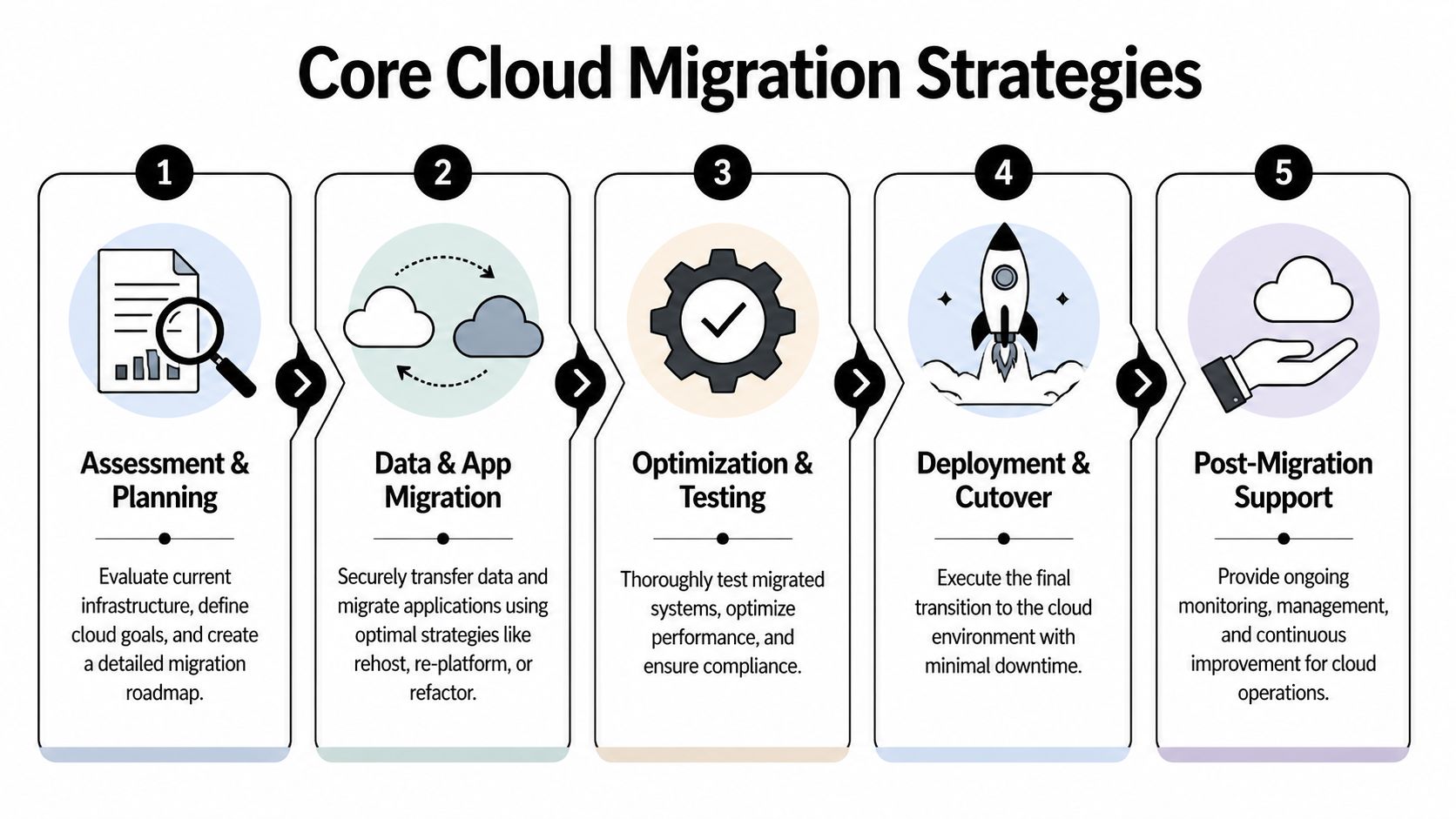
Assess
Mature programs separate from rushed ones as teams map application dependencies, data gravity, network patterns, compliance constraints, and operational ownership. They also determine which workloads can move quickly and which need redesign.
AI-assisted tooling is changing this phase materially. AI-powered migration tools are experiencing 28% growth, and AWS launched a tool in January 2025 that reduced planning time by 60%, according to Market Business Insights on the cloud migration services market. That matters because better discovery shortens planning cycles and improves migration decisions before money gets committed.
Plan
Planning turns technical findings into an executable roadmap. The planning process defines migration waves, rollback paths, test requirements, security controls, and success criteria. Good plans also identify the workloads that should not move yet.
For teams looking for a grounded companion read on optimizing your cloud migration, the most useful guidance usually centers on sequencing and governance, not just tooling choices.
Migrate
Execution includes environment buildout, data transfer, application deployment, validation, and cutover. This phase gets most of the attention, but by this point many key decisions are already locked in. If the assess and plan phases were weak, execution becomes a scramble.
In this context, operational disciplines matter most:
- Dependency control reduces failed cutovers caused by hidden integrations.
- Rollback readiness keeps teams from forcing a bad go-live.
- Security baselines prevent teams from rebuilding old access problems in a new environment.
- Communication cadence keeps business units aligned when migration waves affect production services.
Optimize
The best migration projects don’t end at “it’s running.” They stabilize first, then tune. Performance bottlenecks appear. Idle resources surface. Logging costs spike. Teams discover where automation should have been stronger.
That’s why cloud work should connect directly with broader operational support. For example, Dr3am IT reflects the kind of adjacent delivery capability many organizations need once cloud workloads become part of day-to-day operations.
Operational advice: Don’t approve a migration plan that lacks named owners for optimization, support escalation, and cost review after cutover. That gap turns a project into a recurring expense problem.
A Full Spectrum of Cloud Migration Services
A strong provider doesn’t sell “migration” as one bundled activity. They deliver a set of services that solve different problems at different moments. That distinction matters because most failed programs don’t break on the move itself. They break in the handoffs between architecture, security, data, operations, and ownership.

Assessment and migration planning
This service should produce more than a spreadsheet of servers. It should identify application dependencies, performance baselines, compliance boundaries, licensing constraints, and the likely business impact of each migration wave.
A capable provider also translates findings into decision paths. Which applications should move quickly. Which need replatforming. Which systems should stay put until a contract, integration, or product change makes migration worth it.
The output you want is a practical roadmap, not a generic cloud readiness report.
Application modernization and platform redesign
Some workloads only need a hosting change. Others need structural work. That’s where application modernization services become critical.
This can include:
- Containerization for portability. Useful when teams want cleaner deployment patterns and better resource control.
- Managed service adoption. Moving databases, messaging layers, or storage into cloud-managed services can reduce admin burden.
- Refactoring selected components. Critical for applications that can’t meet performance or resilience goals in their current form.
- Integration redesign. Legacy applications often rely on tightly coupled connections that don’t behave well in distributed environments.
A mature provider knows where to stop. Not every application deserves deep refactoring. Some should move fast with minimal changes. Others deserve targeted modernization because they directly affect revenue, customer experience, or delivery speed.
Data migration and cutover execution
Data work is where many projects get fragile. The challenge isn’t just transfer speed. It’s consistency, validation, timing, and recovery planning. Large datasets, active transactional systems, and reporting dependencies all raise the bar.
Good data migration services usually include a mix of replication planning, validation testing, cutover sequencing, and rollback preparation. This is also where downtime tolerance needs direct discussion. Business leaders should know which systems can tolerate a maintenance window and which require a highly continuous transition model.
Later in the process, it helps to give stakeholders a shared technical reference point. This overview is useful before those conversations:
Security, governance, and compliance support
Cloud migrations often expose policy gaps that were easy to ignore on premises. Identity sprawl, inconsistent access controls, unclear data handling rules, and weak logging practices all become more visible.
This is where service depth matters. The provider should establish governance controls that are practical enough for engineering teams to follow. That includes identity standards, environment segmentation, encryption policies, backup requirements, audit support, and incident response alignment.
The organizations that get this right treat governance as enablement. The ones that get it wrong treat it as paperwork and bolt it on late.
Managed support after go-live
A migration provider should also be ready for the operating phase. Once systems are live, teams need monitoring, patching, performance tuning, cost analysis, backup oversight, and escalation support. Without that, the business inherits a technically migrated environment that still lacks operational discipline.
A broader cloud operations capability is important. One example is Dr3am Cloud, which covers cloud migration, multi-cloud management, and ongoing support as connected responsibilities rather than isolated tasks.
Where integrated practices help
When providers can combine infrastructure, security, AI, hosting, and managed support, handoffs get cleaner. A cloud migration service provider with that range can coordinate application changes, governance controls, operating support, and later optimization without forcing the client to manage multiple disconnected vendors.
That matters most when migration is tied to broader transformation goals such as automation, analytics, security hardening, or platform consolidation.
How to Choose the Right Migration Partner
Most vendor selection mistakes happen because teams evaluate presentation quality instead of delivery fit. A polished demo can hide weak governance. A low implementation estimate can hide expensive post-migration support gaps. A big brand can still assign a thin team to your account.
The better approach is to score providers against the conditions your business faces. If you run regulated workloads, security depth matters more than slideware. If you have a mixed application estate, architectural judgment matters more than a generic migration factory. If your budget is tight, cost transparency matters more than broad promises.
The evaluation criteria that actually matter
A cloud migration service provider should be able to show competence in three layers at once. First, they need technical delivery skill. Second, they need business judgment about sequencing and ROI. Third, they need an operating model for the period after cutover.
Here’s a practical scorecard.
| Evaluation Criteria | What to Look For | Why It Matters |
|---|---|---|
| Cloud architecture depth | Clear workload placement logic, modernization judgment, and platform design capability | Prevents teams from moving everything the same way and paying for bad architectural decisions later |
| Discovery and dependency mapping | Evidence of structured assessment, application mapping, and migration wave planning | Reduces hidden integration failures and surprise cutover issues |
| Security and compliance discipline | Identity controls, logging standards, policy enforcement, and regulated workload experience | Keeps migration from creating new exposure while old controls are being retired |
| Downtime approach | Defined cutover method, rollback planning, and clear communication for business-critical systems | Protects operations during the highest-risk transition windows |
| Post-migration operating model | Monitoring, support, optimization, cost review, and ownership model after go-live | Prevents the “project finished, now what” problem |
| Cost governance maturity | FinOps awareness, resource review process, and budgeting transparency | Helps leaders avoid uncontrolled spend after migration |
| AI and automation usage | Practical use of automation in discovery, planning, testing, or operations | Speeds execution and reduces manual error when applied well |
| Communication and executive alignment | Regular reporting, issue escalation paths, and decision support for leadership | Keeps migration tied to business priorities rather than technical activity alone |
Questions worth asking in the shortlist stage
Don’t ask vendors if they “have experience.” Everyone says yes. Ask questions that force them to expose how they work.
- How do you decide between rehost, replatform, and refactor for mixed portfolios
- What happens when discovery reveals a dependency that changes migration order
- How do you handle business-critical cutovers that can’t tolerate long disruption
- Who owns optimization after production stabilization
- How do you govern access, auditability, and environment sprawl
- What does your escalation path look like when migration waves affect live operations
The best answers are usually specific, cautious, and operational. Weak providers answer with slogans.
What strong evidence looks like
You’re looking for proof of execution discipline, not just confidence. That can include migration runbooks, sample operating dashboards, governance models, workload classification methods, or examples of zero-downtime transition planning. It should also include clarity on who will do the work.
Security evaluation deserves special scrutiny. It’s easy for providers to treat security as a separate stream and assume your internal team will absorb the rest. In practice, migration and security are inseparable. Identity design, secrets management, logging, segmentation, recovery planning, and compliance evidence all need to be considered as part of delivery. For leaders assessing that dimension, Dr3am Security illustrates the kind of adjacent capability that should be available when cloud programs intersect with governance and risk.
A provider becomes much more credible when they can discuss technical trade-offs, operating realities, and executive concerns in the same meeting. That’s usually the difference between a contractor and a long-term partner.
Planning Your Roadmap and Measuring Success
A migration roadmap shouldn’t start with the most complex system in the estate. It should start with sequencing logic that protects the business while building confidence. That usually means choosing early workloads that are important enough to prove value but contained enough to manage safely.
A practical roadmap pattern
Many CTOs do better with phased migration than with a single, all-at-once transformation plan.
A workable pattern often looks like this:
Foundation wave
Build landing zones, identity controls, network patterns, logging, backup standards, and governance guardrails.Low-dependency workloads
Move internal tools, supporting services, or non-critical applications that help teams validate process, tooling, and support models.Core business applications
Migrate customer-facing or operational systems once dependency mapping, testing routines, and rollback processes are proven.Modernization candidates
Replatform or refactor the applications where performance, resilience, or deployment speed meaningfully affects business outcomes.Steady-state optimization
Shift into continuous tuning, support, security review, and spend management.
This approach gives leadership clearer decision points. It also avoids the common mistake of treating every application as equally urgent.
Measure outcomes that matter to the business
Success isn’t “we moved it.” That’s activity, not value. The critical question is whether the new environment improves the way the business operates.
Useful metrics usually include:
- Application performance for customer-facing and operational systems
- System availability during and after cutover
- Deployment speed for engineering teams
- Incident frequency and recovery readiness
- Cloud cost efficiency after stabilization
- Processing time for critical workflows, especially where automation or platform redesign changes throughput
The author brief notes executive testimonials pointing to 60% reductions in processing time and zero-downtime transitions in relevant delivery contexts. Those are the kinds of business-facing results leaders should anchor to, because they tie technical work to operational impact.
Where ROI actually shows up
Cost reduction can be real, but only when teams avoid copying on-prem inefficiencies into cloud billing. According to Codebridge on cloud migration service providers, avoiding over-provisioning in lift-and-shift scenarios can reduce cloud costs by 30% to 50% via right-sizing, while replatforming strategies improve performance.
That trade-off matters. A pure lift-and-shift move may accelerate exit from aging infrastructure, but it can leave too much waste in place. Replatforming takes more planning and engineering effort, yet it often creates better operational performance and a cleaner cost profile.
Decision lens: If a workload is business-critical and long-lived, spend more time on its target-state design. If it’s transitional or low-value, favor speed and controlled risk.
Don’t separate roadmap design from ownership
A roadmap without named owners becomes a slide deck. Every phase should have accountable leaders across platform engineering, security, application teams, operations, and finance. That’s especially important once migrated workloads hit production, because measurement only matters if someone is responsible for acting on it.
The strongest programs review migration success in business terms. Did reporting run faster. Did release friction drop. Did support load improve. Did teams gain headroom for automation and AI initiatives. Those are the outcomes that justify the investment.
Beyond Migration Toward Continuous Optimization
The most expensive misconception in cloud programs is that the hard part ends at go-live. In reality, migration only changes where systems run. Optimization determines whether the business achieves better performance, cleaner governance, and sustainable spend.
Many mid-market firms encounter a common pitfall. They complete the move, decommission old infrastructure, and then discover the monthly cloud bill doesn’t match the business case. FinOps discipline was never embedded. Resource ownership is unclear. Environments expand faster than governance can keep up.
Why post-migration FinOps matters
One of the clearest market gaps is long-term cost governance. Seventy percent of mid-market organizations report unexpected cloud cost overruns post-migration, and AI-driven FinOps tools can reduce these bills by 30% to 50% within 12 months, according to Fluence on comparing cloud migration service providers.
Those numbers line up with what many CTOs already feel operationally. Cloud spend usually drifts for familiar reasons:
- Idle resources stay running
- Teams overprovision for safety and never revisit sizing
- Storage and logging expand without policy controls
- Multiple teams launch services without shared tagging or review discipline
- No one owns optimization across engineering, finance, and operations
For teams building that discipline, these PushOps cloud optimization strategies are a useful companion reference because they frame cost control as an operating practice, not a one-time cleanup exercise.
What a long-term partner does differently
A provider earns long-term value when they help the client run better month after month. That means regular rightsizing reviews, anomaly detection, budgeting guardrails, performance analysis, governance enforcement, and support processes that don’t end when the migration plan closes.
This is the point where many organizations want one provider that can connect migration, cloud operations, AI-enabled automation, security, and managed support into a single working model. Dr3amsystems fits that profile as a technology partner offering AI-driven solutions, secure cloud migration, and dedicated managed support across practices that include Dr3am IT, Dr3am Cloud, Dr3am AI, Dr3am Security, Dr3am Hosting, and Dr3am Marketing.
Cloud value compounds when teams treat optimization as continuous work. That’s how migration becomes a business advantage instead of a hosting change.
If you’re planning a migration or trying to get more value from one that’s already complete, Dr3amsystems offers a free consultation to clarify goals, identify automation opportunities, and build a roadmap tied to security, cost efficiency, and long-term ROI.