
Your team approved the roadmap. The vendor kicked off the sprint. Six weeks later, nobody agrees on what success looks like.
Engineering says the backlog changed. Operations says the workflows were never mapped correctly. Finance sees spend climbing while the business still waits for a usable outcome. Leadership starts asking the wrong question: “Why is delivery slow?” The core question is simpler. Who translated the business need into something the technical team could build correctly the first time?
That gap is where complex initiatives fail. It’s also why business analysis as a service has become a practical operating model for enterprises that need speed without chaos.
From Project Chaos to Strategic Clarity
A familiar scenario plays out in boardrooms and sprint reviews every week. A company launches an AI initiative, cloud migration, ERP modernization, or reporting overhaul because the business needs faster decisions and cleaner operations. The intent is right. The execution breaks because requirements live in meeting notes, Slack threads, Jira comments, and people’s memory.
The result isn’t just confusion. It’s rework, delays, and political friction between teams that should be aligned.
Where projects usually go wrong
Most enterprise failures don’t start with bad technology. They start with unclear business intent. Teams move too quickly into solution mode, then discover halfway through delivery that stakeholders meant something else.
Common symptoms show up early:
- Scope keeps moving: New requests appear because the original need was never defined tightly.
- Teams speak different languages: Executives talk outcomes, developers talk tickets, and nobody translates.
- Approval cycles drag on: Stakeholders hesitate because they don’t trust what’s being built.
- Metrics stay fuzzy: Teams can’t prove value because they never agreed on measurable business success.
That’s why mature organizations treat analysis as a discipline, not a side task. If your team cares about data driven decision making, the first step isn’t another dashboard. It’s getting disciplined about what decision the business is trying to improve and what process, system, or dataset should support it.
Why outsourced analysis is growing
The market is moving in this direction because companies don’t want to build every capability in-house. The global Business Analytics BPO Services market is projected to grow from USD 10.3 billion in 2025 to USD 39.4 billion by 2035, at a 14.4% CAGR, according to Future Market Insights on business analytics BPO services.
That projection matters for one reason. It shows outsourced analytics and analysis support is no longer a niche fix for struggling teams. It’s becoming a standard way to access specialized expertise, accelerate delivery, and avoid the cost of building a large permanent analysis function for every transformation program.
Practical rule: If your architects are interpreting strategy on the fly, you don’t have a delivery problem. You have an analysis problem.
Enterprise leaders should stop treating business analysis like project administration. It’s not note-taking. It’s the control layer that turns strategic intent into executable work.
What Is Business Analysis as a Service
Business analysis as a service is an outsourced capability that converts business needs into structured technical direction. The simplest way to think about it is this: it’s your outsourced brain for project discovery, requirements definition, prioritization, and decision clarity.
A strong provider doesn’t just document meetings. They create the translation layer between executives, operators, architects, developers, security teams, and vendors.
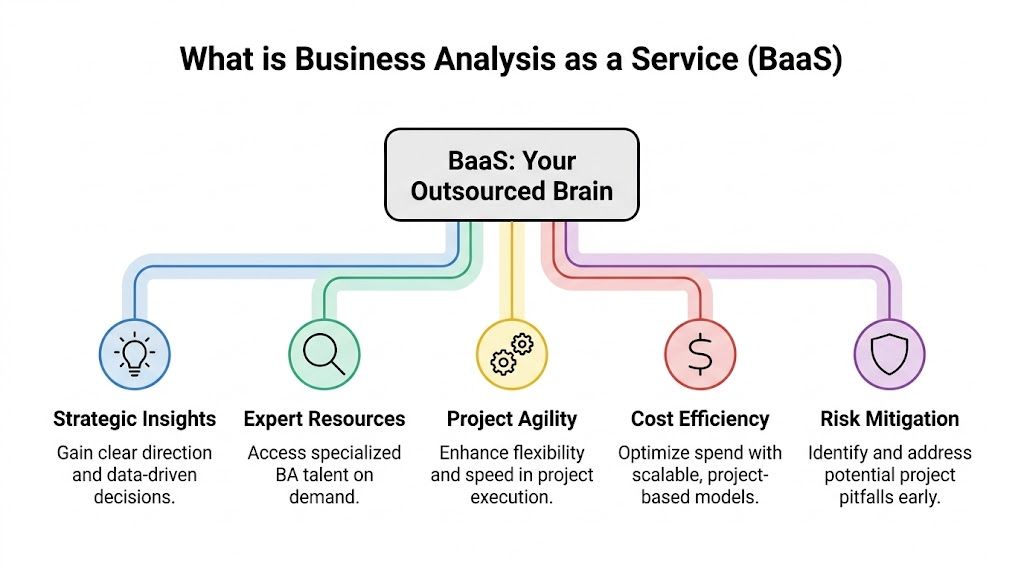
The translation layer most teams are missing
In enterprise work, business people rarely express needs in implementation-ready terms. They describe pain points, compliance concerns, timing pressure, customer complaints, and revenue expectations. Developers can’t build from that alone.
A BaaS team breaks that ambiguity down into usable artifacts such as:
- Business requirements: What problem needs solving and why it matters.
- Functional requirements: What the system must do.
- User stories and acceptance criteria: What delivery teams can estimate and ship.
- Process models: How work flows today, where it breaks, and what should change.
- Change impact analysis: What downstream systems, teams, and controls will be affected.
The service proves its worth. According to Andersen’s BAaaS overview, BaaS functions as a requirements-to-architecture translation layer, and misalignment between business goals and technical implementation typically leads to 30% to 40% project rework in enterprise environments. Good analysis reduces that by forcing structured discovery and disciplined requirements management before delivery drifts.
What competent BaaS looks like in practice
You should expect more than documents. You should expect active control of ambiguity.
A serious BaaS provider will usually:
Run structured discovery
They interview stakeholders, surface hidden assumptions, identify conflicts, and map current-state processes.
Create a single source of truth
They centralize approved requirements, priorities, dependencies, and changes so teams stop arguing over old versions.
Support delivery continuously
They don’t disappear after kickoff. They refine backlog items, clarify acceptance criteria, and keep business intent aligned to release decisions.
Manage change without chaos
Every enterprise project changes. The difference between a stable program and a failing one is whether someone assesses impact before the change hits the sprint.
Business analysis as a service works best when leaders treat it as an operating function tied to outcomes, not as a documentation task delegated at the last minute.
Why this matters for AI and cloud work
AI projects fail when no one defines the business decision, data requirements, guardrails, and workflow impact clearly enough. Cloud migrations fail when no one maps dependencies, business-critical processes, and cutover constraints thoroughly enough.
BaaS gives those initiatives structure. It forces teams to decide what success means before they spend money building the wrong thing.
Choosing Your BaaS Engagement Model
The wrong engagement model creates as much waste as weak analysis. Some organizations need a sharp, short intervention. Others need embedded analytical leadership across multiple workstreams. Don’t buy business analysis as a service as a generic package. Match the model to the delivery problem.

Three engagement models that actually make sense
On-demand expertise
This model works when your team is capable but blocked. You might need support for a discovery sprint, a process redesign workshop, a backlog reset, a vendor evaluation, or a troubled initiative that needs triage.
Typical deliverables include stakeholder interview summaries, current-state and future-state process maps, risk logs, workshop outputs, and a prioritized requirements baseline.
Choose this when the internal team owns delivery but lacks the analytical bandwidth or specialist depth to get unstuck.
Dedicated BA team
This model fits ongoing transformation programs. A dedicated team integrates with agile squads, product owners, architects, security leads, and operations managers across releases.
Expect this setup to produce user stories, acceptance criteria, dependency mapping, cross-team requirement management, backlog refinement support, and traceability between business goals and technical execution.
If you’re weighing outsourcing structures, this comparison of staff augmentation vs. managed services is useful because BaaS can sit in either camp. My advice is blunt. If you want outcomes, buy managed accountability, not just extra hands.
Project-based engagement
This is the cleanest model for initiatives with a defined beginning and end. Examples include CRM replacement, warehouse systems redesign, cloud readiness assessment, governance framework rollout, or analytics platform implementation.
The provider usually owns a defined analysis scope and hands over a package of approved requirements, process designs, user journeys, and decision records that the delivery team can execute.
The five domains buyers should understand
Business analysis as a service isn’t one thing. It spans several analytical disciplines. According to ACE’s explanation of business analysis, the field includes strategy analysis, process analysis, IT or systems analysis, data analysis, and market analysis.
A smart buyer knows which of these domains matters most for the initiative at hand.
| Domain | Best used for | Typical outputs |
|---|---|---|
| Strategy analysis | Aligning transformation to business goals | capability maps, initiative priorities, decision frameworks |
| Process analysis | Fixing operational friction | process flows, bottleneck analysis, future-state workflows |
| IT or systems analysis | Designing the right technical solution | functional specs, integration requirements, system behavior definitions |
| Data analysis | Improving decisions and reporting | data requirements, KPI definitions, analytics use cases |
| Market analysis | Supporting growth and positioning | customer insights, trend inputs, opportunity framing |
What to ask for before you sign
Don’t accept vague promises about “supporting transformation.” Ask what the provider will produce and own.
Use this shortlist:
- Artifact clarity: Get a written list of deliverables. BRDs, user stories, workflow diagrams, backlog governance, functional specs, and approval checkpoints should be explicit.
- Operating cadence: Confirm how they’ll work with product, engineering, and business teams each week.
- Tool fluency: Ask how they use Jira, Confluence, Miro, Lucidchart, Azure DevOps, Tableau, Power BI, or Salesforce where relevant.
- Commercial fit: Make sure the engagement model can flex with your delivery pace and governance style.
For buyers comparing providers, it also helps to review the range of work a modern technology partner can support across adjacent execution areas through end-to-end service offerings.
Buy the engagement model that matches the decision load of the initiative. If your teams make daily tradeoffs across systems, data, and operations, part-time analysis won’t hold.
The Tangible ROI of Outsourcing Business Analysis
Leaders often ask the wrong ROI question. They ask, “How much does outsourced analysis cost?” Ask this instead: What does weak analysis cost when a strategic program goes off course?
That’s the number that matters.

Why large enterprises already invest this way
The broader analytics market makes the direction clear. According to Mordor Intelligence on Analytics as a Service, the AaaS market is valued at USD 20.56 billion in 2025, and large enterprises account for 63.35% of revenue. That tells you where serious operators are placing their bets. They’re buying structured analytics capabilities because enterprise-wide efficiency doesn’t happen by accident.
That logic extends directly to business analysis as a service. When the initiative is expensive, cross-functional, and politically visible, disciplined analysis is cheaper than failure.
Where ROI actually shows up
You don’t need a complicated formula to understand the return. It appears in four places that executives can observe quickly:
- Less rework: Teams spend less time rebuilding what they misunderstood.
- Faster decision cycles: Stakeholders approve work more confidently when requirements are clear.
- Better resource allocation: Engineers focus on building, not interpreting ambiguous requests.
- Lower delivery risk: Programs avoid expensive late-stage surprises in security, compliance, integrations, and workflow design.
A practical ROI review should compare current-state friction against post-engagement delivery behavior. Look at backlog churn, approval delays, escalations, release readiness, and how often teams reopen requirements already thought to be settled.
Analysis is what turns technical effort into business value
A cloud migration with zero disruption doesn’t happen because the migration tool is impressive. It happens because someone mapped dependencies, clarified business-critical windows, documented exceptions, and aligned operations with cutover plans.
An automation effort that produces 60% reductions in processing time only sustains value when the process logic, exception handling, ownership model, and reporting needs were defined properly before implementation.
That’s why ROI from BaaS is mostly defensive and strategic at the same time. It prevents waste, then it accelerates value.
For leaders who want to sharpen their own thinking around operational and transformation outcomes, this library of technology and execution insights is worth reviewing.
A short explainer helps reinforce the business case:
The best ROI from business analysis as a service comes from avoiding the expensive mistake your team hasn’t discovered yet.
BaaS Integration with AI Cloud and Security
Most organizations still under-scope the analyst role in modern transformation. They assign a generalist BA to specialized work and hope the technical teams will fill the gaps. That’s lazy governance.
AI, cloud, and security each demand deeper analysis because the business questions are harder, the dependencies are wider, and the consequences of ambiguity are bigger.

AI needs business definition before model design
Teams get excited about machine learning, copilots, and automation platforms too early. The first job isn’t selecting a model or vendor. The first job is defining the decision, action, or process the AI system is supposed to improve.
A business analyst in AI work should pin down:
- The use case boundary: What exact business task is being improved.
- Decision rights: Who accepts, rejects, or overrides model outputs.
- Data requirements: Which systems hold the needed information and what quality issues exist.
- Success criteria: What outcome the business will recognize as valuable.
- Risk and governance expectations: What human review, auditability, and policy controls are required.
Without that groundwork, AI becomes a demo instead of a capability.
Cloud migration requires dependency intelligence
Cloud projects often fail in planning, not execution. Teams know what servers or applications exist, but they don’t fully understand which business workflows, integrations, reporting jobs, approvals, or peak operating windows depend on them.
That’s why the BA role matters. Analysts connect infrastructure decisions to operational reality.
A capable BA in cloud work will map:
- Application dependencies and integrations.
- Business process touchpoints across departments.
- Cutover constraints tied to revenue, support, or regulatory windows.
- Exception paths that standard migration plans often miss.
Specialized cloud expertise is vital. If you’re assessing how a provider approaches modernization and migration, reviewing a focused cloud practice like enterprise cloud transformation services helps clarify what mature support should look like.
Security requires translation, not slogans
Security teams often speak in policies, controls, and obligations. Product and engineering teams need those translated into buildable requirements.
That translation work includes access models, approval steps, logging expectations, retention needs, segregation of duties, incident escalation rules, and control evidence for audits. If that doesn’t get defined cleanly, teams either overbuild and slow delivery, or underbuild and create exposure.
Strong security analysis turns “we need to be compliant” into a list of system behaviors, workflow constraints, and documentation obligations that teams can actually implement.
Why integrated analysis matters
AI, cloud, and security collide in the same programs. An AI rollout may depend on cloud data architecture. A cloud migration may trigger security redesign. A security requirement may reshape user workflows and reporting logic.
That’s why business analysis as a service should never sit on the edge of these initiatives. It needs to sit in the middle, connecting strategy, operations, architecture, data, and control design.
A Procurement Checklist for Evaluating BaaS Vendors
Most vendor evaluations are too soft. Buyers get impressed by polished decks, broad promises, and generic claims about innovation. Then they discover the provider can’t run a workshop, can’t challenge vague stakeholder input, and can’t keep requirements stable across delivery.
Procurement needs a stricter filter. A business analysis partner should prove they can handle ambiguity, drive decisions, and operate credibly with technical and business leaders in the same room.
What matters more than a sales presentation
You’re not buying a slide deck. You’re buying judgment, communication discipline, and execution structure.
Start with the basics:
- Industry relevance: The team should understand your operating model well enough to ask hard questions quickly.
- Business and technical fluency: They must speak to executives, product owners, developers, architects, and security teams without translation loss.
- Methodology maturity: They should work comfortably in agile, hybrid, or structured governance environments.
- Tool capability: Jira, Confluence, Miro, Lucidchart, Azure DevOps, and analytics tooling shouldn’t be learning experiences for them.
- Evidence of outcomes: Look for proof of accelerated execution, cleaner delivery, and credible executive references.
A provider with adjacent expertise in governance and protection is usually stronger, especially when transformation work intersects with compliance and operational risk. That’s one reason buyers should consider whether the vendor also demonstrates depth in areas such as security operations and risk services.
BaaS Vendor Evaluation Checklist
| Evaluation Criterion | What to Look For | Weight (1-5) |
|---|---|---|
| Domain expertise | Experience with your industry workflows, constraints, and stakeholder environment | 5 |
| Requirements discipline | Clear method for discovery, validation, approval, and change control | 5 |
| Technical fluency | Ability to translate needs into system behavior, integrations, data requirements, and nonfunctional expectations | 5 |
| Agile delivery support | Strong backlog refinement, story writing, acceptance criteria, and sprint collaboration | 4 |
| Executive communication | Concise updates, decision framing, and the confidence to challenge unclear direction | 4 |
| Tool proficiency | Practical use of Jira, Confluence, Miro, Lucidchart, Azure DevOps, Tableau, or Power BI where relevant | 3 |
| Documentation quality | Samples that are clear, traceable, and useful to delivery teams | 4 |
| Change impact capability | Structured handling of downstream effects when priorities or scope shift | 5 |
| Cross-functional coordination | Evidence they can work across product, engineering, operations, compliance, and vendors | 4 |
| Outcome orientation | Executive testimonials, measurable improvement claims that can be substantiated, and a strong operating cadence | 5 |
Questions smart buyers ask in the final round
Don’t end vendor selection with “tell us about your approach.” Ask tougher questions.
- Show us a redacted requirement pack: You want to see how they think, not just hear how they sell.
- Walk us through a change request: The answer reveals whether they can control scope under pressure.
- Explain how you handle conflict between stakeholders: Weak firms document disagreement. Strong firms resolve it.
- Describe your first three weeks on a new engagement: Mature providers have a repeatable operating model.
If a vendor can’t explain how they prevent confusion across business, delivery, and governance teams, they won’t prevent it in your program either.
A Step-by-Step Roadmap for BaaS Engagement
Once you’ve selected a provider, the engagement should move with structure. If the first month feels improvised, the rest of the program will too.
A good business analysis as a service engagement follows a clear progression. It doesn’t bury the client in ceremony, but it does create enough discipline to avoid drift.
Discovery and goal alignment
The engagement starts with business context, not templates. The provider should interview stakeholders, review existing documentation, identify pain points, and pin down the outcomes that matter most.
This phase should answer basic but critical questions. What is the business trying to improve? Which teams are affected? Which decisions are blocked today? What constraints already exist?
Scope definition and team onboarding
Once priorities are clear, the provider should define scope boundaries, assign roles, align communication channels, and establish the source of truth for requirements and decisions.
The starting point for operating discipline involves clear governance. Teams need clear governance around approvals, change requests, escalation paths, and artifact ownership.
A practical starting point is a free consultation and engagement kickoff process that clarifies business goals before delivery work expands.
Iterative execution and continuous feedback
This is the working phase. Analysts refine requirements, facilitate workshops, support sprint planning, manage dependency conversations, and keep stakeholders aligned as new information appears.
Expect regular checkpoints, not long periods of silence. Good BaaS work is visible in decisions made faster, blockers surfaced earlier, and backlog items written clearly enough that engineering stops guessing.
Performance measurement and value optimization
The final phase shouldn’t be treated as a formality. The provider should review what changed in delivery performance, where requirement quality improved, what risks were reduced, and which areas still need refinement.
Useful closing questions include:
- Did decision cycles become faster?
- Did delivery teams spend less time reopening requirement debates?
- Did cross-functional alignment improve?
- Did the project surface new automation or optimization opportunities?
The strongest engagements don’t end with documentation handoff. They leave the client with a cleaner operating model for future work.
Making Business Analysis a Competitive Advantage
Most companies still treat business analysis as overhead. That’s a mistake. In complex environments, business analysis as a service is a competitive capability.
It sharpens execution before projects become expensive. It reduces confusion before teams burn months rebuilding the wrong thing. It gives AI initiatives business grounding, gives cloud programs operational clarity, and gives security requirements a path into real implementation.
If you lead technology, operations, or digital transformation, stop asking whether business analysis deserves budget. Ask whether your current delivery model can keep absorbing ambiguity without paying for it later. For most enterprises, the answer is no.
The firms that execute well don’t just buy technology. They buy clarity, structure, and accountable translation between strategy and delivery.
If your organization is tackling AI adoption, cloud migration, security modernization, or process automation, Dr3amsystems is a strong next conversation. Their team combines strategic planning with hands-on execution across Dr3am IT, Dr3am Cloud, Dr3am AI, Dr3am Security, Dr3am Hosting, and Dr3am Marketing, backed by measurable outcomes such as 60% reductions in processing time and zero-downtime transitions. Start with a free consultation, define the business outcome clearly, and build a roadmap that turns technology investment into operational results.