
Spending isn’t the hard part anymore. Execution is.
Executives already know technology matters. The issue is whether your investment changes throughput, cost structure, resilience, and speed to market, or whether it becomes another expensive modernization program with a polished slide deck and uneven adoption. That’s why digital transformation it services matter. They’re not just outsourced IT tasks. They’re the operating model that turns cloud, AI, automation, and security into business outcomes.
The Trillion Dollar Question Facing Every Leader
The scale of this shift is impossible to ignore. The global digital transformation market is projected to grow from USD 1,107.06 billion in 2025 to USD 1,864.94 billion by 2031, at a 9.1% CAGR, yet only 35% of organizations report full success in their transformation journeys according to MarketsandMarkets digital transformation market projections.

That’s the trillion dollar question. If organizations are pouring this much capital into transformation, why do so many still miss the mark?
Money doesn’t fail. Programs do.
Most failed initiatives don’t collapse because the board underfunded them. They fail because leadership treats transformation like a software purchase instead of a business redesign. Teams buy tools before they fix governance. They move workloads before they clean up architecture. They deploy AI before they establish usable data pipelines. They add security controls after the migration plan is already committed.
The result is predictable. Costs rise. Delivery slows. Internal teams get stretched. The business gets a half-modern stack with full legacy complexity.
Practical rule: If your transformation plan starts with products instead of business bottlenecks, you’re already off course.
The risk isn’t standing still. It’s changing badly.
A lot of executives still frame the decision as transform or wait. That’s the wrong framing. Most firms are already transforming in fragments. A cloud contract here. An automation pilot there. A security upgrade after an audit. Instead, the choice is whether those moves become one coordinated program tied to ROI.
That requires an execution partner mindset, not a vendor mindset. You need people who can align infrastructure, automation, data, and operational support around a business roadmap. If you want a view into how those conversations should sound at the executive level, the Dr3am Insights library is a useful place to calibrate expectations.
What leaders should demand
A serious transformation program should answer four questions early:
- What process gets faster: Name the workflow, not the aspiration.
- What risk gets lower: Downtime, security exposure, support burden, or all three.
- What capability gets enabled: AI readiness, better analytics, faster releases, cleaner integrations.
- What operating cost changes: Not in theory. In the actual business unit.
That’s the lens to use for every discussion about digital transformation it services. If a provider can’t connect architecture decisions to business outcomes, they’re selling activity, not transformation.
Beyond Buzzwords Defining True Transformation
A lot of companies say they’re transforming when they’re really just digitizing old habits.
Scanning paper forms into a portal is useful. Replacing a spreadsheet with SaaS is useful. Moving one application to the cloud is useful. None of that, by itself, is transformation. It’s incremental improvement.
Renovating a house versus engineering a tower
Think of a legacy business like a house that was built room by room over decades. One system handles finance. Another handles operations. A third handles customer records. Someone added a reporting tool later. Then an integration script. Then a helpdesk platform. It all works, but only because people have memorized the workarounds.
True digital transformation it services don’t just repaint the walls. They redesign the structure so the business can scale without accumulating more operational debt.
A modern skyscraper isn’t stronger because it has nicer windows. It’s stronger because the foundation, utilities, load paths, safety systems, and floor plan were designed to work together from the start. That’s the right mental model for transformation.
What counts as real transformation
Real transformation changes how the company operates, not just what software it uses.
That usually means:
- Integrated systems: Finance, operations, customer, and support data stop living in separate silos.
- Process redesign: Teams remove manual approvals, duplicate entry, and handoff delays.
- Decision visibility: Leaders get reliable data fast enough to act on it.
- Scalable architecture: New products, locations, or channels don’t require a technical fire drill.
- Security by design: Controls are built into the operating model instead of added after risk appears.
If your teams still depend on heroic effort to keep core operations moving, the business hasn’t transformed. It has just accumulated more technology.
Digitization and digitalization aren’t enough
The distinction matters.
Digitization is turning analog into digital.
Digitalization is improving an existing process with digital tools.
Transformation is changing the process, the workflow, the accountability model, and often the business capability itself.
That’s why executive teams need a broader lens than “which platform should we buy?” The better question is “what operating constraint are we removing?”
Most organizations don’t have a technology problem first. They have an architecture problem, a process problem, and a prioritization problem.
The C-suite mindset shift
Transformation succeeds when leaders stop delegating it as an IT project.
The CEO should care because growth depends on scalable systems. The COO should care because process friction destroys margin. The CFO should care because fragmented systems make cost discipline harder. The CTO should care because every new initiative becomes slower and riskier when the stack is brittle.
If you’re evaluating your current state, Dr3am IT services sit in the right category of work: infrastructure, support, modernization, and operational alignment. That’s the territory where transformation becomes real.
The Six Pillars of Modernization and Growth
Transformation programs stall for a simple reason. Leaders fund tools before they build the operating capabilities that make those tools pay back. The six pillars below separate expensive activity from measurable progress.
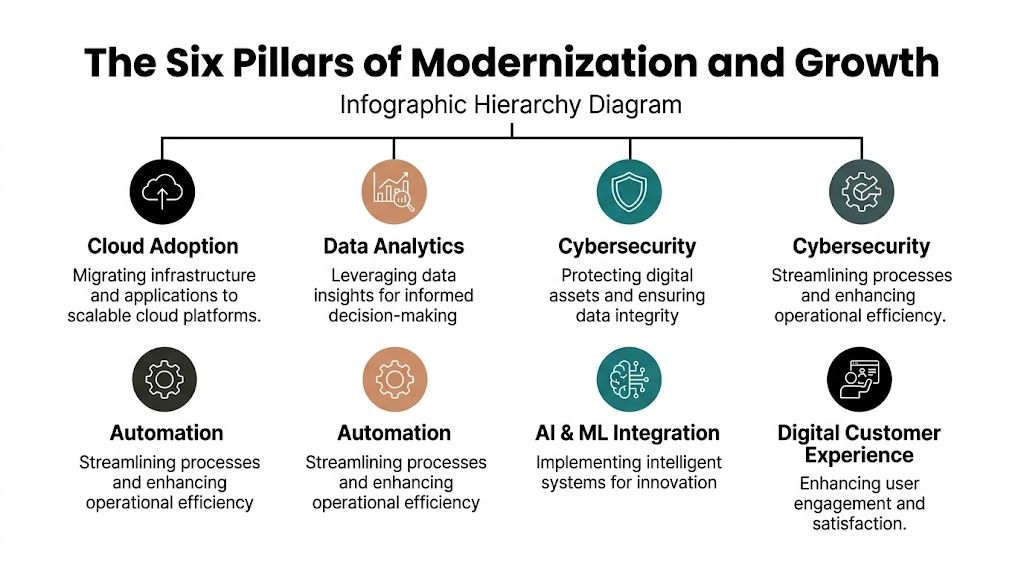
Each pillar should connect to a business outcome. Lower run costs. Faster release cycles. Fewer incidents. Better customer response times. More predictable growth. If one pillar is weak, the others carry more risk and produce less ROI. That is why partner-led execution matters. A firm like Dr3amsystems helps sequence the work, reduce delivery risk, and keep modernization tied to financial results instead of technical activity.
Cloud migration and architecture
Cloud creates value when it improves speed, resilience, and cost control. Poorly planned migration does the opposite. It raises spend, preserves technical debt, and moves old bottlenecks into a new hosting bill.
Executives should push for architecture decisions based on business need, not vendor pressure. Customer-facing applications may need elasticity and faster release cycles. Core systems with heavy integration may need a hybrid path first. Some workloads should be rehosted. Others should be refactored. A few should be retired.
What matters is fit:
- Right-sized workloads: Match compute, storage, and performance to actual demand.
- Containerized applications: Improve portability and release consistency.
- Microservices where they earn their keep: Use them where teams need independent deployment and clear service boundaries.
- Hybrid architecture planning: Reduce migration risk for systems that cannot tolerate disruption.
If you’re sorting through legacy system modernization approaches, start with business criticality, integration complexity, and downtime tolerance. That will give you a better answer than starting with a preferred platform.
AI and machine learning integration
AI should enter the business through use cases that save time, improve decisions, or reduce avoidable work. Start there. Skip experiments that exist only to signal innovation.
The strongest early candidates are document processing, forecasting, anomaly detection, service triage, knowledge retrieval, and workflow assistance. McKinsey’s research on generative AI points to large productivity gains across business functions when companies apply AI to specific workflows and redesign the process around it, not just the model itself (McKinsey on the economic potential of generative AI).
That requires more than a model. It requires governed data, clear ownership, monitoring, and support from the teams who will use the output. The practical stack can vary. Snowflake or BigQuery for analytics. Airflow for orchestration. Kafka for event streams. Power BI or Tableau for visibility. The tool choice matters less than whether the use case reduces labor, shortens cycle time, or improves margin.
Process automation
Automation usually delivers the fastest visible return because it attacks waste directly. Good candidates are high-volume, rules-based processes where delays or manual rekeying create cost and customer frustration.
Start with operational friction that leaders already feel:
- Repeated data entry across systems
- Approval queues that slow revenue or service delivery
- Manual reconciliation work
- Document-heavy workflows with predictable decision rules
- Support requests that can be classified and routed automatically
Pair workflow automation with APIs, OCR, and business rules where possible. Use AI only where judgment or classification improves the result. Automating a broken process at scale just creates faster confusion. An experienced partner helps teams map the current process, remove unnecessary steps, and automate the part that improves throughput.
Cybersecurity as a business enabler
Security affects speed, board confidence, insurability, and customer trust. Treating it as a side stream weakens every modernization effort.
Build security into architecture, identity, data flows, and release practices from the start. That means access design, role-based permissions, encryption, logging, monitoring, backup validation, and incident response planning. When those controls are designed early, leaders can approve modernization work with clearer risk boundaries and fewer delays.
Secure architecture improves decision speed. It also reduces the odds that one migration, one integration, or one rushed release creates an operational setback that wipes out the expected return.
Managed hosting and platform stability
Many companies finish the project and then discover they cannot run the new environment reliably. That is where ROI starts slipping. Downtime, missed patches, poor backup discipline, and weak monitoring erase the gains promised in the business case.
Managed hosting closes that operational gap. It puts uptime management, capacity planning, patching, backup checks, and performance monitoring into a repeatable service model. For companies without a large internal platform team, Dr3am Cloud managed infrastructure and migration support provides a practical option for keeping the environment stable after go-live.
This pillar matters because transformation is not finished at launch. The value shows up in steady operations month after month.
DevOps and release discipline
DevOps improves how technology changes get built, tested, approved, and released. The business result is straightforward. Fewer handoffs. More predictable deployments. Lower change risk. Faster delivery of revenue-supporting features.
Strong release discipline usually includes version-controlled infrastructure, CI/CD pipelines, environment consistency, observability, rollback procedures, and shared accountability across engineering, operations, and security. DORA’s research has consistently shown that strong software delivery practices correlate with better organizational performance, stability, and throughput (Google Cloud DORA research program).
Here is the executive view:
| Pillar | Business value |
|---|---|
| Cloud migration | Scalability, resilience, faster deployment |
| AI and ML | Better decisions, workflow productivity, stronger forecasting |
| Automation | Lower manual effort, fewer delays, cleaner operations |
| Cybersecurity | Lower operational risk, stronger trust, safer change |
| Managed hosting | Stability, support continuity, lower operational burden |
| DevOps | Faster releases, better quality, more predictable execution |
These six pillars work as one system. Cloud without security raises risk. AI without data discipline creates noise. Automation without process redesign hardens inefficiency. Managed hosting without DevOps slows delivery. The companies that get real returns from digital transformation IT services treat these capabilities as an integrated program, then use an experienced partner to phase the work, control risk, and convert modernization into measurable business outcomes.
A Practical Phased Implementation Roadmap
Most transformations fail because companies try to modernize everything at once. That creates too much change, too many dependencies, and too little accountability. A phased roadmap works better because it matches technical sequencing to business risk.
Phase one stabilize and secure
The first phase isn’t glamorous. It’s foundational.
Before you roll out AI, automation, or customer-facing innovation, get clear on what must remain stable, what can be modernized in place, and where the biggest operational risks sit. That starts with discovery. Inventory the systems, integrations, data dependencies, user roles, support pain points, and security exposures.
Key activities in this phase include:
- Architecture assessment: Map what talks to what and where failure would hurt most.
- Security baseline: Review access, logging, encryption posture, backup practices, and response readiness.
- Support model review: Identify where the internal team is overloaded or dependent on tribal knowledge.
- Roadmap design: Prioritize sequence by business impact, not by politics.
For leaders who want a practical external reference, this practical guide to IT digital transformation is useful because it reinforces the need for structured progress over big-bang change.
A free consultation is the right starting point here because it keeps the decision low-risk while forcing clarity on business priorities, automation opportunities, and migration sequencing.
Phase two automate and accelerate
Once the foundation is controlled, move into efficiency.
Process redesign should occur where delay, manual work, and poor handoffs hurt revenue, cost, or customer experience, not universally. Typically, this includes operations, service workflows, reporting, onboarding, and repetitive back-office tasks.
Good phase-two work often includes API integrations, workflow orchestration, document automation, dashboards, and selective AI support. It also includes process ownership. If nobody owns the workflow, automation won’t hold.
Leadership check: Don’t automate a broken approval chain. Fix the decision path first, then automate it.
This is also the right point to invest in practical AI and workflow acceleration capabilities such as AI automation services that connect data, models, and business processes instead of treating AI like a disconnected experiment.
A short explainer can help frame how leaders should think about sequencing and adoption:
Phase three innovate and scale
Only after stability and automation are working should you press hard on expansion.
Now the business is in a position to standardize cloud-native delivery, improve analytics depth, deploy more advanced models, and support new products or channels without reintroducing chaos. This phase is about scaling capability, not adding clutter.
Typical moves here include:
- Expand analytics maturity: Push from descriptive reporting into predictive insight where the data supports it.
- Standardize cloud operations: Improve repeatability across environments and teams.
- Harden customer-facing systems: Make digital channels faster, safer, and easier to evolve.
- Build continuous improvement loops: Use operational data to refine processes instead of waiting for annual transformation reviews.
A roadmap like this keeps digital transformation it services tied to reality. First protect the business. Then remove friction. Then scale what works.
Measuring Success With KPIs That Matter
If your dashboard is full of technical metrics and your executive team still can’t tell whether the business improved, you’re measuring the wrong things.
Uptime matters. Deployment frequency matters. Ticket volume matters. But those are supporting indicators. They don’t tell the board whether transformation improved the economics or responsiveness of the business.
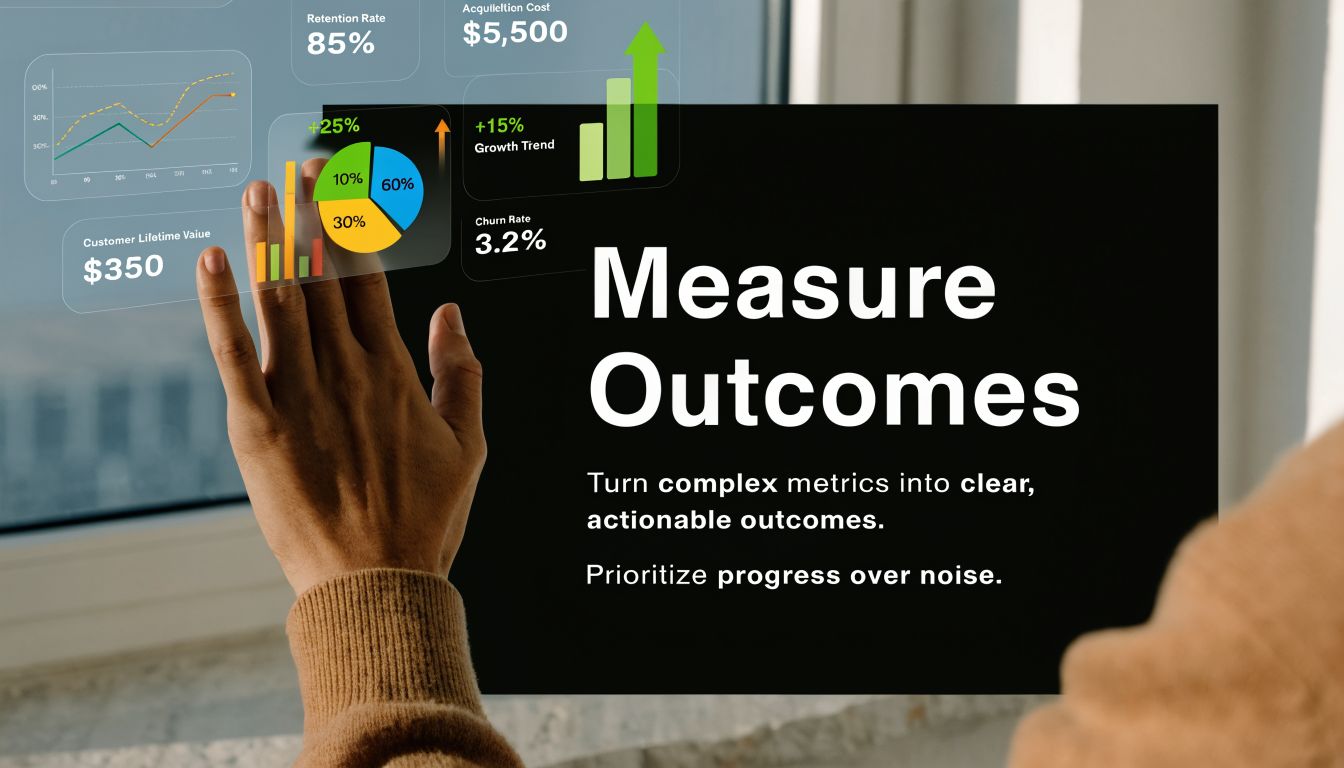
The KPI shift executives need
The best transformation KPIs are tied to throughput, speed, cost, and customer impact. They answer practical questions.
Ask:
- Did manual processing time drop
- Did cost per transaction improve
- Did approval cycles get shorter
- Did customer response times improve
- Did teams launch changes faster without creating instability
Those are business metrics with technical roots. That’s exactly where digital transformation it services should prove value.
One metric can change the conversation
A 60% reduction in processing time is the kind of result executives understand because it translates directly into labor capacity, service speed, and operational throughput. It’s more meaningful than saying a team deployed a new platform or automated a workflow.
This is why every initiative needs a before-and-after definition. Not just a target state architecture. A target business outcome.
Track the work that customers feel and employees repeat. That’s where transformation stops being theoretical.
Build a KPI set that spans functions
Don’t force every team to use the same measurement lens. Use a small set of aligned metrics by audience.
| Executive role | KPI focus |
|---|---|
| CEO | Speed to launch, customer experience, operating leverage |
| COO | Processing time, workflow delays, cost per transaction |
| CFO | Cost control, support burden, efficiency gains |
| CTO | Release speed, stability, incident reduction, architecture health |
That approach keeps everyone tied to the same transformation program while preserving role-specific accountability.
Avoid vanity reporting
Three traps show up constantly:
- Activity metrics without outcomes: Number of systems migrated means little on its own.
- Platform-centric language: Executives don’t care which tool was configured unless it changed a business result.
- No baseline: If you never captured the starting point, your ROI story will be weak.
A good operating review should connect every major technology initiative to one measurable business effect. If that chain isn’t visible, the program may still be busy, but it isn’t yet disciplined.
How to Select the Right Transformation Partner
The biggest myth in transformation is that you can always hire your way through the problem.
You usually can’t. A critical and often overlooked barrier is the talent gap. The broader workforce challenge includes significant gaps in “training and employment opportunities in technology, product, user research, design, and agile delivery,” which makes it harder for CTOs to find the people needed to implement and run AI-driven solutions and cloud migrations, as highlighted in the UNDP report on inclusive digital transformation.
Why DIY looks cheaper than it is
On paper, a DIY approach seems efficient. Use internal teams. Add a few contractors. Stand up a steering committee. Push through the roadmap.
In practice, DIY often means your strongest internal people split time between business continuity and modernization. Priorities compete. Specialized gaps stay open. Security gets reviewed late. Support planning lags implementation. The business absorbs the coordination cost.
That’s why partner selection matters. Not as procurement theater, but as risk control.
What to look for in a partner
Use a hard checklist:
- End-to-end coverage: Strategy, implementation, security, support, and optimization should connect.
- Operational credibility: They should understand migration, automation, hosting, and post-launch support.
- Business fluency: They must talk in outcomes, constraints, and tradeoffs, not just tool names.
- Security integration: If security is treated as a side stream, keep looking.
- Pragmatic execution: You want a team that can phase work without freezing the business.
- Managed support capability: Transformation doesn’t end at go-live.
If security maturity and risk posture are major concerns, the kind of services represented by Dr3am Security belong on the shortlist because they align security work with cloud, operations, and ongoing support.
DIY vs. Partner-Led Transformation A Reality Check
| Factor | DIY Approach | Expert Partner (Dr3amsystems) |
|---|---|---|
| Strategy alignment | Often fragmented across departments | Tied to a defined roadmap and business outcomes |
| Talent coverage | Limited by internal hiring and availability | Access to cross-functional expertise across cloud, AI, security, and support |
| Execution speed | Slowed by competing internal priorities | Structured delivery with clearer sequencing |
| Security integration | Frequently added later | Built into migration and modernization work |
| Managed support | Often thin after launch | Ongoing support is part of the operating model |
| Risk profile | Higher dependency on internal bandwidth | Lower execution risk through dedicated delivery capacity |
A partner should reduce complexity, not add another management layer.
The right transformation partner doesn’t just implement systems. They help leadership make fewer bad bets.
Frequently Asked Questions for Executives
What’s the biggest risk in modernizing legacy systems
The biggest risk is breaking an operation you still depend on. Most legacy environments aren’t fragile because the software is old. They’re fragile because integrations, exceptions, and workarounds were never documented cleanly. That’s why discovery, sequencing, and rollback planning matter more than aggressive timelines.
How do we get team buy-in without slowing momentum
Tie the change to work pain people already feel. Staff rarely resist improvement. They resist confusion, extra workload, and vague promises. Show which manual tasks go away, which approvals get simpler, and what support they’ll have during the transition. Then assign visible process owners, not just project managers.
How long does a transformation engagement take
There isn’t one honest universal answer. A focused automation and modernization effort can move quickly. A broad enterprise transformation across legacy applications, cloud infrastructure, data, and security takes longer because dependencies have to be handled carefully. The right question isn’t “how long will transformation take?” It’s “how soon can we complete the first business-critical phase safely?”
Can we start small
Yes, and you should. Start with a bounded process, a critical workload, or a support problem that creates measurable drag. A contained first phase gives leadership proof, exposes constraints early, and builds internal confidence without betting the whole organization on one launch.
Should we lead with AI or cloud migration
Lead with the constraint. If infrastructure rigidity is slowing everything else, start with cloud and platform work. If a manual workflow is burning time every day, start with automation. If the data layer is fragmented, fix that before promising advanced AI. AI works best when the underlying systems, access controls, and data flows are already usable.
What should we expect from an outside partner
Expect candor. A real partner should challenge bad sequencing, identify internal gaps, and tell you what not to do. They should also leave you with a stronger operating model, not a dependency built on mystery.
If you’re evaluating digital transformation it services and want a practical starting point, Dr3amsystems offers a free consultation to clarify goals, identify automation opportunities, map secure cloud migration priorities, and shape a roadmap across Dr3am IT, Dr3am Cloud, Dr3am AI, Dr3am Security, Dr3am Hosting, and Dr3am Marketing.