
Most advice about technology strategy is wrong.
It tells CEOs to buy better tools, move faster in the cloud, or “adopt AI” as if technology itself creates value. It does not. Alignment creates value. Tools only amplify whatever operating model already exists, including confusion, duplication, and waste.
That is why many leadership teams feel they are spending aggressively on IT and still not seeing the business move. The problem is usually not effort. The problem is that the company never translated business goals into a technology agenda with ownership, sequencing, and measurable outcomes.
Why Your Technology Strategy Is Failing and How to Fix It
Most companies do not have a technology problem. They have a decision problem.
While 93% of business leaders are investing more in technology, only 27% report their technology is fully aligned with business goals (Grant Thornton). That gap represents a crisis. Your board approves budgets. Your teams launch projects. Your vendors deliver platforms. But revenue, margin, speed, and customer experience do not improve in proportion.

A misaligned IT department behaves like a utility. It maintains systems, fights fires, renews licenses, and responds to tickets. A well-led IT function behaves like a growth engine. It removes friction from operations, shortens cycle times, improves decision quality, and gives the business room to scale.
The popular advice is the trap
If your current plan starts with software selection, you are already late.
A CEO should ask tougher questions first.
- Which business bottlenecks cost us the most money? Is it fulfillment delays, reporting lag, weak forecasting, high service costs, or poor lead routing?
- Which systems block execution? Legacy ERP, fragmented CRM data, brittle integrations, manual approvals, or poor identity controls.
- Which technology bets tie directly to growth? Faster product delivery, lower cost per transaction, stronger retention, or cleaner unit economics.
That defines the job of technology strategy consulting. It is not procurement theater. It is not a slide deck full of trends. It is a disciplined process for connecting IT investments to business outcomes before money gets committed.
What fixing it looks like
Leaders who get this right treat strategy as diagnosis first, architecture second, execution third.
Key takeaway: If your IT roadmap is not tied to revenue drivers, cost reduction, risk posture, and operating speed, it is not a strategy. It is a project list.
You need a clear line from business objective to technical initiative to measurable result. That means mapping where the company loses time, where data stalls decisions, where infrastructure limits growth, and where teams duplicate work.
If that sounds familiar, the operational patterns described in these challenges in digital transformation will likely look painfully recognizable.
Technology should not be asked to “support the business.” It should be designed to move the business.
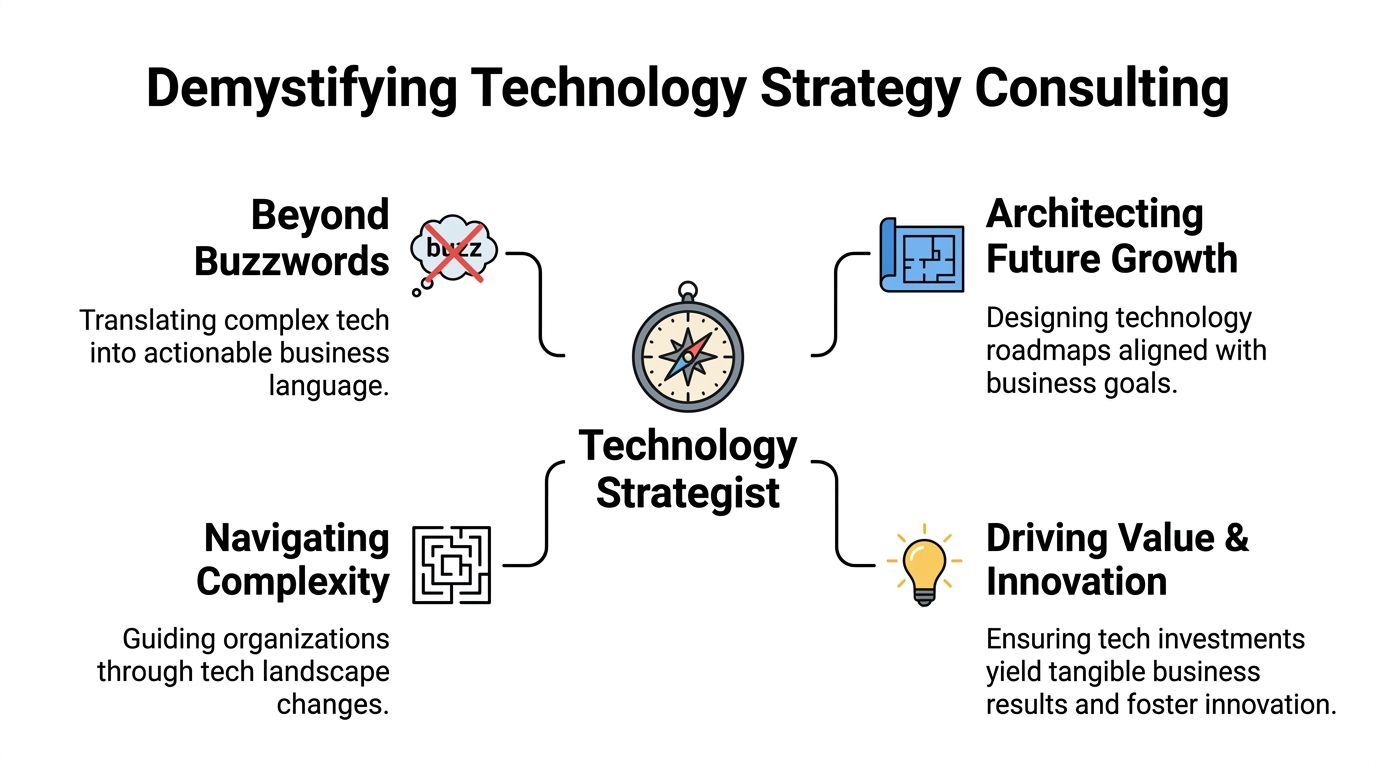
Defining Technology Strategy Consulting Beyond Buzzwords
Technology strategy consulting is often described so vaguely that it becomes useless.
Here is the plain-English definition. A technology strategist is the architect. The strategist defines what the business needs to achieve, what technical capabilities must exist, what sequence makes sense, and what tradeoffs leadership should accept. The implementer is the builder. Builders matter. But if the blueprint is wrong, execution only gets you to the wrong destination faster.
The market itself tells you this discipline is no longer optional. The global technology consulting market reached nearly $400 billion in 2024 and is projected to grow 7% in 2025, driven by demand for AI infrastructure and strategic IT alignment (Source Global Research). Companies are spending because technology choices now shape competitiveness, not just operations.
What a strategist does
A strong technology strategy consultant should do four things well.
Translate business goals into capabilities
If your growth plan depends on faster customer onboarding, the consultant should identify the capabilities behind that goal. Workflow automation, cleaner customer data, better identity management, CRM integration, and real-time visibility.
Sequence investments
Not everything should happen now. Some initiatives unlock others. A company cannot scale AI well if its data is fragmented and governance is weak.
Reduce expensive mistakes
Many businesses waste budget by upgrading applications before cleaning process design, or by migrating infrastructure before defining target architecture and support ownership.
Create operating discipline
Strategy is not a brainstorm. It is a decision system. Who owns each initiative, what gets measured, what gets deferred, and where the business expects returns.
What it is not
Technology strategy consulting is not:
- A vendor beauty contest: Tool selection matters, but it comes after business priorities are clear.
- A one-time workshop: Executive alignment needs to turn into governance, investment logic, and delivery cadence.
- An IT-only exercise: Revenue leaders, finance, operations, security, and product teams all influence the outcome.
Practical advice: If your consultant spends more time discussing platforms than operating model changes, they are selling implementation before earning strategic trust.
Common engagement models
Different companies need different structures.
| Engagement model | Best fit | What it looks like |
|---|---|---|
| Project-based advisory | A specific transformation or major decision | Current-state assessment, target-state design, roadmap, and executive recommendations |
| Retained strategic partner | Ongoing modernization across multiple business units | Quarterly planning, governance support, portfolio prioritization, and architecture oversight |
| Embedded fractional leadership | Mid-market firms without a full strategic bench | Interim CIO, CTO, or transformation lead support tied to execution decisions |
| Strategy plus delivery oversight | Companies that need direction and execution control | The roadmap is created, then tracked through milestones, dependencies, and KPI reviews |
The right model depends on complexity, internal leadership depth, and urgency. But the principle is constant. Technology strategy consulting should sharpen decisions before the company commits to heavy implementation spend.
If you want a practical example of how this work gets framed in a transformation setting, this overview of digital transformation consulting services is useful because it connects strategy to delivery instead of treating them as separate worlds.
The Step-by-Step Process for Building Your Tech Roadmap
A roadmap should not start with a list of projects. It should start with operational truth.
If leadership skips diagnosis, the roadmap turns into politics. Every department fights for its preferred tool, every executive brings a different definition of urgency, and the final plan becomes a compromise that solves nothing important.
Detailed needs assessments reveal that siloed legacy systems can cause 30-50% inefficiencies in data processing, and technical debt can increase operational costs by up to 40% annually in mid-market enterprises (Lumos). That is why the first phase matters more than most companies think.
Step 1 Assess the current state without sugarcoating it
Start with an audit, not a brainstorm.
You need a clear inventory of applications, integrations, data flows, hosting environments, security controls, vendor dependencies, and operational pain points. Tools like a CMDB, architecture diagrams, service maps, and workflow documentation become useful here. They force the conversation out of opinion and into evidence.
Do not let IT do this alone. Interview business leaders, front-line managers, and operations teams. They know where work stalls, where handoffs fail, and where reporting requires heroic effort.
Look for patterns such as:
- Duplicate data entry: Teams rekey the same information across ERP, CRM, ticketing, or finance systems.
- Manual approvals: Revenue, procurement, or service processes wait on email chains instead of controlled workflows.
- Fragile integrations: A single failed sync disrupts reporting or customer fulfillment.
- Support overload: Internal teams spend their time maintaining old systems instead of improving operations.
Step 2 Define business outcomes before technical solutions
This sounds obvious. Most companies still skip it.
Leadership should define what success means in business language. Faster order processing. Better conversion from lead to close. Reduced service costs. Stronger compliance posture. Shorter time to launch. Better management reporting. Pick the outcomes that matter commercially.
Then translate each outcome into technical capabilities.
| Business objective | Required capability examples |
|---|---|
| Reduce operating cost | Workflow automation, application rationalization, stronger observability, managed support |
| Increase revenue velocity | Unified customer data, sales automation, faster provisioning, better forecasting |
| Improve decision quality | Data pipelines, governed reporting, cleaner master data, real-time dashboards |
| Lower operational risk | Identity controls, backup discipline, cloud governance, security monitoring |
A roadmap becomes useful when every initiative can answer one question. What business result does this change improve?
CEO rule: If a technology leader cannot explain an initiative in business terms, do not approve the budget yet.
Step 3 Choose the right architecture bets
Once the business goals are clear, pick the technology pillars that support them.
For many companies, that means some mix of:
- Cloud modernization for scalability, resilience, and faster provisioning
- Data integration through ETL pipelines, event streaming, or lakehouse design
- AI and automation for high-volume repetitive work and better prediction
- Security architecture embedded into identity, access, monitoring, and governance
- Managed support and hosting to protect internal capacity for higher-value work
Discipline is important here. Do not adopt AI where process design is broken. Do not modernize infrastructure while keeping ownership boundaries vague. Do not centralize data without governance.
If you want outside perspective on how companies structure these moves, these digital transformation strategy examples are useful for comparing initiative design across common business scenarios.
Step 4 Build a phased roadmap
A roadmap should balance quick wins and foundational work.
Quick wins build confidence. Foundational work prevents future chaos. You need both. A common mistake is chasing only visible wins while neglecting architecture, security, and data quality. The opposite mistake is spending too long on foundations and starving the business of momentum.
A practical phased roadmap often looks like this:
Stabilize
Address reliability issues, support bottlenecks, access risks, and brittle integrations.
Standardize
Simplify workflows, reduce duplicate tools, define ownership, and improve data consistency.
Modernize
Migrate selected workloads, improve platform architecture, and implement scalable data services.
Optimize
Add automation, AI use cases, performance monitoring, and cost controls.
Govern
Create recurring executive reviews, KPI tracking, and change control so the roadmap stays tied to business outcomes.
Step 5 Assign ownership and metrics
Many strategies often die at this stage.
Every initiative needs one accountable owner, a realistic timeline, dependency visibility, and a measurement plan. If cloud migration belongs to everyone, it belongs to no one. If AI experimentation has no business sponsor, it becomes an innovation hobby.
Use metrics that reflect business and technical health together. Examples include processing time, release speed, uptime, cost per transaction, backlog volume, and time to resolve incidents. Keep the list short enough that executives review it.
Step 6 Revisit the roadmap quarterly
Technology strategy consulting is not about producing a static artifact. It is about improving decisions as conditions change.
Markets shift. Internal constraints change. New risks emerge. Good leaders revisit roadmap priorities, adjust sequencing, and shut down weak initiatives before they consume more capital.
If your current plan cannot absorb change without becoming chaotic, you do not have a roadmap. You have a wish list.
For teams that need a stronger planning structure, this guide to a digital transformation roadmap offers a practical reference point for how phased execution should be organized.
Integrating AI Cloud and Security Into Your Strategy
Most leadership teams still treat AI, cloud, and security as separate workstreams. That is sloppy strategy.
AI depends on usable data and scalable infrastructure. Cloud decisions affect cost, agility, and resilience. Security determines whether the business can scale safely without multiplying operational and regulatory risk. These are not parallel topics. They are one operating system for modern growth.

Data tech transformations that integrate AI and ML can yield 2-3x faster model development cycles and 25-40% revenue growth, while optimized cloud data solutions reduce TCO by 30-50% (BridgeView IT). The point is not that every company should race into model building. The point is that when data, infrastructure, and governance are designed together, the business can move faster and spend better.
AI belongs in operations, not in slides
Too many AI programs start with demos and end with disappointment.
Real AI strategy starts with a narrow business case. Use it where volume is high, rules are repeatable, and decisions benefit from better prediction or faster classification. That could mean support triage, document extraction, forecasting, anomaly detection, or workflow routing.
The sequence matters.
- Start with data readiness: If customer, product, or operational data is fragmented, the model will reflect that mess.
- Choose a bounded use case: Pick one workflow where success can be measured in speed, accuracy, or labor reduction.
- Design for production: Include monitoring, governance, fallbacks, and ownership from day one.
For leadership teams evaluating how AI changes digital visibility and customer acquisition, this overview of Answer Engine Optimization is a useful side read because it shows how AI-driven interfaces are changing how buyers discover answers, not just how internal teams automate work.
Cloud should improve agility and economics
A cloud migration is not automatically strategic.
If your company lifts old complexity into a new hosting bill, you have modernized cost location, not capability. Cloud belongs in your strategy when it improves deployment speed, reliability, scalability, resilience, or support efficiency.
A good cloud strategy usually includes:
| Priority | Good strategic question |
|---|---|
| Workload placement | Which systems benefit from elasticity, and which should remain where they are for now? |
| Architecture design | Are we moving monoliths, refactoring services, or cleaning interfaces first? |
| Operations model | Who owns performance, backup, patching, cost control, and incident response after migration? |
| Financial discipline | How will leadership track spend, utilization, and business value after the move? |
Companies that get cloud right define the target operating model before they move critical systems. They decide how support works, how environments are governed, and how availability will be maintained.
A practical discussion of execution considerations appears in this resource on how to implement AI in business, especially where AI and cloud architecture must support each other instead of evolving separately.
After strategy is set, leadership teams often benefit from a visual explainer like this:
Security is not the cleanup crew
Security should shape architecture choices early. It should not arrive after the migration, after the AI pilot, or after the procurement decision.
A modern technology strategy should cover identity design, access control, data handling, logging, backup discipline, and governance before scaling new platforms. Security leaders need enough authority to influence design, not just review exceptions.
Board-level reality: A growth strategy that ignores security is not bold. It is fragile.
The companies that scale well do not bolt security onto cloud and AI. They build security into both.
How to Select the Right Consulting Partner
Choosing a consulting partner is not about picking the most recognizable logo. It is about choosing who you trust to influence capital allocation, operating design, and execution priorities.
That is why the safe choice is often the wrong choice.
While many companies use Big Four firms, there is a growing appetite for “fresh ideas” from new partners, as businesses seek to balance implementation scale with the agility and innovation found in specialized firms, especially in emerging areas like AI optimization (ITPro). That tension is real. Large firms bring process and scale. Specialized firms often bring sharper thinking, faster decisions, and more practical modern expertise.
What matters more than brand size
A strong partner should challenge your assumptions, not just validate your current plan.
You want a team that can speak with the CFO about investment logic, with operations about workflow friction, with security about control design, and with engineering about architecture tradeoffs. If they only speak one language, they are not strategic enough for enterprise change.
Vendor selection checklist
| Evaluation Criterion | What to Look For | Red Flag |
|---|---|---|
| Business outcome focus | They tie recommendations to revenue, cost, risk, and speed | They lead with tools, platforms, or certifications |
| Strategic depth | They can assess operating model, architecture, and governance together | They jump straight to implementation staffing |
| Modern capability | Clear experience in AI, cloud, security, integrations, and managed operations | They rely on generic transformation language |
| Execution realism | They sequence work based on dependencies and internal capacity | They present every initiative as equally urgent |
| Measurement discipline | They define KPIs and owners before work begins | They promise transformation without a scorecard |
| Partnership fit | Senior people stay engaged beyond the sales process | Senior leaders disappear after kickoff |
| Knowledge transfer | Your team becomes stronger during the engagement | The model depends on long-term consultant dependency |
Questions every CEO should ask
Use direct questions. Do not ask for more presentations.
- Where do you think we are wasting money today?
- Which initiatives should we stop, not start?
- What must be true operationally for this roadmap to succeed?
- How will you measure whether your strategy is working inside two quarters?
- Who from your senior team will stay accountable after the contract is signed?
Selection principle: Buy judgment, not volume. You need fewer people with sharper thinking, not more people producing status reports.
If your company is also weighing external support models, this review of IT outsourcing companies is a practical companion because outsourcing decisions and strategy-partner decisions often intersect.
The wrong consulting partner increases activity. The right one improves decision quality.
From Strategy to Results Measuring Your ROI
A strategy is only valuable if leadership can prove it changed the business.
That means measuring technology the way an operator would measure any growth investment. Did it reduce cost, increase throughput, improve reliability, shorten delivery cycles, or create new revenue capacity?

Start with business-linked metrics
Good ROI tracking connects technical change to operational performance.
Examples include:
- Processing time: If automation speeds intake, approvals, or reporting, cycle time should drop.
- Cost per transaction: If workflows improve and systems are consolidated, unit cost should improve.
- Deployment frequency and lead time for changes: These DORA-style indicators show whether delivery capability is getting healthier.
- System uptime and incident volume: Stability matters because outages destroy productivity and confidence.
- Forecast accuracy and reporting lag: Better data should improve management decisions, not just dashboard aesthetics.
Do not track dozens of metrics. Track the few that expose whether the business is becoming faster, leaner, and more reliable.
Tie initiatives to outcome categories
A practical scorecard often groups ROI into three buckets.
| ROI category | Example of what to measure |
|---|---|
| Efficiency gains | Processing time, manual touches removed, support burden |
| Financial impact | Cost reduction, infrastructure efficiency, transaction economics |
| Growth enablement | Faster launches, better customer response, improved scalability |
This approach helps executives avoid one of the biggest measurement mistakes. They judge every technology investment as if it should produce immediate direct revenue. Some investments reduce risk. Some increase speed. Some create the platform for later revenue expansion.
Use proof, not optimism
When a provider can point to 60% reductions in processing time and zero-downtime transitions, leadership should pay attention. Those outcomes matter because they connect technical work to operating impact.
Measurement rule: If your post-implementation review cannot show what changed in cost, speed, reliability, or revenue capacity, the initiative was not governed tightly enough.
ROI reviews should happen on a schedule. Monthly for active programs. Quarterly for strategic portfolio decisions. Shut down weak initiatives early. Expand the ones that create visible gains.
Technology becomes a growth engine when the executive team treats it with the same performance discipline applied to sales, operations, and finance.
Taking Action Your Path to a Winning Tech Strategy
A winning technology strategy does not start with a platform demo or a migration plan.
It starts with a hard look at where the business is losing speed, money, and control. Then leadership decides which capabilities matter most, sequences the work realistically, and measures results with discipline. That is how an IT department stops being a cost center and starts influencing margin, growth, and resilience.
If you are a CEO, do not ask your team for another long list of tools. Ask for a roadmap tied to business outcomes.
If you are a CTO or CIO, stop defending technology spend in technical language. Translate it into throughput, cost efficiency, reliability, and growth capacity.
If you are running operations, push for tighter ownership, cleaner workflows, and fewer systems doing overlapping work.
Technology strategy consulting matters because most companies do not fail from lack of ambition. They fail from fragmented execution.
The businesses that win are not the ones that buy the most technology. They are the ones that align technology to the few things that move the company forward.
Dr3amsystems helps businesses turn strategy into execution with a practical mix of advisory, implementation, and ongoing support. Through Dr3amsystems, companies can access a free consultation to clarify goals, uncover automation opportunities, and shape a roadmap tied to business value. The team supports end-to-end modernization through Dr3am IT, Dr3am Cloud, Dr3am AI, Dr3am Security, Dr3am Hosting, and Dr3am Marketing, with a focus on AI-driven solutions, secure cloud migrations, dedicated managed support, reliability, cost efficiency, and measurable ROI. If you need a partner that can modernize legacy systems, deploy data pipelines and machine learning, strengthen security, and keep critical operations running smoothly, Dr3amsystems is a strong next step.