
At its heart, API testing is about validating the invisible connections that power your software. It’s less about what users see on the screen and more about making sure the "backstage" machinery—the logic, the data exchange, the security protocols—is running perfectly.
Think of it as the engine of your application. While users interact with the dashboard and steering wheel, API testing ensures the pistons are firing, the fuel is flowing, and the transmission is shifting smoothly. It’s where we validate the core business logic, security, and performance of your entire system.
What Is API Testing in Simple Terms

Let's use a classic analogy: an API (Application Programming Interface) is like a waiter in a busy restaurant. You, the customer, tell the waiter what you want from the menu. The waiter then goes to the kitchen (the server), communicates your order, and brings back the correct dish (the data or response).
API testing is simply the process of making sure that waiter is fantastic at their job. Does the waiter always write down the correct order? Do they deliver it to the kitchen without any mistakes? Do they bring your food back promptly, and is it exactly what you asked for?
The Foundation of Modern Software
In today's world, that "waiter" is doing a lot more than just fetching data. It's processing payments, updating your inventory in real-time, and feeding information to complex AI models.
When an API fails, it's not a minor bug. It's a failed credit card transaction. It's a lost customer order. It's a complete breakdown in the communication that keeps your business running. That’s why having a solid API testing strategy has moved from a simple QA task to a critical business function. If you're new to the concept, this Understanding APIs: A Beginner's Guide is a great place to start.
The numbers tell the same story. The API Testing Market is projected to explode from USD 4.074 billion in 2024 to an incredible USD 33.14 billion by 2035. This isn’t a coincidence. It's a direct result of the shift toward microservices architectures, now used by 87% of enterprises, where dozens or even hundreds of APIs must work in perfect harmony.
To break it down even further, here's a quick look at the core ideas.
API Testing at a Glance
| Concept | Simple Explanation | Business Impact |
|---|---|---|
| Functionality | Does the API do what it's supposed to do? | Ensures core business rules work correctly (e.g., a discount code applies). |
| Reliability | Does the API consistently return the right results? | Builds customer trust by preventing errors and inconsistent behavior. |
| Performance | Can the API handle the expected load quickly? | Prevents slow load times and system crashes that drive users away. |
| Security | Is the API protected from threats and unauthorized access? | Protects sensitive user data and prevents costly security breaches. |
This table shows how testing the "unseen" parts of your software directly contributes to a better, more reliable product and a stronger bottom line.
For technology partners like Dr3amsystems, this focus on API integrity is non-negotiable. It’s the foundation for everything we build, from dependable AI-driven platforms to seamless cloud migrations. By ensuring every connection is fast, reliable, and secure, we help businesses deliver measurable results—like 60% reductions in processing time—and execute zero-downtime transitions.
This commitment to the engine behind the interface is what powers real-world growth and operational excellence. You can see how we apply these principles in our guide to Dr3am Apps.
Why API Testing Is Critical for AI and Cloud Success

As companies embrace the cloud and build AI into their products, the number of interconnected APIs multiplies fast. Every new service, data source, or machine learning model adds another link to the chain. The problem is, each of those links is a potential weak point that could bring down your entire system.
This transforms API testing from a simple quality check into a core requirement for keeping the business running. It's the work happening behind the scenes to ensure your big investments in new technology actually pay off instead of introducing new, unexpected risks.
Protecting Your AI from Corrupted Data
An AI is only as good as the data it’s trained on. This is where untested APIs become a serious liability. They are a common source of corrupt, incomplete, or poorly formatted data getting into your machine learning pipelines, triggering the classic "garbage in, garbage out" problem.
For example, think about an AI model built to predict which customers are about to cancel their subscriptions. If a faulty API sends it skewed data about user activity, the model will get it wrong. Your marketing team could end up wasting money trying to retain happy customers while completely missing those who are actually about to leave. Your AI investment is now actively misleading you.
For an AI system, an API is its lifeline to the real world. A weak API not only starves the AI of good data but can actively poison it with bad information, leading to poor decisions that erode business value and trust.
Thorough API validation is the only way to ensure the integrity of your data. At Dr3amsystems, our AI-driven solutions are built upon a bedrock of meticulously tested APIs. We make sure every data pipeline is clean and reliable, delivering exactly what the AI model needs to turn raw information into accurate insights that help your business.
Securing the Expanded Cloud Attack Surface
Cloud and multi-cloud setups create a sprawling digital footprint with hundreds of entry points for attackers. Every single API is like a door into your system, and without solid security testing, too many of those doors are left unlocked. It only takes one vulnerable API to expose your entire network to a catastrophic data breach.
Imagine an e-commerce platform that relies on different cloud services for payments, inventory, and customer support. A security flaw in just one of those service APIs could let an attacker:
- Steal sensitive customer payment details.
- Manipulate inventory numbers to cause chaos.
- Take over user accounts through a broken authentication process.
The industry is waking up to this reality. The global API Testing Market was valued at USD 1.5 billion in 2023 and is projected to skyrocket to USD 12.4 billion by 2033. This massive growth highlights a major shift toward securing these vital connections. You can dig into the data behind this trend by reviewing the full market report.
Ensuring Reliability and Performance at Scale
Beyond data integrity and security, API testing is what keeps your applications running smoothly when it matters most. A real-world example says it all: an online store’s payment gateway API fails during the Black Friday rush. The outcome is immediate—lost revenue, angry customers, and a lasting stain on the brand's reputation.
Performance testing confirms your APIs can handle spikes in traffic without crashing or even slowing down. It’s what gives a business the confidence to grow, knowing its backend systems won't buckle under the pressure. This focus on reliability is how Dr3amsystems delivers concrete results, such as achieving zero-downtime transitions for cloud migrations and a 60% reduction in processing time for key operations.
By putting a serious API testing strategy in place, we make sure the systems we deliver are not just powerful but also resilient. This practical, results-driven discipline allows our clients to fully capitalize on the cloud and build a technology foundation for real, sustainable growth.
Understanding the Core Types of API Tests
To build a truly resilient system, you can't just run one kind of test. Think of it like building a house—you need separate inspections for the foundation, the plumbing, and the electrical wiring. Each checks for a different kind of problem. The same is true for your software's APIs; a multi-layered testing approach is the only way to ensure they're truly solid.
Let's walk through the essential categories. Getting a handle on what each one does is the first step toward building a complete API quality strategy that actually protects your business.
Functional and Validation Testing
Functional testing answers the most basic question of all: Does the API do what it’s supposed to do?
Imagine you just bought a new coffee maker. Functional testing is pressing the 'brew' button to see if it makes coffee. It's about verifying that individual API endpoints work correctly under normal circumstances. Does calling the GetUser endpoint actually return a user's data? Does the UpdatePassword endpoint successfully change the password?
This type of testing confirms:
- The API returns the correct data and status codes for a given request.
- It handles expected inputs and produces the right outputs.
- It follows the defined business logic without any strange deviations.
Validation testing is a close cousin, confirming that the API actually meets the business need it was designed for. It makes sure the final product aligns with what everyone agreed on in the first place.
Integration Testing
Okay, so your individual APIs work. Great. But now for the real test: Do they work together?
Modern applications are rarely single, self-contained units. They're complex ecosystems where your services talk to each other, to databases, and to third-party tools. Integration testing is where you see if those conversations are happening correctly.
Consider an e-commerce checkout. A single click might trigger a user service, a product inventory API, a payment gateway, and a shipping calculator. Integration testing is the dress rehearsal that ensures the order flows smoothly from one service to the next without dropping data or causing a system-wide failure.
Integration testing is where you find out if your perfectly built components can actually communicate. A breakdown here is like having a team of experts who are all fluent in different languages—individually brilliant, but collectively useless until they find a common tongue.
Performance and Load Testing
Once we know everything works, the next question is, "How well does it work under pressure?"
This is where performance testing comes in. It’s like stress-testing a bridge before opening it to traffic—you have to know how much weight it can handle before it starts to buckle. For APIs, this means measuring key metrics that directly impact user experience.
- Response Time: How quickly does the API send back a response? Milliseconds matter.
- Latency: What's the total round-trip time for a request?
- Throughput: How many requests can the API handle per second or minute?
Load testing is a specific type of performance test that simulates real-world traffic, like the surge you’d expect during a Black Friday sale. It’s crucial for preventing the crashes and slowdowns that lose you customers and revenue. Achieving something like a 60% reduction in processing time is a direct result of this kind of rigorous optimization.
Security Testing
Finally, we have to ask the most important question of all: Is the API safe from attackers?
Every API is a potential doorway into your system. Security testing is the process of checking all the locks on those doors. You're essentially hiring a team of ethical hackers to try and break in, probing for weaknesses and ensuring only authorized users can access specific data.
In today's environment, this isn't optional. It’s a non-negotiable step for protecting your customer data, your intellectual property, and your reputation.
At Dr3amsystems, this is a central pillar of how we build and manage systems. Our dedicated Dr3am Security practice focuses on proactively finding and fixing these vulnerabilities before they can be exploited. This expert-led approach ensures your APIs aren't just functional and fast—they're fortified against modern threats.
To tie this all together, it helps to see how these different tests compare side-by-side. Each one targets a unique aspect of API quality and protects your business from a different kind of risk.
Comparing Key API Test Types
| Test Type | What It Validates | Common Tools | Business Risk Mitigated |
|---|---|---|---|
| Functional | The API behaves as documented and meets its core requirements. | Postman, Swagger UI, Jest | Incorrect business logic, broken features, poor user experience. |
| Integration | Multiple APIs, services, and databases can communicate and exchange data correctly. | Postman, Custom Scripts, Karate | System-wide failures, data corruption, broken user workflows. |
| Performance | The API's speed, stability, and scalability under various load conditions. | JMeter, K6, Gatling | Application crashes, slow response times, lost revenue, customer churn. |
| Security | The API is resilient against common threats and vulnerabilities. | OWASP ZAP, Burp Suite, SAST/DAST Scanners | Data breaches, unauthorized access, compliance penalties, brand damage. |
As you can see, you can't just pick one. A comprehensive strategy that blends all four is what separates a fragile application from a truly robust one.
A Practical Guide to the API Testing Workflow
So, you understand the different types of API tests. But knowing the ingredients is one thing; knowing how to cook the meal is something else entirely. A truly effective API testing strategy isn’t a checklist you run through at the end. It's a structured workflow that builds confidence and quality into your software from day one.
Think of it as a shift from reactive bug hunting to proactive quality assurance. Instead of a last-minute chore, testing becomes a continuous loop that accelerates development and catches problems when they're small and easy to fix.
This flow isn't random. It’s a logical progression that layers different kinds of tests to build a comprehensive safety net for your application.
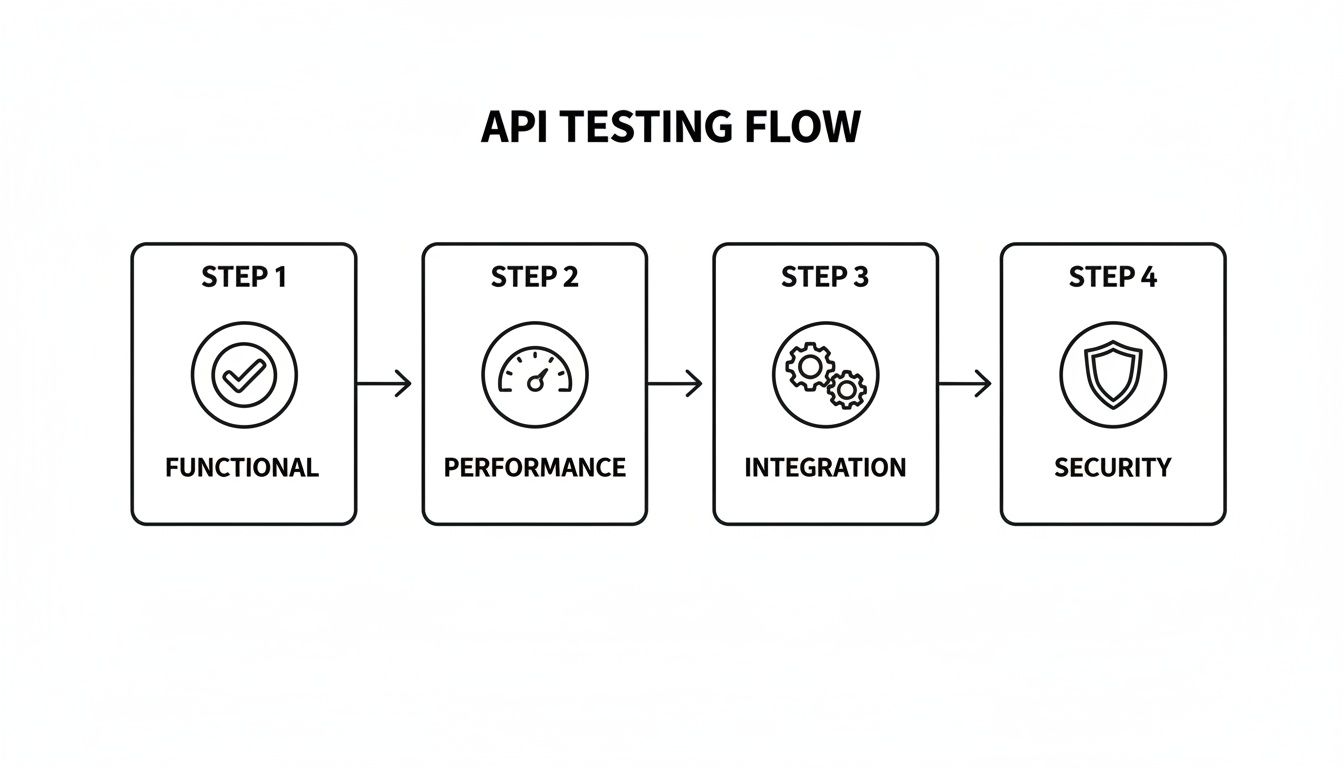
As you can see, the process starts with the basics—does it work?—and then systematically adds layers to check how it performs, how it connects with other systems, and whether it’s secure.
Setting the Stage for Success
Before you write a single line of test code, you need to get your house in order. This starts with creating a dedicated test environment. This space should mirror your live production environment as closely as possible to avoid the dreaded "well, it worked on my machine" problem and ensure your test results are trustworthy.
Next, your team needs a shared understanding of what the API is supposed to do. This is where solid API documentation, like an OpenAPI (formerly Swagger) spec, becomes your single source of truth. It’s the blueprint that defines every endpoint, expected request, and response, eliminating guesswork for both developers and testers.
Designing and Scripting Test Cases
With your environment and documentation ready, it's time to map out your tests. A good starting point is this practical guide to test RESTful API endpoints, which covers the core principles you’ll apply.
Begin with the "happy path"—verifying the API behaves correctly with perfectly valid inputs. Once that's solid, you can get creative with negative tests and edge cases.
- What happens when a required field is missing from a request?
- How does the API respond to an expired or invalid authentication token?
- Does it gracefully handle an unusually large payload, or does it fall over?
Tools like Postman are fantastic for this exploratory phase, letting you manually poke and prod endpoints quickly. For building a repeatable, automated suite, you'll want to turn to tools like ReadyAPI or coding frameworks like REST Assured or pytest to script your tests.
Integrating Testing into CI/CD Pipelines
This is where you get the biggest bang for your buck. By plugging your automated API tests directly into a Continuous Integration/Continuous Deployment (CI/CD) pipeline, you create an incredibly powerful, automated feedback system. Now, every time a developer commits code, your entire test suite runs automatically.
A CI/CD pipeline with integrated API tests acts as an automated quality gate. It ensures that no new code is merged or deployed unless it passes all the critical functional, performance, and security checks, preventing bad code from ever reaching production.
This DevOps mindset is at the core of how Dr3amsystems helps clients build and ship software faster and more reliably. By embedding quality checks directly into the development process, we catch issues at their source—when they are cheapest and easiest to fix. This automation is a key enabler behind real-world results like achieving zero-downtime transitions and deploying stable, high-performance systems.
Analyzing Results for Actionable Insights
The final step in this loop is turning test results into action. A failed test isn't just a red light; it's a data point rich with information. A good test report will tell you exactly what went wrong, which endpoint failed, and the difference between the expected and actual results.
This immediate feedback allows developers to dive in and fix the bug quickly. But over time, analyzing these reports reveals broader trends. Are certain endpoints consistently causing problems? Is performance slowly degrading with each release? These insights help you focus your resources where they matter most, driving continuous improvement and ensuring your APIs can scale with your business.
Achieving Business Goals with an Expert API Strategy
It’s one thing to understand the technical side of API testing. But for business leaders, the real question is how it connects to what matters most: revenue, cost savings, and a stable operation. A solid API strategy isn't just another IT expense—it's a direct investment in keeping your business running and growing.
This is where having the right technology partner changes everything. At Dr3amsystems, we don't see API testing as a chore; it's a fundamental tool for delivering on our promises. The results speak for themselves. When we help clients achieve things like a 60% reduction in processing time or execute a zero-downtime transition to a new system, it’s not by accident.
It’s the outcome of a carefully planned and executed API strategy that ensures every part of the system is reliable, secure, and ready for whatever comes next. That commitment to API integrity is the backbone of everything we do.
From Dr3am AI to Dr3am Cloud
Whether we're developing intelligent systems or moving critical infrastructure to the cloud, our services rely on flawless communication between different software components. APIs are the glue holding modern technology together, so making sure they work correctly is non-negotiable.
- Dr3am AI: Our AI solutions need clean, consistent data to generate accurate insights. We use rigorous API testing to guarantee the data pipelines feeding our machine learning models are sound. This ensures the results are trustworthy and can drive real business value.
- Dr3am Cloud: Moving to the cloud safely involves hundreds of API connections working in perfect sync. Our testing protocols verify every single link in that chain. This is how we can manage complex migrations with zero downtime, giving you the confidence to get the most out of your cloud investment.
- Dr3am Security: We protect your most important digital assets by proactively hunting for vulnerabilities in every API. This approach strengthens your defenses from the inside out, making sure your systems aren't just powerful but also secure by design.
This comprehensive view means that when you work with us, you’re not just buying a service. You’re getting a deep-seated commitment to quality that reinforces your entire technology stack from the ground up.
API testing stops being a technical task and becomes a strategic asset when it’s tied directly to business goals. It's the mechanism that guarantees reliability, strengthens security, and unlocks the full ROI of your technology.
Your Roadmap to Measurable Results
For many CTOs and CEOs, the hardest part is simply knowing where to begin. You might be dealing with a tangled web of old legacy software and modern services, making it tough to see the risks and opportunities clearly. That's why we always start with a free consultation.
This first conversation is all about cutting through the noise. We’ll work with you to understand your business goals, find the key spots where automation can deliver the biggest wins, and map out a technology plan that lines up with your objectives. We talk about API testing in terms of business value, not technical jargon:
- Cost Efficiency: It's exponentially cheaper to find and fix bugs at the API level than to wait until they affect your customers.
- Business Continuity: Ensuring your critical services can handle traffic spikes prevents costly outages that can damage both your revenue and your reputation.
- Sustainable Growth: A scalable and reliable API architecture is the foundation you need to build on for future innovation and market expansion.
By partnering with Dr3amsystems, you get access to enterprise-level expertise and the hands-on support to make it happen. We help you modernize old systems, improve your security, and scale your infrastructure with a practical, results-first approach. Our goal is to keep your core operations running like clockwork while setting you up for long-term success. If you're looking for more ways to connect technology strategy with business value, you can find further articles in our Dr3am Insights blog.
Common Questions About API Testing Answered
When teams start digging into API testing, a handful of questions almost always surface. Business leaders, developers, and project managers alike want to know what it means for their projects, budgets, and timelines. Let's walk through the most common questions we hear and get you some clear, practical answers.
What Is the Difference Between API Testing and UI Testing?
I often explain this with a simple analogy: think of your software as a restaurant.
User Interface (UI) testing is like being a customer in the dining room. You're checking if the menu is easy to read, if the waiter takes your order correctly, and if the food looks appealing when it arrives. It's all about the final presentation and the user's direct experience.
API testing, on the other hand, is like going straight into the kitchen. You're not looking at the plated food; you're checking if the ovens are at the right temperature, if the ingredients are fresh, and if the chefs are following the recipes correctly. API testing bypasses the user interface to validate the core logic, data, and rules that make the whole operation work.
While a good dining experience is crucial, problems in the kitchen (the API) are far more serious than a crooked painting on the wall (a minor UI glitch). By catching issues at the API level, you ensure the entire system is fundamentally sound, secure, and reliable.
How Do You Start Building an API Testing Strategy?
Getting started doesn't require a massive, complicated plan. The first step is always to read the blueprint: the API documentation. A good specification, like one using the OpenAPI standard, tells you exactly what each endpoint does, the data it needs, and the response you should expect.
Next, you'll want to pick a tool that fits your team's skillset. For many, Postman is the perfect entry point for manual testing and simple automated checks. If your team is more code-centric, a framework like REST Assured that integrates directly with your development environment might be a better choice.
From there, build your test suite incrementally:
- Start with the "happy path": First, just confirm the API works as expected with perfectly valid inputs.
- Move to negative tests: Now, try to break it. Send bad data, leave out required fields, or use invalid credentials to see how it handles errors.
- Add basic performance checks: Make sure the API responds quickly even under a bit of load.
- Include simple security scans: Check for obvious, common vulnerabilities.
Of course, if you want to get this right from day one, a partner like Dr3amsystems can help create a structured roadmap. We start with a free consultation to map out a strategy that aligns with your specific goals, helping you build a culture of automated quality from the ground up.
Can API Testing Be Fully Automated?
Absolutely. In fact, the vast majority of it should be automated. Automation is what gives modern development its speed and reliability.
Automated API tests are designed to run inside a CI/CD pipeline. This means every single time a developer pushes a code change, hundreds of tests can run in minutes. This creates an immediate feedback loop, catching bugs and regressions long before they have a chance to make it into the live environment. It’s your most powerful quality gate.
That said, automation doesn't replace everything. A small amount of manual, exploratory testing is still incredibly valuable. A curious human can spot unusual edge cases or logical flaws that an automated script, which only does what it's told, might completely miss.
At Dr3amsystems, we push for a high-automation approach to get the most efficiency. By automating all the repetitive but critical checks, we let your team focus on building new features, not just fixing old ones.
What Are the Most Critical API Security Risks to Test For?
When it comes to security, you need to know your enemy. The OWASP API Security Top 10 is the industry-standard guide to the biggest threats APIs face today.
You should be testing for all of them, but a few are especially critical:
- Broken Object Level Authorization (BOLA): This is a huge one. It’s when a user can access data they aren't supposed to see just by guessing IDs. For example, if an attacker can change
/api/user/501/detailsto/api/user/502/detailsand see another user's private information, you have a BOLA vulnerability. - Broken User Authentication: These are flaws in how you log users in and manage their sessions. Things like weak password requirements, predictable session tokens, or not invalidating a token on logout can allow an attacker to easily impersonate a real user.
- Excessive Data Exposure: This happens when the API sends back more information than the front-end application actually needs. The extra data might not be displayed on the screen, but a savvy attacker can intercept the API response and steal sensitive information that should have never left the server.
Testing for these vulnerabilities is a fundamental part of our Dr3am Security practice. We help businesses lock their digital doors to protect their data and maintain customer trust. You can find more answers to common questions on our company FAQ page.
Ready to build a technology strategy that drives measurable business outcomes? Dr3amsystems acts as your expert partner, delivering AI-driven solutions, secure cloud migrations, and dedicated managed support. Start with a free consultation to build a roadmap that aligns technology with your business value. Learn more at dr3amsystems.com.