
Business process automation tools are all about taking those repetitive, multi-step tasks that bog down your team and letting software handle them instead. Think of them as digital assistants that orchestrate actions across different systems, freeing up your people to focus on strategic work, not just ticking boxes.
From Manual Tasks to Automated Workflows
Let's get real for a second. Imagine your finance team spending hours every single week processing invoices. They're stuck matching purchase orders, chasing approvals through endless email chains, and manually punching data into your accounting software. It’s slow, it’s a breeding ground for costly mistakes, and it keeps your skilled professionals from doing high-value financial analysis.
Now, what if that entire workflow just… happened? An invoice lands in an inbox, a tool instantly extracts the key data, matches it to the right PO, routes it for digital approval, and syncs the final numbers with your ERP system—all in minutes. That’s the power of Business Process Automation (BPA).
A Strategic Shift in Business Operations
Adopting business process automation tools isn't a perk for massive corporations anymore; it's a must-do for any business that wants to compete. This isn't about chasing trends. It's about fundamental business needs: slashing operational costs, getting more done with less, and freeing up your team's brainpower.
The market numbers tell the story loud and clear. The global BPA market is exploding from $14.87 billion in 2024 to a projected $16.46 billion in 2025. Experts even see it growing by another USD 17.68 billion by 2029, largely because AI and machine learning are making these tools smarter than ever. You can read more about what's coming next for BPA on Codewave.com.
At its heart, BPA is about designing smarter ways to work. It’s not just about doing the same tasks faster; it’s about fundamentally rethinking workflows to eliminate bottlenecks, improve accuracy, and create a more agile organization.
The Technologies Powering Modern Automation
So, what makes today's automation so much more powerful? It's the blend of old-school workflow rules with a healthy dose of intelligence. While earlier systems were stuck with simple "if this, then that" logic, modern tools are a whole different beast. They can handle complex decisions, adapt on the fly, and even make sense of messy, unstructured data like emails and PDFs.
The tech driving this evolution includes a few key players:
- Artificial Intelligence (AI): Gives software the ability to perform tasks that once required a human touch, like understanding text, spotting patterns, and making informed judgments.
- Machine Learning (ML): This is a type of AI where the software learns from data over time, getting smarter and more accurate without someone having to manually update its programming.
- Robotic Process Automation (RPA): Think of these as "software bots" that you train to mimic human actions for simple, rules-based tasks—like copying and pasting data between applications.
This combination of technologies is how companies are building a real competitive advantage. A partner like Dr3amsystems can help you navigate this space, using our Dr3am AI and Dr3am Cloud practices to build solutions that actually deliver, like achieving a 60% reduction in processing time. We create smart, solid automation that’s tied directly to your business goals. To see how we put this into practice, check out our work at Dr3am Apps and find out how we help our clients get results faster.
Understanding The Different Types Of Automation Tools
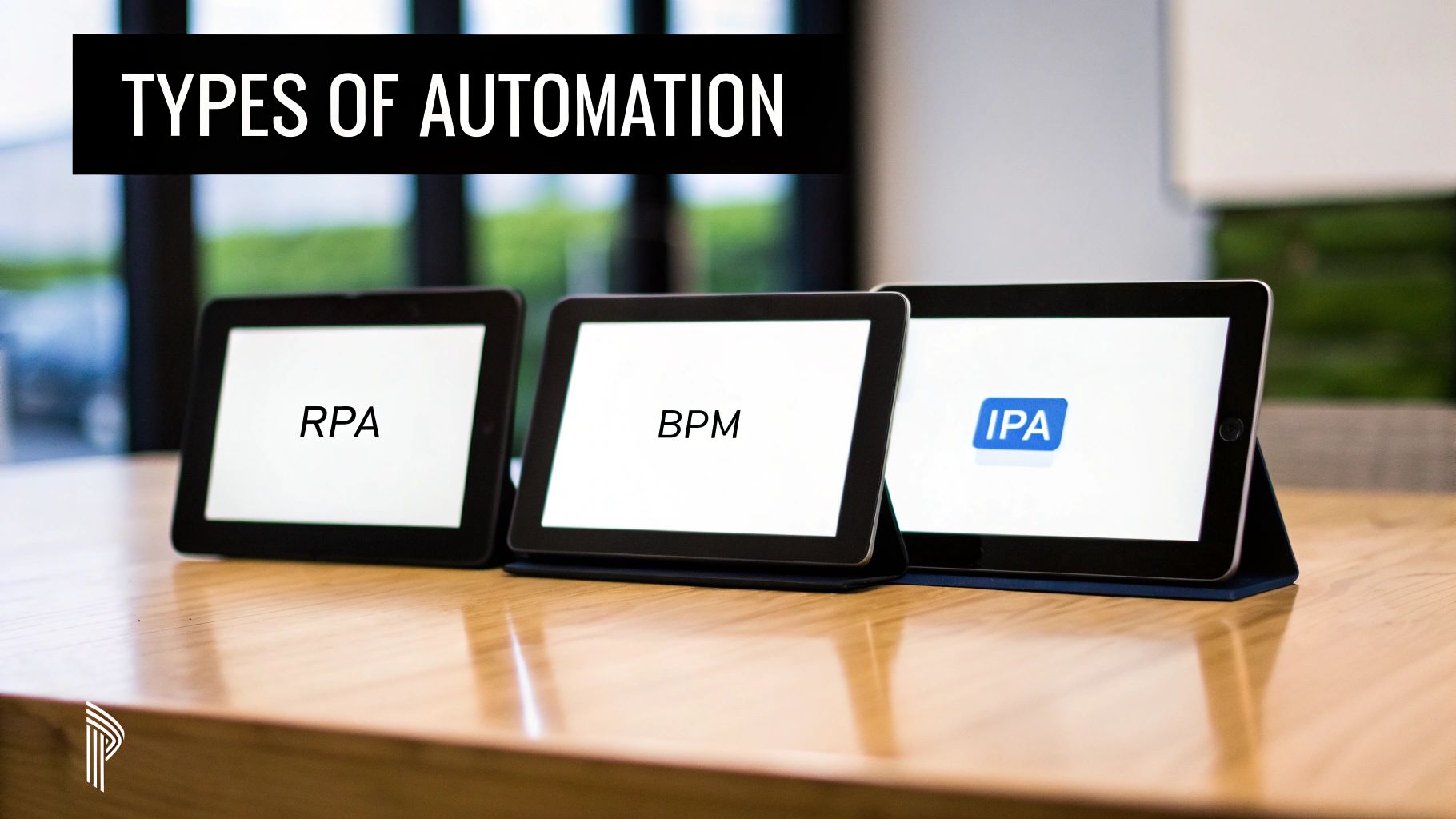
Diving into business process automation tools can feel a lot like trying to decipher a new language. You'll hear acronyms like RPA, BPM, and IPA thrown around, and it's easy to get lost in the jargon. But getting a handle on these core categories is the first real step toward picking the right tool for your company's unique challenges.
The key thing to remember is that not all automation is the same. Each type is a specialist designed for a specific job. You wouldn't hire a data entry clerk to architect a skyscraper, and you wouldn't ask the architect to manually key in thousands of invoices. Success comes from matching the right tool to the right task.
Robotic Process Automation: The Digital Assistant
Think of Robotic Process Automation (RPA) as your team of digital assistants. These software "bots" are built to mimic the repetitive, rules-based tasks that humans do every day. They work right at the user interface—clicking, copying, pasting, and typing data across different applications, just like a person would.
RPA really shines when you have tasks that are predictable and don't require any complex decision-making. Its power is in pure speed and accuracy.
- Ideal Use Cases: Transferring data from a spreadsheet into a CRM, running payroll calculations, or checking information across multiple systems.
- Key Strength: You can implement it quickly for fast wins on simple, structured work. It essentially automates what your team is already doing, just much faster and without any typos.
The main drawback? RPA bots are sticklers for rules. If a process changes even slightly or an unexpected pop-up appears, the bot will get stuck and need a human to step in. It’s a fantastic tool for automating individual tasks, but it doesn't manage the entire end-to-end business process.
Business Process Management: The Workflow Architect
If RPA bots are your digital assistants, then Business Process Management (BPM) software is the workflow architect. BPM platforms take a much bigger-picture view, giving you the power to design, map out, execute, and monitor complex business processes from beginning to end. Instead of just automating a single task, BPM orchestrates the entire journey of work as it moves between departments, systems, and people.
This holistic approach gives you incredible visibility into how your business actually runs. It helps you pinpoint bottlenecks and continuously refine your operations, acting like a central nervous system for your workflows.
A BPM system isn't just about automation; it's about process optimization. It provides the framework to manage and refine the entire lifecycle of a workflow, ensuring it aligns with strategic business goals and delivers consistent outcomes.
Intelligent Process Automation: The Smart Decision-Maker
This brings us to Intelligent Process Automation (IPA), which is the next stage in the evolution of automation. It combines the task-focused power of RPA and the big-picture view of BPM with a game-changing ingredient: artificial intelligence. Think of IPA as the 'smart decision-maker' on your automation team. It leverages technologies like machine learning (ML) and natural language processing (NLP) to handle work that involves unstructured data and requires a bit of judgment.
For instance, where a simple RPA bot would fail if an invoice format changed, an IPA system can learn to read and understand the new layout on its own. This ability to learn, adapt, and handle exceptions is what makes IPA so powerful for messy, real-world business problems. It’s this level of intelligence that helps businesses achieve stunning results, like 60% reductions in processing time, by solving problems that were once too complex to automate.
To see what this looks like in practice, it often helps to compare these technologies side-by-side.
Comparison of Key Business Process Automation Technologies
| Technology Type | Primary Function | Best For | Key Feature |
|---|---|---|---|
| RPA | Mimics human actions for repetitive, rule-based tasks. | Data entry, form filling, basic report generation. | Operates on the user interface level. |
| BPM | Orchestrates and manages entire end-to-end business processes. | Workflow approvals, customer onboarding, claims processing. | Provides a holistic view of the process lifecycle. |
| IPA | Combines RPA/BPM with AI to handle complex data and decisions. | Invoice processing with varied formats, customer service sentiment analysis. | Learns from data and adapts to exceptions. |
Ultimately, choosing the right path depends on your specific goals—whether you need a quick fix for a repetitive task or a deep, intelligent overhaul of a core business process.
Working with an expert partner like Dr3amsystems can help you unlock these advanced capabilities. You can learn more about how we integrate AI into powerful business solutions by exploring our AI-driven offerings. We focus on building robust systems that don’t just automate tasks but also deliver the intelligence needed to create real business value and a powerful ROI.
How to Choose the Right Automation Partner
Picking the right business process automation tool is a big step, but it’s only half the journey. The software itself is just one piece of the puzzle. The technology partner you choose to guide the implementation will ultimately make or break your entire initiative.
A great partner doesn't just talk about features and functions. They bring strategic guidance to the table, along with the technical chops and a genuine curiosity to understand what you’re trying to achieve.
Think of it like this: buying a set of professional-grade power tools won't turn you into a master carpenter overnight. You still need the architect's vision, the engineer's grasp of physics, and the builder's hands-on skill. A true automation partner plays all of these roles, making sure the final solution is designed correctly, built to last, and delivers the results you were promised.
Look Beyond the Software Demo
When you're vetting potential partners, you have to dig deeper than the slick software they're selling. A real partner provides an end-to-end solution, not just a product key. Their expertise should cover the entire lifecycle of your automation project, from the initial "what if" conversations all the way to long-term optimization.
Here’s what you should be looking for in a partner:
- Expertise in Scalability: Can they build something that grows with you? A system that works perfectly for ten people might completely fall apart when you scale to a hundred. A good partner anticipates your future needs from day one.
- Airtight Security Protocols: Automation tools inevitably touch sensitive company and customer data. Your partner needs a rock-solid track record in security, ensuring your new processes are not only efficient but also compliant and safe from threats.
- Seamless Integration Skills: Your new automation tool can't live on an island; it has to talk to everything else in your tech stack. A skilled partner can handle complex integrations without a hitch, preventing data silos and creating a single, unified workflow.
A strategic partner doesn't just sell you software; they invest in your outcome. They bring a holistic approach that connects technology directly to business results, guaranteeing reliability and maximizing your return on investment.
The Value of an Integrated Team
The most effective partners bring a diverse set of skills to the project. Automation isn't a standalone discipline—it leans heavily on secure cloud infrastructure, smart data management, and reliable support. This is where an integrated partner like Dr3amsystems really shines.
Our specialized practices—Dr3am AI, Dr3am Cloud, and Dr3am Security—aren't separate entities; they work in lockstep to deliver a complete solution.
This model means every angle of your automation project is handled by experts. We can manage complex, zero-downtime cloud migrations, embed sophisticated AI to make your processes smarter, and offer dedicated support to keep your most critical operations running flawlessly. You can learn more about our company's results-first approach by exploring our mission and values.
Tying Partnership Directly to ROI
At the end of the day, automation is about getting measurable results. The potential is massive: 95% of IT professionals see productivity jump after a successful rollout, and over 70% of employees agree that their workflows get faster.
But the stakes are high. With implementation costs ranging from $30,000 to $250,000 and 35% of finance professionals blaming poor systems for their biggest headaches, a misstep can be costly. These numbers highlight just how critical an expert partner is to navigate the complexities and ensure a positive return. You can find more of these automation statistics from Vena Solutions.
A partner like Dr3amsystems starts every conversation with a free consultation to map your goals and tie every technical decision back to real business value. By focusing on outcomes—like helping our clients achieve 60% reductions in processing time—we ensure your investment does more than just fix a problem. It becomes a catalyst for growth and a lasting competitive advantage.
Seeing Automation in Action Across Your Business
It's one thing to talk about automation in the abstract, but the real "aha!" moment comes when you see how business process automation tools solve tangible, everyday problems. These aren't just theoretical advantages; they're practical solutions that turn costly bottlenecks into sources of incredible efficiency. The impact is felt everywhere.
From the finance department to HR and out to the warehouse floor, automation acts like a force multiplier. It allows your teams to get more done with far greater accuracy and speed. Let's look at a few real-world examples to see how this plays out.
Revolutionizing Finance with Automated Accounts Payable
For most finance teams, the accounts payable (AP) process is a constant headache. Think about it: manual data entry from invoices, chasing down approvals over email, and the ever-present risk of a typo causing a late payment. It’s slow, tedious, and can easily strain relationships with your vendors.
An automated AP system completely flips the script. Here’s a typical flow:
- Intelligent Data Capture: An invoice lands in an inbox, and an AI-powered tool immediately reads it. It pulls out the vendor name, invoice number, line items, and the total amount, no matter how the invoice is formatted.
- Automated Matching and Routing: The system instantly checks that data against the corresponding purchase order in your ERP. If everything lines up, it’s automatically sent to the right person for approval based on rules you’ve already set.
- Seamless Integration: Once approved, the payment is scheduled, and every piece of data is pushed back into your accounting software. Not a single manual keystroke is needed.
The result? A massive drop in manual work and a huge boost in efficiency. At Dr3amsystems, we've implemented these exact workflows for our clients, achieving outcomes like a 60% reduction in invoice processing time. This frees up your financial experts to focus on high-value strategic analysis instead of getting bogged down in paperwork.
Streamlining HR for a Flawless Employee Onboarding Experience
A new hire’s first impression of your company is formed long before they even sit down at their desk. Unfortunately, the onboarding process is often a clunky, disjointed mess of manual tasks. HR is juggling paperwork, IT is scrambling to set up equipment, and managers are trying to schedule training—it can feel chaotic for everyone, especially the new employee.
Business process automation can orchestrate this entire journey into a smooth, welcoming experience. The moment a candidate accepts their offer, an automated workflow can kick off a perfectly timed sequence of events.
- IT Provisioning: A ticket is automatically created to set up user accounts, order a new laptop, and grant access to all the necessary software.
- HR Paperwork: The system sends out digital offer letters and tax forms for a quick e-signature, then securely files the completed documents.
- Welcome and Training: The new hire is automatically enrolled in orientation, and a welcome email from their direct manager lands in their personal inbox with a clear schedule for their first day.
This kind of coordination ensures nothing gets missed. It creates a professional, organized first impression that gets employee engagement started on the right foot. To see more ways to apply this kind of thinking, check out our collection of Dr3am Insights on business optimization.
Optimizing Operations and Supply Chain Logistics
In operations and logistics, visibility is everything. When you’re managing the supply chain manually, you’re often dealing with data silos, delayed shipment information, and a painful inability to react when something goes wrong. Automation breaks down those walls by connecting all your systems into one transparent, agile network.
Imagine a manufacturing company tracking inventory from the warehouse all the way to a customer’s front door. An automated system can:
- Monitor Inventory Levels: Automatically place a reorder with a supplier the moment stock levels dip below a certain threshold, preventing costly stockouts.
- Track Shipments in Real-Time: Give both your internal teams and your customers a live view of where a shipment is at any given moment.
- Manage Documentation: Instantly generate and send all the necessary shipping labels, packing slips, and customs forms without any manual intervention.
A partner like Dr3amsystems specializes in these kinds of complex modernizations. We guide businesses through zero-downtime transitions from old, clunky systems to secure, cloud-based automated platforms. By connecting your data pipelines and fortifying your infrastructure, we give your operations teams the complete control they need to cut costs and keep customers happy.
A Practical Guide to Successful Implementation
A powerful tool is only as good as its implementation. You can subscribe to the best business process automation tools on the market, but without a smart strategy, you’ll just be paying for expensive software that gathers dust. Real success comes from a thoughtful plan that balances the tech with the very human side of change.
To get it right, you need a pragmatic roadmap that helps you sidestep common pitfalls like fuzzy goals or pushback from your team. Think of it less as installing software and more as creating a connected, efficient flow of work across the entire company.
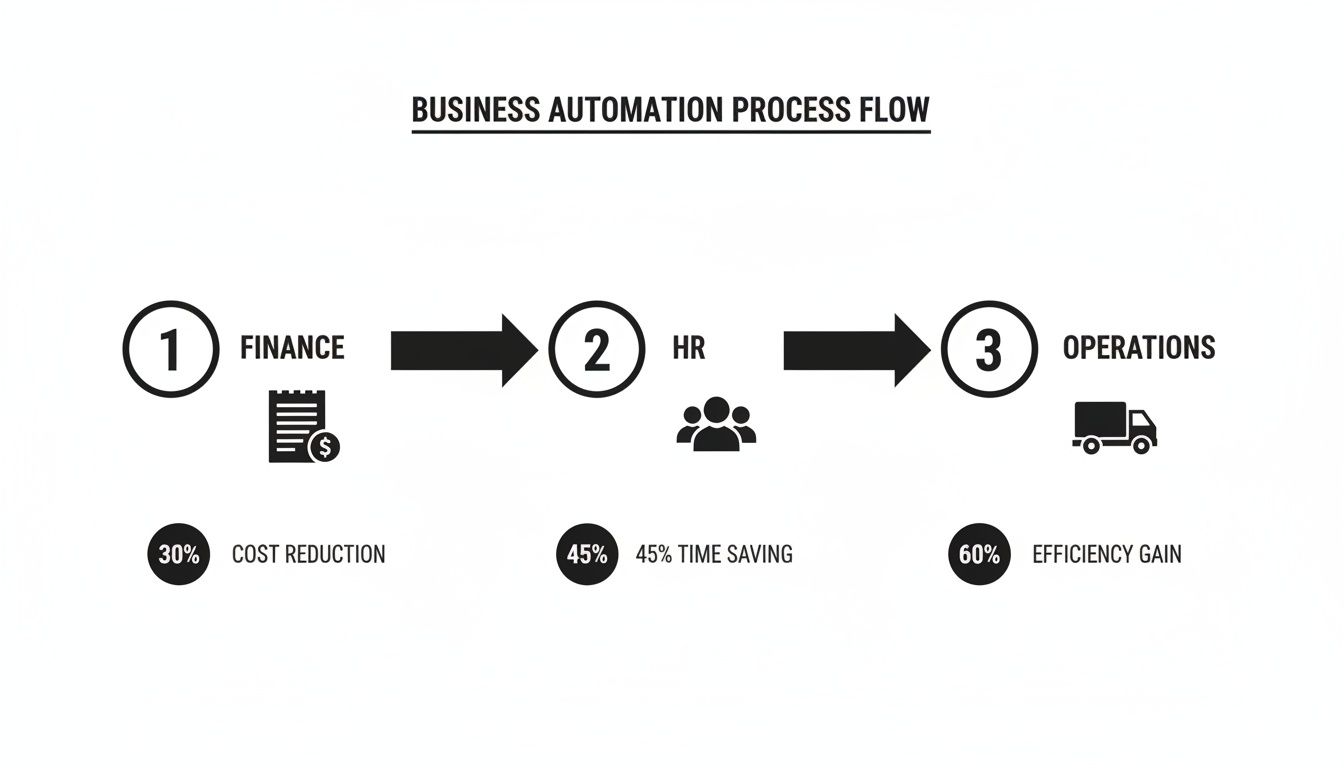
The goal isn't just to patch up isolated problems; it's to build a cohesive system where work moves smoothly from one department to the next. A proven framework is the only way to navigate this journey and ensure your investment starts paying off from day one.
Building The Business Case And Defining Goals
Before anyone writes a single line of code, every successful automation project starts with clear objectives. What, exactly, are you trying to fix? Are you aiming to slash invoice processing times, get new hires up to speed faster, or cut down on costly supply chain errors?
If you don't define your goals, you're flying blind. A solid business case needs to map out:
- The Current State: Document the workflow as it exists today. Where are the bottlenecks? How much time and money are lost to manual steps?
- The Desired Future State: Paint a clear picture of what the new, automated process will look like. What specific improvements are you expecting?
- Key Performance Indicators (KPIs): Define how you'll measure success. Is it a 25% reduction in manual mistakes or a 40% faster cycle time?
This is where a partner-led discovery phase is worth its weight in gold. The free consultation we offer at Dr3amsystems is designed to do just this—clarify your goals, pinpoint the most impactful automation opportunities, and build a rock-solid business case that gets everyone on the same page.
Managing The Human Side Of Automation
Often, the biggest obstacle to a successful rollout has nothing to do with technology. It’s your people. Employees can be suspicious of automation, fearing that these new tools are coming for their jobs. You have to tackle this concern head-on.
It's a valid worry. Experts predict that 83 million jobs could be displaced by automation in the coming years. But at the same time, new, higher-value roles are being created. With data entry roles expected to see the sharpest decline—around 7.5 million positions disappearing—it's crucial to position automation as a tool for empowerment, not replacement. You can dig into more of these workforce automation statistics on Ziphq.com.
Honest communication is everything. Frame the new tools as digital assistants that handle the boring, repetitive tasks. This frees up your team to focus on the work that actually drives the business forward—strategic thinking, creative problem-solving, and customer-facing initiatives. Don't skimp on transparent communication and proper training; they are non-negotiable for getting your team on board.
A Phased Deployment And Continuous Improvement
Trying to automate your entire business at once is a classic recipe for disaster. The smarter approach is a phased deployment, starting with small, manageable projects that deliver quick wins. This builds momentum and gives you valuable lessons you can apply to bigger, more complex rollouts down the line.
Start with a pilot program. Pick a single process that's a known pain point, automate it, and prove the concept. Once you’ve demonstrated success and ironed out the kinks, you can start scaling the solution to other departments. It’s a methodical approach that lowers risk and makes for a much smoother transition.
Remember, implementation isn’t a one-and-done event. The best automation strategies are built on a cycle of continuous improvement. After you go live, keep a close eye on your KPIs, gather feedback from the people using the tools, and always be on the lookout for new ways to optimize. This is why a partner like Dr3amsystems provides dedicated managed support—to ensure your systems don't just run smoothly, but are constantly being refined to deliver more and more value over time.
Ready to Get Started with Automation?
We’ve covered a lot of ground, moving business process automation from a buzzword into a tangible strategy. You now have a clearer picture of the different tools available, how they work in the real world, and what it takes to implement them successfully. The next step? Putting that knowledge into practice.
But choosing the right partner to help you is easily the most critical decision you'll make. It’s not about finding a software vendor; it’s about finding a team that delivers real-world outcomes. At Dr3amsystems, we built our entire approach around one thing: making complex technology work for your business goals, plain and simple.
From a Good Idea to Great Results
Every project we take on starts with a free consultation. We use this time to get to the heart of what you want to achieve and pinpoint the best automation opportunities hiding in your current processes. We’re all about delivering results you can actually measure.
It’s not just talk. Our clients have seen a 60% reduction in processing time and have made the switch to modern systems with zero downtime. We combine smart, AI-powered solutions with a rock-solid cloud foundation and dedicated support to get you there faster. We don’t just install software; we build resilient, efficient engines for growth.
A successful automation project is never just about the tech. It’s about having a practical, results-driven partner who knows how to connect powerful tools to real business value—ensuring everything is reliable, cost-effective, and delivers a clear return.
Your All-in-One Technology Partner
Dr3amsystems brings all the necessary expertise under one roof to make sure your automation journey succeeds from day one. Our dedicated teams—Dr3am AI, Dr3am Cloud, and Dr3am Security—work together to deliver a complete solution.
We’re here to handle every piece of the puzzle:
- Modernizing old systems so you have a solid foundation to build on.
- Building smart data pipelines and machine learning models to improve decision-making.
- Locking down your security to protect your operations and sensitive information.
- Providing continuous optimization to keep your systems getting better over time.
Whether you're just starting to look into business process automation tools or you’re ready to take an existing program to the next level, our team has the hands-on experience to guide you. We focus on reliability and ROI, making sure your essential operations run like clockwork while you unlock new efficiencies.
Ready to find the automation opportunities that will push your business forward? Schedule a free consultation with our experts to build a roadmap that ties technology directly to your most important goals.
Common Questions About Business Process Automation
Even with a clear understanding of what business process automation tools can do, a few practical questions always pop up when it's time to get started. Let's tackle some of the most common ones we hear from leaders.
What's the Real First Step to Implementing Automation?
It’s tempting to jump straight into software demos, but the real first step has nothing to do with technology. It’s all about deeply understanding your own processes. You need to map out your current workflows to pinpoint the exact bottlenecks, manual data entry points, and repetitive tasks that are holding you back.
This is where having an experienced partner makes a world of difference. Our free consultation is designed to do just that—help you clarify your goals, find the quick wins and high-impact opportunities, and lay out a practical roadmap before you ever commit to a tool. This ensures your investment hits the mark.
How Do We Actually Measure the ROI of These Tools?
Measuring the return on your automation investment is a mix of hard numbers and powerful, "softer" benefits. The quantitative side is straightforward: you can track cost savings from fewer manual hours, measure faster turnaround times, and count the reduction in costly human errors.
But the qualitative wins are just as crucial. Think about the boost in employee morale when tedious work disappears from their plate, or the increase in customer satisfaction because they get faster, more accurate service. At Dr3amsystems, we help you set up these benchmarks from the very beginning, so you can track and prove the value of your initiative.
A great ROI isn't just about saving money; it's about creating new potential. When you automate the routine, you give your team the bandwidth to innovate, tackle bigger challenges, and focus on the kind of strategic work that was always on the back burner.
Is Automation Going to Replace Our Employees?
This is a big one, and the answer is no. The goal of smart automation is to augment your team, not replace them. By letting software handle the predictable, low-value tasks, you free up your people to focus on what they do best: creative problem-solving, strategic thinking, and building customer relationships.
A solid change management plan is key here, and it's a core part of how we manage implementations. We help you communicate the vision clearly, showing your team how automation is a tool to make their jobs better—not to make them obsolete. It's about getting rid of the frustrating parts of the job so they can excel at the valuable parts.
Ready to move from strategy to reality? Partner with Dr3amsystems to accelerate your results with AI-powered automation and expert guidance. Learn more about our approach.