
Picking a cloud provider is more than just an IT decision; it's a foundational business move that will echo through your company for years. Get it right, and you’ve built a launchpad for innovation and growth. Get it wrong, and you're stuck wrestling with surprise bills, a clunky tech stack, and a partner who just doesn’t get your vision.
It’s about finding a platform that genuinely aligns with your strategic goals, technical realities, and budget. The aim isn't just to "move to the cloud" but to achieve real, measurable business outcomes—like slashing data processing times or pulling off a migration so smooth your customers don't even notice. A technology partner like Dr3amsystems helps organizations achieve these results by providing AI-driven solutions, secure cloud migrations, and dedicated managed support to accelerate business outcomes.
A Practical Framework for Choosing Your Cloud Partner
Let's cut through the marketing noise. This isn't about comparing endless lists of features. It’s about creating a clear, actionable framework to find a long-term partner who will help you scale, innovate, and keep costs in check. The decision you make will directly impact your ability to deploy sophisticated AI pipelines, manage data effectively, and adapt to market changes.
This process starts with your business strategy, which then dictates the technology you need and the budget you can allocate. It’s a top-down approach.
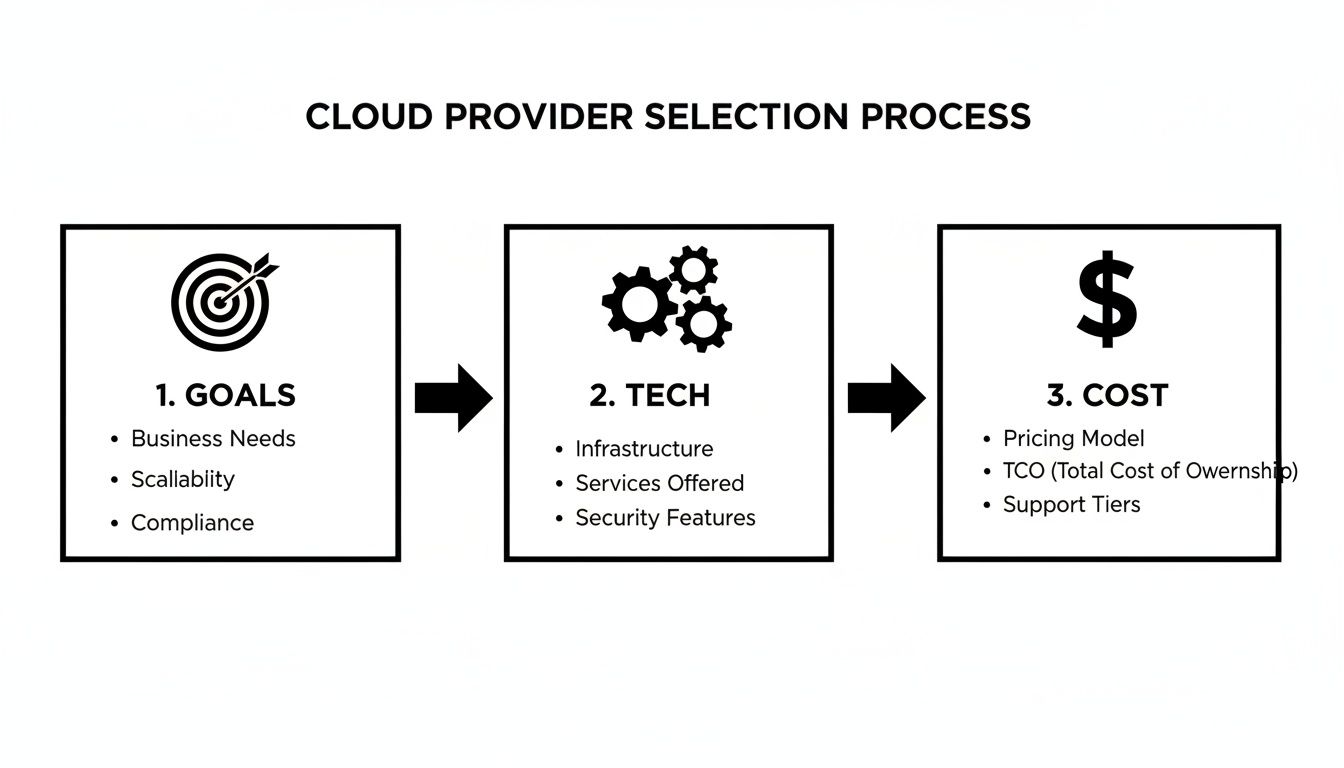
As the visual shows, your business goals have to drive the entire conversation. From there, you can dive into the technical specifics and financial modeling.
To help structure your thinking, here's a quick look at the core pillars of a solid evaluation process. This table breaks down what you should be asking and why it's critical for your business.
Cloud Provider Decision Framework at a Glance
| Evaluation Pillar | Key Questions to Ask | Why It Matters for Your Business |
|---|---|---|
| Business Goals | What specific outcomes are we trying to achieve? (e.g., faster time-to-market, 20% cost reduction) | This ensures the cloud migration serves a strategic purpose, not just a technical one. It aligns the project with measurable ROI. |
| Technical Needs | Does the provider excel at the services we need most? (e.g., AI/ML, data analytics, serverless) | Matching your core workload requirements to a provider's strengths avoids performance bottlenecks and future rework. |
| Cost & TCO | What is the total cost of ownership, including data transfer, storage, and support fees? | A simple price-per-VM comparison is misleading. TCO reveals the true, long-term financial impact on your bottom line. |
| Security & Compliance | Can the provider meet our industry-specific compliance needs (e.g., HIPAA, GDPR)? | Non-compliance can lead to massive fines and reputational damage. This is a non-negotiable checkpoint. |
| Reliability & SLAs | What are their uptime guarantees, and what are the penalties for failing to meet them? | Your business depends on availability. A strong SLA provides financial recourse and peace of mind for critical applications. |
This framework gives you a repeatable and defensible way to compare your options, ensuring you cover all your bases before making a commitment.
Start with the Established Leaders
When you’re just starting your search, it makes sense to look at the providers with proven scale and reliability. There's a reason the "Big Three"—AWS, Microsoft Azure, and Google Cloud—held a combined 66% of the global cloud market in Q4 2023.
Their market share is a direct result of immense investment in infrastructure, security, and a dizzying array of services. For instance, AWS offers over 200 fully-featured services from data centers across the globe. Sticking with a major player gives you a degree of confidence in the stability you need for mission-critical operations. It’s this kind of reliability that allows partners like Dr3amsystems to deliver zero-downtime transitions for our clients.
A successful cloud strategy is less about the provider you choose and more about the partner you choose to implement it. An expert partner ensures your migration is secure, cost-efficient, and aligned with your business goals from day one.
Ultimately, the best provider is the one whose platform directly empowers your business to do what it does best. That's where an experienced technology partner comes in. At Dr3amsystems, our Dr3am Cloud practice is designed to guide you through this entire process. We offer everything from initial strategy and consultation to the hands-on execution needed to make your cloud journey a success.
Defining What Success Looks Like for Your Business
Before you even glance at a provider’s pricing page or technical specs, the most important work happens internally. You have to figure out what "success" actually means for your business. It's easy to get lost in feature comparisons, but without a clear destination, you're just wandering. You risk picking a provider for bells and whistles you'll never touch, or locking into a pricing model that cripples you down the road.
Think about it. Are you an e-commerce company bracing for a 10x traffic spike on Black Friday? Your definition of success is flawless uptime under pressure. Or are you a healthcare startup where ironclad data sovereignty and HIPAA compliance are non-negotiable? That’s a completely different set of priorities. Your business goals are the only lens that matters here.
From Ambition to Actionable Metrics
High-level goals like "be more agile" or "cut costs" are fine for a whiteboard session, but they're useless for making a decision this big. You need to distill those ambitions into specific, measurable Key Performance Indicators (KPIs). This is how you turn a vague idea into a concrete scorecard for evaluating each provider.
This is exactly where we start at Dr3amsystems. Our process always kicks off with a free consultation to clarify goals, uncover automation opportunities, and design a roadmap that aligns technology with business value. The goal is to make the cloud a strategic enabler, not just a line item on the IT budget.
Let’s look at a few real-world examples of how this translation works:
Goal: Ship new features faster.
- KPI: Shrink our average dev-to-deployment cycle from 6 weeks to 1 week.
- KPI: Move from monthly deployments to daily pushes.
Goal: Lower our infrastructure and operational costs.
- KPI: Cut annual infrastructure spend by 20% by moving from CapEx to OpEx.
- KPI: Free up 500 hours of engineering time per quarter by adopting managed services.
Goal: Get smarter with our data.
- KPI: Slash the time to run complex analytics queries from 4 hours to under 15 minutes.
- KPI: Give the BI team real-time sales data with less than a 1-minute delay.
Aligning Goals with Technical Strategy
Once you have these KPIs locked down, you can finally start connecting them to the technical capabilities you need. This is the bridge between your business strategy and the cloud provider you choose. It keeps you laser-focused on what will actually drive results, preventing you from getting sidetracked by slick marketing.
Your success metrics are your North Star. If a provider's core strengths don't directly support your top three KPIs, they are not the right fit, no matter how attractive their pricing or feature list seems.
For example, a client came to us with the goal of reducing their data processing time by 60%—a target we successfully hit. That single KPI immediately narrowed the field to providers with best-in-class high-performance computing, efficient data pipelines, and mature AI/ML services. It turned a vague search into a focused evaluation.
Building Your Business Case
This upfront work does more than just help you pick a provider. It builds the internal business case for the entire cloud project. When you can walk into a boardroom and say, "This move will cut our op-ex by 20% and help us launch products four times faster," you get immediate buy-in. It rallies the whole company around a shared vision.
This strategic foundation is absolutely critical for any major tech initiative. For a deeper dive into aligning IT with executive-level goals, our guide on Pro Enterprise services walks through creating a tech roadmap that delivers tangible business outcomes. By doing this groundwork, you ensure you’re not just buying cloud services—you’re investing in a platform designed to make your vision a reality.
Aligning Technical Capabilities with Your Roadmap
Once you have your business goals nailed down, it’s time to get into the weeds—the technology itself. Think of choosing a cloud provider less like picking a utility and more like selecting a long-term technology partner. Their platform will be the foundation for everything you build for the next five to ten years.
This goes way beyond a simple cost comparison of virtual machines or storage. It’s about digging deep to see if their core platform and, just as importantly, their future direction, truly line up with your own technical roadmap.

You need to look at their entire service portfolio. Everything from the basic compute and networking building blocks to their most advanced AI and machine learning platforms needs to be on the table. The right choice here is completely dependent on what you need to build and where you see your company going.
Evaluating Core Services for Your Workloads
Every application has its own personality and its own demands. A legacy monolithic app you’re trying to move to the cloud is a completely different beast than a modern, cloud-native application built from the ground up with containers and microservices.
Your first move should be to map your most important workloads to what each provider does best.
Here are a few real-world scenarios I see all the time:
- For container-native development: You need to get serious about their managed Kubernetes service (think Amazon EKS, Azure Kubernetes Service (AKS), or Google Kubernetes Engine (GKE)). How clunky is it to provision a cluster? What about their serverless container options? The ecosystem around container management—things like service mesh and observability tools—is what separates a production-ready environment from a science project.
- For data-intensive applications: Scrutinize their database offerings. Do they have a solid, managed version of what you already use, like PostgreSQL or MySQL? For insane throughput, you might be tempted by their proprietary databases, but you have to carefully weigh that performance boost against the very real risk of getting locked in.
- For legacy system migration: How well do they support traditional infrastructure? Do they offer bare-metal servers or specialized instances that can handle your older, finicky software dependencies? A smooth "lift-and-shift" migration depends on a platform that doesn’t force you into a complete, and expensive, re-architecture on day one.
This is exactly where an experienced partner can save you from making a very costly mistake. Having someone who can analyze your current architecture and point you to the provider with the most direct, cost-effective path forward is invaluable. To get a feel for how we handle this, take a look at our approach to modernizing a company's tech stack with our Dr3am IT solutions.
The AI Ecosystem Litmus Test
For almost any company with an eye on the future, a provider’s AI and machine learning capabilities are a massive deal-breaker. This is where the big three—AWS, Azure, and Google Cloud—really start to show their differences. Don't get distracted by the marketing hype; you need to dive into the nitty-gritty of their AI stack.
Here are the questions I always ask:
- Model Availability: What's their menu of foundation models? How easy is it to actually fine-tune them with your own proprietary data?
- Data Integration: How painful is it to connect your data lakes and warehouses to their ML platforms? Without strong, seamless data pipeline tools, your models will starve.
- Developer Experience: How good are their SDKs and APIs? A platform that lets your developers quickly experiment and deploy models is what will actually get your AI initiatives off the ground.
A provider’s investment and momentum in AI is a huge tell. With the global cloud market projected to hit $1.614 trillion by 2030, largely fueled by AI, you want to bet on a horse that's running hard. For example, Microsoft Azure's recent 33% YoY growth was massively boosted by its AI services. That’s a powerful signal they are committed to the kind of innovation that businesses need.
For companies focused on using AI to get real results—like the 60% reduction in processing times Dr3amsystems delivers—this isn’t a nice-to-have. Choosing a provider with a mature and constantly evolving AI platform is non-negotiable. It protects your investment and guarantees you’ll have access to the tools that will power the next wave of business automation.
Assessing the Provider’s Innovation Roadmap
Finally, you need to lift your head up and look beyond what they offer today. Where are they going tomorrow? A cloud provider is a long-term relationship, and you need to be sure they’re innovating in the areas that matter most to your business.
Check out their recent product announcements, their contributions to open-source projects, and any public roadmaps you can find. Are they investing heavily in serverless, edge computing, or even quantum? Their commitment to open standards, like those championed by the Cloud Native Computing Foundation (CNCF), can also be a good sign that they’re dedicated to interoperability and not just locking you into their ecosystem.
Picking a provider whose technical vision aligns with your own is the best way to ensure you don’t outgrow their platform in a few years. A technology partner like Dr3amsystems can perform this deep-dive diligence, pulling from our expertise across Dr3am AI, Dr3am Cloud, and Dr3am Security to vet providers against your unique roadmap. This comprehensive approach ensures you don't just pick a platform for today, but one that will empower your growth for years to come.
4. Don't Get Blinded by Sticker Prices: Understanding Your True Cloud Costs
When you first land on a cloud provider's pricing page, it’s all too easy to start comparing the hourly cost of a virtual machine. This is a classic, and often costly, mistake.
The sticker price for a cloud service is almost never the final bill you’ll pay. To make a smart decision, you have to look past the simple pay-as-you-go rates and really dig into the Total Cost of Ownership (TCO).
Calculating your TCO forces you to think about all the related expenses that can turn a cheap-looking service into a major line item on your budget. It's about building a realistic financial model that reflects how your team will actually use the cloud, not just how it’s priced on a website. Without this foresight, you're setting yourself up for budget overruns that can put your entire project at risk.
Uncovering The Costs Hiding in Plain Sight
So, where's the gap between the advertised price and your actual cloud spend? These "hidden" costs aren't intentionally buried, but they do require some careful planning to anticipate and manage. In my experience, ignoring them is the most common reason organizations get hit with surprise bills.
Here are the usual suspects to factor into your TCO analysis:
- Data Egress Fees: Providers almost always charge you for data moving out of their network. If your app sends a lot of data to users or other systems, these fees can quickly become one of your biggest—and most unpredictable—expenses.
- Premium Support Plans: The free support tier is rarely enough for a production system. Getting enterprise-level support with guaranteed response times comes at a premium, often calculated as a percentage of your total monthly bill.
- Third-Party Tools: Your provider’s built-in security and monitoring tools might not cut it. You'll likely need to budget for third-party solutions for things like advanced threat detection, deep observability, or specific compliance reporting.
- Operational Overhead: Who is going to manage, patch, and optimize this new cloud environment? The human cost—your team's time and salary—is a very real expense that has to be part of the equation.
A Quick Look at Provider Cost Models
To help you get started, here's a high-level comparison of the common cost factors and savings mechanisms you'll find across the major cloud providers. This isn't exhaustive, but it provides a solid foundation for your TCO analysis.
| Cost Factor | AWS (Amazon Web Services) | Microsoft Azure | Google Cloud Platform (GCP) |
|---|---|---|---|
| Compute Pricing | On-Demand, Savings Plans, Reserved Instances (RIs), Spot Instances | Pay-As-You-Go, Reservations, Azure Hybrid Benefit, Spot VMs | On-Demand, Sustained Use Discounts (SUDs), Committed Use Discounts (CUDs), Spot VMs |
| Data Egress | Tiered pricing; generally free for data ingress, charged per GB for egress. | Tiered pricing; similar model to AWS, charges for data leaving Azure regions. | Tiered pricing; charges per GB for egress, with some free tiers. |
| Storage Costs | Tiered by storage class (e.g., S3 Standard, Glacier) and data transfer. | Tiered by performance (e.g., Premium SSD, Standard HDD) and redundancy options. | Tiered by class (e.g., Standard, Nearline, Coldline) and location. |
| Support Plans | Developer, Business, Enterprise On-Ramp, and Enterprise tiers. | Basic, Developer, Standard, Professional Direct, and Unified tiers. | Basic, Standard, Enhanced, and Premium support tiers. |
| Key Savings | Savings Plans (1 or 3-year commitment on compute usage) are highly flexible. | Azure Hybrid Benefit allows using on-premises Windows/SQL licenses. | Sustained Use Discounts are applied automatically for running VMs over a month. |
As you can see, while the concepts are similar, the specific names and mechanisms differ. Digging into the details for your specific use case is absolutely critical for an accurate cost projection.
Shifting from Cost to Value
A mature cloud strategy isn't just about finding the cheapest option; it's about maximizing value. This means moving your focus from the raw price of infrastructure to how a provider's services can reduce your team's operational load and help you hit your business goals faster.
For example, a managed service like a serverless function platform or a fully managed database might look more expensive per hour than a basic virtual machine. But it also frees your engineers from spending dozens of hours on patching, scaling, and maintenance. That's time they can put back into building new features that actually make you money.
The single most effective way to control your cloud costs is to architect for cost-efficiency from day one. Trying to fix an inefficient design after it's already in production is always more painful and expensive.
This is exactly where a partner like Dr3amsystems can make a huge difference. We don't just migrate workloads; we design architectures that are cost-effective from the ground up. We help you find the right mix—using reserved instances for your predictable workloads while tapping into spot instances for fault-tolerant tasks—to slash your costs without compromising performance.
How to Build a Predictable Cloud Budget
Forecasting your cloud spend comes down to one thing: understanding your workload patterns. Are your resource needs spiky and unpredictable, or are they stable and consistent? Answering that question is the key to picking the right pricing model.
- Pay-As-You-Go: This is your go-to for new projects, dev/test environments, or any workload with unpredictable traffic. You only pay for what you use, giving you total flexibility.
- Reserved Instances (RIs) & Savings Plans: These are perfect for your steady-state applications where you know what you need. By committing to one or three years of usage, you can get discounts of up to 72% off on-demand prices.
- Spot Instances: Here, you bid on unused compute capacity at a massive discount—we're talking up to 90% off. They're fantastic for things like batch processing or data analysis, but be aware they can be terminated with little notice.
An experienced partner can help you build a hybrid model that blends these options to fit your specific needs. This ensures you aren't overpaying for flexibility you don't need or locking yourself into commitments that don't make sense.
If you want to build a more detailed financial model, you can find more on how we approach cloud cost optimization in our pricing guide. Our FinOps guidance is all about making sure your cloud spend stays predictable and directly tied to the value it's creating for your business.
Getting Serious About Security, Compliance, and Support
When you move to the cloud, you're entering into a partnership. It’s a shared responsibility model, and you need to know exactly what you’re on the hook for and what the provider covers. They handle the security of the cloud—the physical buildings, the global network, the hardware. Your job is to secure everything you put in the cloud.
But that doesn't mean you can just take their word for it. You have to kick the tires and look under the hood. We're talking about a deep dive into their identity and access management (IAM) tools, network security options, and how they handle data encryption by default. Your company's security posture is only as strong as the foundation it's built on.

Don't Just Trust—Verify Their Compliance
Every big cloud provider will tell you they're secure. The real differentiator, especially for regulated industries, is their list of certifications. This isn't just a collection of logos for their website; it's proof they can meet the stringent demands your business operates under. A failed audit because your provider doesn't have the right paperwork can bring things to a screeching halt.
First things first, make a list of the regulatory frameworks that matter to you. For example:
- HIPAA: A must-have for anything touching protected health information.
- SOC 2 Type II: Table stakes for most SaaS companies that want to work with enterprise customers.
- GDPR: Non-negotiable if you’re handling data from anyone in the EU.
- PCI DSS: Absolutely essential if you process, store, or transmit credit card data.
Don’t just ask the sales rep. All major providers have public compliance portals where they post their current audit reports and certifications. Go download them. This is the hard evidence you need to prove their infrastructure is up to snuff.
Reading Between the Lines of an SLA
A Service Level Agreement (SLA) is the provider's promise of uptime, but it's amazing how often those numbers are misunderstood.
A 99.9% uptime SLA sounds great on paper, right? But do the math. That allows for 8.77 hours of downtime over a year. If you run an e-commerce site, that's a full business day of lost sales. Bump that up to 99.99%, and you're down to just 52.6 minutes per year. That's a huge difference.
But here’s the most important part of any SLA: the remedy clause. If they fail to meet their promise, what do you actually get? Almost always, the answer is service credits—a small discount on next month's bill. That credit won't win back the customers you lost or repair the damage to your brand during an outage.
That’s why you can't just pick the provider with the highest percentage. Your architecture, disaster recovery plan, and support model are what truly keep you online.
Why Your Support Plan Matters More Than You Think
When something breaks at 3 AM on a holiday weekend—and it will—the quality of the support you get can be the difference between a five-minute fix and a five-hour crisis. The free, basic-tier support offered by cloud providers is almost never good enough for a real business.
When you're comparing support plans, ask the tough questions:
- Response Times: What's the guaranteed response time for a severity-1 incident? Is it 15 minutes or 4 hours?
- Access to Experts: Will you get a senior engineer on the line immediately, or will you have to fight your way through three tiers of a call center first?
- Proactive Help: Do they offer any proactive services, like an architectural review, or are they purely reactive?
This is where a dedicated partner can completely change the game. Standard provider support is designed to fix their platform when it breaks. A managed services partner, on the other hand, is focused on your outcomes.
Under our Dr3am Hosting and Dr3am Security practices, we provide proactive, hands-on management. We're not just a number to call when things go wrong; we're continuously monitoring your environment to prevent issues from happening in the first place. You can learn more about our comprehensive security services to see what that looks like in practice.
A partner's job is to close the gap between the powerful tools a cloud provider offers and the real-world stability and performance your business demands. We handle the infrastructure so you can get back to building what matters.
Planning Your Move: Migration Strategy and Proof of Concept
A great choice on paper is just that—paper. The real test is turning that decision into a smooth, successful migration. This is where the rubber meets the road, and where you de-risk the entire project. Rushing into a massive migration without testing the waters is a classic mistake that almost always leads to blown budgets and late-night emergencies.
The best way to kick things off is with a tightly-scoped Proof of Concept (POC). Think of it as a dress rehearsal. A POC lets you validate your most critical assumptions on a small scale before you go all-in. You're testing real-world performance, getting a feel for actual costs, and seeing how your team adapts to the new environment—all without betting the farm.
How Will You Get There? Choosing Your Migration Path
Once your POC gives you the green light, the next big question is how to actually move your workloads. There’s no single right answer here. The best strategy depends entirely on the application's age, architecture, and what you hope to achieve in the cloud.
You’ll generally encounter a few common paths:
- Rehosting (The "Lift and Shift"): This is exactly what it sounds like. You pick up an application and move it to the cloud with very few, if any, changes. It's fast and relatively straightforward, making it a great option for legacy systems you can't afford to rebuild from scratch.
- Refactoring (The "Re-architect"): This is a deeper investment. You’re actively modifying the application to use cloud-native services like serverless functions or managed databases. It takes more work upfront, but the payoff is huge in terms of performance, scalability, and long-term cost savings.
This is a critical juncture where an experienced partner can save you a world of pain. Analyzing an entire application portfolio to map out the right strategy for each piece is complex. At Dr3amsystems, we live and breathe this stuff. We handle everything from the initial plan to the final cutover, specializing in secure, zero-downtime transitions so your business never misses a beat.
A Word on Vendor Lock-In: Keep Your Options Open
Before you write a single line of code, you need to talk about vendor lock-in. This is the risk of weaving your systems so tightly into one provider’s proprietary services that leaving becomes a technical and financial nightmare. It’s easy to do, but with a little foresight, it's also easy to avoid.
Building for portability isn't about planning for failure. It's about maintaining strategic control. It gives you the freedom to adopt the best technology tomorrow, regardless of which vendor creates it.
The key is to lean on open standards and cloud-agnostic tools from the start. For example, using Kubernetes to manage your containers or Terraform to define your infrastructure means your core setup isn't tied to AWS, Azure, or Google Cloud. You build once and retain the flexibility to deploy anywhere.
This is the kind of strategic thinking a seasoned partner brings to the table. Dr3amsystems doesn’t just build for today; we design cloud architectures that are reliable and cost-effective while preserving your long-term agility. We make sure your migration is more than just a change of scenery—it’s a move toward a truly resilient and future-proof technology stack.
Frequently Asked Questions

We've guided countless CTOs, founders, and IT leaders through this process. Along the way, a few key questions always come up. Here are the straight-up answers based on our experience in the trenches.
What Is the Biggest Mistake Companies Make?
Hands down, the biggest misstep is getting tunnel vision on pricing. Too many teams get bogged down comparing the hourly cost of a virtual machine and completely miss the bigger picture. They forget to account for things like data egress fees, the strength of the AI and machine learning services, or the quality of the developer tools that will either accelerate or frustrate their engineers.
A cheap foundation is useless if it can't support your business roadmap. That's why we always tell our clients to put their business goals on the whiteboard first, and then look at the technology.
Should We Start with a Multi-Cloud Strategy?
Honestly, for most companies, the answer is no. Starting with a single, primary cloud provider is almost always more practical. It streamlines everything—management, security, and billing—while allowing your team to build deep, valuable expertise on one platform. You also get access to better volume discounts.
Jumping into a multi-cloud setup from day one introduces a massive amount of complexity. Suddenly you're wrestling with cross-cloud security policies, complex networking, and a cost management nightmare.
The smarter play? Design your architecture for portability from the get-go using things like containers and open standards. That way, you have the option to go multi-cloud or hybrid later if you need to for specific compliance reasons or to tap into a unique, best-of-breed service from another provider.
An expert partner accelerates your success and minimizes risk. While you can go it alone, a partner brings experience from hundreds of migrations, helping you avoid common pitfalls and get the maximum ROI from your cloud investment.
How Does a Partner Like Dr3amsystems Help?
Think of a technology partner as an accelerator and a safety net. Sure, you can absolutely navigate the cloud on your own. But a partner like Dr3amsystems has already seen and solved the problems you haven't even thought of yet, because we’ve done this hundreds of times.
We help you sidestep the common traps, architect a solution that's optimized for cost right from the start, and pull off a zero-downtime transition. Beyond the initial move, our managed services—like Dr3am Cloud and Dr3am Security—handle the ongoing optimization and support. This lets your team get back to what they do best: building great products, not managing infrastructure.
Making the right cloud decision is one of the most important technical choices your business will face. At Dr3amsystems, we start every conversation with a free consultation to map out a strategy that ties your technology directly to your business ambitions.
Book your free consultation today and let’s build your cloud future with confidence.