
Let’s be honest, nobody enjoys the tedious, repetitive tasks that clog up the workday. Imagine if you could build a digital assembly line that runs 24/7, never makes a mistake, and handles all that grunt work for you. That, in a nutshell, is IT automation.
It's the engine that powers truly efficient modern businesses, transforming clunky, error-prone manual processes into smooth, reliable operations. As a technology partner, Dr3amsystems helps businesses accelerate these outcomes with AI-driven solutions, secure cloud migrations, and dedicated managed support.
What Is IT Automation and Why Is Everyone Talking About It?
In a world where speed and accuracy are everything, sticking with manual processes is like trying to win a race on foot while your competitors are in sports cars. Automation is the upgrade. It steps in to slash human error, speed up service delivery, and—most importantly—free up your brilliant people to focus on the big-picture thinking that actually grows the business.
This isn't just about doing the same old things faster. It's about completely rethinking how work gets done. It’s what allows businesses to scale without breaking, tighten up security, and stay ahead of the curve.
The Real Engine of Business Efficiency
At its core, IT automation is a strategic lever, not just a piece of software. Think of it as a new way of operating—a philosophy where you capture the "how-to" for keeping your technology running and turn it into code.
This could be as straightforward as setting up automatic data backups every night or as sophisticated as spinning up an entire cloud server environment with a single click. No matter the scale, the goal is always the same: boost reliability, cut down on manual labor, and get predictable results every single time.
For instance, a technology partner like Dr3amsystems can pinpoint these exact opportunities, leading to tangible outcomes like a 60% reduction in processing time for crucial business workflows. Backed by executive testimonials, the Dr3amsystems team delivers measurable results and prioritizes reliability, cost efficiency, and ROI.
When you take the human variable out of rule-based tasks, you get perfect consistency. A script never gets tired, it never gets distracted, and it won't make a typo at 4:59 PM on a Friday.
The Building Blocks of Modern Automation
To truly get a handle on automation, you need to understand its core components. These aren't just buzzwords; they're the foundational pillars that work together to manage the complex IT environments we all rely on today.
This quick-glance table breaks down the key concepts you’ll see throughout this guide.
Core Components of Modern IT Automation
| Automation Component | Primary Function | Common Use Case |
|---|---|---|
| Orchestration | Coordinating multiple automated tasks across different systems to create a single, seamless workflow. | Onboarding a new employee by automatically creating accounts in HR, email, and project management tools. |
| Robotic Process Automation (RPA) | Using software "bots" to mimic human clicks and keystrokes for interacting with user interfaces. | Pulling data from an old legacy application that doesn't have an API and entering it into a modern CRM. |
| Infrastructure as Code (IaC) | Managing and provisioning servers, networks, and databases through code instead of manual setup. | Deploying an identical, error-free testing environment for developers in minutes. |
| CI/CD Pipelines | Automating the steps involved in building, testing, and deploying new software releases. | Pushing a code update from a developer's machine to live production servers without manual intervention. |
| Runbook Automation | Automating standard operating procedures (SOPs) for IT operations, like incident response or system restarts. | Automatically restarting a failed server and notifying the on-call engineer. |
Understanding how these pieces fit together is the first step toward building a more resilient and agile operation.
This is exactly how Dr3amsystems applies these principles in their Dr3am IT managed services, ensuring client operations run like clockwork while paving the way for continuous improvement. This approach helps organizations move faster, minimize risk, and scale their technology with confidence.
Understanding the Pillars of IT Automation
To really get what IT automation is all about, you have to look under the hood at the core technologies that drive it. These aren't just buzzwords; they're the actual tools and methods that work together to turn manual, slow processes into fast, automated workflows. Each one solves a different kind of problem.
This map helps visualize how these key pillars connect back to the main goal: making IT operations run smoother.
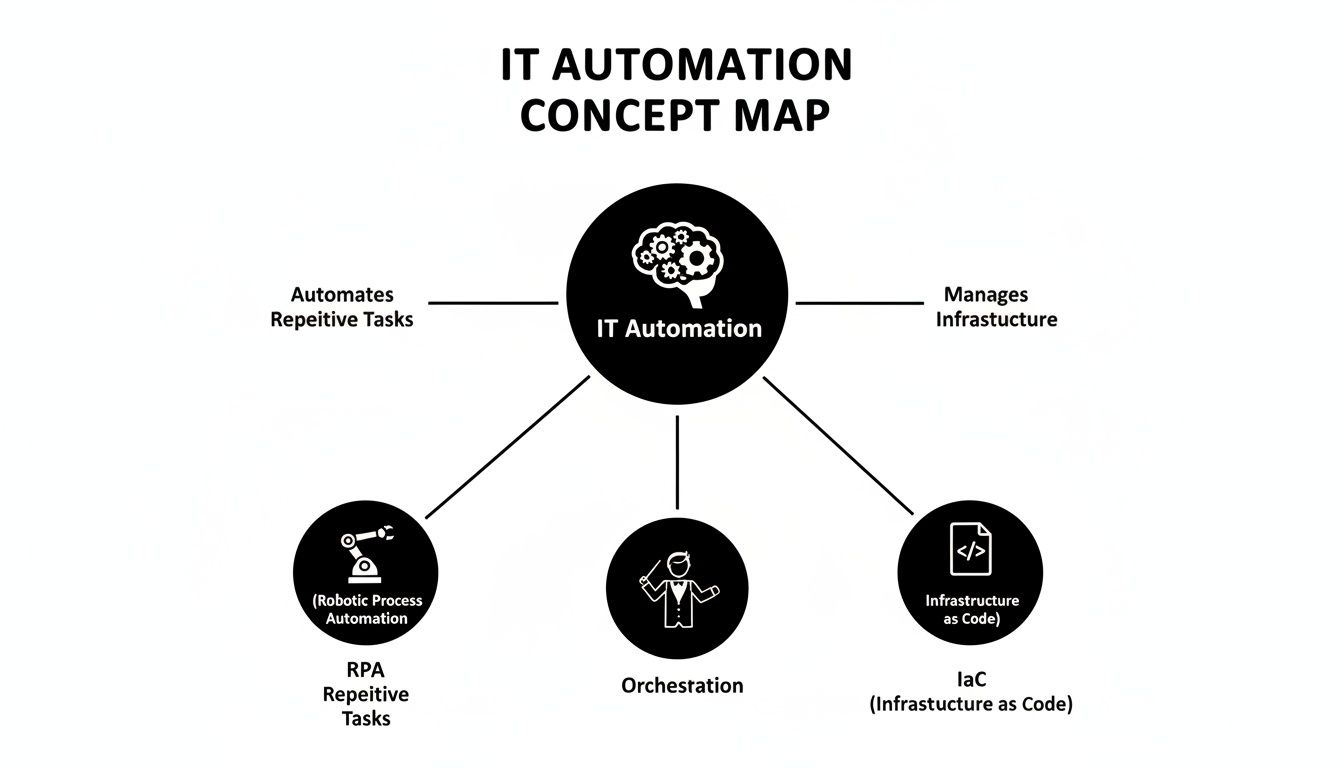
As you can see, IT automation isn't one single thing. It’s a mix of specialized approaches like RPA, orchestration, and Infrastructure as Code, each designed for different parts of your tech stack.
Robotic Process Automation: The Digital Workforce
Think of Robotic Process Automation (RPA) as your 'digital workforce.' These are software bots programmed to do exactly what a human does on a computer screen—clicking, typing, copying, and pasting. They're perfect for repetitive, rule-based tasks that happen on the front end.
Imagine an employee who spends hours manually moving data from a spreadsheet into an old CRM system that doesn’t have an API. An RPA bot can take over that entire job, running 24/7 without getting tired or making typos. This frees up your people to focus on work that actually requires a human brain.
The market growth shows just how big of a deal this is. The global IT robotic automation market is expected to jump from US$ 5.92 billion in 2025 to a staggering US$ 17.25 billion by 2032. Why? Because it works. 86% of businesses say RPA has made them more productive, and 59% have seen major cost savings. These are the kinds of results we target at Dr3amsystems, where our AI-driven solutions often achieve up to a 60% reduction in processing time for clients. You can explore more about these market trends and what they mean for businesses.
Orchestration: The Master Conductor
If RPA bots are the individual musicians, then Orchestration is the conductor leading the whole symphony. It’s what coordinates multiple automated tasks across different systems to pull off a complex, end-to-end workflow.
A simple automation might just restart a server. An orchestrated workflow, on the other hand, does a whole lot more. It can provision the server, install the right software, configure the network, run security checks, and then add it to a load balancer—all without anyone lifting a finger. At Dr3amsystems, our end-to-end services span strategy, implementation, and ongoing optimization to ensure these complex workflows deliver business value.
Orchestration makes sure all the separate automated pieces work in perfect harmony. It’s the glue that connects different systems, turning a bunch of isolated tasks into a smooth and valuable business process.
Infrastructure as Code: The Master Blueprint
Infrastructure as Code (IaC) is about managing your entire IT setup—servers, networks, databases—through code instead of manual configuration. Think of it as creating a master blueprint for your whole technology environment.
With an IaC blueprint, you can spin up an exact copy of your production environment for testing in minutes. This gets rid of the classic "well, it worked on my machine" headache and ensures everything is consistent and secure, which is absolutely essential for modern cloud operations.
At Dr3amsystems, our Dr3am Cloud practice depends on IaC to pull off secure, zero-downtime cloud migrations. By defining the infrastructure in code, we can guarantee that every environment is built identically, which slashes both risk and the time it takes to migrate.
CI/CD Pipelines: The Automated Software Factory
Finally, there are Continuous Integration/Continuous Delivery (CI/CD) pipelines, which essentially create an automated factory for your software. This approach automates every step of getting software from a developer's keyboard to your customers.
- Continuous Integration (CI): This part automatically merges code changes from all your developers into one central place, then runs builds and tests to make sure nothing broke.
- Continuous Delivery (CD): Once the code passes its tests, this part automatically gets it ready and pushes it to a staging environment, so it's ready to go live at the push of a button.
This automated pipeline makes software releases incredibly fast and reliable. It allows you to get new features out to your customers much quicker and with far fewer bugs, closing the gap between development and operations.
What Automation Actually Does for Your Business
Forget the technical jargon for a moment. The real reason to care about IT automation isn't about the tools themselves; it’s about what they unlock for your business. This isn't just about swapping out old tech for new. It's about fundamentally changing how your organization operates, shifting your team's focus from just keeping the lights on to driving real, strategic growth.
When you get automation right, the results aren't just theoretical—they show up on the bottom line. It's a strategic lever that builds a more resilient, efficient, and competitive company. And these benefits ripple out from the IT department to touch every single part of the business.
Slash Costs and Get More Done
The first and most obvious win from automation is a serious drop in operational costs. When you hand over repetitive, manual tasks to a machine, you immediately cut down on the hours your team spends on low-value work. But it's not just about labor savings. You also slash the hidden costs of human error, which can cause everything from frustrating downtime and rework to serious security breaches.
Think about something as routine as server patching. Automating it can save hundreds of staff hours a year. Even better, it ensures critical security updates are rolled out instantly and without fail, closing vulnerabilities far faster than any human ever could. This one-two punch of saving time while cutting risk is where the ROI on automation really starts to shine.
Automation frees your most skilled people from the monotony of repetitive tasks. This allows them to pivot from just keeping the lights on to driving genuine innovation and solving complex business problems.
The impact on overall efficiency is massive. Automated workflows mean faster service delivery, smoother internal processes, and the ability to react to market shifts with far more agility. This is the core idea behind our AI-driven solutions at Dr3amsystems, which are designed to deliver concrete results like 60% reductions in processing time and enable zero-downtime operational changes.
Lock Down Security and Compliance
In a landscape filled with cyber threats and complex regulations, your best defense is consistency. Human error is still one of the biggest weak spots in any security plan, and automation is the most effective way to eliminate it from your day-to-day processes. When you use code to define and enforce security policies, you guarantee that every configuration and every action is performed correctly, every single time.
This is a huge part of our Dr3am Security practice. Automating things like access control, regular compliance checks, and threat response ensures your security posture is rock-solid and uniform across your entire infrastructure. It not only makes you safer but also makes audit prep much less painful, since every automated action is logged and easily traceable.
The data speaks for itself. Business Process Automation (BPA) is a major stepping stone toward digital maturity. A staggering 86% of businesses report higher productivity, and 92% see better compliance outcomes thanks to RPA. These numbers show exactly why more and more companies are using automation to build operations they can truly rely on. You can dig deeper into the impact of business automation statistics and see how it's reshaping entire industries.
Boost Your Team's Morale and Spark Innovation
Here's a benefit people don't talk about enough: the positive effect on your team. Let's be honest, nobody gets excited about spending their day on mind-numbing, repetitive tasks. Automating that drudgery out of their jobs leads to much higher job satisfaction and helps prevent burnout.
More importantly, it frees up your people to do what they do best: think, create, and solve complex problems. When your talented engineers and IT pros are no longer bogged down by monotony, they become a powerful engine for innovation and growth. By investing in automation, you’re really investing in the potential of your people. We share more of our thoughts on how technology can fuel business growth over on our Dr3am Insights blog.
Putting IT Automation to Work: Real-World Examples
It’s one thing to talk about automation concepts like orchestration and RPA in theory. It’s another thing entirely to see them solve real, everyday business headaches. Let's move past the buzzwords and look at how smart automation is actually being used to tighten up operations, strengthen security, and deliver results you can see on the bottom line.

Each of these examples tells a familiar story: a common frustration, a clever automated fix, and a powerful business outcome. This is how automation stops being a technical project and starts becoming a true strategic advantage.
Streamlining IT Operations with Automated Provisioning
The Problem: Your development team is ready to build the next big thing, but they're stuck waiting for a new server environment. The old way involves a ticket, a queue, and an IT admin manually clicking through screens to configure servers, install software, and set up networking. This process can drag on for days, even weeks, killing momentum before a project even starts.
The Automated Solution: This is a perfect job for Infrastructure as Code (IaC). Instead of manual setup, the entire process is automated. A developer simply picks a pre-defined template from a self-service portal, and an orchestration tool does all the heavy lifting. It provisions the server, applies the right configurations, installs the necessary apps, and runs security checks—all without human intervention.
The Business Outcome: What once took weeks now takes minutes. Developers get the tools they need almost instantly, which means projects get off the ground faster and new features reach customers sooner. This is the kind of operational friction we love to eliminate in our Dr3am IT practice, empowering your teams to focus on innovation, not waiting.
Bolstering Cybersecurity with Automated Threat Response
The Problem: Your security operations center (SOC) is drowning in alerts. Analysts spend their days sifting through a firehose of notifications, trying to distinguish real threats from false alarms. It's a slow, error-prone process. By the time they confirm a real attack is underway, the damage might already be done.
The Automated Solution: A Security Orchestration, Automation, and Response (SOAR) platform is put in place to act as a digital first responder. When a critical alert comes in—say, a suspicious login from halfway across the world—the system doesn't wait for a human. It immediately kicks off a runbook to lock the account, isolate the machine from the network, and collect forensic data for the analyst to review.
The Business Outcome: The time it takes to respond to a threat is slashed from hours to seconds. Automation handles the immediate containment, minimizing the blast radius of an attack before an analyst has even finished their coffee. This proactive defense hardens the entire organization’s security posture—a core principle of our Dr3am Security services.
By automating the initial, repetitive steps of incident response, you free your expert security analysts to focus on complex threat hunting and strategic defense planning, rather than chasing down routine alerts.
Transforming Finance with Automated Invoice Processing
The Problem: The accounts payable team is buried under a mountain of invoices, each one a little different. An employee has to manually open PDFs and emails, find the vendor name, invoice number, and amount, and then painstakingly type it all into the accounting system. It’s tedious, boring, and a breeding ground for expensive typos.
The Automated Solution: We deploy a Robotic Process Automation (RPA) bot, powered by Optical Character Recognition (OCR), to take over. The bot watches an inbox for new invoices, uses OCR to read the document like a human would, and extracts the critical data. It then validates that information against your database and plugs it directly into the accounting software. Any exceptions are flagged for a quick human review.
The Business Outcome: Processing time plummets—we regularly see reductions of over 60% with our AI-powered solutions at Dr3amsystems. Accuracy skyrockets, which means fewer payment errors and happier vendors. More importantly, your finance pros are freed from mind-numbing data entry and can focus on high-value work like financial analysis and strategic planning. To see more examples of this, check out our insights on building scalable business solutions.
IT Automation Impact Across Business Functions
Automation isn't a one-size-fits-all solution; its value comes from solving specific, tangible problems within different departments. The table below shows a few examples of how tailored automation can transform challenges into wins across the organization.
| Business Function | Common Challenge | Automation Solution | Key Business Impact |
|---|---|---|---|
| IT Operations | Slow, manual server provisioning delays projects and stifles innovation. | Infrastructure-as-Code (IaC) and Orchestration to create self-service, on-demand environments. | 90%+ reduction in provisioning time; faster time-to-market for new applications. |
| Cybersecurity | Overwhelmed security teams struggle to respond to threats in time. | SOAR platforms that automate initial incident triage and containment actions. | Drastically reduced Mean Time to Respond (MTTR); minimized damage from security breaches. |
| Finance & AP | Manual invoice processing is slow, error-prone, and costly. | RPA with OCR to extract data from documents and enter it into financial systems. | Improved data accuracy, 60-80% faster processing cycles, and freed-up staff for analysis. |
| Human Resources | Onboarding new employees involves repetitive paperwork and system access requests. | Workflow Automation to trigger account creation, hardware requests, and training enrollment. | Consistent and faster onboarding experience; reduced administrative burden on HR staff. |
As you can see, the right automation strategy goes far beyond just IT. It becomes a powerful tool for improving efficiency, reducing risk, and creating more value in every corner of the business.
Taking Automation to the Next Level with AI and Cloud
Basic automation is a great start, but the real magic happens when you pair it with artificial intelligence and the immense power of the cloud. This combination is what turns a simple, scripted task into something that can think, learn, and adapt. We’re moving beyond just following instructions to making intelligent decisions—a field we call Intelligent Process Automation (IPA).
Here’s a simple way to think about it: a standard automation bot is like an assembly line robot, perfectly performing the same mechanical task over and over. An AI-powered bot, on the other hand, is like the seasoned quality control inspector at the end of the line—it can spot a subtle defect, figure out what likely caused it, and decide on the next best step.
What Happens When AI Gets Involved?
Bringing technologies like machine learning (ML) and natural language processing (NLP) into your automation toolkit changes the game entirely. Suddenly, you're not just limited to the clean, structured data you find in a spreadsheet. Intelligent automation can dive into the messy, unstructured information that really drives a business.
This opens the door to automating processes that were always considered too "human" or variable for a machine to handle.
- Reading Between the Lines: AI can actually read and comprehend text from emails, PDFs, and customer support chats. It pulls out the important details and uses them to kick off the right workflow.
- Making Judgment Calls: Instead of following a rigid "if-then" rule, machine learning models can analyze data to spot anomalies, predict outcomes, or flag a transaction that looks fraudulent.
- Getting Smarter Over Time: An intelligent system learns as it goes. It analyzes its own performance and fine-tunes its processes, becoming more efficient without needing a developer to constantly rewrite the code.
This is exactly where Dr3amsystems thrives. We combine our Dr3am AI and Dr3am Cloud expertise to build these kinds of sophisticated solutions. We don't just move data; we design intelligent pipelines that enrich and analyze it, deploying ML models that turn raw information into a genuine strategic advantage. You can see how we put this into practice at our Dr3am AI practice.
Why the Cloud is the Perfect Playground
Of course, running these advanced, AI-driven systems takes a serious amount of computing horsepower. That’s where the cloud comes in. It provides the perfect, elastic foundation for intelligent automation without the headache and cost of buying and maintaining a room full of servers.
The cloud gives intelligent automation the raw power it needs to scale up for a big project and then scale right back down when it's done. That agility means you only pay for what you use, making this level of automation accessible to everyone, not just the giants.
This powerful duo—AI and the cloud—is reshaping the market right now. In fact, the global IPA market hit USD 15.2 billion in 2024, and cloud-based systems are the clear favorite, making up a massive 62% share as businesses ditch their old on-premise setups. As companies everywhere look for ways to work smarter, you can learn more about the explosive growth of the IPA market and see why this combination is becoming so critical.
For instance, we recently helped a client deploy an AI-powered bot, hosted entirely in the cloud, to manage their customer support inbox. The bot reads incoming emails, understands the customer's mood and intent, and automatically routes the ticket to the right specialist with a complete summary. That's a task far beyond what simple automation could ever do, and a perfect example of how AI and the cloud work together to solve real business problems.
Your Roadmap to Successful IT Automation
Knowing that IT automation can change your business is one thing. Actually making it happen is a completely different ballgame. The journey doesn't start with buying a bunch of flashy new tools or hiring an army of engineers. It starts with a smart, focused plan that goes after the right opportunities—the ones that will give you the biggest impact, fast.
Think of it like building a house. You wouldn't just start throwing up walls without a solid blueprint, right? The same logic applies here. Your first job is to pinpoint the "quick wins." These are those mind-numbing, repetitive tasks that eat up your team's time and are magnets for human error. That's your starting line.
Charting Your Course with a Strategic Partner
Picking the right processes to automate is crucial, but choosing the right partner to help you is just as important. A good guide can help you sidestep the common traps and build a roadmap that actually lines up with what your business needs to achieve. This is where partnering with a firm like Dr3amsystems really makes a difference.
Our process kicks off with a free consultation, not a sales pitch. The goal is to get crystal clear on your objectives and find those hidden automation opportunities. We'll dig in to understand your specific challenges and what a successful outcome really means for your team. From there, we build a practical plan that ties every piece of technology directly to business value, so you know every step is delivering a real return.
A successful automation initiative is built on a clear vision. It answers the question, "What business problem are we trying to solve?" before ever asking, "What tool should we use?"
From Blueprint to Reality
Once we have a solid strategy, bringing it to life becomes a clear, manageable process. At Dr3amsystems, we stick with you from start to finish.
- Custom Strategy: We develop a plan that's unique to you, starting with the processes that will deliver the most bang for your buck.
- Expert Implementation: Our team does the heavy lifting, whether that means deploying sophisticated AI solutions or managing complex, zero-downtime cloud migrations.
- Ongoing Managed Support: We don't just build it and walk away. Our team provides continuous support to make sure your automated systems are running like a well-oiled machine, always optimized for performance and cost.
This complete approach ensures your most important operations stay reliable while you scale for the future. Whether you're looking to modernize old systems or expand your cloud footprint, we've got the enterprise experience to keep you moving forward. You can see how we tackle tough infrastructure projects with our expert Dr3am Cloud services.
Ready to make your automation goals a reality? It all starts with a simple conversation. Schedule a free consultation with Dr3amsystems today, and let's start building a practical roadmap to get you where you need to go.
Frequently Asked Questions About IT Automation
As we wrap up, let's tackle a few common questions that always come up when business leaders start thinking about automation. These answers should help clarify the core ideas and give you a practical perspective as you map out your own path.
What's the Real Difference Between Automation and Orchestration?
It's easy to get these two mixed up, but the distinction is pretty simple when you think about it.
Imagine a single musician playing a note perfectly. That's automation—one specific, self-contained task executed flawlessly. A script that reboots a server is a perfect example. It does one thing, and it does it well.
Orchestration, however, is the conductor leading the entire orchestra. It doesn't just play one note; it coordinates multiple automated tasks across many different systems to complete a complex process from start to finish. For instance, an orchestrated workflow might spin up a new server, install the necessary applications, run a full security scan, and finally add it to the live environment—all without anyone lifting a finger.
How Do We Figure Out What to Automate First?
This is the big question, isn't it? The best place to start is with the low-hanging fruit: tasks that are painfully repetitive, strictly follow a set of rules, and are easy for a human to mess up. Think of them as your quick wins.
Good candidates usually involve things like:
- Routine data entry that happens every day.
- Generating the same reports over and over.
- Running system backups and checks.
Start small to win big. Focus on tasks that are high-volume but low-complexity. Nailing these early on builds incredible momentum and makes it much easier to show the value of automation to the rest of the company.
Having an outside perspective can be a huge help here. In a free consultation, the Dr3amsystems team can work with you to analyze your current processes and pinpoint the opportunities that will give you the biggest bang for your buck, making sure your first step is a confident one.
Is IT Automation Just for Huge Companies?
Not anymore. While giant corporations were definitely the first to jump on board, today's cloud platforms and managed services have put powerful automation within reach for businesses of all sizes. You don't need a massive budget to get started.
The trick is to start with a single, well-defined project that solves a real problem you're facing right now. Once you see the results and get a return on that initial effort, you can expand your automation footprint as your business grows. It’s a smarter, more scalable way to build a powerful capability over time.
Ready to move from theory to practice? The expert team at Dr3amsystems can help you build a realistic roadmap that connects automation directly to your business goals. Schedule your free consultation today and see how AI-driven solutions and secure cloud migrations can help you move faster.