
Think of a digital transformation roadmap as your strategic blueprint—a guide that connects every tech initiative directly back to a real business goal. It’s far more than just an IT project plan. This is your playbook for growth, ensuring that big investments in things like cloud migration and AI-driven solutions actually pay off instead of just becoming expensive distractions.
Why a Roadmap Is Your Most Critical Business Tool

It’s easy for leaders to feel the pressure to adopt every new piece of tech that comes along. Without a solid plan, that pressure just creates chaos. A well-crafted digital transformation roadmap cuts through the noise and provides a clear, actionable path forward. It makes sure every decision—whether it’s modernizing old systems or deploying machine learning—directly supports a goal you can actually measure.
The philosophy is simple: successful transformation happens when technology serves specific outcomes. You stop chasing shiny objects and start building a framework that ties every single initiative back to real value.
Turning Ambition into Action
Without a roadmap, your digital efforts can feel disconnected. You might buy a new CRM, move a few servers to the cloud, or dabble with an AI tool, but these isolated projects rarely add up to a cohesive strategy. They don't move the needle in a meaningful way.
A strategic roadmap forces you to ask the tough questions right from the start:
- What specific operational problem are we trying to fix here?
- How, exactly, will this tech make our customers' lives better?
- What’s the ROI we’re aiming for, and how will we track it?
This is where having an expert technology partner like Dr3amsystems makes a huge difference. As a company that helps businesses accelerate outcomes with AI-driven solutions, secure cloud migrations, and dedicated managed support, our engagements begin with a free consultation to clarify goals, uncover automation opportunities, and design a roadmap that aligns technology with business value.
Navigating the High Stakes of Transformation
Companies are pouring money into modernization. Global spending on digital transformation is on track to hit nearly $4 trillion by 2027. But here’s the reality check: success is anything but guaranteed. A startling 35% of transformations around the world actually hit their value targets.
That gap between spending and success tells you everything you need to know. Having a plan is the single biggest factor in getting it right. Your roadmap is what de-risks these massive investments and gives you a fighting chance.
A roadmap isn't about perfectly predicting the future. It’s about building a flexible framework that lets your organization adapt to change with confidence, making sure technology always serves the business—not the other way around.
Ultimately, a digital transformation roadmap is what gets you past the hype and into execution. It gives you the clarity and confidence to guide your team through change, ensuring every step is deliberate and impactful. For more strategic insights, feel free to explore our other articles at https://dr3amsystems.com/dr3am-insights/.
Conducting an Honest Assessment of Your Current State

Before you can map out where you’re going, you have to get brutally honest about where you are right now. The first real step in building a digital transformation roadmap is a full, candid audit of your organization's current state. This goes way beyond just making a list of your software. It’s about a clear-eyed look at your people, processes, and platforms to uncover both the hidden risks and the golden opportunities.
A surface-level audit is a recipe for a flawed strategy. To build a plan that actually works, you have to dig into the specifics of what drives your business forward—and what’s holding it back. It's this foundational work where a partner like Dr3amsystems can make an immediate difference. Through our focused practices—Dr3am IT, Dr3am Cloud, Dr3am AI, Dr3am Security, Dr3am Hosting, and Dr3am Marketing—we provide end-to-end services, starting with a consultation to clarify your current state and design a value-driven roadmap. Learn more at https://dr3amsystems.com/dr3am-it/.
Evaluating Your Technology Infrastructure
Think of your tech stack as the engine of your business. But over the years, layers of accumulated software and quick fixes can create a mountain of technical debt. These outdated systems and patched-together integrations are often the biggest roadblocks to progress, quietly draining your resources and killing your ability to adapt.
Start by asking some tough questions about your core infrastructure:
- Legacy Systems: Which of our essential applications are running on old hardware or unsupported software? These aren't just slow; they're ticking security time bombs.
- Scalability: If we suddenly doubled our customer base next quarter, could our systems handle it, or would they crash and burn? A lack of scalability is a direct threat to any growth plans.
- Integration Gaps: Where are the disconnects between our systems? These data silos force people into mind-numbing manual work, introduce costly errors, and make a single view of the business impossible.
The answers to these questions will point you straight to where modernization efforts, like a secure cloud migration, will have the biggest and fastest impact. There’s a good reason why moving from rigid, on-premise servers to a flexible cloud environment is a common first move—it lays the groundwork for everything else to come.
Analyzing Operational Processes
Technology is only one side of the coin. Your day-to-day operational workflows are what truly determine how efficiently your business runs. I’ve seen countless companies shocked to discover just how many manual, repetitive tasks are eating up their teams' time, crushing both productivity and morale.
Look for the friction in your operations. Where are the bottlenecks? For instance, does your finance team lose weeks every quarter manually reconciling invoices when they could be focused on strategic analysis? Does your customer service team have to copy and paste information between five different screens just to resolve one customer ticket?
These manual pain points aren't just minor annoyances; they are prime targets for automation. A partner with AI expertise can pinpoint workflows where intelligent solutions can deliver game-changing results, like the 60% reductions in processing time Dr3amsystems has achieved for clients, a testament to our pragmatic, results-focused approach.
Assessing Data Maturity and Workforce Skills
In today’s economy, data is either your most powerful asset or a massive liability. An honest assessment of your data maturity is about figuring out which camp you’re in. Can you actually trust your data? Is it readily available to the people who need it to make smart decisions, or is it trapped in disconnected systems? Building the data pipelines necessary to power machine learning and business intelligence is a non-negotiable part of any real transformation.
Finally, take a hard look at your team. Do they have the skills to embrace new tools and processes? I've seen great transformation initiatives fail because the workforce was either unprepared for or resistant to the change. Identifying skill gaps early on lets you build a real plan for training and upskilling, ensuring your people are empowered to make the new vision a reality.
Defining Your Vision with Strategic Business Outcomes
Once you’ve got a solid grasp of where you stand today, it's time to build a compelling vision for where you want to go. The biggest mistake I see companies make is letting the technology drive the conversation. A truly effective digital transformation roadmap flips that around, making sure your business goals are always in the driver's seat.
This is about moving beyond vague tech buzzwords and setting sharp, measurable objectives. Instead of saying, "We need to adopt AI," a strategic vision is much more specific: "We will slash customer ticket resolution time by 40% by launching an AI-powered support chatbot." The technology is simply the tool you use to achieve the mission.
From Pain Points to Tangible Goals
The deep dive you just did into your current state uncovered all the friction points and roadblocks holding your business back. The next step is to translate those problems into clear, strategic goals. For instance, if your audit revealed that system downtime is eating into revenue and eroding customer trust, then achieving 99.99% uptime through a secure cloud migration becomes a non-negotiable objective.
This is where a good technology partner proves their worth. At Dr3amsystems, our initial conversations are spent connecting these dots with our clients. We don't just talk about cloud infrastructure; we talk about the stability, growth, and peace of mind that come from a zero-downtime transition managed by our Dr3am Cloud team. Our clients benefit from expert guidance and hands-on execution that keeps critical operations running smoothly.
When you frame it this way, getting buy-in from leadership becomes much simpler. You're no longer just asking for a budget for new servers. You're presenting a concrete plan to protect revenue and strengthen your brand's reputation.
Connecting Solutions to Real-World Challenges
To bring this all together, it's incredibly helpful to map your persistent business problems directly to specific digital initiatives. This simple exercise builds an ironclad business case for every single project on your roadmap. By positioning each technology investment as a direct solution to a known challenge, your plan becomes logical, practical, and much harder to argue with.
This approach ensures that powerful solutions like Dr3am AI are seen as strategic enablers, not just another interesting tech project. You can learn more about how to accelerate outcomes with AI-driven solutions and apply this thinking to your own challenges.
The table below offers a practical way to connect common business headaches to tangible transformation goals.
Mapping Business Challenges to Digital Transformation Solutions
A practical guide showing how to connect common business problems with specific technology initiatives within your digital transformation roadmap.
| Business Challenge | Digital Transformation Objective | Key Technologies | Potential Dr3amsystems Solution |
|---|---|---|---|
| High Operational Costs and Manual Errors | Reduce manual data entry and processing time by 60%. | Robotic Process Automation (RPA), AI-driven workflows, Integrated data pipelines. | Dr3am AI: Implementing intelligent automation to streamline repetitive tasks in finance and operations. |
| Poor Customer Experience and Slow Response Times | Improve customer satisfaction scores by 25% within 12 months. | AI-powered chatbots, Unified CRM platforms, Self-service portals. | Dr3am Marketing: Integrating systems to create a seamless, personalized customer journey across all touchpoints. |
| System Instability and Frequent Downtime | Achieve 99.99% uptime for critical applications and guarantee business continuity. | Scalable cloud infrastructure, Automated failover systems, Proactive monitoring. | Dr3am Cloud & Dr3am Hosting: Executing a secure, zero-downtime migration to a resilient cloud environment. |
| Data Silos Preventing Strategic Insights | Create a single source of truth for business data to enable real-time decision-making. | Centralized data warehouse, Business intelligence (BI) dashboards, Data pipeline automation. | Dr3am AI: Designing and deploying robust data pipelines to unify information and power analytics. |
| Growing Cybersecurity Threats and Compliance Risks | Strengthen security posture to protect sensitive data and meet industry regulations. | Endpoint detection and response (EDR), Security information and event management (SIEM), DevSecOps practices. | Dr3am Security: Implementing an integrated security framework that protects assets from endpoint to cloud. |
By taking this structured, outcome-focused approach, your digital transformation roadmap becomes a powerful strategic plan, not just a technical document. It clearly articulates the "why" behind every single "what," ensuring every initiative is laser-focused on delivering real, measurable business value. This immediately shifts the entire conversation from one about cost to one about investment and ROI.
Designing Your Future State Architecture
Once you’ve nailed down your vision and what you’re trying to achieve, it’s time to get into the nuts and bolts. We need to design the technical engine that will actually bring your goals to life. This isn't just a shopping trip for new software; it's about architecting a cohesive, scalable, and secure foundation that can handle whatever comes next.
Think of this as the blueprint for your company's future. It's where we translate those high-level business objectives into a concrete technical plan. This plan almost always stands on three critical pillars: the cloud, AI and data, and security. Get these right, and your technology won't just support the business—it'll push it forward.
Building Your Foundation in the Cloud
Let's be honest, any serious digital transformation today is built on the cloud. It’s no longer a trend; it's the standard. In fact, global adoption rates soared past 90% by 2023. The cloud is what gives you the power to scale, innovate with AI, and build resilient operations without being chained to rigid, old-school data centers. It's all about gaining genuine agility.
But saying "we're moving to the cloud" is just the start. The real strategy comes in choosing the right approach for your business:
- Public Cloud: Think AWS, Azure, or Google Cloud. This model gives you incredible scale and cost-efficiency because you're using shared infrastructure. It's a fantastic choice for businesses with fluctuating workloads or those planning for rapid growth.
- Private Cloud: This is your own dedicated infrastructure. It delivers an extra layer of security and control, which is often a non-negotiable for organizations in highly regulated industries or those with strict data sovereignty rules.
- Hybrid Cloud: This approach gives you the best of both worlds. You can blend public and private clouds, keeping your most sensitive data secure on-premise while using the public cloud's raw power for everything else.
The right choice comes down to your unique needs around security, performance, and budget. A poorly planned migration can cause absolute chaos and cost a fortune in downtime. This is precisely why it’s critical to work with a partner specializing in zero-downtime transitions. That's a core focus for the Dr3am Cloud practice here at Dr3amsystems—we make sure the transition is seamless, protecting your revenue and keeping the business running smoothly from day one.
Weaving in AI and Data Pipelines
Artificial intelligence has officially moved out of the science fiction aisle and into the business solutions section. The trick is to cut through the hype and find practical, high-impact ways to use it that directly support your business goals.
Forget a vague objective like "implement AI." Instead, look back at the pain points you uncovered in your initial assessment. For instance, is your finance team drowning in manual invoice processing? An AI-powered automation tool is a perfect quick win, often delivering a measurable 60% reduction in processing time.
But here's the catch: AI is only as smart as the data you feed it. Before you can even think about deploying a fancy machine learning model, you need solid, trustworthy data pipelines. These are the unsung heroes that collect, clean, and pipe data from all your different systems—your CRM, ERP, and operational platforms—into your analytics and AI tools.
Building effective data pipelines is non-negotiable. It’s about creating a single source of truth you can rely on to power everything from BI dashboards to predictive analytics. This is where Dr3amsystems' Dr3am AI team excels, designing the end-to-end data architecture that turns raw information into a true strategic asset, enabling clients to adopt AI responsibly.
Integrating Security from the Start
In the old days, security was often treated like an afterthought—a final checkbox to tick off before going live. That approach is a recipe for disaster today. In a modern architecture, security has to be part of the conversation from the very beginning. It needs to be woven into every single stage of development and deployment, a practice we call DevSecOps.
This means your security experts are in the trenches with your developers and operations teams right from the start. Security isn’t a roadblock; it’s a guardrail. By baking automated security checks and protocols directly into your workflows, you spot and fix vulnerabilities early on, long before they can become expensive, brand-damaging disasters.
This proactive mindset is a core principle of our Dr3am Security practice. When you build security into your architecture from the ground up, you create a far more resilient environment that protects your data, your customers, and your reputation—all without slowing down innovation.
To see how Dr3amsystems can help you design and build a secure, scalable cloud strategy, you can learn more about our comprehensive cloud services. We ensure your future state is built not just for performance, but for long-term resilience and trust.
4. Map Out Your Phased Implementation Plan
A brilliant strategy is worthless if it just sits in a document. You've designed your future state architecture—that's the blueprint. Now, you need the construction schedule to actually build it. This is where your digital transformation roadmap shifts from a high-level vision to a grounded, tactical guide for getting things done.
Forget the old “big bang” approach where you try to launch everything at once. From my experience, that's a recipe for disaster. It’s far too risky, disruptive, and takes forever to show a return. A much smarter play is an agile, phased rollout. You want to secure early wins that build momentum, show real value to stakeholders, and give you the flexibility to learn and adjust as you go.
Establish Realistic Milestones and Phases
The key to making a massive transformation feel manageable is to break it down into logical phases. Each phase needs a clear theme and must deliver a specific, tangible outcome. This structure stops your teams from getting overwhelmed and keeps everyone focused on the immediate goal right in front of them.
A common, and highly effective, approach is to follow a natural technology progression:
- Phase 1: Foundational Cloud Migration. The absolute first priority is stability and scalability. This phase is all about moving your critical infrastructure to a secure cloud environment. A successful migration, especially a zero-downtime one like those we manage at Dr3amsystems, creates the non-negotiable platform for every innovation that follows.
- Phase 2: Pilot an Automation Project. With your cloud foundation solid, you can now pick off a high-impact, low-risk process to automate. Think about streamlining invoice processing in finance or deploying an internal chatbot for IT support tickets. The goal here is a quick, measurable win that proves the power of AI and automation to the skeptics.
- Phase 3: Unify Data and Launch Analytics. This phase is where you start breaking down those stubborn data silos. The focus is on building data pipelines to create a single source of truth, which then empowers your teams with real-time dashboards and business intelligence tools they can actually trust.
- Phase 4: Scale AI-Driven Solutions. Now that you have a solid data foundation, you can get to the really exciting stuff. This is where you deploy more advanced AI and machine learning models to tackle core business challenges, from predictive maintenance on the factory floor to hyper-personalized customer experiences.
This visual shows how each piece of your future architecture logically stacks on top of the last—moving from a stable cloud foundation to advanced AI, all wrapped in a constant layer of security.
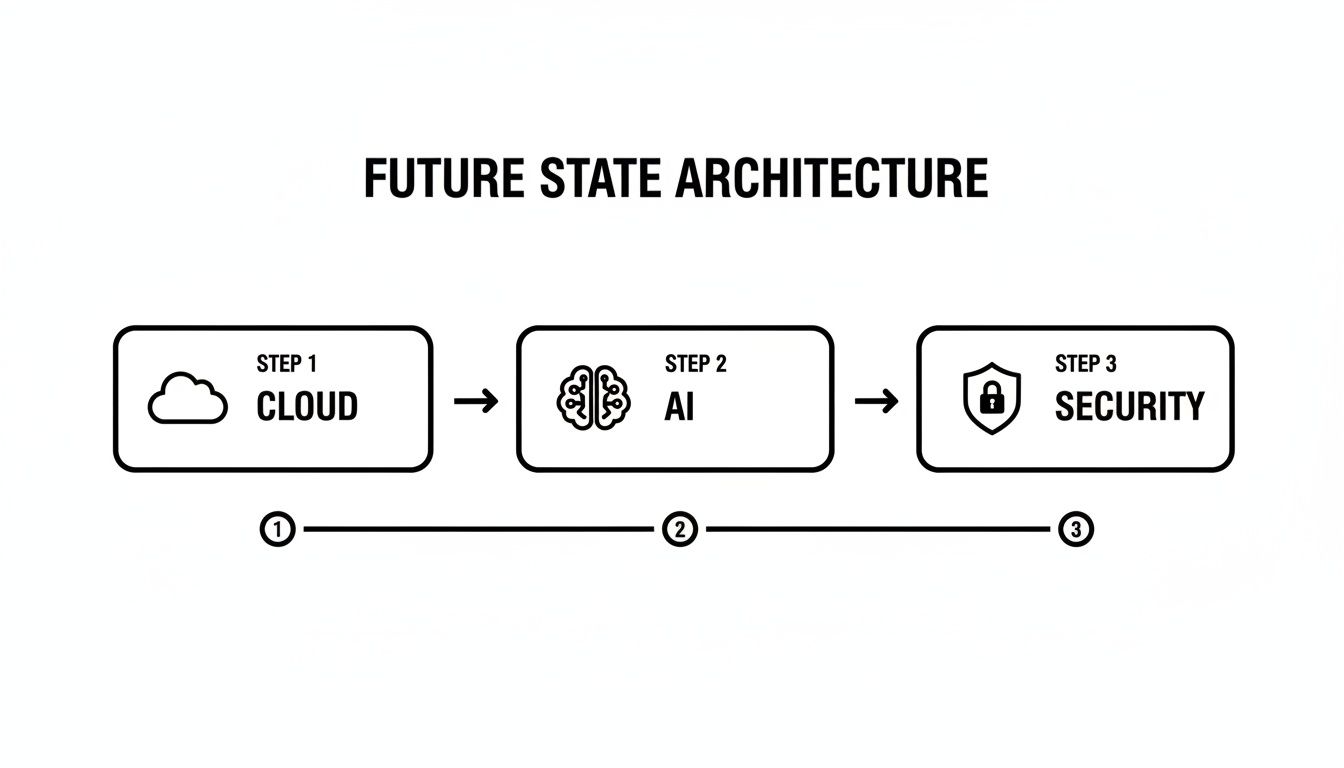
This illustrates a crucial point: each step enables the next. You can't jump straight to sophisticated AI without first building a robust and secure infrastructure to support it.
Define KPIs That Actually Matter
Your roadmap is just a wish list without clear metrics for success. Vague goals like “improve efficiency” simply won’t cut it. You need to define specific Key Performance Indicators (KPIs) for each phase that tie directly back to business value. This is how you prove ROI and keep the funding flowing.
For example, your KPIs might include:
- Operational Metrics: Reduction in manual processing time, decrease in system downtime, or faster software deployment cycles.
- Financial Metrics: Lower operational costs, increased revenue per customer, or higher employee productivity.
- Customer Metrics: Improvement in Customer Satisfaction (CSAT) scores, reduction in customer churn, or faster ticket resolution times.
A great KPI tells a story. When we help a client achieve a 60% reduction in processing time, it’s not just a number—it’s a powerful narrative about freeing up skilled people to focus on strategic work instead of soul-crushing repetitive tasks. Backed by executive testimonials, the Dr3amsystems team delivers these measurable results consistently.
Build a Governance and Change Management Framework
Look, the technology is only half the battle. Your people and processes are the other, arguably more important, half. A strong governance framework is what keeps your implementation from going off the rails. It means defining crystal-clear ownership, establishing communication channels, and having a set process for making decisions.
Your governance plan should answer a few essential questions:
- Who is on the steering committee? You need a cross-functional group of leaders responsible for overseeing the roadmap and bulldozing any roadblocks.
- What is the communication plan? How will you keep stakeholders in the loop on progress, wins, and setbacks? Regular, honest updates build trust and keep the energy up.
- How will you handle scope creep? Define the formal process for evaluating and approving any changes to the plan before it becomes a problem.
Running parallel to governance is a proactive change management strategy. You have to prepare your organization for new ways of working. This involves communicating the "why" behind the changes, rolling out targeted training to build new skills, and creating a feedback loop to address concerns. When you make your team part of the journey, you turn potential resistance into your biggest source of support.
If you're thinking about how custom solutions fit into this picture, you might be interested in exploring our custom application development services.
Answering the Tough Questions About Digital Transformation
Rolling out a digital transformation roadmap is a big undertaking, and it's natural to have some tough questions. I've been in these planning sessions, and even the most solid strategies face scrutiny from leaders worried about risk, ROI, and getting things done right. Let's tackle some of the most common concerns I hear.
How Do We Justify the Upfront Cost?
The initial price tag can cause sticker shock, but I always reframe the conversation around the much higher cost of doing nothing. You have to think in terms of risk mitigation and future revenue. A secure cloud migration, for example, isn't just another line item on a budget; it's insurance against the massive financial and reputational hit of downtime or a data breach on an old, rickety system.
The trick is to build a business case that ties every dollar to a real-world outcome. Let's say you're looking at an AI automation project. Sure, there's an investment. But if you can show it will lead to a 60% reduction in processing time, the ROI conversation gets a lot easier. As a technology partner, Dr3amsystems prioritizes reliability, cost efficiency, and ROI in every engagement.
Where Should We Start for the Quickest Wins?
Everyone wants to go big, but you can't boil the ocean. My advice? Start with a pilot project that's high-impact but low-risk, and make sure it solves a pain point everyone in the room already agrees on. A great place to look is often in departments like finance or operations, where you can find a manual, mind-numbingly repetitive workflow just begging to be automated.
A successful pilot does two critical things:
- It scores a quick, measurable victory that gets everyone excited and builds momentum.
- It acts as a real-world proof-of-concept to win over the skeptics.
This approach proves the value of the larger plan early on, making it much simpler to get the green light for the more ambitious phases of your roadmap.
How Do We Ensure Employee Buy-In?
This is a big one. The technology is just one piece of the puzzle; your people are the other. When you see resistance, it’s usually not about the tech itself. It's often rooted in a fear of the unknown or genuine concern about job security. The only way through this is with open, transparent communication and getting people involved directly.
You have to clearly explain the "why" behind it all. Show your teams how these new tools are designed to eliminate the tedious parts of their jobs, not the people themselves. Better yet, bring them into the process of redesigning workflows or picking the new software. When people feel like they’re co-creating the solution, they become your biggest champions instead of your biggest roadblocks.
A partner with deep experience can be invaluable here. At Dr3amsystems, we’ve learned that a successful transformation is as much about managing human dynamics as it is about deploying new tech. Our approach always includes helping you build a communication plan that turns that natural uncertainty into genuine excitement and enables continuous improvement.
What if Our Priorities Change Mid-Roadmap?
Things change. A digital transformation roadmap has to be a living document, not something carved in stone. The market shifts, a new competitor emerges, an unexpected opportunity pops up—your strategy has to be nimble enough to adapt. This is precisely why an agile, phased approach is so important.
When you break the plan into smaller, iterative cycles, you create natural checkpoints to stop and reassess priorities. If the business environment changes, you can pivot without throwing the entire initiative off the rails. That built-in agility is what keeps your roadmap relevant and ensures it continues to deliver real value, no matter what comes your way.
Ready to turn your vision into a practical, results-driven plan? Dr3amsystems is the technology partner that helps businesses accelerate outcomes with AI-driven solutions, secure cloud migrations, and dedicated managed support. Start with a free consultation to clarify your goals and design a digital transformation roadmap that aligns technology with true business value.