
The IT project initiation phase is where an idea gets its legs. It's the formal process of defining a project, getting it authorized, and pointing it in a clear direction. This isn't just a preliminary step; it's the strategic foundation that sets the stage for success or failure long before you've committed serious resources.
Why IT Project Initiation Is Your Most Critical Phase
Think of IT project initiation like drawing up the architectural blueprints for a skyscraper. Before a single shovel hits the ground, every detail—from the foundation to the core structure—has to be meticulously planned. A flawed blueprint guarantees structural failure. In the same way, a weak initiation almost always leads to a costly project collapse down the road.
This isn't about bureaucratic box-ticking. It’s the single greatest predictor of whether you’ll deliver on time and on budget. It’s the moment you transform a promising concept into a viable, authorized, and clearly defined undertaking. Get this right, and you’ve got a real advantage. Get it wrong, and it can be disastrous.
The High Cost of a Poor Start
For technology and operations leaders, the stakes are enormous. The uncomfortable truth is that a huge number of IT projects never quite make it.
Industry data shows that only 31% of software projects are considered truly successful. A staggering 52% are challenged by budget overruns or missed deadlines, and 19% fail completely. These failures, often rooted in a messy initiation, contribute to an estimated waste of $109 million for every $1 billion spent.
These numbers tell a clear story. Vague success metrics and poor stakeholder alignment right at the start are what sink most projects.
Setting the Foundation for Success
A disciplined start is about more than just setting a goal. It’s a structured approach to answering the fundamental questions that prevent chaos from taking over later.
The key objectives of the initiation phase are to:
- Validate the Business Need: Is this project solving a real problem? Does it actually align with our company's strategy?
- Define Clear Objectives: What does "done" look like? We need measurable outcomes, not just vague hopes.
- Secure Executive Buy-In: Get the formal approval and resource commitments from leadership.
- Identify Key Stakeholders: Figure out who needs to be involved and manage their expectations from day one.
This is exactly where having an experienced partner can make all the difference. At Dr3amsystems, we start every engagement with a free consultation to clarify goals, find opportunities for automation, and build a roadmap that ties technology directly to business value. We help you build a solid foundation, preventing the common pitfalls that derail projects before they even begin. You can explore more of our thinking on technology strategy and execution in our Dr3am Insights section.
The Core Components of a Bulletproof Initiation Process

Once an IT project idea starts picking up steam, the urge to dive headfirst into planning is strong. But experienced leaders know that skipping the foundational work is a recipe for disaster. A truly solid IT project initiation hinges on creating a few critical documents first.
These aren't just bureaucratic hurdles; they're the strategic pillars that keep your project aligned, on budget, and headed for success. Think of it as a logical progression: you start with the big-picture "why," get formal approval on the "what," and then clearly define the boundaries of "how." Each document builds on the last, forging a shared vision that guides every stakeholder.
The Business Case: The Story That Secures Buy-In
Before you spend a single dollar or assign a single team member, you have to answer the most important question of all: "Why are we even doing this?" The Business Case is your definitive answer. It’s a persuasive document that justifies the entire effort by linking the project directly to tangible business goals.
Its job is to convince decision-makers that this project isn't just a "nice-to-have" but a strategic necessity. A great business case avoids technical jargon and speaks the language of the C-suite: value, growth, and efficiency.
A compelling Business Case needs to include:
- The Problem or Opportunity: A crystal-clear statement of the pain point you’re solving or the competitive edge you’re chasing.
- Proposed Solution: A high-level rundown of what you plan to do and how it directly addresses that core need.
- Financial Analysis: An honest look at the costs, the expected benefits, and the all-important return on investment (ROI).
- Strategic Alignment: A direct line connecting this project to the company's overarching objectives.
Ultimately, this document is your project's internal sales pitch. Make it sharp, concise, and relentlessly focused on business value.
The Project Charter: The Official Green Light
Once the Business Case gets the thumbs-up, it’s time to create the Project Charter. This is the formal document that officially brings the project to life. It gives the project manager the authority to start assigning resources and getting things done.
The charter takes the "why" from the Business Case and translates it into the project's "what" and "who."
The Project Charter is essentially a contract between the project sponsor, key stakeholders, and the project team. It’s the single source of truth that defines the project's purpose and objectives, preventing confusion and setting clear expectations right from the start.
Unlike a detailed project plan, the charter is a high-level summary. It’s brief enough for a busy executive to grasp in minutes but has enough substance to guide the project team. It empowers the project manager and establishes the initial rules of the game.
The Scope Statement: The Fence That Prevents Creep
With the project officially a "go," the next move is to define its exact boundaries with a Scope Statement. If the charter is the map, the scope statement is the fence. Its entire purpose is to prevent "scope creep"—that insidious, uncontrolled expansion of requirements that blows up timelines and budgets.
A well-crafted scope statement is brutally specific about what the project includes and—just as critically—what it excludes. This clarity is your best defense against mismatched expectations and helps the team stay laser-focused on delivering what was promised.
Key elements of a strong Scope Statement are:
- Project Deliverables: A detailed list of the tangible things the project will produce.
- Project Boundaries: A clear line in the sand defining what’s in and what’s out.
- Success Criteria: The specific, measurable metrics you'll use to declare victory.
- Constraints and Assumptions: A rundown of known limits (like budget or deadlines) and any assumptions made during planning.
These three documents—the Business Case, Project Charter, and Scope Statement—form the bedrock of a successful IT project initiation. They ensure every project is not just strategically sound but also clearly defined and officially sanctioned.
To give you a clearer picture, here’s a quick breakdown of how these essential artifacts function and where our team typically steps in to guide the process.
Key Artifacts in IT Project Initiation
| Artifact | Primary Purpose | Key Audience | Dr3amsystems' Role |
|---|---|---|---|
| Business Case | To justify the investment and secure funding by linking the project to strategic goals. | Executive Leadership, Sponsors, Finance Department | We help quantify business value, analyze ROI, and craft a compelling narrative that resonates with decision-makers. |
| Project Charter | To formally authorize the project and grant the project manager authority. It defines the "what" and "who." | Project Sponsor, Project Manager, Key Stakeholders | We facilitate workshops to translate high-level goals into a clear charter that aligns all stakeholders from day one. |
| Scope Statement | To define the project's boundaries, deliverables, and success criteria to prevent scope creep. | Project Team, Stakeholders, Project Manager | Our team works with you to meticulously define what's in and out of scope, ensuring there are no ambiguities. |
Getting these foundational pieces right is non-negotiable for any complex technology initiative. To see how these principles translate into real-world success, you can learn more about our structured approach within our Dr3am IT services.
How to Identify and Align Key Stakeholders

Let's be blunt: even the most elegant technical solution will crash and burn if the right people aren't on board. During IT project initiation, identifying and aligning stakeholders isn't just a "nice-to-have" soft skill; it's a mission-critical function. A stakeholder is anyone with skin in the game—from the executive sponsor signing the checks to the end-users whose daily routines are about to change.
Ignoring these people is a recipe for disaster. At best, you’ll face quiet resistance; at worst, you get outright project sabotage. On the flip side, proactive engagement can turn your biggest skeptics into your most powerful champions. The real goal here is to build a coalition of support that will see the project through its inevitable bumps in the road.
Mapping the Human Landscape
Before you can get anyone aligned, you first have to figure out who "everyone" is. Start by brainstorming a master list of every person, group, or department that will be touched by your project. Think bigger than just the core project team. What about finance, legal, HR, or marketing? Get them all down.
Once you have your list, it's time for analysis. One of the most effective tools for this is a classic stakeholder analysis matrix. It’s a simple but powerful way to categorize people based on two key factors:
- Influence: How much real power do they have to affect the project's direction?
- Interest: How much will the project's outcome actually impact them?
This little grid is your secret weapon for prioritizing your time and energy. It helps you focus your communication efforts where they will count the most.
By mapping your stakeholders, you stop playing defense with your communications and start playing offense. You can anticipate concerns, manage expectations, and frame your message in a way that truly connects with each group.
For example, a CFO likely has high influence but may have low day-to-day interest. They need the bottom line: clear, concise updates on the budget and ROI. In contrast, a team of end-users has low influence but incredibly high interest. They need to know exactly how this new system will make their jobs better (or harder).
Building Bridges with Proactive Communication
With your stakeholder map complete, you can now build a communication strategy that creates genuine alignment. This is about more than just firing off a weekly email newsletter. It’s about designing a structured flow of information to keep everyone in the loop and feeling involved. A solid plan should define who gets what information, how often, and through which specific channels.
This is often where an experienced partner like Dr3amsystems can make all the difference. As a technology partner backed by executive testimonials, we thrive on being the bridge between highly technical experts and business leaders. We cut through the jargon to ensure business goals and technical realities stay perfectly in sync, translating complex needs into clear, actionable plans everyone can get behind.
Formalizing Engagement with Governance
Finally, you need to formalize how and when stakeholders will be involved. This requires a clear governance structure baked into the project from day one. Two key events lock this in:
- The Kickoff Meeting: Don't treat this as a simple formality. It’s your single best chance to gather all key stakeholders in one room, walk through the project charter, reinforce the objectives, and set clear expectations. It gets everyone on the same page from the very beginning.
- Decision Gates: Build specific checkpoints, or "gates," into the project timeline. These are formal moments where key stakeholders must review progress and give official sign-off before the project can move to the next phase. This practice eliminates surprises and confirms everyone is still aligned.
By methodically identifying, analyzing, and engaging your stakeholders, you build a rock-solid foundation of human support for your project. This people-first approach is an absolutely non-negotiable part of a successful IT project initiation. It ensures the technology you're building isn't just powerful, but is actually welcomed and used by the very people it's meant to help.
Common Initiation Pitfalls and How to Avoid Them
Even the most brilliant project ideas can fall apart before a single line of code is written. The initiation phase is a minefield of small mistakes that can quietly poison a project from the start. These aren't dramatic, sudden failures; they're the slow-burn problems that build up over time, leading to blown budgets, missed deadlines, and a final product that just doesn't deliver.
Knowing what these common traps look like is the first step to sidestepping them entirely. A little discipline upfront is the best defense against the chaos a bad start can create.
Pitfall 1: The Project with Vague Objectives
Have you ever been on a project with a goal like "improve customer experience"? What does that even mean? Without a clear, measurable target, the project team is essentially flying blind. Every stakeholder has their own idea of what "better" looks like, which leads to endless debates and conflicting priorities.
This kind of ambiguity is a classic recipe for failure. When you don't define what success is, you can never actually achieve it. The project just drifts along, burning through time and money without ever hitting a real goal.
The Solution: Nail down your objectives using the SMART framework (Specific, Measurable, Achievable, Relevant, Time-bound). Instead of a fuzzy goal like "improve customer experience," get specific: "Reduce average customer support ticket resolution time by 25% within six months by implementing a new AI-driven chatbot." Now that's a finish line the team can sprint towards.
Pitfall 2: The Ever-Expanding Scope
Every seasoned project manager has a war story about this one. It starts with a perfectly good plan, but then someone says, "Could we just add one more feature?" These little requests seem harmless at first, but they pile up, stretching timelines, burning out the team, and draining the budget.
This is scope creep, and it’s almost always a symptom of a weak initiation. If you don't set firm boundaries and have a process for changes, your project becomes a free-for-all where new requirements can sneak in unchecked.
A shocking 54% of IT project failures are traced back to poor project management, and a huge chunk of that waste starts right here in the initiation phase. For every $1 billion spent on projects, an incredible $122 million is lost because of these early mistakes. You can dig into the numbers in the full research paper.
The Solution: Write an ironclad Scope Statement that clearly defines what’s in the project and—just as critically—what is out. Then, establish a formal change request process from day one. This forces everyone to stop and think about the true cost of a change—in time, money, and resources—before it gets a green light.
Pitfall 3: Ignoring Security from the Start
Too many projects treat security like a last-minute checklist item to tick off before going live. This is a massive, and costly, mistake. Trying to bolt on security at the end is far less effective and way more expensive than building it in from the ground up.
When you ignore security during initiation, you're practically inviting data breaches, compliance nightmares, and serious damage to your company's reputation down the road.
The Solution: Weave security into the project's DNA from the very beginning. Run a preliminary risk assessment during the initiation phase to spot potential threats early. This "security-by-design" mindset makes protection a core part of the architecture, not just a patch. It’s a proactive approach that forms the foundation of our Dr3am Security services, where we make sure security is part of the conversation from the very first strategy session.
Navigating the Minefield with an Expert Partner
Avoiding these pitfalls takes more than just good intentions; it requires discipline, foresight, and the experience to know which tough questions to ask. It's all about setting firm boundaries before the project gains a life of its own. This is where having a strategic technology partner can make all the difference.
At Dr3amsystems, we start every engagement with a free consultation to tackle these exact risks. We sit down with your team to bring clarity to business goals, find smart automation opportunities, and map out a solid plan. By guiding these crucial conversations, we help you defuse risks like vague objectives and scope creep long before they can derail your project, ensuring your IT project initiation sets you up for a win.
Integrating AI and Cloud Strategies from Day One
In today's world, no IT project is an island. It’s almost always part of a much bigger picture that involves AI and the cloud. The biggest mistake you can make is treating these as afterthoughts—things you can just bolt on later. That's a surefire recipe for failure. The most successful IT project initiation plans weave these strategies in from the very beginning.
This means asking the tough questions before the project even has a formal name. Let's say you're launching a new data platform. The conversation should immediately turn to the cloud. Is this architecture built to scale on AWS or Azure? Are we designing it to feed machine learning models down the road? Thinking this way from day one saves a mountain of pain and costly rework later on.
Seeding Success for AI and Cloud Initiatives
The initiation phase is your golden opportunity. It’s the perfect time to spot where AI-driven automation could make a real difference and to map out a smart, secure path to the cloud. You’re not just building for today; you're building a foundation that can handle whatever innovations come next.
This isn't just talk. It involves a few critical activities right at the start:
- Assess Cloud Readiness: Is the project even a good fit for the cloud? You need to analyze its architecture, how sensitive the data is, and what kind of performance it needs to decide on the right strategy—be it public, private, or a hybrid model.
- Identify AI Opportunities: Look at the project's scope with an "automation first" mindset. Could machine learning predict user behavior? Could an AI-powered chatbot handle customer questions? Find these wins early.
- Incorporate Security-by-Design: Don't leave security for the end. It's not a patch you can apply later. Cloud and AI bring their own unique security headaches, so a "security-by-design" approach has to be baked into the initial architecture.
When you embed these elements into your initiation process, you’re making sure the project is locked in with the company's bigger goals, setting it up to win both now and in the future.
Why So Many AI Pilots Fail at Initiation
The hype around AI has created a gold rush of pilot projects, but frankly, the results have been a massive disappointment. The problem usually isn't the tech itself. It’s a complete breakdown during the initiation stage.
MIT research found something stunning: a whopping 95% of generative AI pilots are failing. It’s not because the tech is bad, but because of a 'learning gap' in how companies are trying to use it. Businesses are pouring in billions, yet most pilots just fizzle out with zero impact because they skipped the hard work of a disciplined initiation. They never picked a single, clear pain point to solve or set any real metrics for success. You can read more about these findings on AI project failures.
This statistic tells a story we've seen play out time and again. A successful AI project starts with a focused, realistic, and sharply defined initiation. You simply can't "sprinkle some AI" on a problem and hope for the best.
Building a Strategic Foundation with an Expert Partner
Let's be honest—navigating the maze of AI, cloud, and security requires deep, specialized expertise. This is where bringing in a technology partner who has been there and done that becomes so important. They can ensure your project is built on solid ground from the very beginning.
At Dr3amsystems, our specialized practices—Dr3am AI, Dr3am Cloud, and Dr3am Security—were created to solve these exact challenges. We don’t just sling technology. We work with you to make sure your projects deliver real, measurable business value. Our process starts with a free consultation to get crystal clear on your goals, find automation opportunities, and build a roadmap that connects the tech to your bottom line. We help you get past the pilot-purgatory and into responsible AI adoption and confident cloud integration. Getting the IT project initiation phase right is everything. To see how we do it, check out our guide on Dr3am AI implementation.
Your 90-Day Roadmap for Flawless Project Initiation
Knowing the theory is one thing, but putting it into practice is where the real work begins. To truly master IT project initiation, you need a concrete plan. This 90-day roadmap is designed to help technology leaders move from concept to execution, building a disciplined and repeatable initiation process from the ground up.
Think of it as your toolkit for implementation. We're going to break down what can feel like a massive organizational shift into a series of clear, manageable steps.
Days 1–30: Building the Foundational Framework
The first month is all about laying the groundwork. You’ll be creating the core building blocks and getting everyone on the same page. The goal here isn't speed; it's about establishing a solid, standardized foundation that will support every project that follows.
Here’s your checklist for this crucial first phase:
- Develop Standard Templates: Create the official, go-to templates for your Business Case, Project Charter, and Scope Statement. These are your non-negotiables.
- Establish a Stakeholder Register: Build a master template for identifying and mapping all project stakeholders based on their influence and interest levels.
- Define Governance Gates: Clearly outline the key decision points and formal sign-offs required for a project to officially pass from initiation into the planning stage.
This timeline gives you a sense of how an idea, especially an AI project, can evolve into a fully scoped initiative within this first 30-day window.
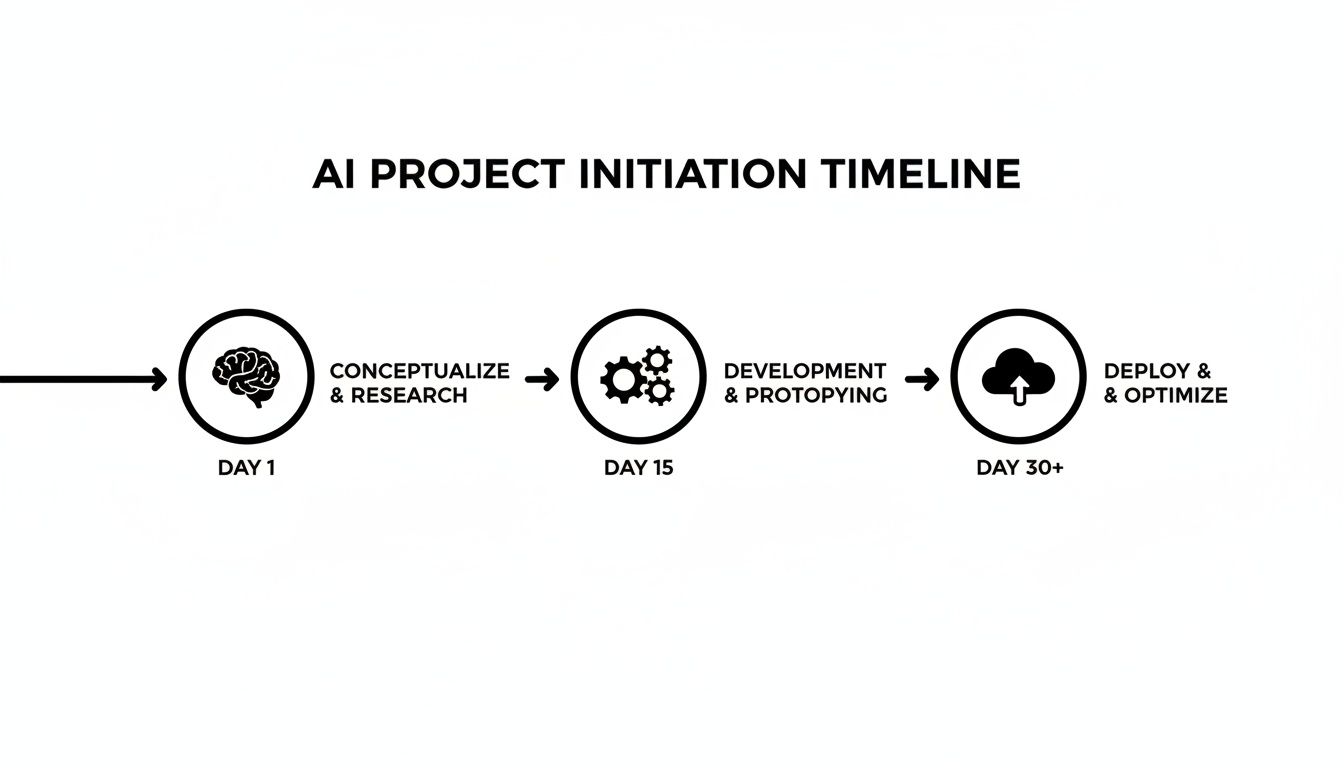
As you can see, the progression from concept to a concrete plan happens fast, which is why getting the initial planning right is so critical.
Days 31–90: Pilot, Get Feedback, and Refine
With your framework in place, the next 60 days are about testing it in the real world. It's time to select a pilot project—something with moderate complexity is ideal—and run it through your new process from start to finish. This is where you learn what works and what needs tweaking.
Your key milestones for this period are:
- Execute a Pilot Initiation: Take your chosen project through every step of the new process, from the initial business case all the way to a signed-off charter.
- Gather Stakeholder Feedback: Once the pilot initiation is complete, sit down with the project team and key stakeholders. Conduct interviews to find out what went well and identify any friction points.
- Iterate and Finalize: Use that direct feedback to refine your templates, adjust the governance model, and finalize everything before you roll it out across the entire organization.
This structured rollout is designed to avoid widespread disruption while building institutional muscle memory. When you start small and prove the value of a disciplined process, you create internal champions who will help drive its adoption.
Accelerate Your Journey with an Expert Partner
Walking this path requires focus and a good deal of experience. Bringing in a specialist partner can speed up the process immensely and help you sidestep the common traps that many organizations fall into. A flawless IT project initiation process starts with a clear, strategic plan.
At Dr3amsystems, our partnerships begin with a free consultation to understand your goals, find opportunities for automation, and build a technology roadmap that sets you up for success. We help companies modernize their systems, deploy robust data pipelines, and fortify security, always with an eye on reliability and ROI. Our deep expertise in secure Dr3am Cloud migrations ensures your infrastructure is scalable, cost-efficient, and ready for whatever comes next. Let us help you build the foundation for your next winning project.
Common Questions About IT Project Initiation
Getting a handle on the IT project initiation phase can bring up a few common questions. Let's walk through some of the most frequent ones to clear things up.
What’s the Real Difference Between a Business Case and a Project Charter?
It's easy to get these two mixed up, but they play very different roles. Think of the business case as the sales pitch. It’s the document you create before the project is even approved, and its sole job is to answer the question, "Why should we do this?" It lays out the problem, the proposed solution, and the expected business value, essentially justifying the investment.
The project charter, on the other hand, comes after the project gets the green light. This is the official starting gun. It formally authorizes the project and gives the project manager the authority to start assembling resources. While the business case answers the "why," the charter defines the "what" and "who," outlining the project’s objectives, scope, and key players.
Who Actually Kicks Off a Project?
Project initiation isn't a one-person show; it’s a team effort. The initial idea and the business case usually come from a project sponsor. This is often a senior leader or department head who sees the business need and is willing to champion the cause.
Once the project is approved, a project manager is assigned. Their first big task is to drive the creation of the project charter. They'll work hand-in-hand with the sponsor and other key stakeholders to hammer out the details, making sure everyone is on the same page before the real planning begins.
How Can an Outside Expert Help During This Early Stage?
Bringing in an expert technology partner during initiation can be a game-changer. They offer a fresh, unbiased perspective that helps poke holes in the business case, spot risks you might have missed, and ensure your project is built on a solid technical foundation, especially when it comes to cloud, AI, and security.
An experienced partner can facilitate workshops and stakeholder interviews to make sure no stone is left unturned. This structured approach is incredibly effective at translating big-picture business goals into a concrete, achievable plan, helping you sidestep the common mistakes that can doom a project from the start.
Ready to ensure your next IT project is built on a flawless foundation? Dr3amsystems provides the strategic guidance and hands-on execution needed to accelerate outcomes. From secure cloud migrations to AI-driven solutions, we deliver measurable results like 60% reductions in processing time and zero-downtime transitions. Start with a free consultation to design a technology roadmap that aligns with your business goals.